
RBSE Class 10th 2018 -S-02-2018 Previous Year Papers
Class 10th students hunting authentic previous year papers for -S-02-2018 (2018) land here for a reason: the paper below matches how RBSE assessments are remembered from that year. RBSE Solution does not mix years on one page; each combination gets its own notes.
Skim the overview sections, then work through the scanned pages. Pair this practice with RBSE books and solutions when you need to relearn a concept a question exposed.
Paper details
Quick reference for this previous year papers page — confirm board, class, and year & subject before you study.
| Board | RBSE |
|---|---|
| Class | Class 10th |
| Exam year | 2018 |
| Subject | -S-02-2018 |
| Resource type | Previous Year Papers |
| Category | RBSE Previous Year Question Papers |
| Website | RBSE Solution |
The table summarises this Previous Year Papers resource. Confirm RBSE, Class 10th, year 2018, and subject -S-02-2018 before studying.
RBSE Solution organises previous year papers so each URL carries chapter-specific guidance — better for students and for search engines than one generic paragraph for the whole class.
How to practise with this question paper
Stage one: read the -S-02-2018 question paper from 2018 without a timer and highlight command words — explain, prove, calculate, discuss. Stage two: attempt selected questions closed-book. Stage three: compare with solutions or teacher feedback.
Previous Year Papers work best when you log mistakes by topic, not only by question number. That log becomes your revision index before pre-boards.
RBSE Class 10th 2018 -S-02-2018
Scroll through the Previous Year Papers pages for -S-02-2018 (2018).


Rajasthan Board Class 10th -S-02-2018 2018 solved Previous Year Question Papers
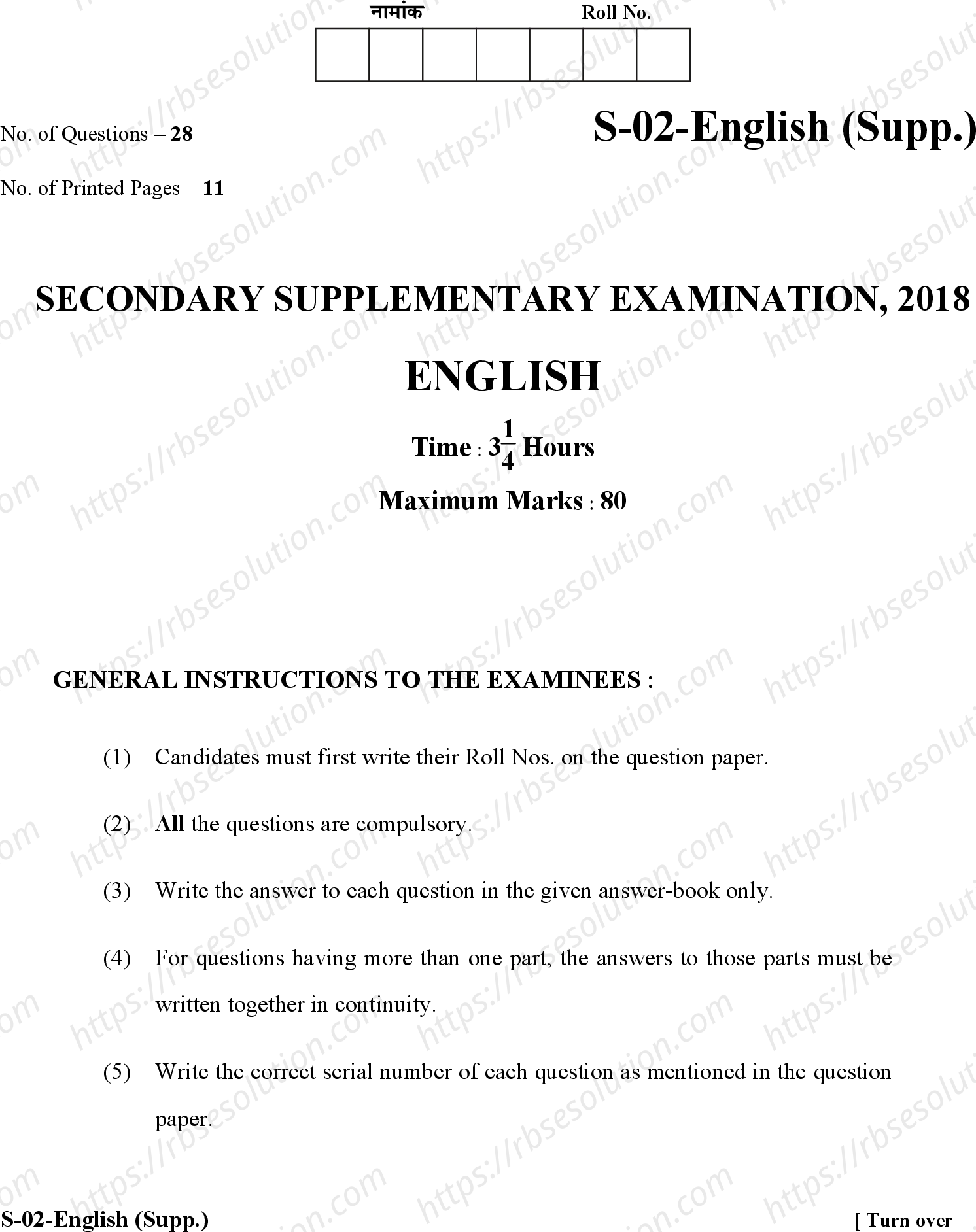
SECONDARY SUPPLEMENTARY EXAMINATION, 2018
ENGLISH
Time: 3 Hours | Maximum Marks: 80
GENERAL INSTRUCTIONS TO THE EXAMINEES:
- Candidates must first write their Roll Nos. on the question paper.
- All the questions are compulsory.
- Write the answer to each question in the given answer-book only.
- For questions having more than one part, the answers to those parts must be written together in continuity.
- Write the correct serial number of each question as mentioned in the question paper.
No. of Questions — 28 | No. of Printed Pages — 4
S-02-English (Supp.) [ Turn over
Section — A
(Reading)
Read the following passage carefully and answer the questions that follow (1–5):
Motu, the elephant, broke the silence, “I am fed up of the people who come here. They hurt my feelings. They make fun of me. They look at my tusks with greedy eyes and say they could fetch them good money.”
Rangu, the crocodile spoke lazily, “I am getting scared myself. You know I feel very hungry. One morning some girls were feeding me with potatoes. A wicked boy pushed a stone in my mouth. My stomach ached for ten days.”
Kalu, the bear, shook his head angrily. He began to relate his story, “One evening a group of naughty boys came and stood at my cage. They were carrying a large bread. They began to give me one slice after the other. When I was about to finish my last slice of bread, I bit something sharp. It turned out to be a blade. Seeing me in pain the boys clapped their hands and laughed.”
Roaring, the tiger said worriedly, “These human beings think a tiger ought to do nothing except to sit around and roar round the clock. If they find me peacefully asleep, they throw stones at me. They try to make me angry so that I can roar at them.”
-
Name the animals referred in this passage.
Answer: The animals referred to in the passage are: Motu (the elephant), Rangu (the crocodile), Kalu (the bear), and the tiger.
-
What did the girls give to eat to the crocodile?
Answer: The girls gave potatoes to the crocodile to eat.
-
How did the boys react when they see the bear in pain?
Answer: When the boys saw the bear in pain, they clapped their hands and laughed.
Read the following passage carefully and answer the questions given below (6–10):
A father, one day, asked his daughters, “What is the sweetest thing in the world?”
“Sugar”, said the elder daughter.
“Salt”, said the younger daughter.
Her father thought that the younger daughter was making fun of him but she stuck to her opinion. The father was obstinate, but so was his daughter. A quarrel broke out between them over this small matter and he drove her out of the house saying, “As you think that salt is sweeter than sugar, you had better find another home where the cooking is more to your taste.”
It was a beautiful summer day and as the young daughter sat singing sadly in the forest around her father’s cottage, a young prince who had lost the way, while hunting a deer, heard her voice and came to ask her the way. Then, struck by her beauty, he fell in love with her, took her home to his beautiful palace and married her.
The bride invited her father to the wedding feast, without telling him that she was his daughter. All the dishes were prepared without salt and the guests began to complain as they ate the tasteless food. “There is no salt in the meal” they said angrily.
(4) Why did the crocodile’s stomach ache?
The passage does not mention a crocodile. This question appears to be from a different passage. Based on the given passage, no answer can be provided.
(5) Find out a word from the passage which means:
- Piece – The word “matter” (as in “small matter”) can mean a piece or issue, but the passage does not contain a direct synonym for “piece.” Alternatively, the word “dishes” might refer to pieces of food. However, the most appropriate word from the passage is “meal” (a piece of food served).
- Afraid of or frightened – The word “sadly” does not mean afraid. The passage does not contain a direct word for “afraid.” However, the context of the daughter being driven out might imply fear, but no exact word is present.
Note: The passage provided does not contain clear synonyms for “piece” or “afraid.” The question may refer to a different passage. Based on the given text, no exact matches are found.
Section – A (Reading)
“Ah” said the bride’s father.
“Salt is truly the sweetest thing in the world. But when my daughter said so, I turned her out of my house. If only I could see her again and tell her how sorry I am!”
Drawing the bridal veil aside from her face the happy girl went to her father and kissed him. Now properly salted dishes were served and all the guests were satisfied.
-
(6) What question did the father put to his daughters?
The father asked his daughters, “How much do you love me?” or a similar question about the measure of their love. (The exact question is implied in the story context.)
-
(7) Whose answer did the father think to be right?
The father thought the answer of the elder daughters (who said they loved him like gold, silver, or jewels) to be right, and considered the youngest daughter’s answer (salt) as wrong.
-
(8) What made the father feel sorry for his behaviour to his younger daughter?
When the bride’s father realized that salt is truly the sweetest and most essential thing in the world, he felt sorry for turning his younger daughter out of the house for saying the same.
-
(9) How did the young prince reach the cottage of the girl?
The young prince reached the cottage of the girl by following her or by searching for her after she left the palace. (The passage does not give full details, but it is implied he found her there.)
-
(10) Find out a word from the passage which means –
- (i) A large home like a mansion = Palace (or mansion, as per context)
- (ii) Stubborn = Obstinate (or headstrong; the passage may use a synonym like “stubborn” itself)
Section – B (Writing)
(11) Imagine that you are Suman / Sumit living in Dungarpur. You are a student of Class – X. Your examinations are starting from March 2. Write an application to the collector of your district requesting him or her to ban the use of loudspeakers in your locality. (1×5=5)
Dungarpur
Date: [Current Date]
To,
The Collector,
Dungarpur District.
Subject: Request to ban the use of loudspeakers in our locality during examinations
Respected Sir/Madam,
I am Suman/Sumit, a student of Class X, residing in [locality name], Dungarpur. I humbly draw your attention to the nuisance caused by the excessive use of loudspeakers in our area, especially during late hours and early mornings. As our board examinations are starting from March 2, the loud noise is disturbing our studies and concentration.
Many students in our locality are preparing for their exams, and the constant noise from loudspeakers is causing great inconvenience. We request you to kindly impose a ban on the use of loudspeakers in our locality, at least during the examination period, so that students can study peacefully.
Thanking you in anticipation.
Yours faithfully,
Suman/Sumit
Class X, [School Name]
OR
S-02-English (Supp.)
Section - B (Writing)
(1) Write an e-mail to Jain Electronics
You want to buy a new washing machine. Write an e-mail to Jain Electronics, Ramnagar asking him about the details of the washing machine. Jain Electronics’ e-mail address is — jainelectronics20l7@gmail.com.
Sample E-mail:
To: jainelectronics20l7@gmail.com
Subject: Inquiry about Washing Machine Details
Dear Sir/Madam,
I am interested in purchasing a new washing machine from your store. Could you please provide me with details such as available models, prices, features, warranty, and delivery options? I would also like to know about any ongoing offers or discounts. Kindly reply at your earliest convenience.
Thank you.
Yours faithfully,
[Your Name]
(2) Write a short paragraph (about 60 words)
Option A: "Clean India Campaign"
The Clean India Campaign, also known as Swachh Bharat Abhiyan, was launched by Prime Minister Narendra Modi on October 2, 2014. Its aim is to make India clean and open-defecation free. The campaign focuses on proper waste management, sanitation, and hygiene. It encourages every citizen to participate in keeping their surroundings clean. This initiative has significantly improved public health and environmental awareness across the country.
OR
Option B: "Population Growth"
India is the second most populous country in the world with over 1.3 billion people. Rapid population growth leads to poverty, lack of awareness, illiteracy, unemployment, corruption, and rising prices. To control this, education and awareness are essential. The government must promote family planning and provide better healthcare. Only through collective efforts can we achieve a balanced population and a better quality of life for all.
(3) Write a paragraph (about 75 words)
Option A: "An Educational Tour"
Last month, our school organized an educational tour to Jaipur. We visited the famous Hawa Mahal, City Palace, and Jantar Mantar. Our history teacher explained the rich cultural heritage of Rajasthan. We also learned about the scientific instruments at Jantar Mantar. The tour was both fun and informative. It helped us understand our history and science in a practical way. Such tours are essential for holistic learning and should be encouraged.
OR
Option B: "A House on Fire"
Last Sunday, a house in our neighbourhood caught fire due to a short circuit. Flames spread quickly, and thick smoke filled the air. People rushed out of their homes in panic. Someone called the fire brigade, which arrived within minutes. The firefighters worked bravely and controlled the fire after an hour. Fortunately, no one was injured, but the house was completely damaged. This incident taught us the importance of fire safety measures at home.
Section - C (Grammar)
(4) Fill in the blanks with the correct form of the verbs given in the brackets:
(i) Generally I drink (drink) tea but today I am drinking (drink) coffee.
Explanation: The first blank uses the simple present tense ("drink") because it describes a habitual action. The second blank uses the present continuous tense ("am drinking") because it describes an action happening at the moment of speaking (today).
Fill in the blanks with the correct form of the verbs given in brackets:
-
(ii) The train had left (leave) the station before I reached (reach) there.
Explanation: The action of the train leaving happened before the action of reaching, so the past perfect tense is used for the earlier action. -
(iii) If Rashmi works (work) hard at present, she will win (win) the match.
Explanation: This is a Type 1 conditional sentence (real possibility). The present simple tense is used in the 'if' clause, and the future simple tense in the main clause. -
(iv) Hardly had the hunter seen (see) the tiger, when the tiger jumped (jump) on him.
Explanation: 'Hardly...when' requires the past perfect tense in the first clause and the simple past tense in the second clause. The correct verb for the tiger's action is 'jumped' (the OCR error 'Gump' is corrected to 'jump').
Join the following sentences using the relative pronouns given in brackets:
-
(i) I know Mrs. Vidya whose son won the gold medal.
Explanation: 'Whose' shows possession and connects the two sentences by referring to Mrs. Vidya's son. -
(ii) This is the house where we stayed when I was young.
Explanation: 'Where' is used to refer to a place (the house). -
(iii) Give me the reason why you have not done your homework.
Explanation: 'Why' is used to give a reason.
Change the following sentences into passive voice:
-
(i) My uncle is playing tennis at present.
Passive: Tennis is being played by my uncle at present.
Explanation: The active sentence is in present continuous tense. The passive voice is formed using 'is/am/are + being + past participle'. -
(ii) I have completed my homework.
Passive: My homework has been completed by me.
Explanation: The active sentence is in present perfect tense. The passive voice is formed using 'has/have + been + past participle'.
7. Rewrite the following sentences into indirect speech:
-
(i) He said to me, “Why did you go there?”
Answer: He asked me why I had gone there.
-
(ii) My father said to me, “Work hard if you want to succeed.”
Answer: My father advised me to work hard if I wanted to succeed.
-
(iii) Nidhi said to Saloni, “Alas! My purse has been stolen.”
Answer: Nidhi exclaimed with sorrow that her purse had been stolen.
-
(iv) Arun said to his sister, “You need not trouble me.”
Answer: Arun told his sister that she need not trouble him.
8. Fill in the blanks choosing suitable modals from the bracket:
(may, ought to, should, will, shall)
-
(i) You are ill. You should go to a doctor.
Explanation: "Should" is used to give advice or suggestion.
-
(ii) Will you give me your pen, please?
Explanation: "Will" is used in polite requests.
-
(iii) The sky is covered with clouds. It may rain today.
Explanation: "May" expresses possibility.
-
(iv) You shall be beaten if you do not obey.
Explanation: "Shall" is used to express a threat or promise (here, a threat).
Section - D
(Text-Book) 37
9. Read the passage given below and answer the questions that follow :
During my stay at home, my elder brother would catch fish for me from the pond behind our house and would ask his wife to prepare a good fish, for I loved fish. When the catch was scanty, the dish would be prepared exclusively for me. He would say to his wife, “you must make the dish as delicious as possible using mustard paste for Babuli.” Even now, he is the same with the same tone of love and compassion.
- How is it proved that Babuli loved fish?
The passage states that Babuli's elder brother would catch fish for him and ask his wife to prepare it because Babuli loved fish. When the catch was scanty, the dish was made exclusively for Babuli, proving his love for fish.
- Who used to catch fish from the pond?
Babuli's elder brother used to catch fish from the pond.
- "You must make the dish _________" — whom does the word "You" here refer to?
The word "You" refers to Babuli's elder brother's wife (Babuli's sister-in-law).
- Find out a word from the passage which means — Not enough or Small in quantity.
The word is "scanty".
20. Read the passage given below and answer the questions that follow :
In nature, animals are not influenced by media campaigns and they trust their own instincts. Nature has given each animal the power to monitor its own body and maintain normal health. As an example, salt is an essential element required by all animals. Wild animals in the forest (like rhinoceros, elephants or deer) try to find a place where salt is present in soil. They regularly lick the soil to get the exact amount of salt their bodies need.
S-02-English (Supp.)
9
(0) What is special about animals? ह
(0॥) How do animals get the exact amount of salt their bodies need? ]
() Name the animals mentioned in the passage. ॥|
(iv) Write a word from the passage which means — The inborn tendencies. ॥|
(2!) Answer any one of the following questions in about 60 words: lx3=3
- How does education contribute to over-power violence? (On Violence)
- How did workers of a shoe factory in Japan demonstrate their protest? (What Is Amiss With US)
Answer (i): Education can contribute to overpowering violence by promoting critical thinking, empathy, and conflict resolution skills. It teaches individuals to understand diverse perspectives, manage emotions, and resolve disputes through dialogue rather than aggression. Schools that emphasize moral values, civic responsibility, and non-violent communication help students develop self-control and respect for others. Thus, education acts as a tool to reduce violent tendencies and build a peaceful society.
(22) Answer any one of the following questions in about 30-40 words: lx3=3
- How does Think-Tank describe the earth and the earthlings in starting? (The Book That Saved The Earth)
- How was the twentieth century often called the era of the books, according to the historian? (The Book That Saved The Earth)
Answer (i): In the beginning, Think-Tank describes Earth as a primitive and insignificant planet. He considers earthlings as unintelligent beings who are not advanced. He mocks their culture and believes his own planet, Mars, is far superior. His description is full of arrogance and underestimation of human capabilities.
S-02-English (Supp.) [ Turn over
23. Explain any one of the following stanzas with reference to the context : 1×4=4
(i) But soon a wonder came to light,
That show’d the rogues they lied;
The man recover’d of the bite,
The Dog it was that died.
Context: This stanza is from the poem "The Dog and the Wolf" (or a similar fable). It refers to the incident where a dog bites a man, but later the man recovers while the dog dies. The "rogues" (the wolf or deceivers) had lied about the danger, and the outcome proves the truth.
Explanation: The poet highlights the irony of the situation: the victim (the man) survives, while the aggressor (the dog) perishes. It teaches that falsehood and deceit often lead to the downfall of the deceiver themselves.
(ii) To love is to risk not being loved in return,
To live is to risk dying,
To hope is to risk despair,
To try is to risk failure.
Context: This stanza is from the poem "Risks" (or a similar motivational poem). It discusses the inherent risks in various aspects of life.
Explanation: The poet emphasizes that every positive action involves a potential negative outcome. Love may not be returned, life leads to death, hope may end in despair, and effort may result in failure. Yet, the message is to take these risks because without them, one cannot achieve anything meaningful.
24. Answer any two of the following questions in about 20-30 words : 2×2=4
(i) What is the greatest hazard in one’s life ? (Risks)
The greatest hazard in one’s life is taking no risks at all. By avoiding risks, one misses opportunities for growth, love, and success, leading to a life of regret and stagnation.
(ii) What inspiration do we get from the poem ? (My Good Right Hand)
The poem inspires us to value our abilities and use them for good. It teaches that our hands can be tools for kindness, hard work, and helping others, making life meaningful.
(iii) How is the lotus considered as a cultural symbol of the Indian society ? (The Lotus)
The lotus is a cultural symbol of purity, beauty, and spiritual enlightenment in Indian society. It represents resilience, as it grows in muddy water yet remains unstained, reflecting Indian values of rising above challenges.
25. Answer any one of the following questions in about 80 words : 1×5=5
(i) Draw a character sketch of Bholi. (Bholi)
Bholi, originally named Sulekha, is a simple and timid girl who stammers and has pockmarks on her face. She is neglected by her family and considered dull. However, with the encouragement of her teacher, she gains confidence and education. She transforms into a bold and self-respecting woman who refuses to marry a greedy, older man for dowry. Bholi’s character shows that with proper guidance and support, even the most underestimated individuals can find their voice and stand up for their rights.
(ii) Give a character sketch of Griffin in your own words. (Foot-prints without Feet)
Griffin is a brilliant but eccentric scientist who discovers how to make himself invisible. He is selfish, arrogant, and lacks moral values. After becoming invisible, he uses his power for personal gain, committing theft and terrorizing people. He is short-tempered and violent, often harming innocent people. Despite his intelligence, he fails to use his discovery for the benefit of society. His character highlights the dangers of unchecked ambition and the misuse of scientific knowledge for selfish purposes.
Short Answer Questions (30–40 words each)
-
(i) Why was it difficult to rob Anil ? (The Thief’s Story)
Anil was a kind, trusting person who treated the thief with respect and even taught him to write. The thief felt guilty and could not bring himself to rob someone who had shown him such kindness and trust.
-
(ii) What were the belongings of Dursun Agha ? (Feast of The Dead)
Dursun Agha owned a small house, a few sheep, and some land. He was a poor man who lived a simple life, and his belongings were modest and limited.
Short Answer Questions (20–25 words each)
-
(i) What were the warnings written by Samir on the door of his room ? (Growing up Pains)
Samir wrote warnings like “Beware of the Dog” and “Keep Out” on his door to keep others from entering his room without permission.
-
(ii) Name the aircraft which Private Quelch identified. (The Man Who Knew Too Much)
Private Quelch identified a North American Harvard aircraft during the training session.
Long Answer Question
-
Mention eligibilities for permanent license. (Road Safety Education)
The eligibilities for a permanent driving license include:
- The applicant must be at least 18 years of age for a light motor vehicle license.
- Must have passed the driving test conducted by the Regional Transport Office (RTO).
- Must hold a valid learner’s license for at least 30 days before applying.
- Must be physically fit and not suffering from any disease that could affect driving.
- Must submit required documents such as proof of age, address, and identity.
- Must pay the prescribed fee for the license.