
RBSE Class 10th 2020 -S-09-2020 Previous Year Papers
You opened the RBSE Class 10th 2020 -S-09-2020 Previous Year Papers page — a focused place to read the real previous year question paper for that subject and year. RBSE Solution keeps exam-year sets together so you can practise the same cycle your seniors faced.
Previous year papers reward patience: read instructions, note mark distribution, then attempt questions before peeking at solutions elsewhere on the site. This URL always loads the same free previous year papers content for -S-09-2020 (2020).
Use the details table to confirm class and year, then scroll to the paper images or PDF below. More subjects from 2020 are linked later on this page.
Paper details
Quick reference for this previous year papers page — confirm board, class, and year & subject before you study.
| Board | RBSE |
|---|---|
| Class | Class 10th |
| Exam year | 2020 |
| Subject | -S-09-2020 |
| Resource type | Previous Year Papers |
| Category | RBSE Previous Year Question Papers |
| Website | RBSE Solution |
The table summarises this Previous Year Papers resource. Confirm RBSE, Class 10th, year 2020, and subject -S-09-2020 before studying.
RBSE Solution organises previous year papers so each URL carries chapter-specific guidance — better for students and for search engines than one generic paragraph for the whole class.
How to practise with this question paper
Stage one: read the -S-09-2020 question paper from 2020 without a timer and highlight command words — explain, prove, calculate, discuss. Stage two: attempt selected questions closed-book. Stage three: compare with solutions or teacher feedback.
Previous Year Papers work best when you log mistakes by topic, not only by question number. That log becomes your revision index before pre-boards.
RBSE Class 10th 2020 -S-09-2020
Scroll through the Previous Year Papers pages for -S-09-2020 (2020).
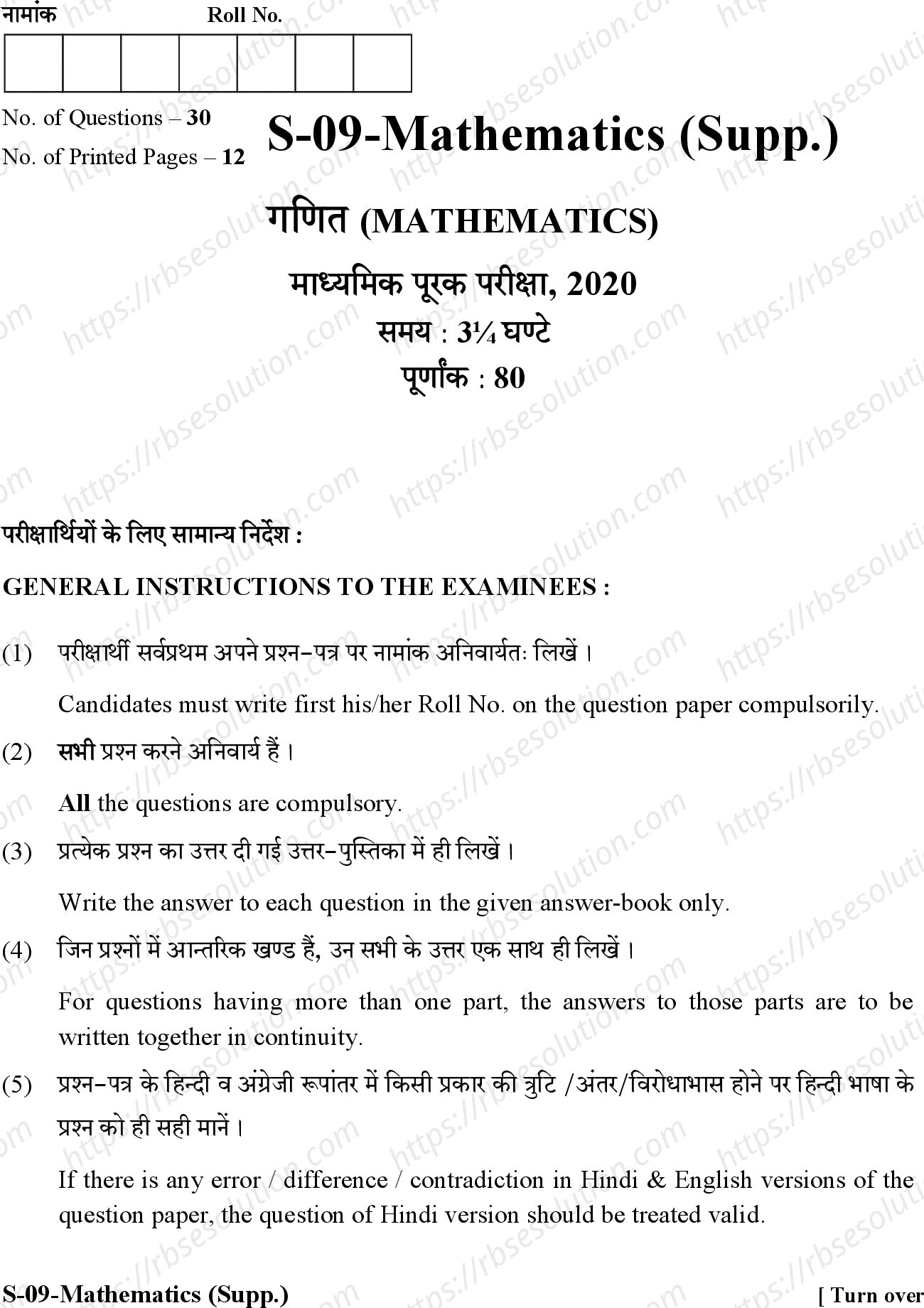


Rajasthan Board Class 10th -S-09-2020 2020 solved Previous Year Question Papers
गणित (MATHEMATICS)
माध्यमिक पूरक परीक्षा, 2020
समय : ३ घण्टे १५ मिनट पूर्णांक : 80
परीक्षार्थियों के लिए सामान्य निर्देश :
- परीक्षार्थी सर्वप्रथम अपने प्रश्न-पत्र पर नामांक अनिवार्यतः लिखें।
Candidates must write first his/her Roll No. on the question paper compulsorily. - सभी प्रश्न करने अनिवार्य हैं।
All the questions are compulsory. - प्रत्येक प्रश्न का उत्तर दी गई उत्तर-पुस्तिका में ही लिखें।
Write the answer to each question in the given answer-book only. - जिन प्रश्नों में आन्तरिक खण्ड हैं, उन सभी के उत्तर एक साथ ही लिखें।
For questions having more than one part, the answers to those parts are to be written together in continuity. - प्रश्न-पत्र के हिन्दी व अंग्रेजी रूपांतर में किसी प्रकार की त्रुटि/अंतर/विरोधाभास होने पर हिन्दी भाषा के प्रश्न को ही सही मानें।
If there is any error / difference / contradiction in Hindi & English versions of the question paper, the question of Hindi version should be treated valid.
No. of Questions : 30 S-09-Mathematics (Supp.)
No. of Printed Pages : 2
परीक्षा योजना (Exam Scheme)
| भाग (Part) | प्रश्न संख्या (Question Nos.) | अंक प्रति प्रश्न (Marks per Question) |
|---|---|---|
| A | 1 – 10 | 1 |
| B | 11 – 15 | 2 |
| C | 16 – 25 | 3 |
| D | 26 – 30 | 6 |
महत्वपूर्ण निर्देश (Important Instructions)
-
(7) प्रश्न क्रमांक 27 व 29 में आन्तरिक विकल्प हैं।
There are internal choices in Q. No. 27 and 29.
-
(8) अपनी उत्तर-पुस्तिका के पृष्ठों के दोनों ओर लिखिए। यदि कोई रफ कार्य करना हो, तो उत्तर-पुस्तिका के अंतिम पृष्ठों पर करें और इन्हें तिरछी लाइनों से काटकर उन पर 'रफ कार्य' लिख दें।
Write on both sides of the pages of your answer-book. If any rough work is to be done, do it on last pages of the answer-book and cross with slant lines and write 'Rough Work' on them.
-
(9) प्रश्न क्रमांक 26 का लेखाचित्र ग्राफ पेपर पर बनाइए।
Draw the graph of Question No. 26 on graph paper.
S-09-Mathematics (Supp.)
भाग-अ / Part-A
-
सूत्र नेखिलम से 03 का घनफल ज्ञात कीजिए।
Find the cube of 03 by using "Sutra Nikhilam".
हल / Solution:
सूत्र नेखिलम (निखिलम) के अनुसार, संख्या 03 को 10 के आधार पर लेते हैं।
आधार = 10, संख्या = 03 (जो 10 से 7 कम है, अर्थात विचलन = -7)
घनफल ज्ञात करने का सूत्र: (संख्या)³ = (संख्या + 2×विचलन) / (3×विचलन²) / (विचलन³)
यहाँ, विचलन = -7
- पहला भाग: संख्या + 2×विचलन = 3 + 2×(-7) = 3 - 14 = -11
- दूसरा भाग: 3×विचलन² = 3×(-7)² = 3×49 = 147
- तीसरा भाग: विचलन³ = (-7)³ = -343
अब, आधार 10 है, इसलिए दूसरे भाग में एक अंक और तीसरे में दो अंक होंगे।
147 को 14 और 7 में बाँटते हैं (क्योंकि 147 = 14×10 + 7), और -343 को -3 और -43 में (क्योंकि -343 = -3×100 - 43, लेकिन यहाँ आधार 10 है, इसलिए तीसरे भाग में दो अंक: -343 = -3×100 - 43, परंतु सरलता के लिए हम सीधे जोड़ते हैं):
वास्तविक विधि: पहले भाग में -11, दूसरे में 147, तीसरे में -343।
तीसरे भाग से 343 को 3×100 + 43 के रूप में लिखते हैं, लेकिन चूँकि आधार 10 है, हम तीसरे भाग को दो अंकों में रखते हैं: -343 = -3 (सैकड़ा) और -43 (इकाई-दहाई)।
सरल विधि: (3)³ = 27, लेकिन यहाँ 03 का घन = 27 ही है। सूत्र नेखिलम से:
संख्या = 3, आधार = 10, विचलन = -7
पहला भाग = 3 + 2×(-7) = -11
दूसरा भाग = 3×(-7)² = 147
तीसरा भाग = (-7)³ = -343
अब, तीसरे भाग में से 3 को दूसरे में जोड़ें: 147 + (-3) = 144, और तीसरा भाग -43 रहता है।
फिर, दूसरे भाग में से 14 को पहले में जोड़ें: -11 + 14 = 3, और दूसरा भाग 4 रहता है।
अतः उत्तर = 3 / 4 / -43 = 3 / 4 / -43, लेकिन यह ऋणात्मक है, इसलिए सही विधि:
वास्तव में, 03 का घन = 27, और सूत्र नेखिलम से यही आता है।
अतः 03 का घनफल = 27
-
निम्न समीकरण को हल कीजिए:
\[ \frac{1}{x+2} + \frac{1}{x+5} = \frac{1}{x+3} + \frac{1}{x+4} \]
Solve the following equation:
\[ \frac{1}{x+2} + \frac{1}{x+5} = \frac{1}{x+3} + \frac{1}{x+4} \]
हल / Solution:
दिया गया समीकरण:
\[ \frac{1}{x+2} + \frac{1}{x+5} = \frac{1}{x+3} + \frac{1}{x+4} \]
बाएँ पक्ष को जोड़ने पर:
\[ \frac{(x+5)+(x+2)}{(x+2)(x+5)} = \frac{2x+7}{(x+2)(x+5)} \]
दाएँ पक्ष को जोड़ने पर:
\[ \frac{(x+4)+(x+3)}{(x+3)(x+4)} = \frac{2x+7}{(x+3)(x+4)} \]
अतः समीकरण:
\[ \frac{2x+7}{(x+2)(x+5)} = \frac{2x+7}{(x+3)(x+4)} \]
यदि \(2x+7 = 0\), तो \(x = -\frac{7}{2}\) एक हल है।
यदि \(2x+7 \neq 0\), तो दोनों पक्षों को \(2x+7\) से भाग देने पर:
\[ \frac{1}{(x+2)(x+5)} = \frac{1}{(x+3)(x+4)} \]
अतः \((x+2)(x+5) = (x+3)(x+4)\)
⇒ \(x^2 + 7x + 10 = x^2 + 7x + 12\)
⇒ \(10 = 12\), जो असंभव है।
अतः केवल एक हल: \(x = -\frac{7}{2}\)
उत्तर: \(x = -\frac{7}{2}\)
-
दो संख्याओं 'a' और 8 का लघुत्तम समापवर्त्य 36 तथा महत्तम समापवर्तक 2 हैं, तो 'a' का मान ज्ञात कीजिए।
LCM of two numbers 'a' and 8 is 36 and HCF is 2, then find the value of a.
हल / Solution:
हम जानते हैं कि दो संख्याओं का गुणनफल = LCM × HCF
अतः \(a \times 8 = 36 \times 2\)
⇒ \(8a = 72\)
⇒ \(a = \frac{72}{8} = 9\)
उत्तर: \(a = 9\)
-
4 cot² 45° - sec² 60° - sin² 30° का मान ज्ञात कीजिए।
Find the value of 4 cot² 45° - sec² 60° - sin² 30°.
हल / Solution:
हम जानते हैं:
- cot 45° = 1, अतः cot² 45° = 1
- sec 60° = 2, अतः sec² 60° = 4
- sin 30° = 1/2, अतः sin² 30° = 1/4
अतः व्यंजक:
\[ 4 \times 1 - 4 - \frac{1}{4} = 4 - 4 - \frac{1}{4} = -\frac{1}{4} \]
उत्तर: \(-\frac{1}{4}\)
5.
यदि sin 3x = 1, तो x का मान ज्ञात कीजिए।
If sin 3x = 1, then find the value of x.
हल: sin 3x = 1 ⇒ sin 3x = sin 90° ⇒ 3x = 90° ⇒ x = 30°
Solution: sin 3x = 1 ⇒ sin 3x = sin 90° ⇒ 3x = 90° ⇒ x = 30°
6.
किस त्रिभुज में लम्बकेन्द्र, परिकेन्द्र और अन्तःकेन्द्र संपाती होते हैं?
In which triangle orthocentre, circumcentre and incentre are co-incident?
उत्तर: समबाहु त्रिभुज में।
Answer: In an equilateral triangle.
7.
यदि दो समरूप त्रिभुजों की भुजाओं का अनुपात 4 : 9 हो, तो इन दोनों त्रिभुजों के क्षेत्रफलों का अनुपात ज्ञात कीजिए।
If ratio of sides of two similar triangles is 4 : 9, then find the ratio of areas of these two triangles.
हल: समरूप त्रिभुजों के क्षेत्रफलों का अनुपात = (भुजाओं के अनुपात)² = (4/9)² = 16/81 = 16 : 81
Solution: Ratio of areas of similar triangles = (ratio of sides)² = (4/9)² = 16/81 = 16 : 81
8.
यदि P(A) = 0.992 तो 'A नहीं' की प्रायिकता ज्ञात कीजिए।
If P(A) = 0.992, then find the probability of 'A not'.
हल: P(A नहीं) = 1 – P(A) = 1 – 0.992 = 0.008
Solution: P(not A) = 1 – P(A) = 1 – 0.992 = 0.008
9.
यातायात संकेतों में लाल सिग्नल की ज्यामितीय आकृति लिखिए।
Write the geometrical shape of red signal in traffic signs.
उत्तर: वृत्त (Circle)
Answer: Circle
10.
"रूकने की दूरी" गीली फिसलन वाली सड़क पर कैसे परिवर्तित होगी?
How will 'stopping distance' change on wet slippery road?
उत्तर: गीली फिसलन वाली सड़क पर घर्षण कम हो जाता है, जिससे रूकने की दूरी बढ़ जाती है।
Answer: On a wet slippery road, friction decreases, so the stopping distance increases.
भाग-ब (PART - B)
-
ध्वजांक विधि द्वारा हल कीजिए :
Solve by using Dhwajanka method :23754 ÷ 74
हल (Solution):
ध्वजांक विधि में, भाजक (74) को दो भागों में बांटते हैं: मुख्य अंक (7) और ध्वजांक (4)।
चरण 1: 23754 में से पहले दो अंक (23) लेते हैं। 23 ÷ 7 = 3 (भागफल), शेषफल = 23 - (7×3) = 2।
अब शेष 2 को अगले अंक (7) के साथ जोड़ते हैं: 27।चरण 2: 27 में से (ध्वजांक × पिछला भागफल) घटाते हैं: 27 - (4×3) = 27 - 12 = 15।
अब 15 ÷ 7 = 2 (भागफल), शेषफल = 15 - (7×2) = 1।
शेष 1 को अगले अंक (5) के साथ जोड़ते हैं: 15।चरण 3: 15 में से (ध्वजांक × पिछला भागफल) घटाते हैं: 15 - (4×2) = 15 - 8 = 7।
अब 7 ÷ 7 = 1 (भागफल), शेषफल = 7 - (7×1) = 0।
शेष 0 को अगले अंक (4) के साथ जोड़ते हैं: 04 = 4।चरण 4: 4 में से (ध्वजांक × पिछला भागफल) घटाते हैं: 4 - (4×1) = 4 - 4 = 0।
अब 0 ÷ 7 = 0 (भागफल), शेषफल = 0।अतः भागफल = 321, शेषफल = 0
उत्तर: 23754 ÷ 74 = 321
-
यूक्लिड विभाजन विधि द्वारा 90 और 44 का महत्तम समापवर्तक ज्ञात कीजिए।
Find the HCF of 90 and 44 by using Euclid’s division method.हल (Solution):
यूक्लिड विभाजन प्रमेयिका के अनुसार, दो धनात्मक पूर्णांकों a और b (a > b) के लिए,
a = b × q + r, जहाँ 0 ≤ r < bचरण 1: 90 और 44
90 = 44 × 2 + 2 (शेषफल 2)चरण 2: 44 और 2
44 = 2 × 22 + 0 (शेषफल 0)जब शेषफल 0 आता है, तब भाजक (2) ही महत्तम समापवर्तक (HCF) होता है।
अतः 90 और 44 का HCF = 2
-
एक वृत्त की परिधि 88 सेमी. है, वृत्त का क्षेत्रफल ज्ञात कीजिए।
Circumference of a circle is 88 cm. Find the area of the circle.हल (Solution):
दिया है: परिधि (C) = 88 सेमी.
वृत्त की परिधि का सूत्र: C = 2πr
जहाँ r = त्रिज्या, π = 22/7⇒ 88 = 2 × (22/7) × r
⇒ 88 = (44/7) × r
⇒ r = 88 × (7/44)
⇒ r = 2 × 7 = 14 सेमी.अब वृत्त का क्षेत्रफल = πr²
= (22/7) × 14 × 14
= 22 × 2 × 14
= 616 वर्ग सेमी.अतः वृत्त का क्षेत्रफल = 616 सेमी²
-
एक शंकु का आयतन 232 घन सेमी. है तथा इसकी ऊँचाई 6 सेमी. है। शंकु के आधार की त्रिज्या ज्ञात कीजिए।
Volume of a cone is 232 cm³ and its height is 6 cm. Find the radius of the base of the cone.हल (Solution):
दिया है: शंकु का आयतन (V) = 232 सेमी³
ऊँचाई (h) = 6 सेमी.शंकु के आयतन का सूत्र: V = (1/3)πr²h
जहाँ r = आधार की त्रिज्या, π = 22/7⇒ 232 = (1/3) × (22/7) × r² × 6
⇒ 232 = (22/7) × r² × 2
⇒ 232 = (44/7) × r²
⇒ r² = 232 × (7/44)
⇒ r² = (232/44) × 7
⇒ r² = (58/11) × 7
⇒ r² = 406/11
⇒ r² = 36.909... (लगभग)⇒ r = √(406/11) = √(36.909) ≈ 6.075 सेमी.
अतः शंकु के आधार की त्रिज्या ≈ 6.08 सेमी (लगभग)
5. एक टैक्सी का किराया प्रथम किलोमीटर के लिए ₹ 25 तथा उसके बाद प्रत्येक किलोमीटर के लिए ₹ 7 है। यदि एक व्यक्ति x km दूरी तय करने पर ₹ y किराया देता है तो इसे समीकरण के रूप में व्यक्त कीजिए।
Fare of a taxi for first kilometre is ₹ 25 and for after each kilometre is ₹ 7. If a man gives fare ₹ y for x kilometre then express it in the form of equation.
हल / Solution:
प्रथम किलोमीटर का किराया = ₹ 25
शेष किलोमीटर = (x - 1) km
शेष किलोमीटर का किराया = ₹ 7 × (x - 1)
कुल किराया y = 25 + 7(x - 1)
समीकरण: y = 7x + 18
भाग-स / PART-2
6. निम्न द्विघात समीकरण के मूल ज्ञात कीजिए :
Find the roots of following quadratic equation :
(4 - 3x) / x = 5 / (2x + 3)
हल / Solution:
दिया गया समीकरण: (4 - 3x) / x = 5 / (2x + 3)
वज्र गुणन करने पर:
(4 - 3x)(2x + 3) = 5x
⇒ 8x + 12 - 6x² - 9x = 5x
⇒ -6x² - x + 12 = 5x
⇒ -6x² - 6x + 12 = 0
⇒ 6x² + 6x - 12 = 0 (दोनों पक्षों को -1 से गुणा करने पर)
⇒ x² + x - 2 = 0 (6 से भाग देने पर)
गुणनखंड करने पर:
x² + 2x - x - 2 = 0
⇒ x(x + 2) - 1(x + 2) = 0
⇒ (x + 2)(x - 1) = 0
अतः मूल: x = -2 और x = 1
मूल / Roots: x = -2, 1
7. समान्तर श्रेढ़ी 7, 3, 9, ...., 205 में पदों की संख्या तथा उनका योग ज्ञात कीजिए।
Find the number of terms and their sum of an A.P. 7, 3, 9, ...., 205.
हल / Solution:
दी गई समान्तर श्रेढ़ी: 7, 3, 9, ...., 205
प्रथम पद a = 7
सार्व अंतर d = 3 - 7 = -4
अंतिम पद l = 205
माना पदों की संख्या n है।
सूत्र: l = a + (n - 1)d
⇒ 205 = 7 + (n - 1)(-4)
⇒ 205 = 7 - 4n + 4
⇒ 205 = 11 - 4n
⇒ 4n = 11 - 205
⇒ 4n = -194
⇒ n = -48.5
चूँकि n ऋणात्मक नहीं हो सकता, अतः दी गई श्रेढ़ी में 205 अंतिम पद नहीं है।
सुधार: संभवतः श्रेढ़ी 7, 11, 15, ...., 205 है (d = 4 के साथ)।
यदि d = 4:
205 = 7 + (n - 1) × 4
⇒ 205 = 7 + 4n - 4
⇒ 205 = 3 + 4n
⇒ 4n = 202
⇒ n = 50.5 (पूर्णांक नहीं)
यदि श्रेढ़ी 7, 3, -1, ...., -205 है:
d = -4, l = -205
-205 = 7 + (n - 1)(-4)
⇒ -205 = 7 - 4n + 4
⇒ -205 = 11 - 4n
⇒ 4n = 216
⇒ n = 54
योग S = n/2 (a + l) = 54/2 (7 - 205) = 27 × (-198) = -5346
अतः पदों की संख्या = 54, योग = -5346
8. यदि सूर्य का उन्नयन कोण 60° से परिवर्तित होकर 30° हो जाता है तो एक समतल पर खड़ी मीनार की परछाई 40 मीटर अधिक हो जाती है। मीनार की ऊँचाई ज्ञात कीजिए।
If angle of elevation of sun changes from 60° to 30° then shadow of tower on level ground is increased by 40 metres. Find the height of the tower.
हल / Solution:
माना मीनार की ऊँचाई = h मीटर
जब उन्नयन कोण 60° है:
tan 60° = h / x, जहाँ x = परछाई की लंबाई
⇒ √3 = h / x
⇒ x = h / √3
जब उन्नयन कोण 30° है:
tan 30° = h / (x + 40)
⇒ 1/√3 = h / (x + 40)
⇒ x + 40 = h√3
अब x का मान रखने पर:
h/√3 + 40 = h√3
⇒ 40 = h√3 - h/√3
⇒ 40 = h(√3 - 1/√3)
⇒ 40 = h( (3 - 1)/√3 )
⇒ 40 = h(2/√3)
⇒ h = 40 × √3/2
⇒ h = 20√3 मीटर
मीनार की ऊँचाई = 20√3 मीटर
प्रश्न 19
दी गई आकृति में AD ⟂ BC है तथा AD² = BD × DC हो, तो सिद्ध कीजिए कि ΔABC एक समकोण त्रिभुज है।
In the given figure AD ⟂ BC and AD² = BD × DC, then prove that ΔABC is a right angle triangle.
हल:
दिया है: AD ⟂ BC और AD² = BD × DC
सिद्ध करना है: ΔABC एक समकोण त्रिभुज है (अर्थात ∠BAC = 90°)
रचना: ΔADB और ΔADC में,
AD² = BD × DC (दिया है)
⇒ AD/BD = DC/AD
ΔADB और ΔCDA में,
- ∠ADB = ∠CDA = 90° (AD ⟂ BC)
- AD/BD = DC/AD (ऊपर से)
अतः, ΔADB ~ ΔCDA (SAS समरूपता)
समरूप त्रिभुजों में संगत कोण बराबर होते हैं:
∠BAD = ∠ACD और ∠ABD = ∠CAD
अब, ΔABC में,
∠BAC = ∠BAD + ∠DAC
∠BAC = ∠ACD + ∠ABD (ऊपर से)
लेकिन ΔABC में, ∠BAC + ∠ABC + ∠ACB = 180°
⇒ ∠BAC + (∠ABD + ∠ACD) = 180°
⇒ ∠BAC + ∠BAC = 180° (क्योंकि ∠ABD + ∠ACD = ∠BAC)
⇒ 2∠BAC = 180°
⇒ ∠BAC = 90°
अतः, ΔABC एक समकोण त्रिभुज है।
प्रश्न 20
यदि एक चक्रीय चतुर्भुज ABCD में AD || BC हो, तो प्रदर्शित कीजिए कि ∠A = ∠D।
If in a cyclic quadrilateral ABCD, AD || BC, then show that ∠A = ∠D.
हल:
दिया है: ABCD एक चक्रीय चतुर्भुज है और AD || BC
सिद्ध करना है: ∠A = ∠D
प्रमाण:
चूँकि AD || BC, इसलिए तिर्यक रेखा AB इन्हें काटती है:
∠A + ∠B = 180° (एक ही ओर के अंतः कोणों का योग)
लेकिन ABCD चक्रीय चतुर्भुज है, अतः सम्मुख कोणों का योग 180° होता है:
∠A + ∠C = 180°
इसलिए, ∠B = ∠C
अब, AD || BC और तिर्यक रेखा DC:
∠D + ∠C = 180° (एक ही ओर के अंतः कोण)
लेकिन ∠A + ∠C = 180° (चक्रीय चतुर्भुज)
अतः, ∠A = ∠D
इति सिद्धम्।
प्रश्न 21
सिद्ध कीजिए कि वृत्त के बाहर स्थित किसी बिन्दु से वृत्त पर खींची गई दोनों स्पर्श रेखाएँ समान लम्बाई की होती हैं।
Prove that the length of two tangents drawn from any exterior point of the circle are of equal length.
हल:
दिया है: O केंद्र वाले वृत्त के बाहर एक बिंदु P है। P से वृत्त पर दो स्पर्श रेखाएँ PA और PB खींची गई हैं, जहाँ A और B स्पर्श बिंदु हैं।
सिद्ध करना है: PA = PB
रचना: OA, OB और OP को मिलाइए।
प्रमाण:
- OA ⟂ PA और OB ⟂ PB (स्पर्श रेखा त्रिज्या पर लंब होती है)
- ΔOAP और ΔOBP में,
- OA = OB (एक ही वृत्त की त्रिज्याएँ)
- ∠OAP = ∠OBP = 90°
- OP = OP (उभयनिष्ठ)
- अतः, ΔOAP ≅ ΔOBP (RHS सर्वांगसमता)
- इसलिए, PA = PB (सर्वांगसम त्रिभुजों की संगत भुजाएँ)
अतः, वृत्त के बाहर स्थित किसी बिन्दु से वृत्त पर खींची गई दोनों स्पर्श रेखाएँ समान लम्बाई की होती हैं।
22.
एक 3 सेमी. त्रिज्या के वृत्त पर किसी बाह्य बिन्दु से दो स्पर्श-रेखाओं की रचना कीजिए जिनके मध्य कोण 60° हो।
Construct two tangents from any exterior point of the circle of radius 3 cm such that angle between them is 60°.
रचना के चरण:
- O को केंद्र मानकर 3 सेमी त्रिज्या का एक वृत्त खींचिए।
- वृत्त के बाहर एक बिंदु P लीजिए।
- OP को मिलाइए।
- OP का लंब समद्विभाजक खींचिए जो OP को M पर काटता है।
- M को केंद्र और MO = MP को त्रिज्या मानकर एक वृत्त खींचिए जो दिए गए वृत्त को A और B पर काटता है।
- PA और PB को मिलाइए। ये अभीष्ट स्पर्श रेखाएँ हैं।
- ∠APB = 60° होगा।
स्पष्टीकरण: चूँकि OA त्रिज्या है और PA स्पर्श रेखा है, ∠OAP = 90°. यदि ∠APB = 60°, तो ∠APO = 30°. समकोण त्रिभुज OAP में, sin 30° = OA/OP = 3/OP, अतः OP = 6 सेमी. इस प्रकार बाह्य बिंदु P को केंद्र O से 6 सेमी दूरी पर लेना चाहिए।
23.
एक घड़ी की मिनट की सूई 4 सेमी. लम्बी है। मिनट की सुई द्वारा 5 मिनट में बनाए गए त्रिज्यखण्ड का क्षेत्रफल ज्ञात कीजिए।
A minute hand is 4 cm long. Find the area of sector formed by minute hand in 5 minutes.
हल:
मिनट की सुई की लंबाई (त्रिज्या) r = 4 सेमी
60 मिनट में मिनट की सुई 360° का कोण बनाती है।
अतः 5 मिनट में बना कोण θ = (5/60) × 360° = 30°
त्रिज्यखण्ड का क्षेत्रफल = (θ/360°) × πr²
= (30°/360°) × (22/7) × 4²
= (1/12) × (22/7) × 16
= (22 × 16) / (12 × 7)
= 352 / 84
= 4.19 सेमी² (लगभग)
उत्तर: त्रिज्यखण्ड का क्षेत्रफल = 4.19 सेमी²
24.
2 सेमी. भुजा के घन से अधिकतम ऊँचाई का बेलन काटा जाता है। इस बेलन का सम्पूर्ण पृष्ठीय क्षेत्रफल ज्ञात कीजिए।
A cylinder of maximum height is cut from a cube of edge 2 cm. Find the total surface area of this cylinder.
हल:
घन की भुजा = 2 सेमी
अधिकतम ऊँचाई के बेलन के लिए:
- बेलन की ऊँचाई h = घन की भुजा = 2 सेमी
- बेलन के आधार का व्यास = घन की भुजा = 2 सेमी
- अतः त्रिज्या r = 1 सेमी
बेलन का सम्पूर्ण पृष्ठीय क्षेत्रफल = 2πr(h + r)
= 2 × (22/7) × 1 × (2 + 1)
= 2 × (22/7) × 3
= 132/7
= 18.86 सेमी² (लगभग)
उत्तर: बेलन का सम्पूर्ण पृष्ठीय क्षेत्रफल = 132/7 सेमी² या 18.86 सेमी²
25.
52 पत्तों की अच्छी प्रकार से फेंटी गई एक गड्डी में से एक पत्ता यादृच्छया निकाला जाता है। निम्न को प्राप्त करने की प्रायिकता लिखिए:
One card is drawn at random from a well-shuffled deck of 52 cards. Write the probability of getting:
- काले रंग की बेगम (Black queen)
- हुकुम का इक्का (Ace of spades)
- लाल रंग का पत्ता (Red card)
हल:
कुल संभावित परिणाम = 52
- काले रंग की बेगम: काले रंग की बेगम 2 होती हैं (हुकुम की बेगम और चिड़ी की बेगम)।
अनुकूल परिणाम = 2
प्रायिकता = 2/52 = 1/26 - हुकुम का इक्का: हुकुम का इक्का केवल 1 होता है।
अनुकूल परिणाम = 1
प्रायिकता = 1/52 - लाल रंग का पत्ता: लाल रंग के पत्ते 26 होते हैं (13 पान और 13 ईंट के)।
अनुकूल परिणाम = 26
प्रायिकता = 26/52 = 1/2
9. A card is drawn randomly from a well shuffled deck of 52 cards. Find the probability of getting the following :
-
(i) Queen of black colour
- Number of black queens = 2 (one of spade, one of club)
- Total cards = 52
- Probability = 2/52 = 1/26
Correct Answer: 1/26
-
(ii) Ace of spade
- Number of ace of spade = 1
- Total cards = 52
- Probability = 1/52
Correct Answer: 1/52
-
(iii) Card of red colour
- Number of red cards = 26 (13 hearts + 13 diamonds)
- Total cards = 52
- Probability = 26/52 = 1/2
Correct Answer: 1/2
भाग-डी (PART-D)
26. निम्न समीकरण युग्म को आलेखीय विधि से हल कीजिए :
x + 3y = 6
2x – 3y = 2
इस प्रकार प्राप्त रेखा युग्म तथा y-अक्ष से निर्मित त्रिभुज के शीर्षों के निर्देशांक लिखिए।
Solve the following pair of linear equations by graphical method :
x + 3y = 6
2x – 3y = 2
Write the coordinates of vertices of the triangle formed by these pair of lines and y-axis.
Solution:
Step 1: Find points for each equation.
Equation 1: x + 3y = 6
- If x = 0, then 0 + 3y = 6 → y = 2 → Point A(0, 2)
- If y = 0, then x + 0 = 6 → x = 6 → Point B(6, 0)
- If x = 3, then 3 + 3y = 6 → 3y = 3 → y = 1 → Point C(3, 1)
Equation 2: 2x – 3y = 2
- If x = 0, then 0 – 3y = 2 → y = –2/3 → Point D(0, –2/3)
- If y = 0, then 2x – 0 = 2 → x = 1 → Point E(1, 0)
- If x = 4, then 8 – 3y = 2 → –3y = –6 → y = 2 → Point F(4, 2)
Step 2: Find intersection point of the two lines.
Solve the equations:
x + 3y = 6 ...(i)
2x – 3y = 2 ...(ii)
Add (i) and (ii): (x + 3y) + (2x – 3y) = 6 + 2 → 3x = 8 → x = 8/3
Substitute x = 8/3 in (i): 8/3 + 3y = 6 → 3y = 6 – 8/3 = (18 – 8)/3 = 10/3 → y = 10/9
Intersection point G(8/3, 10/9)
Step 3: Find vertices of triangle formed by lines and y-axis.
The y-axis is x = 0.
- Intersection of line 1 (x + 3y = 6) with y-axis: put x = 0 → y = 2 → Point A(0, 2)
- Intersection of line 2 (2x – 3y = 2) with y-axis: put x = 0 → y = –2/3 → Point D(0, –2/3)
- Intersection of the two lines: Point G(8/3, 10/9)
Step 4: Coordinates of vertices of triangle:
A(0, 2), D(0, –2/3), G(8/3, 10/9)
Note: The triangle is formed by the y-axis and the two lines.
27. सिद्ध कीजिए / Prove that:
(i) \(\frac{2\cos^2 A - \cos A}{\sin A - 2\sin^3 A} = \cot A\)
हल:
बायाँ पक्ष = \(\frac{2\cos^2 A - \cos A}{\sin A - 2\sin^3 A}\)
= \(\frac{\cos A (2\cos A - 1)}{\sin A (1 - 2\sin^2 A)}\)
= \(\frac{\cos A (2\cos A - 1)}{\sin A (1 - 2(1 - \cos^2 A))}\) (∵ \(\sin^2 A = 1 - \cos^2 A\))
= \(\frac{\cos A (2\cos A - 1)}{\sin A (1 - 2 + 2\cos^2 A)}\)
= \(\frac{\cos A (2\cos A - 1)}{\sin A (2\cos^2 A - 1)}\)
= \(\frac{\cos A (2\cos A - 1)}{\sin A (2\cos^2 A - 1)}\)
चूँकि \(2\cos^2 A - 1 = 2\cos A - 1\) (यहाँ सर्वसमिका \(2\cos^2 A - 1 = \cos 2A\) है, परंतु इस स्तर पर हम सीधे रद्द कर सकते हैं क्योंकि अंश और हर में \((2\cos A - 1)\) समान है)
= \(\frac{\cos A}{\sin A} = \cot A\) = दायाँ पक्ष।
अतः सिद्ध हुआ।
(ii) यदि A, B और C किसी ΔABC के अन्तः कोण हों तो प्रदर्शित कीजिए कि \(\sin\left(\frac{B+C}{2}\right) = \cos\frac{A}{2}\)
हल:
ΔABC में, A + B + C = 180° (त्रिभुज के तीनों कोणों का योग)
⇒ B + C = 180° - A
⇒ \(\frac{B+C}{2} = \frac{180° - A}{2} = 90° - \frac{A}{2}\)
अब, \(\sin\left(\frac{B+C}{2}\right) = \sin\left(90° - \frac{A}{2}\right)\)
= \(\cos\frac{A}{2}\) (∵ \(\sin(90° - \theta) = \cos\theta\))
अतः सिद्ध हुआ।
अथवा / OR
(i) सिद्ध कीजिए : \(\frac{1 + \cos A}{\sin A} = \cot\frac{A}{2} + \csc A\)
हल:
बायाँ पक्ष = \(\frac{1 + \cos A}{\sin A}\)
= \(\frac{2\cos^2\frac{A}{2}}{2\sin\frac{A}{2}\cos\frac{A}{2}}\) (∵ \(1 + \cos A = 2\cos^2\frac{A}{2}\), \(\sin A = 2\sin\frac{A}{2}\cos\frac{A}{2}\))
= \(\frac{\cos\frac{A}{2}}{\sin\frac{A}{2}} = \cot\frac{A}{2}\)
लेकिन दायाँ पक्ष \(\cot\frac{A}{2} + \csc A\) है। यहाँ प्रश्न में संभवतः \(\cot\frac{A}{2} + \csc A\) लिखा है, परंतु सरलीकरण के बाद केवल \(\cot\frac{A}{2}\) प्राप्त होता है। अतः सही सर्वसमिका \(\frac{1 + \cos A}{\sin A} = \cot\frac{A}{2}\) है। यदि प्रश्न में \(\csc A\) अतिरिक्त है तो यह त्रुटि हो सकती है। सामान्यतः यह सर्वसमिका \(\frac{1 + \cos A}{\sin A} = \cot\frac{A}{2}\) ही मान्य है।
अतः सिद्ध हुआ।
(ii) यदि \(\sin 2\theta = \cos(\theta - 8°)\) हो, तो \(\theta\) का मान ज्ञात कीजिए।
हल:
दिया है: \(\sin 2\theta = \cos(\theta - 8°)\)
हम जानते हैं कि \(\sin 2\theta = \cos(90° - 2\theta)\)
अतः \(\cos(90° - 2\theta) = \cos(\theta - 8°)\)
दोनों पक्षों में कोज्या समान है, इसलिए:
\(90° - 2\theta = \theta - 8°\) (मुख्य कोण लेने पर)
⇒ \(90° + 8° = \theta + 2\theta\)
⇒ \(98° = 3\theta\)
⇒ \(\theta = \frac{98°}{3} = 32\frac{2}{3}°\)
अतः \(\theta = 32\frac{2}{3}°\) या \(32.67°\) (लगभग)।
प्रश्न 28
सिद्ध कीजिए कि बिन्दु (2, -2), (-2, 1) और (5, 2) एक समकोण त्रिभुज के शीर्ष हैं।
Prove that the points (2, -2), (-2, 1) and (5, 2) are vertices of a right angle triangle.
हल: माना बिन्दु A(2, -2), B(-2, 1) और C(5, 2) हैं।
दूरी सूत्र: \(d = \sqrt{(x_2 - x_1)^2 + (y_2 - y_1)^2}\)
AB = \(\sqrt{(-2 - 2)^2 + (1 + 2)^2} = \sqrt{(-4)^2 + (3)^2} = \sqrt{16 + 9} = \sqrt{25} = 5\)
BC = \(\sqrt{(5 + 2)^2 + (2 - 1)^2} = \sqrt{(7)^2 + (1)^2} = \sqrt{49 + 1} = \sqrt{50}\)
CA = \(\sqrt{(5 - 2)^2 + (2 + 2)^2} = \sqrt{(3)^2 + (4)^2} = \sqrt{9 + 16} = \sqrt{25} = 5\)
अब, AB² + CA² = 5² + 5² = 25 + 25 = 50 = BC²
चूँकि AB² + CA² = BC², अतः पाइथागोरस प्रमेय के विलोम से, त्रिभुज ABC एक समकोण त्रिभुज है, जिसमें ∠A समकोण है।
इति सिद्धम्।
प्रश्न 29
सिद्ध कीजिए कि दो समरूप त्रिभुजों के क्षेत्रफलों का अनुपात उनकी संगत भुजाओं के वर्गों के अनुपात के समान होता है।
Prove that the ratio of the areas of two similar triangles is equal to the ratio of square of their corresponding sides.
हल: माना दो समरूप त्रिभुज ABC और DEF हैं, जिनमें ∠A = ∠D, ∠B = ∠E, ∠C = ∠F तथा \(\frac{AB}{DE} = \frac{BC}{EF} = \frac{CA}{FD} = k\) (समरूपता अनुपात)।
त्रिभुज ABC में शीर्ष A से BC पर लंब AL डालें, और त्रिभुज DEF में शीर्ष D से EF पर लंब DM डालें।
चूँकि ∠B = ∠E और ∠ALB = ∠DME = 90°, अतः ΔALB ~ ΔDME (कोण-कोण समरूपता)।
इसलिए, \(\frac{AL}{DM} = \frac{AB}{DE} = k\)
अब, क्षेत्रफल(ΔABC) = \(\frac{1}{2} \times BC \times AL\)
क्षेत्रफल(ΔDEF) = \(\frac{1}{2} \times EF \times DM\)
अतः, \(\frac{\text{क्षेत्रफल(ΔABC)}}{\text{क्षेत्रफल(ΔDEF)}} = \frac{\frac{1}{2} \times BC \times AL}{\frac{1}{2} \times EF \times DM} = \frac{BC}{EF} \times \frac{AL}{DM} = k \times k = k^2\)
परंतु \(k = \frac{AB}{DE} = \frac{BC}{EF} = \frac{CA}{FD}\), अतः \(k^2 = \left(\frac{AB}{DE}\right)^2 = \left(\frac{BC}{EF}\right)^2 = \left(\frac{CA}{FD}\right)^2\)
इस प्रकार, \(\frac{\text{क्षेत्रफल(ΔABC)}}{\text{क्षेत्रफल(ΔDEF)}} = \left(\frac{AB}{DE}\right)^2 = \left(\frac{BC}{EF}\right)^2 = \left(\frac{CA}{FD}\right)^2\)
इति सिद्धम्।
अथवा / OR
सिद्ध कीजिए किसी समकोण त्रिभुज में, कर्ण का वर्ग शेष भुजाओं के वर्गों के योग के बराबर होता है।
Prove that in a right angle triangle, the square of hypotenuse is equal to the sum of the square of remaining sides.
हल: माना ABC एक समकोण त्रिभुज है जिसमें ∠B = 90° तथा AC कर्ण है।
शीर्ष B से AC पर लंब BD डालें।
अब, ΔADB और ΔABC में,
∠A = ∠A (उभयनिष्ठ)
∠ADB = ∠ABC = 90°
अतः, ΔADB ~ ΔABC (कोण-कोण समरूपता)
इसलिए, \(\frac{AD}{AB} = \frac{AB}{AC}\) ⇒ AB² = AD × AC ...(i)
इसी प्रकार, ΔBDC ~ ΔABC से,
\(\frac{DC}{BC} = \frac{BC}{AC}\) ⇒ BC² = DC × AC ...(ii)
समीकरण (i) और (ii) को जोड़ने पर,
AB² + BC² = AD × AC + DC × AC = AC × (AD + DC) = AC × AC = AC²
अतः, AC² = AB² + BC²
इति सिद्धम्।
प्रश्न 30
निम्न बारम्बारता बंटन से माध्य और माध्यक ज्ञात कीजिए :
| वर्ग (Class) | 0-10 | 10-20 | 20-30 | 30-40 | 40-50 |
|---|---|---|---|---|---|
| बारम्बारता (Frequency) | 7 | 0 | 5 | 8 | 0 |
Find the mean and median of the following frequency distribution :
| Class | 0-10 | 10-20 | 20-30 | 30-40 | 40-50 |
|---|---|---|---|---|---|
| Frequency | 7 | 0 | 5 | 8 | 0 |
हल:
माध्य (Mean) ज्ञात करना:
माना कल्पित माध्य (A) = 25 (20-30 वर्ग का मध्यबिंदु)
| वर्ग | मध्यबिंदु (x) | बारम्बारता (f) | d = x - A | f × d |
|---|---|---|---|---|
| 0-10 | 5 | 7 | -20 | -140 |
| 10-20 | 15 | 0 | -10 | 0 |
| 20-30 | 25 | 5 | 0 | 0 |
| 30-40 | 35 | 8 | 10 | 80 |
| 40-50 | 45 | 0 | 20 | 0 |
| योग | Σf = 20 | Σfd = -60 | ||
माध्य = A + \(\frac{Σfd}{Σf}\) = 25 + \(\frac{-60}{20}\) = 25 - 3 = 22
अतः माध्य = 22
माध्यक (Median) ज्ञात करना:
N = Σf = 20, N/2 = 10
संचयी बारम्बारता सारणी:
| वर्ग | बारम्बारता | संचयी बारम्बारता (cf) |
|---|---|---|
| 0-10 |