
RBSE Class 10th 2024 Mathematics-S-09-2024 Previous Year Papers
Class 10th students hunting authentic previous year papers for Mathematics-S-09-2024 (2024) land here for a reason: the paper below matches how RBSE assessments are remembered from that year. RBSE Solution does not mix years on one page; each combination gets its own notes.
Skim the overview sections, then work through the scanned pages. Pair this practice with RBSE books and solutions when you need to relearn a concept a question exposed.
Paper details
Quick reference for this previous year papers page — confirm board, class, and year & subject before you study.
| Board | RBSE |
|---|---|
| Class | Class 10th |
| Exam year | 2024 |
| Subject | Mathematics-S-09-2024 |
| Resource type | Previous Year Papers |
| Category | RBSE Previous Year Question Papers |
| Website | RBSE Solution |
The table summarises this Previous Year Papers resource. Confirm RBSE, Class 10th, year 2024, and subject Mathematics-S-09-2024 before studying.
RBSE Solution organises previous year papers so each URL carries chapter-specific guidance — better for students and for search engines than one generic paragraph for the whole class.
How to practise with this question paper
Stage one: read the Mathematics-S-09-2024 question paper from 2024 without a timer and highlight command words — explain, prove, calculate, discuss. Stage two: attempt selected questions closed-book. Stage three: compare with solutions or teacher feedback.
Previous Year Papers work best when you log mistakes by topic, not only by question number. That log becomes your revision index before pre-boards.
RBSE Class 10th 2024 Mathematics-S-09-2024
Scroll through the Previous Year Papers pages for Mathematics-S-09-2024 (2024).
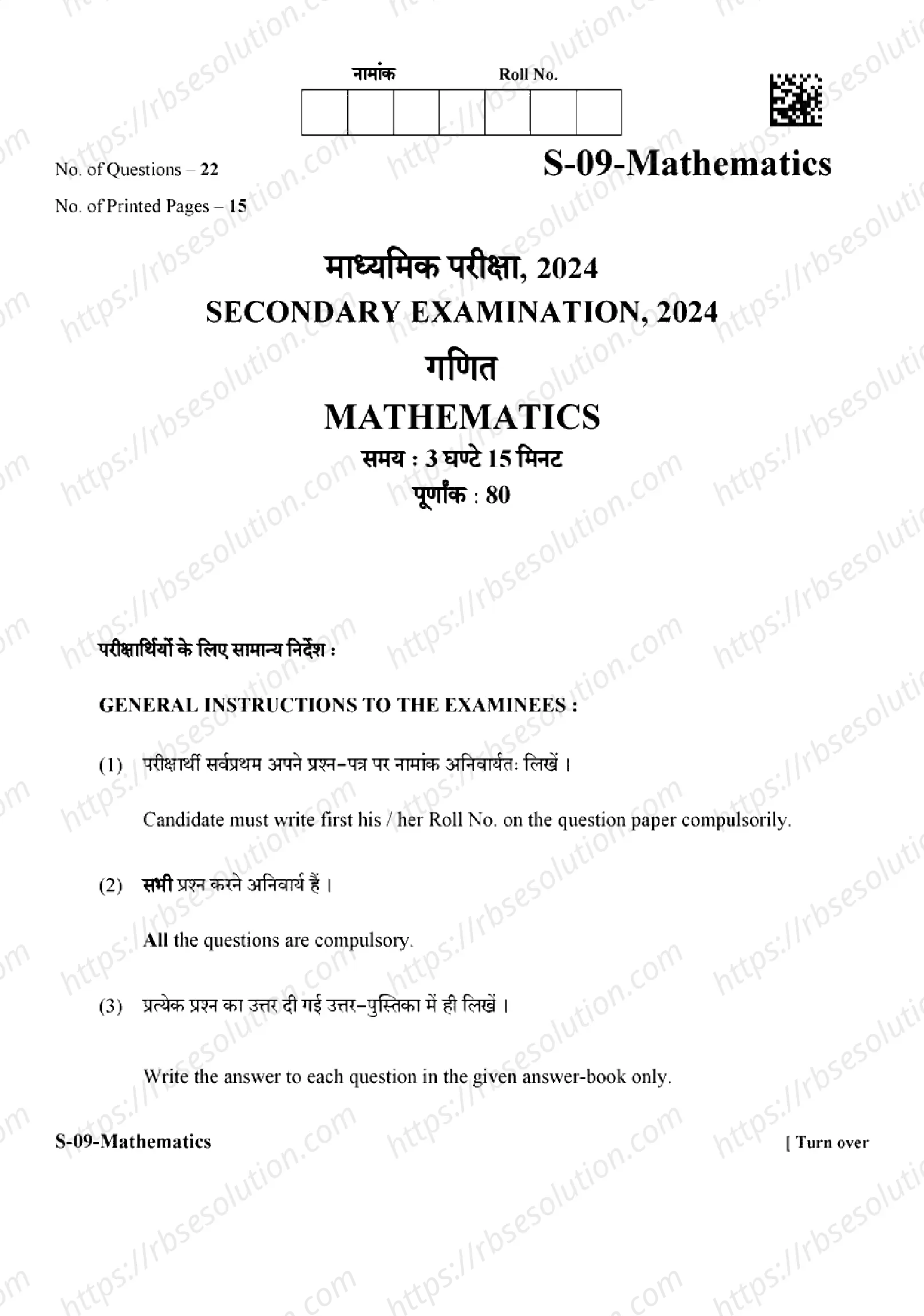


Rajasthan Board Class 10th Mathematics-S-09-2024 2024 solved Previous Year Question Papers
माध्यमिक परीक्षा, 2024
SECONDARY EXAMINATION, 2024
गणित
MATHEMATICS
समय : 3 घण्टे 5 मिनट | पूर्णांक : 80
परीक्षार्थियों के लिए सामान्य निर्देश :
GENERAL INSTRUCTIONS TO THE EXAMINEES :
- परीक्षार्थी सर्वप्रथम अपने प्रश्न-पत्र पर नामांक अनिवार्यतः लिखें।
Candidate must write first his / her Roll No. on the question paper compulsorily. - सभी प्रश्न करने अनिवार्य हैं।
All the questions are compulsory. - प्रत्येक प्रश्न का उत्तर दी गई उत्तर-पुस्तिका में ही लिखें।
Write the answer to each question in the given answer-book only.
No. of Questions — 22 | No. of Printed Pages — 5
S-09-Mathematics [ Turn over
निर्देश / Instructions
-
जिन प्रश्नों में आन्तरिक खण्ड हैं, उन सभी के उत्तर एक साथ ही लिखें।
For questions having more than one part, the answers to those parts are to be written together in continuity.
-
प्रश्न-पत्र के हिन्दी व अंग्रेजी रूपांतर में किसी प्रकार की त्रुटि/अंतर/विरोधाभास होने पर हिन्दी भाषा के प्रश्न को ही सही मानें।
If there is any error / difference / contradiction in Hindi & English versions of the question paper, the question of Hindi version should be treated valid.
-
प्रश्न का उत्तर लिखने से पूर्व प्रश्न का क्रमांक अवश्य लिखें।
Write down the serial number of the question before attempting it.
-
प्रश्न क्रमांक 6 से 22 तक में आन्तरिक विकल्प हैं।
There are internal choices in Question Nos. 6 to 22.
-
अपनी उत्तर-पुस्तिका के पृष्ठों के दोनों ओर लिखिए। यदि कोई रफ़ कार्य करना हो, तो उत्तर-पुस्तिका के अंतिम पृष्ठों पर करें और इन्हें तिरछी लाइनों से काटकर उन पर 'रफ़ कार्य' लिख दें।
Write on both sides of the pages of your answer-book. If any rough work is to be done, do it on last pages of the answer-book and cross with slant lines and write "Rough Work" on them.
S-09-Mathematics
खण्ड-अ / SECTION - A
बहुविकल्पीय प्रश्न :
Multiple Choice Questions :
वस्तुनिष्ठ प्रश्नों के उत्तर का सही विकल्प चयन कर उत्तर-पुस्तिका में लिखिए :
Choose the correct option to answer the following objective questions and write in the answer sheet :
-
(i) दो संख्याओं का महत्तम समापवर्तक 27 है तथा उनका लघुत्तम समापवर्त्य 162 है। यदि एक संख्या 54 है, तो दूसरी संख्या है :
The Highest Common Factor of two numbers is 27 and their Least Common Multiple is 162. If one number is 54, then the other number is :- (अ) 81
- (ब) 27
- (स) 54
- (द) 18
सही उत्तर / Correct Answer: (अ) 81
व्याख्या / Explanation: हम जानते हैं कि दो संख्याओं का गुणनफल = HCF × LCM होता है। अतः, 54 × दूसरी संख्या = 27 × 162 ⇒ दूसरी संख्या = (27 × 162) / 54 = 81.
-
(ii) बहुपद x² – 2x – 8 के शून्यक हैं :
The zeroes of the polynomial x² – 2x – 8 are :- (अ) 2, 4
- (ब) 2, 5
- (स) -2, 4
- (द) -2, 6
सही उत्तर / Correct Answer: (स) -2, 4
व्याख्या / Explanation: x² – 2x – 8 = x² – 4x + 2x – 8 = x(x – 4) + 2(x – 4) = (x – 4)(x + 2). अतः शून्यक x = 4 और x = -2 हैं।
प्रश्न (iii)
यदि पहली संख्या x का दुगुना दूसरी संख्या y के 7 गुने से 5 कम है, तो निम्न में से कौन सा समीकरण सही है?
- (A) 2x = 7y + 5
- (B) 5x = 7y + 2
- (C) 7x = 2y – 5
- (D) 2x = 7y – 5
व्याख्या: पहली संख्या x का दुगुना = 2x, दूसरी संख्या y के 7 गुने से 5 कम = 7y – 5. अतः समीकरण 2x = 7y – 5 है।
प्रश्न (iv)
यदि समान्तर श्रेढ़ी का प्रथम पद 2 और सार्व अन्तर 3 हो, तो nवाँ पद होगा:
- (A) 3n + 2
- (B) 3n – 1
- (C) 3n – 1
- (D) 3n – 2
व्याख्या: समान्तर श्रेढ़ी का nवाँ पद = a + (n – 1)d = 2 + (n – 1) × 3 = 2 + 3n – 3 = 3n – 1.
प्रश्न (v)
3 के प्रथम पाँच गुणजों का योगफल है:
- (A) 42
- (B) 39
- (C) 45
- (D) 33
व्याख्या: 3 के प्रथम पाँच गुणज = 3, 6, 9, 12, 15. इनका योग = 3 + 6 + 9 + 12 + 15 = 45.
प्रश्न (vi)
यदि किसी त्रिभुज POR में PQ² + QR² = PR² हो, तो कौन सा कोण समकोण होगा ?
- (अ) ∠P
- (ब) ∠Q
- (स) ∠R
- (द) इनमें से कोई नहीं
English: If PQ² + QR² = PR² in triangle POR, then which angle will be a right angle?
- (A) ∠P
- (B) ∠Q
- (C) ∠R
- (D) None of these
सही उत्तर: (ब) ∠Q
व्याख्या: पाइथागोरस प्रमेय के अनुसार, यदि किसी त्रिभुज में सबसे बड़ी भुजा का वर्ग अन्य दो भुजाओं के वर्गों के योग के बराबर हो, तो वह त्रिभुज समकोण त्रिभुज होता है और सबसे बड़ी भुजा के सामने का कोण समकोण होता है। यहाँ PR सबसे बड़ी भुजा है, इसलिए इसके सामने का कोण Q समकोण होगा।
प्रश्न (vii)
बिन्दु (0, 3) की x-अक्ष से दूरी होगी :
- (अ) 3
- (ब) 0
- (स) 2
- (द) 1
English: The distance of point (0, 3) from x-axis will be :
- (A) 3
- (B) 0
- (C) 2
- (D) 1
सही उत्तर: (अ) 3
व्याख्या: x-अक्ष से दूरी बिन्दु के y-निर्देशांक के बराबर होती है। बिन्दु (0, 3) का y-निर्देशांक 3 है, अतः दूरी 3 इकाई है।
प्रश्न (viii)
2 sin 45° cos 45° का मान है :
- (अ) 2
- (ब) 0
- (स) 1/2
- (द) 1
English: The value of 2 sin 45° cos 45° is :
- (A) 2
- (B) 0
- (C) 1/2
- (D) 1
सही उत्तर: (द) 1
व्याख्या: sin 45° = 1/√2 और cos 45° = 1/√2 होता है। अतः 2 × (1/√2) × (1/√2) = 2 × (1/2) = 1. या सूत्र 2 sin θ cos θ = sin 2θ से, 2 sin 45° cos 45° = sin 90° = 1.
(ix) यदि किसी वृक्ष की छाया उसकी ऊँचाई की √3 गुना हो, तो सूर्य का उन्नयन कोण है :
If the shadow of a tree is √3 times its height, then angle of elevation of the sun is :
- 90°
- 60°
- 45°
- 30°
(x) किसी वृत्त के व्यास के सिरों पर खींची गई स्पर्श-रेखाएँ परस्पर होती हैं :
The tangents drawn at the ends of any diameter of a circle are mutually :
- perpendicular
- parallel
- intersecting
- secant
(xi) यदि एक वृत्त की परिधि 76 सेमी है, तो उसकी त्रिज्या है :
If the circumference of a circle is 76 cm, then its radius is :
- 2 cm
- 4 cm
- 28 cm
- 7 cm
(xii) यदि एक गोले का आयतन 36π घन सेमी है, तो उसकी त्रिज्या है :
If the volume of a sphere is 36π cm³, then its radius is :
- (अ) 3 सेमी (A) 3 cm
- (ब) 6 सेमी (B) 6 cm
- (स) 2 सेमी (C) 2 cm
- (द) 5 सेमी (D) 5 cm
हल / Solution:
गोले का आयतन = (4/3)πr³ = 36π
⇒ (4/3)r³ = 36
⇒ r³ = 36 × (3/4) = 27
⇒ r = 3 सेमी (cm)
सही उत्तर / Correct Answer: (अ) 3 सेमी (A) 3 cm
(xiii) प्रथम 11 पूर्ण संख्याओं का माध्य होगा :
The mean of first 11 whole numbers will be :
- (अ) 4 (A) 4
- (ब) 5 (B) 5
- (स) 5.5 (C) 5.5
- (द) 6 (D) 6
हल / Solution:
प्रथम 11 पूर्ण संख्याएँ: 0, 1, 2, 3, 4, 5, 6, 7, 8, 9, 10
योग = 0+1+2+3+4+5+6+7+8+9+10 = 55
माध्य = 55/11 = 5
सही उत्तर / Correct Answer: (ब) 5 (B) 5
(xiv) बंटन 3, 3, 5, 3, 4, 2, 8, 4, 3, 4, 3 का बहुलक है :
The mode of distribution 3, 3, 5, 3, 4, 2, 8, 4, 3, 4, 3 is:
- (अ) 7 (A) 7
- (ब) 3 (B) 3
- (स) 4 (C) 4
- (द) 5 (D) 5
हल / Solution:
बारंबारता: 3 → 5 बार, 4 → 3 बार, 2 → 1 बार, 5 → 1 बार, 8 → 1 बार
सबसे अधिक बार आने वाली संख्या = 3
सही उत्तर / Correct Answer: (ब) 3 (B) 3
(xv) यदि P(E) = 0.05 है, तो 'E नहीं' की प्रायिकता होगी :
If P(E) = 0.05, then the probability of “Not E” will be :
- (अ) 0.90 (A) 0.90
- (ब) 0.59 (B) 0.59
- (स) 0.50 (C) 0.50
- (द) 0.95 (D) 0.95
हल / Solution:
P(Not E) = 1 – P(E) = 1 – 0.05 = 0.95
सही उत्तर / Correct Answer: (द) 0.95 (D) 0.95
खंड-ब (Section-B)
2. निम्नलिखित प्रश्नों में रिक्त स्थानों की पूर्ति करते हुए उत्तर-पुस्तिका में लिखिए ।
Fill in the blanks in the following questions and write them in the answer book.
-
समांतर श्रेढ़ी -3, ... का 11वाँ पद है।
The eleventh term of Arithmetic Progression -3, ... isउत्तर: श्रेढ़ी -3, -1, 1, 3, ... है। यहाँ प्रथम पद a = -3, सार्वअंतर d = 2 है।
11वाँ पद = a + (11-1)d = -3 + 10×2 = -3 + 20 = 17 -
cos² 60° – sin² 60° का मान = ______
The value of cos² 60° – sin² 60° isउत्तर: cos 60° = 1/2, sin 60° = √3/2
cos² 60° – sin² 60° = (1/2)² – (√3/2)² = 1/4 – 3/4 = -2/4 = -1/2 -
यदि एक वृत्त का क्षेत्रफल 54 सेमी² है, तो उसकी त्रिज्या है।
If the area of a circle is 54 cm², then its radius isउत्तर: वृत्त का क्षेत्रफल = πr² = 54
⇒ r² = 54/π = 54 × 7/22 = 378/22 = 189/11 ≈ 17.18
⇒ r = √(189/11) = √(17.18) ≈ 4.14 सेमी -
यदि एक शंकु की त्रिज्या 6 सेमी व ऊँचाई 8 सेमी है, तो उसकी तिर्यक ऊँचाई है।
If the radius of a cone is 6 cm and height is 8 cm, then its slant height isउत्तर: तिर्यक ऊँचाई l = √(r² + h²) = √(6² + 8²) = √(36 + 64) = √100 = 10 सेमी
-
3 माध्यक = 2 माध्य + ______
3 Median = 2 Mean + ______उत्तर: 3 माध्यक = 2 माध्य + बहुलक (Mode)
-
वर्ग अन्तराल 60 – 75 का वर्ग चिह्न है।
The class mark of the class interval 60 – 75 isउत्तर: वर्ग चिह्न = (निम्न सीमा + उच्च सीमा)/2 = (60 + 75)/2 = 135/2 = 67.5
-
एक पासे को उछाले जाने पर 6 से बड़ा अंक आने की प्रायिकता होती है।
The probability of getting a number greater than 6 when a die is thrown, isउत्तर: पासे पर अंक 1, 2, 3, 4, 5, 6 होते हैं। 6 से बड़ा कोई अंक नहीं है। अतः अनुकूल परिणाम = 0, कुल परिणाम = 6
प्रायिकता = 0/6 = 0
अतिलघूत्तरात्मक प्रश्न / Very Short Answer Type Questions
-
(i) यदि x = 2⁷ × 3² और y = 2² × 3² हो, तो x और y का लघुत्तम समापवर्त्य (ल.स.प.) ज्ञात कीजिए।
If x = 2⁷ × 3² and y = 2² × 3², then find the Least Common Multiple (L.C.M.) of x and y.हल / Solution:
ल.स.प. ज्ञात करने के लिए प्रत्येक अभाज्य गुणनखंड की अधिकतम घात ली जाती है।
x = 2⁷ × 3²
y = 2² × 3²
अतः ल.स.प. = 2⁷ × 3² = 128 × 9 = 1152उत्तर / Answer: 1152
-
(ii) बहुपद x² – 3 के शून्यक ज्ञात कीजिए।
Find the zeroes of the polynomial x² – 3.हल / Solution:
बहुपद के शून्यक ज्ञात करने के लिए x² – 3 = 0 रखते हैं।
x² = 3
x = ±√3उत्तर / Answer: √3 और –√3
-
(iii) रैखिक समीकरण युग्म x + y = 14 और x – y = 4 को हल कीजिए।
Solve the pair of linear equations x + y = 14 and x – y = 4.हल / Solution:
दोनों समीकरणों को जोड़ने पर:
(x + y) + (x – y) = 14 + 4
2x = 18
x = 9
x का मान पहले समीकरण में रखने पर:
9 + y = 14
y = 5उत्तर / Answer: x = 9, y = 5
-
(iv) निम्न आकृति में यदि DE || BC हो, तो EC का मान ज्ञात कीजिए।
In the given figure, if DE || BC, then find the value of EC.हल / Solution:
चूँकि DE || BC है, अतः थेल्स प्रमेय (आधारभूत समानुपातिकता प्रमेय) के अनुसार:
AD/DB = AE/EC
आकृति में मान नहीं दिए गए हैं, अतः EC का मान ज्ञात नहीं किया जा सकता। कृपया आकृति में दिए गए मानों का उपयोग करें।नोट: यदि AD, DB और AE दिए हों, तो EC = (AE × DB) / AD होगा।
-
(v) बिन्दुओं (–a, a) तथा (a, –a) के बीच की दूरी ज्ञात कीजिए।
Find the distance between the points (–a, a) and (a, –a).हल / Solution:
दूरी सूत्र: d = √[(x₂ – x₁)² + (y₂ – y₁)²]
यहाँ (x₁, y₁) = (–a, a) और (x₂, y₂) = (a, –a)
d = √[(a – (–a))² + (–a – a)²]
d = √[(a + a)² + (–2a)²]
d = √[(2a)² + (2a)²]
d = √[4a² + 4a²] = √(8a²) = 2√2 aउत्तर / Answer: 2√2 a इकाई
-
(vi) एक ऊर्ध्वाधर खम्भे की परछाईं खम्भे की ऊँचाई के बराबर है, तो सूर्य का उन्नयन कोण ज्ञात कीजिए।
The shadow of a vertical pole is equal to the height of the pole, then find the angle of elevation of the sun.हल / Solution:
माना खम्भे की ऊँचाई = h, परछाईं की लंबाई = h
tan θ = लंब/आधार = h/h = 1
tan θ = 1
θ = 45°उत्तर / Answer: 45°
(vii) मीनार की ऊँचाई ज्ञात कीजिए
यदि एक मीनार के पाद बिन्दु से 100 मीटर की दूरी पर स्थित एक बिन्दु से उसके शिखर का उन्नयन कोण 60° है, तो मीनार की ऊँचाई ज्ञात कीजिए।
If the angle of elevation of the top of a tower from a point at a distance of 100 metre from its foot is 60°, then find the height of the tower.
हल: माना मीनार की ऊँचाई = h मीटर है।
tan 60° = h / 100
√3 = h / 100
h = 100√3 मीटर
उत्तर: मीनार की ऊँचाई 100√3 मीटर है।
(viii) चाप की लम्बाई ज्ञात कीजिए
एक वृत्त की त्रिज्या 7 सेमी है तथा केन्द्र पर अंतरित कोण 60° है। चाप की लम्बाई ज्ञात कीजिए।
The radius of circle is 7 cm and the angle subtended at the centre is 60°. Find the length of arc.
हल: चाप की लम्बाई = (θ/360°) × 2πr
= (60°/360°) × 2 × (22/7) × 7
= (1/6) × 2 × 22
= (44/6) = 22/3 सेमी
उत्तर: चाप की लम्बाई 22/3 सेमी (≈ 7.33 सेमी) है।
(ix) घन की भुजा ज्ञात कीजिए
एक घन का सम्पूर्ण पृष्ठीय क्षेत्रफल 294 वर्ग मीटर है। घन की भुजा ज्ञात कीजिए।
The total surface area of a cube is 294 square metre. Find the side of the cube.
हल: घन का सम्पूर्ण पृष्ठीय क्षेत्रफल = 6a², जहाँ a = भुजा
6a² = 294
a² = 294/6 = 49
a = √49 = 7 मीटर
उत्तर: घन की भुजा 7 मीटर है।
(x) गोले का पृष्ठीय क्षेत्रफल ज्ञात कीजिए
7 सेमी त्रिज्या के गोले का पृष्ठीय क्षेत्रफल ज्ञात कीजिए।
Find the surface area of a sphere of radius 7 cm.
हल: गोले का पृष्ठीय क्षेत्रफल = 4πr²
= 4 × (22/7) × 7 × 7
= 4 × 22 × 7
= 616 वर्ग सेमी
उत्तर: गोले का पृष्ठीय क्षेत्रफल 616 वर्ग सेमी है।
खण्ड-ब (Section-B)
लघूत्तरात्मक प्रश्न (Short Answer Type Questions)
4. सिद्ध कीजिए कि √5 एक अपरिमेय संख्या है।
Prove that √5 is an irrational number.
हल: मान लीजिए √5 एक परिमेय संख्या है। तब इसे p/q के रूप में लिखा जा सकता है, जहाँ p और q सह-अभाज्य पूर्णांक हैं और q ≠ 0।
√5 = p/q
दोनों पक्षों का वर्ग करने पर:
5 = p²/q²
p² = 5q² ...(i)
इससे पता चलता है कि 5, p² को विभाजित करता है, अतः 5, p को भी विभाजित करेगा।
माना p = 5m, तो (i) में रखने पर:
(5m)² = 5q²
25m² = 5q²
q² = 5m²
इससे पता चलता है कि 5, q² को विभाजित करता है, अतः 5, q को भी विभाजित करेगा।
इस प्रकार p और q दोनों में 5 एक उभयनिष्ठ गुणनखंड है, जो हमारी प्रारंभिक कल्पना (p और q सह-अभाज्य हैं) के विपरीत है।
अतः हमारी कल्पना गलत है। इसलिए √5 एक अपरिमेय संख्या है।
5. बहुपद 2x² - x - 6 के शून्यक ज्ञात कीजिए।
Find the zeroes of the polynomial 2x² - x - 6.
हल: बहुपद 2x² - x - 6 के शून्यक ज्ञात करने के लिए इसे गुणनखंडित करते हैं:
2x² - x - 6 = 2x² - 4x + 3x - 6
= 2x(x - 2) + 3(x - 2)
= (x - 2)(2x + 3)
अब, (x - 2)(2x + 3) = 0
x - 2 = 0 ⇒ x = 2
2x + 3 = 0 ⇒ x = -3/2
उत्तर: बहुपद के शून्यक 2 और -3/2 हैं।
6. A संख्याओं का अन्तर 26 है और एक संख्या दूसरी संख्या की तीन गुनी हो, तो संख्याएँ ज्ञात कीजिए |
The difference of two numbers is 26 and one number is three times the other number, then find the numbers.
हल: माना छोटी संख्या = x, तो बड़ी संख्या = 3x
प्रश्नानुसार, 3x − x = 26 ⇒ 2x = 26 ⇒ x = 13
अतः संख्याएँ 13 और 39 हैं।
7. निम्न आकृति में यदि DE || BC, AD = x, DB = x − 2, AE = x + 2 तथा EC = x − 1 हो, तो x का मान ज्ञात कीजिए |
In the following figure, if DE || BC, AD = x, DB = x − 2, AE = x + 2 and EC = x − 1, then find the value of x.
हल: थेल्स प्रमेय (Basic Proportionality Theorem) से,
AD/DB = AE/EC
⇒ x/(x − 2) = (x + 2)/(x − 1)
⇒ x(x − 1) = (x + 2)(x − 2)
⇒ x² − x = x² − 4
⇒ −x = −4 ⇒ x = 4
8. यदि बिन्दु (x, 3) और (5, 7) के बीच की दूरी 5 इकाई हो, तो x का मान ज्ञात कीजिए |
If the distance between the points (x, 3) and (5, 7) is 5 units, then find the value of x.
हल: दूरी सूत्र का प्रयोग करने पर,
√[(5 − x)² + (7 − 3)²] = 5
⇒ (5 − x)² + 16 = 25
⇒ (5 − x)² = 9
⇒ 5 − x = ±3
⇒ x = 2 या x = 8
9. यदि tan A = 1 हो, तो 2 sin A cos A का मान ज्ञात कीजिए |
If tan A = 1, then find the value of 2 sin A cos A.
हल: tan A = 1 ⇒ A = 45°
2 sin A cos A = sin 2A = sin 90° = 1
अतः अभीष्ट मान 1 है।
10. दो खम्भों के शीर्ष, जिनकी ऊँचाई 20 मीटर तथा 4 मीटर हैं, एक तार से जुड़े हुए हैं। तार क्षैतिज रेखा के साथ 30° का कोण बनाता है, तो तार की लम्बाई ज्ञात कीजिए | (तार सरल रेखीय रूप में जुड़ा हुआ है)
The tops of two pillars, whose heights are 20 m and 4 m, are connected by a wire. If the wire makes an angle of 30° with the horizontal line, then find the length of the wire. (Wire is connected in straight line form)
हल: खम्भों की ऊँचाइयों का अन्तर = 20 − 4 = 16 मीटर
माना तार की लम्बाई = L मीटर
समकोण त्रिभुज में, sin 30° = (ऊँचाई का अन्तर) / L
⇒ 1/2 = 16/L
⇒ L = 32 मीटर
अतः तार की लम्बाई 32 मीटर है।
11. दो संकेन्द्रीय वृत्तों की त्रिज्याएँ 5 सेमी तथा 3 सेमी हैं। बड़े वृत्त की उस जीवा की लम्बाई ज्ञात कीजिए जो छोटे वृत्त को स्पर्श करती हो |
Two concentric circles are of radii 5 cm and 3 cm. Find the length of the chord of the larger circle which touches the smaller circle.
हल: माना बड़े वृत्त की जीवा AB छोटे वृत्त को बिन्दु M पर स्पर्श करती है।
OM ⟂ AB (स्पर्श बिन्दु पर त्रिज्या)
समकोण त्रिभुज OAM में, OA = 5 सेमी, OM = 3 सेमी
AM² = OA² − OM² = 25 − 9 = 16 ⇒ AM = 4 सेमी
अतः जीवा AB = 2 × AM = 8 सेमी
प्रश्न 12
त्रिज्या 21 सेमी वाले वृत्त का एक चाप केंद्र पर 60° का कोण अंतरित करता है। चाप द्वारा बनाए गए त्रिज्यखंड का क्षेत्रफल ज्ञात कीजिए।
An arc of a circle of radius 21 cm subtends an angle of 60° at the centre. Find the area of the sector formed by the arc.
हल:
त्रिज्यखंड का क्षेत्रफल = (θ/360°) × πr²
यहाँ, θ = 60°, r = 21 सेमी, π = 22/7
क्षेत्रफल = (60/360) × (22/7) × 21 × 21
= (1/6) × (22/7) × 441
= (1/6) × 22 × 63
= (22 × 63) / 6
= 22 × 10.5
= 231 सेमी²
अतः त्रिज्यखंड का क्षेत्रफल 231 सेमी² है।
प्रश्न 13
एक लम्ब वृत्तीय बेलन के आधार का क्षेत्रफल 154 सेमी² है तथा इसकी ऊँचाई 15 सेमी है, इसका वक्र पृष्ठीय क्षेत्रफल ज्ञात कीजिए।
The area of the base of a right circular cylinder is 154 cm² and its height is 15 cm, find its curved surface area.
हल:
आधार का क्षेत्रफल = πr² = 154 सेमी²
⇒ (22/7) × r² = 154
⇒ r² = 154 × (7/22)
⇒ r² = 49
⇒ r = 7 सेमी
बेलन का वक्र पृष्ठीय क्षेत्रफल = 2πrh
= 2 × (22/7) × 7 × 15
= 2 × 22 × 15
= 660 सेमी²
अतः बेलन का वक्र पृष्ठीय क्षेत्रफल 660 सेमी² है।
प्रश्न 14
निम्न बारम्बारता बंटन का माध्य ज्ञात कीजिए:
| x | 5 | 6 | 7 | 8 | 9 | 10 |
|---|---|---|---|---|---|---|
| f | 8 | 6 | 2 | 7 | 5 | 6 |
Find the mean of the following frequency distribution:
| x | 5 | 6 | 7 | 8 | 9 | 10 |
|---|---|---|---|---|---|---|
| f | 8 | 6 | 2 | 7 | 5 | 6 |
हल:
माध्य = Σ(fx) / Σf
Σf = 8 + 6 + 2 + 7 + 5 + 6 = 34
Σ(fx) = (5×8) + (6×6) + (7×2) + (8×7) + (9×5) + (10×6)
= 40 + 36 + 14 + 56 + 45 + 60
= 251
माध्य = 251 / 34 ≈ 7.38
अतः माध्य लगभग 7.38 है।
प्रश्न 15
एक बाल पासा ऐसा पासा है जिसके छः फलकों पर निम्नलिखित अक्षर अंकित हैं:
A B C D E A
इस पासे को एक बार फेंका जाता है। इसकी क्या प्रायिकता है कि (i) A प्राप्त हो? (ii) D प्राप्त हो?
A child has a die whose six faces show the letters as given below:
A B C D E A
The die is thrown once. What is the probability of getting (i) A? (ii) D?
हल:
पासे के कुल फलक = 6
(i) A प्राप्त करने की प्रायिकता:
A अक्षर वाले फलकों की संख्या = 2 (दो फलकों पर A है)
P(A) = अनुकूल परिणामों की संख्या / कुल संभावित परिणाम = 2/6 = 1/3
(ii) D प्राप्त करने की प्रायिकता:
D अक्षर वाले फलकों की संख्या = 1
P(D) = 1/6
अतः (i) A प्राप्त करने की प्रायिकता 1/3 है, और (ii) D प्राप्त करने की प्रायिकता 1/6 है।
खण्ड-स / Section - C
दीर्घ-उत्तरीय प्रश्न / Long Answer Type Questions:
-
10 और 250 के बीच में 4 के कितने गुणज हैं ?
How many multiples of 4 lie between 10 and 250?हल: 10 और 250 के बीच 4 के गुणज हैं: 12, 16, 20, ..., 248। यह एक समांतर श्रेणी (AP) है जिसमें प्रथम पद a = 12, सार्व अंतर d = 4, और अंतिम पद l = 248 है।
AP का nवाँ पद: an = a + (n-1)d
248 = 12 + (n-1) × 4
248 - 12 = (n-1) × 4
236 = (n-1) × 4
n - 1 = 236 / 4 = 59
n = 60अतः 10 और 250 के बीच 4 के 60 गुणज हैं।
अथवा / OR
0 और 50 के बीच की विषम संख्याओं का योग ज्ञात कीजिए।
Find the sum of the odd numbers between 0 and 50.हल: 0 और 50 के बीच विषम संख्याएँ: 1, 3, 5, ..., 49। यह एक AP है जिसमें a = 1, d = 2, और अंतिम पद l = 49 है।
पदों की संख्या: l = a + (n-1)d
49 = 1 + (n-1) × 2
48 = (n-1) × 2
n - 1 = 24
n = 25योग Sn = n/2 × (a + l) = 25/2 × (1 + 49) = 25/2 × 50 = 25 × 25 = 625
अतः 0 और 50 के बीच विषम संख्याओं का योग 625 है।
-
यदि बिन्दु A(6, 1), B(8, 2), C(9, 4) और D(p, 3) एक समांतर-चतुर्भुज के शीर्ष इसी क्रम में हों, तो p का मान ज्ञात कीजिए।
If the points A(6, 1), B(8, 2), C(9, 4) and D(p, 3) are the vertices of a parallelogram, taken in order, find the value of p.हल: समांतर चतुर्भुज में विकर्ण एक-दूसरे को समद्विभाजित करते हैं। अतः विकर्ण AC और BD के मध्य-बिंदु समान होंगे।
AC का मध्य-बिंदु = ((6+9)/2, (1+4)/2) = (15/2, 5/2)
BD का मध्य-बिंदु = ((8+p)/2, (2+3)/2) = ((8+p)/2, 5/2)
दोनों मध्य-बिंदु बराबर हैं:
15/2 = (8+p)/2
15 = 8 + p
p = 7अतः p का मान 7 है।
अथवा / OR
उस बिन्दु के निर्देशांक ज्ञात कीजिए जो बिन्दुओं (-1, 7) और (4, -3) को मिलाने वाले रेखाखण्ड को 2 : 3 के अनुपात में विभाजित करता है।
Find the coordinates of the point which divides the line segment joining the points (-1, 7) and (4, -3) in the ratio 2 : 3.हल: माना बिन्दु P(x, y) रेखाखण्ड AB को 2 : 3 के अनुपात में विभाजित करता है, जहाँ A(-1, 7) और B(4, -3) हैं।
विभाजन सूत्र: P(x, y) = ((m₁x₂ + m₂x₁)/(m₁+m₂), (m₁y₂ + m₂y₁)/(m₁+m₂))
यहाँ m₁ = 2, m₂ = 3, x₁ = -1, y₁ = 7, x₂ = 4, y₂ = -3
x = (2×4 + 3×(-1)) / (2+3) = (8 - 3) / 5 = 5/5 = 1
y = (2×(-3) + 3×7) / (2+3) = (-6 + 21) / 5 = 15/5 = 3
अतः अभीष्ट बिन्दु के निर्देशांक (1, 3) हैं।
-
सिद्ध कीजिए कि किसी वृत्त के परिगत समांतर-चतुर्भुज समचतुर्भुज होता है।
Prove that the parallelogram circumscribing a circle is a rhombus.हल: माना ABCD एक समांतर चतुर्भुज है जो एक वृत्त को बिंदुओं P, Q, R, S पर स्पर्श करता है।
वृत्त के बाह्य बिंदु से खींची गई स्पर्श रेखाएँ बराबर होती हैं। अतः:
AP = AS (बिंदु A से स्पर्श रेखाएँ)
BP = BQ (बिंदु B से)
CR = CQ (बिंदु C से)
DR = DS (बिंदु D से)समांतर चतुर्भुज में AB = CD और AD = BC
अब, AB + CD = AP + BP + CR + DR = AS + BQ + CQ + DS = (AS + DS) + (BQ + CQ) = AD + BC
चूँकि AB = CD और AD = BC, तो 2AB = 2AD ⇒ AB = AD
अतः समांतर चतुर्भुज की सभी भुजाएँ बराबर हैं, इसलिए यह एक समचतुर्भुज है। सिद्ध हुआ।
अथवा / OR
सिद्ध कीजिए कि वृत्त के परिगत बने चतुर्भुज की आमने-सामने की भुजाएँ वृत्त के केन्द्र पर संपूरक कोण अंतरित करती हैं।
Prove that opposite sides of quadrilateral circumscribing a circle subtend supplementary angles at the centre of the circle.हल: माना ABCD एक चतुर्भुज है जो वृत्त को बिंदुओं P, Q, R, S पर स्पर्श करता है। वृत्त का केंद्र O है।
स्पर्श बिंदु पर त्रिज्या स्पर्श रेखा पर लंब होती है। अतः OP ⟂ AB, OQ ⟂ BC, OR ⟂ CD, OS ⟂ DA
चतुर्भुज OPBQ में, ∠OPB + ∠OQB = 90° + 90° = 180°
इसलिए ∠POQ + ∠PBQ = 180° (चतुर्भुज के कोणों का योग 360°)इसी प्रकार, ∠ROS + ∠RDS = 180°
अब, ∠POQ + ∠ROS = 180° - ∠PBQ + 180° - ∠RDS = 360° - (∠PBQ + ∠RDS)
चूँकि ∠PBQ + ∠RDS = 180° (समांतर चतुर्भुज के आसन्न कोण संपूरक), तो:
∠POQ + ∠ROS = 360° - 180° = 180°
अतः भुजाओं AB और CD द्वारा केंद्र पर अंतरित कोण संपूरक हैं। इसी प्रकार BC और AD के लिए भी। सिद्ध हुआ।
9. निम्न बारम्बारता बंटन का माध्यक ज्ञात कीजिए :
Find the median of the following frequency distribution :
| वर्ग (Class) | 0-10 | 10-20 | 20-30 | 30-40 | 40-50 |
|---|---|---|---|---|---|
| बारम्बारता (Frequency) | 4 | 28 | 42 | 20 | 6 |
हल / Solution:
सर्वप्रथम संचयी बारम्बारता (cumulative frequency) ज्ञात करते हैं:
| वर्ग | बारम्बारता (f) | संचयी बारम्बारता (cf) |
|---|---|---|
| 0-10 | 4 | 4 |
| 10-20 | 28 | 32 |
| 20-30 | 42 | 74 |
| 30-40 | 20 | 94 |
| 40-50 | 6 | 100 |
कुल बारम्बारता N = 100, अतः N/2 = 50.
संचयी बारम्बारता 50 से ठीक बड़ी 74 है, जो वर्ग 20-30 में आती है। अतः माध्यक वर्ग = 20-30.
माध्यक सूत्र: Median = l + [(N/2 - cf) / f] × h
यहाँ, l = 20 (माध्यक वर्ग की निचली सीमा), cf = 32 (माध्यक वर्ग से पहले की संचयी बारम्बारता), f = 42 (माध्यक वर्ग की बारम्बारता), h = 10 (वर्ग आकार).
Median = 20 + [(50 - 32) / 42] × 10 = 20 + (18/42) × 10 = 20 + (3/7) × 10 = 20 + 30/7 = 20 + 4.2857 ≈ 24.29
अतः माध्यक ≈ 24.29 है।
अथवा / OR
यदि निम्न बारम्बारता बंटन का माध्य 2.5 हो, तो k का मान ज्ञात कीजिए।
If the mean of the following frequency distribution is 2.5, then find the value of k.
| x | 5 | 15 | 25 | 35 | 45 |
|---|---|---|---|---|---|
| f | 6 | 4 | 3 | k | 2 |
हल / Solution:
माध्य (Mean) = (Σ fi xi) / (Σ fi) = 2.5 (दिया है)
Σ fi = 6 + 4 + 3 + k + 2 = 15 + k
Σ fi xi = (6×5) + (4×15) + (3×25) + (k×35) + (2×45)
= 30 + 60 + 75 + 35k + 90 = 255 + 35k
अतः, (255 + 35k) / (15 + k) = 2.5
⇒ 255 + 35k = 2.5 (15 + k)
⇒ 255 + 35k = 37.5 + 2.5k
⇒ 35k - 2.5k = 37.5 - 255
⇒ 32.5k = -217.5
⇒ k = -217.5 / 32.5 = -6.69 (लगभग)
चूँकि बारम्बारता ऋणात्मक नहीं हो सकती, अतः प्रश्न में दिए गए आँकड़ों में कोई त्रुटि प्रतीत होती है। यदि माध्य 2.5 सही है, तो k का मान ऋणात्मक आता है, जो संभव नहीं है।
खण्ड-द / SECTION - D
निबंधात्मक प्रश्न / Essay Type Questions
20. एक समकोण त्रिभुज की ऊँचाई इसके आधार से 7 सेमी कम है। यदि कर्ण 13 सेमी का हो, तो अन्य दो भुजाएँ ज्ञात कीजिए।
The altitude of a right triangle is 7 cm less than its base. If the hypotenuse is 13 cm, find the other two sides.
हल / Solution:
माना आधार (base) = x cm है।
तब ऊँचाई (altitude) = (x - 7) cm (क्योंकि ऊँचाई आधार से 7 cm कम है)
कर्ण (hypotenuse) = 13 cm (दिया है)
पाइथागोरस प्रमेय से: (आधार)² + (ऊँचाई)² = (कर्ण)²
⇒ x² + (x - 7)² = 13²
⇒ x² + (x² - 14x + 49) = 169
⇒ 2x² - 14x + 49 - 169 = 0
⇒ 2x² - 14x - 120 = 0
⇒ x² - 7x - 60 = 0 (दोनों पक्षों को 2 से भाग देने पर)
⇒ x² - 12x + 5x - 60 = 0
⇒ x(x - 12) + 5(x - 12) = 0
⇒ (x - 12)(x + 5) = 0
अतः x = 12 या x = -5 (लंबाई ऋणात्मक नहीं हो सकती, इसलिए x = 12)
आधार = 12 cm, ऊँचाई = 12 - 7 = 5 cm
अतः त्रिभुज की अन्य दो भुजाएँ 12 cm और 5 cm हैं।
अथवा / OR
दो क्रमागत धनात्मक पूर्णांक ज्ञात कीजिए जिनके वर्गों का योग 365 हो।
Find two consecutive positive integers, sum of whose squares is 365.
हल / Solution:
माना दो क्रमागत धनात्मक पूर्णांक x और (x + 1) हैं।
प्रश्नानुसार, x² + (x + 1)² = 365
⇒ x² + (x² + 2x + 1) = 365
⇒ 2x² + 2x + 1 - 365 = 0
⇒ 2x² + 2x - 364 = 0
⇒ x² + x - 182 = 0 (दोनों पक्षों को 2 से भाग देने पर)
⇒ x² + 14x - 13x - 182 = 0
⇒ x(x + 14) - 13(x + 14) = 0
⇒ (x + 14)(x - 13) = 0
अतः x = -14 या x = 13
चूँकि पूर्णांक धनात्मक है, इसलिए x = 13
तब दूसरा पूर्णांक = 13 + 1 = 14
अतः अभीष्ट क्रमागत धनात्मक पूर्णांक 13 और 14 हैं।
जाँच: 13² + 14² = 169 + 196 = 365 (सही है)
S-09-Mathematics
प्रश्न 21 (दोनों विकल्प)
प्रश्न: सिद्ध कीजिए कि (cosec θ – cot θ)² = (1 – cos θ) / (1 + cos θ)
Prove that: (cosec θ – cot θ)² = (1 – cos θ) / (1 + cos θ)
हल / Solution:
बायाँ पक्ष (LHS):
(cosec θ – cot θ)² = (1/sin θ – cos θ/sin θ)² = ((1 – cos θ)/sin θ)² = (1 – cos θ)² / sin² θ
चूँकि sin² θ = 1 – cos² θ = (1 – cos θ)(1 + cos θ), तब:
= (1 – cos θ)² / [(1 – cos θ)(1 + cos θ)] = (1 – cos θ) / (1 + cos θ)
अतः बायाँ पक्ष = दायाँ पक्ष। (Proved)
अथवा / OR
प्रश्न: सिद्ध कीजिए कि (cosec A – sin A) (sec A – cos A) (tan A + cot A) = 1
Prove that: (cosec A – sin A) (sec A – cos A) (tan A + cot A) = 1
हल / Solution:
बायाँ पक्ष (LHS):
(cosec A – sin A) = (1/sin A – sin A) = (1 – sin² A)/sin A = cos² A / sin A
(sec A – cos A) = (1/cos A – cos A) = (1 – cos² A)/cos A = sin² A / cos A
(tan A + cot A) = (sin A/cos A + cos A/sin A) = (sin² A + cos² A)/(sin A cos A) = 1/(sin A cos A)
अब गुणा करने पर:
= (cos² A / sin A) × (sin² A / cos A) × (1/(sin A cos A))
= (cos² A × sin² A × 1) / (sin A × cos A × sin A × cos A) = (cos² A sin² A) / (cos² A sin² A) = 1
अतः बायाँ पक्ष = दायाँ पक्ष। (Proved)
प्रश्न 22 (दोनों विकल्प)
प्रश्न: निम्न बंटन का 7.5 कल्पित माध्य मानकर माध्य ज्ञात कीजिए:
Find the mean of the following distribution by considering assumed mean as 7.5:
| वर्ग (Class) | 0-5 | 5-10 | 10-15 | 15-20 | 20-25 | 25-30 |
|---|---|---|---|---|---|---|
| बारम्बारता (f) | 3 | 4 | 15 | 24 | 6 | 5 |
हल / Solution:
कल्पित माध्य (A) = 7.5
वर्ग माप (h) = 5
प्रत्येक वर्ग का मध्य मान (xi) और विचलन (di = xi – A) ज्ञात करते हैं:
| वर्ग | fi | xi | di = xi – 7.5 | fi × di |
|---|---|---|---|---|
| 0-5 | 3 | 2.5 | -5 | -15 |
| 5-10 | 4 | 7.5 | 0 | 0 |
| 10-15 | 15 | 12.5 | 5 | 75 |
| 15-20 | 24 | 17.5 | 10 | 240 |
| 20-25 | 6 | 22.5 | 15 | 90 |
| 25-30 | 5 | 27.5 | 20 | 100 |
Σfi = 3 + 4 + 15 + 24 + 6 + 5 = 57
Σfidi = -15 + 0 + 75 + 240 + 90 + 100 = 490
माध्य (Mean) = A + (Σfidi / Σfi) = 7.5 + (490 / 57) = 7.5 + 8.596 ≈ 16.10
अतः अभीष्ट माध्य ≈ 16.10 है।
अथवा / OR
प्रश्न: निम्न बारम्बारता बंटन का बहुलक ज्ञात कीजिए:
Find the mode of the following frequency distribution:
| वर्ग (Class) | 1-3 | 3-5 | 5-7 | 7-9 | 9-11 |
|---|---|---|---|---|---|
| बारम्बारता (f) | 7 | 8 | 2 | 2 | 1 |
हल / Solution:
सर्वाधिक बारम्बारता 8 है, जो वर्ग 3-5 में है। अतः बहुलक वर्ग = 3-5
बहुलक वर्ग की निम्न सीमा (l) = 3
बहुलक वर्ग का वर्ग माप (h) = 2
बहुलक वर्ग की बारम्बारता (f1) = 8
बहुलक वर्ग से ठीक पहले वर्ग की बारम्बारता (f0) = 7
बहुलक वर्ग के ठीक बाद वाले वर्ग की बारम्बारता (f2) = 2
बहुलक (Mode) = l + [(f1 – f0) / (2f1 – f0 – f2)] × h
= 3 + [(8 – 7) / (2×8 – 7 – 2)] × 2
= 3 + [1 / (16 – 9)] × 2
= 3 + (1/7) × 2
= 3 + 2/7