
RBSE Class 10th 2026 HALF-YEARLY-SOCIAL-SCIENCE-1004 Previous Year Papers
You opened the RBSE Class 10th 2026 HALF-YEARLY-SOCIAL-SCIENCE-1004 Previous Year Papers page — a focused place to read the real previous year question paper for that subject and year. RBSE Solution keeps exam-year sets together so you can practise the same cycle your seniors faced.
Previous year papers reward patience: read instructions, note mark distribution, then attempt questions before peeking at solutions elsewhere on the site. This URL always loads the same free previous year papers content for HALF-YEARLY-SOCIAL-SCIENCE-1004 (2026).
Use the details table to confirm class and year, then scroll to the paper images or PDF below. More subjects from 2026 are linked later on this page.
Paper details
Quick reference for this previous year papers page — confirm board, class, and year & subject before you study.
| Board | RBSE |
|---|---|
| Class | Class 10th |
| Exam year | 2026 |
| Subject | HALF-YEARLY-SOCIAL-SCIENCE-1004 |
| Resource type | Previous Year Papers |
| Category | RBSE Previous Year Question Papers |
| Website | RBSE Solution |
The table summarises this Previous Year Papers resource. Confirm RBSE, Class 10th, year 2026, and subject HALF-YEARLY-SOCIAL-SCIENCE-1004 before studying.
RBSE Solution organises previous year papers so each URL carries chapter-specific guidance — better for students and for search engines than one generic paragraph for the whole class.
How to practise with this question paper
Stage one: read the HALF-YEARLY-SOCIAL-SCIENCE-1004 question paper from 2026 without a timer and highlight command words — explain, prove, calculate, discuss. Stage two: attempt selected questions closed-book. Stage three: compare with solutions or teacher feedback.
Previous Year Papers work best when you log mistakes by topic, not only by question number. That log becomes your revision index before pre-boards.
RBSE Class 10th 2026 HALF-YEARLY-SOCIAL-SCIENCE-1004
Scroll through the Previous Year Papers pages for HALF-YEARLY-SOCIAL-SCIENCE-1004 (2026).
Rajasthan Board Class 10th HALF-YEARLY-SOCIAL-SCIENCE-1004 2026 solved Previous Year Question Papers
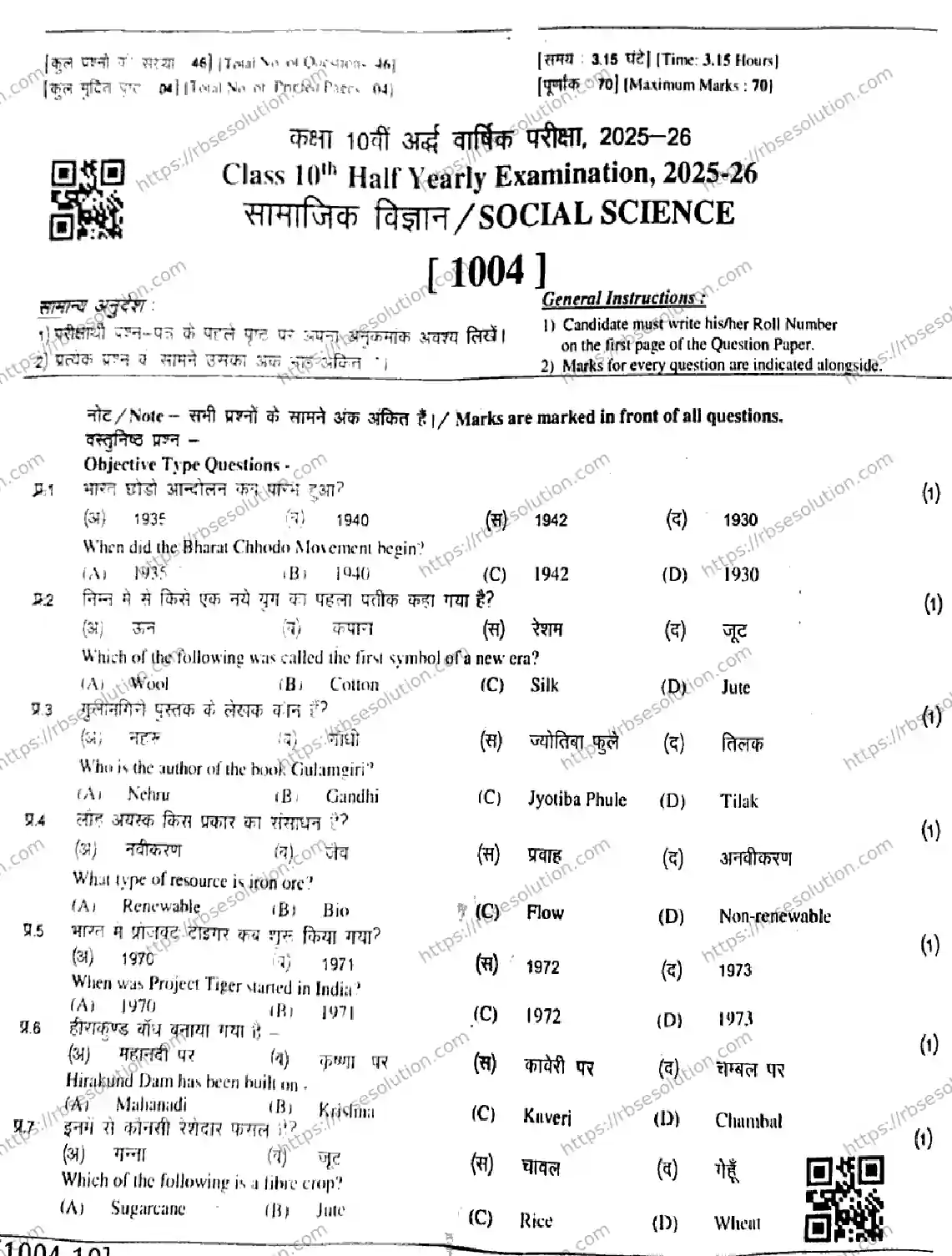
कक्षा 10वीं अर्द्ध वार्षिक परीक्षा, 2025-26
Class 10th Half Yearly Examination, 2025-26
सामाजिक विज्ञान / SOCIAL SCIENCE [1004]
समय: 3.45 घंटे (Time: 3.45 Hours) | पूर्णांक: 70 (Maximum Marks: 70)
कुल प्रश्नों की संख्या: 46 (Total No. of Questions: 46) | कुल मुद्रित पृष्ठ: 04 (Total No. of Printed Pages: 04)
सामान्य निर्देश / General Instructions:
- परीक्षार्थी प्रश्न पत्र के प्रथम पृष्ठ पर अपना अनुक्रमांक अवश्य लिखें। (Candidate must write his/her Roll Number on the first page of the Question Paper.)
- प्रत्येक प्रश्न के सामने अंक अंकित हैं। (Marks for every question are indicated alongside.)
नोट / Note: सभी प्रश्नों के सामने अंक अंकित हैं। (Marks are marked in front of all questions.)
खण्ड - अ / Section - A
वस्तुनिष्ठ प्रश्न / Objective Type Questions
प्रश्न 1. भारत छोड़ो आन्दोलन कब शुरू हुआ? (1)
(A) 1935 (B) 1940 (C) 1942 (D) 1930
When did the Bharat Chhodo Movement begin?
- (A) 1935
- (B) 1940
- (C) 1942
- (D) 1930
व्याख्या: भारत छोड़ो आन्दोलन 8 अगस्त 1942 को महात्मा गांधी के नेतृत्व में शुरू हुआ था।
प्रश्न 2. निम्न में से किसे एक नये युग का पहला प्रतीक कहा गया है? (1)
(A) ऊन (B) कपास (C) रेशम (D) जूट
Which of the following was called the first symbol of a new era?
- (A) Wool
- (B) Cotton
- (C) Silk
- (D) Jute
व्याख्या: कपास को औद्योगिक क्रांति के नए युग का पहला प्रतीक माना जाता है, क्योंकि इसने वस्त्र उद्योग में क्रांति ला दी।
प्रश्न 3. 'गुलामगिरी' पुस्तक के लेखक कौन हैं? (1)
(A) नेहरू (B) गांधी (C) ज्योतिबा फुले (D) तिलक
Who is the author of the book Gulamgiri?
- (A) Nehru
- (B) Gandhi
- (C) Jyotiba Phule
- (D) Tilak
व्याख्या: 'गुलामगिरी' पुस्तक ज्योतिबा फुले द्वारा लिखी गई थी, जिसमें उन्होंने जाति व्यवस्था और सामाजिक अन्याय की आलोचना की।
प्रश्न 4. लौह अयस्क किस प्रकार का संसाधन है? (1)
(A) नवीकरणीय (B) जैव (C) प्रवाह (D) अनवीकरणीय
What type of resource is iron ore?
- (A) Renewable
- (B) Bio
- (C) Flow
- (D) Non-renewable
व्याख्या: लौह अयस्क एक अनवीकरणीय संसाधन है क्योंकि इसका निर्माण लाखों वर्षों में होता है और एक बार उपयोग करने के बाद यह समाप्त हो जाता है।
प्रश्न 5. भारत में प्रोजेक्ट टाइगर कब शुरू किया गया? (1)
(A) 1970 (B) 1971 (C) 1972 (D) 1973
When was Project Tiger started in India?
- (A) 1970
- (B) 1971
- (C) 1972
- (D) 1973
व्याख्या: प्रोजेक्ट टाइगर 1 अप्रैल 1973 को भारत में बाघों के संरक्षण के लिए शुरू किया गया था।
प्रश्न 6. हीराकुंड बाँध किस नदी पर बनाया गया है? (1)
(A) महानदी पर (B) गोदावरी पर (C) कावेरी पर (D) चम्बल पर
Hirakund Dam has been built on which river?
- (A) Mahanadi
- (B) Godavari
- (C) Kaveri
- (D) Chambal
व्याख्या: हीराकुंड बाँध ओडिशा में महानदी नदी पर बनाया गया है, जो भारत के सबसे लंबे बाँधों में से एक है।
प्रश्न 7. निम्नलिखित में से कौन सी एक नकदी फसल है? (1)
(A) गन्ना (B) जूट (C) चावल (D) गेहूँ
Which of the following is a cash crop?
- (A) Sugarcane
- (B) Jute
- (C) Rice
- (D) Wheat
व्याख्या: गन्ना एक नकदी फसल है क्योंकि इसका उपयोग चीनी और गुड़ बनाने के लिए किया जाता है और यह किसानों को आर्थिक लाभ देती है।
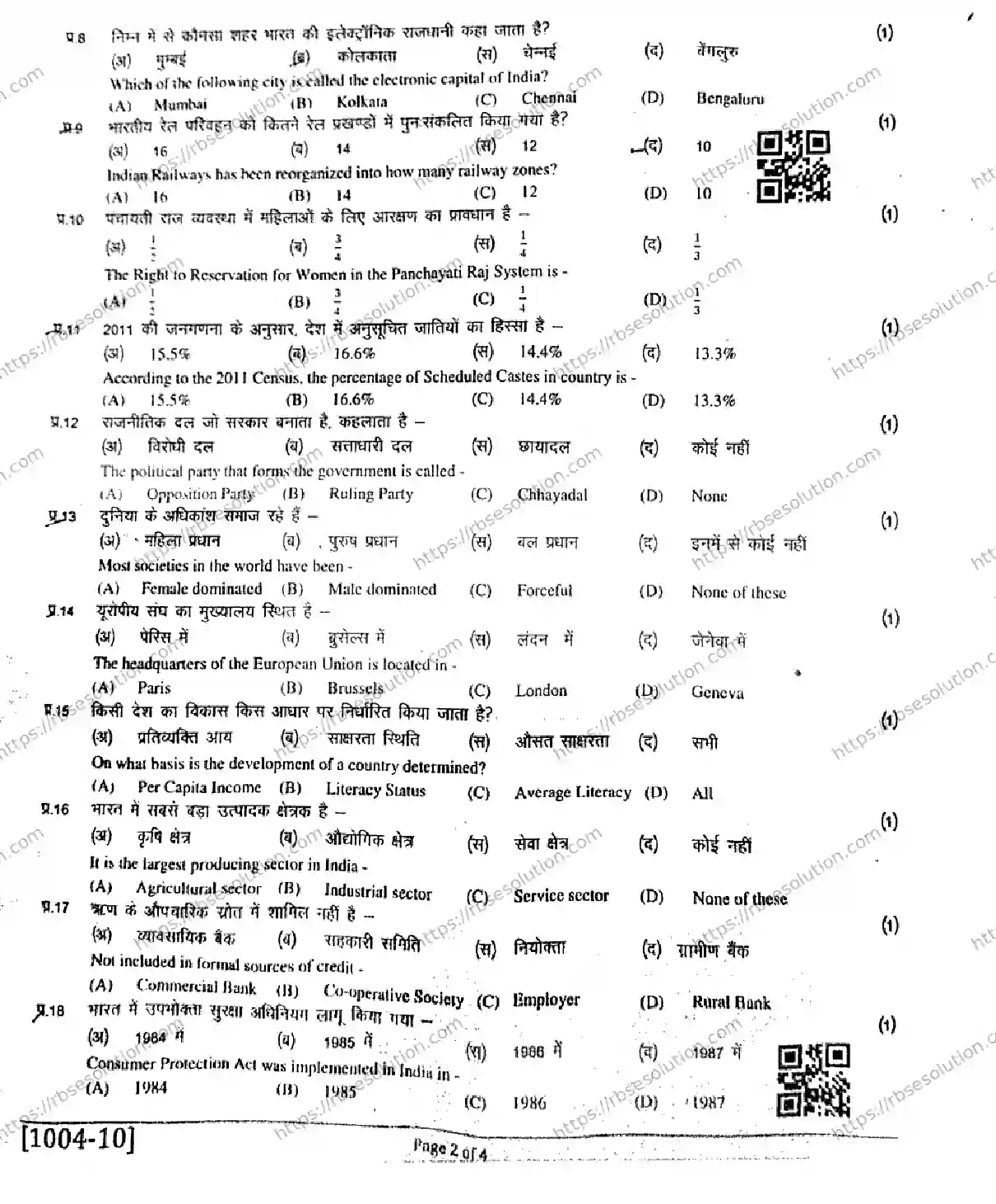
निम्न में से कौनसा शहर भारत की इलेक्ट्रॉनिक राजधानी कहा जाता है?
- (अ) मुंबई
- (ब) कोलकाता
- (स) चेन्नई
- (द) बेंगलुरु
बेंगलुरु को भारत की इलेक्ट्रॉनिक राजधानी कहा जाता है क्योंकि यहाँ अनेक इलेक्ट्रॉनिक्स और सूचना प्रौद्योगिकी कंपनियाँ स्थित हैं।
भारतीय रेलवे को कितने रेल प्रखण्डों में पुनर्गठित किया गया है?
- (अ) 6
- (ब) 17
- (स) 8
- (द) 10
भारतीय रेलवे को 17 रेल प्रखण्डों (ज़ोन) में पुनर्गठित किया गया है।
पंचायती राज व्यवस्था में महिलाओं के लिए आरक्षण का प्रावधान है -
- (अ) 1/2
- (ब) 1/3
- (स) 1/4
- (द) 1/5
पंचायती राज व्यवस्था में महिलाओं के लिए एक-तिहाई (1/3) सीटें आरक्षित हैं।
2011 की जनगणना के अनुसार, देश में अनुसूचित जातियों का हिस्सा है -
- (अ) 5.5%
- (ब) 16.6%
- (स) 4.4%
- (द) 3.3%
2011 की जनगणना के अनुसार, अनुसूचित जातियों की जनसंख्या देश की कुल जनसंख्या का 16.6% है।
जो राजनीतिक दल सरकार बनाता है, कहलाता है -
- (अ) विरोधी दल
- (ब) सत्ताधारी दल
- (स) छायादल
- (द) कोई नहीं
सरकार बनाने वाला दल सत्ताधारी दल कहलाता है।
दुनिया के अधिकांश समाज रहे हैं -
- (अ) महिला प्रधान
- (ब) पुरुष प्रधान
- (स) बल प्रधान
- (द) इनमें से कोई नहीं
अधिकांश समाज पुरुष प्रधान रहे हैं, जहाँ पुरुषों का प्रभुत्व अधिक रहा है।
यूरोपीय संघ का मुख्यालय स्थित है -
- (अ) पेरिस में
- (ब) ब्रुसेल्स में
- (स) लंदन में
- (द) जिनेवा में
यूरोपीय संघ का मुख्यालय बेल्जियम के ब्रुसेल्स शहर में स्थित है।
किसी देश का विकास किस आधार पर निर्धारित किया जाता है?
- (अ) प्रतिव्यक्ति आय
- (ब) साक्षरता स्थिति
- (स) औसत साक्षरता
- (द) सभी
किसी देश का विकास प्रतिव्यक्ति आय, साक्षरता दर और औसत साक्षरता जैसे कई आधारों पर निर्धारित किया जाता है।
भारत में सबसे बड़ा उत्पादक क्षेत्रक है -
- (अ) कृषि क्षेत्र
- (ब) औद्योगिक क्षेत्र
- (स) सेवा क्षेत्र
- (द) कोई नहीं
भारत में सेवा क्षेत्र सबसे बड़ा उत्पादक क्षेत्र है, जो सकल घरेलू उत्पाद में सबसे अधिक योगदान देता है।
ऋण के औपचारिक स्रोत में शामिल नहीं है -
- (अ) व्यावसायिक बैंक
- (ब) सहकारी समिति
- (स) नियोक्ता
- (द) ग्रामीण बैंक
नियोक्ता ऋण का औपचारिक स्रोत नहीं है; औपचारिक स्रोतों में बैंक और सहकारी समितियाँ शामिल हैं।
भारत में उपभोक्ता सुरक्षा अधिनियम लागू किया गया -
- (अ) 1968 में
- (ब) 1986 में
- (स) 1985 में
- (द) 1990 में
उपभोक्ता सुरक्षा अधिनियम भारत में 1986 में लागू किया गया था।
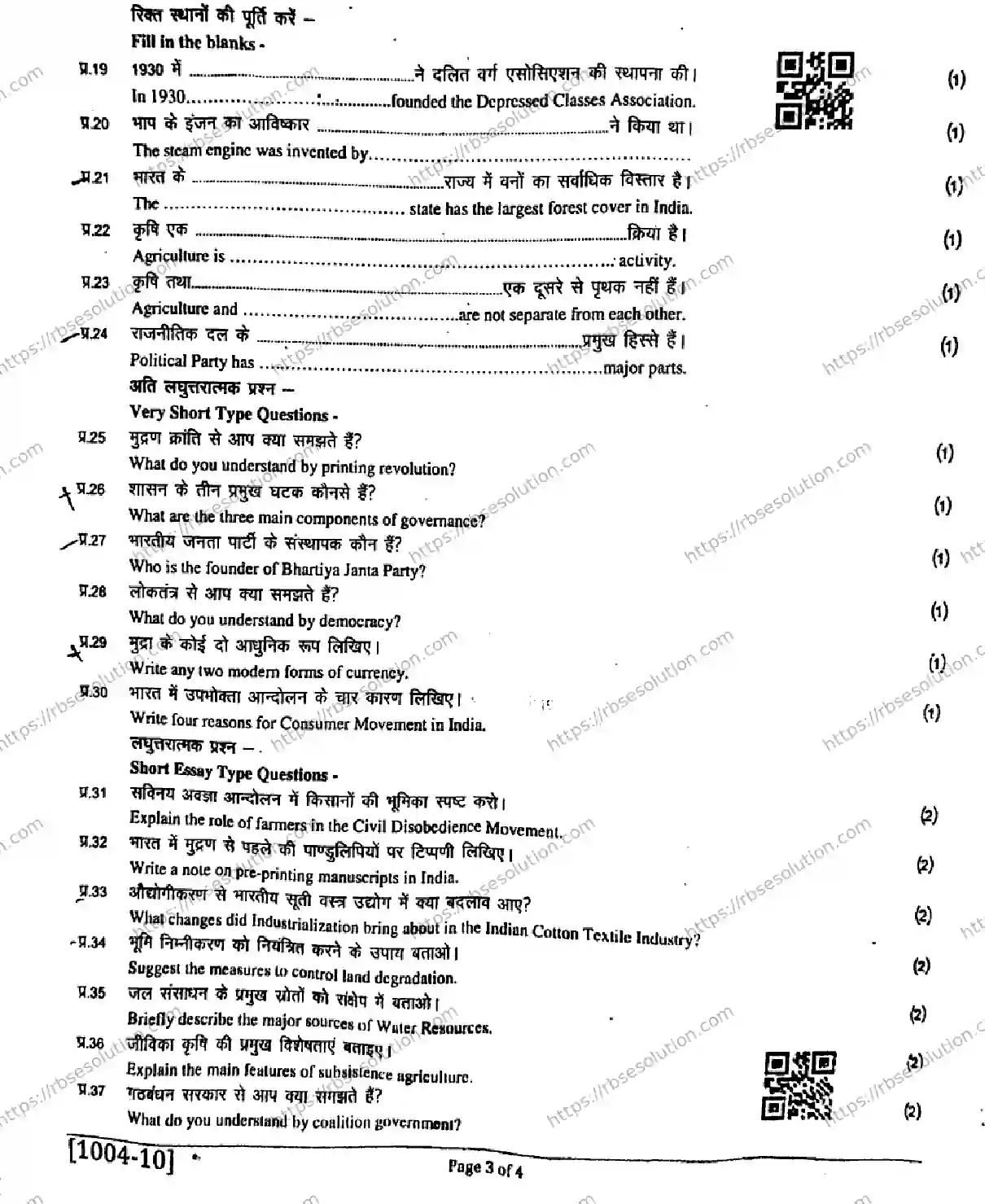
रिक्त स्थानों की पूर्ति करें -
Fill in the blanks -
- 1930 में डॉ. भीमराव अंबेडकर ने दलित वर्ग एसोसिएशन की स्थापना की।
In 1930, Dr. B. R. Ambedkar founded the Depressed Classes Association. - भाप के इंजन का आविष्कार जेम्स वॉट ने किया।
The steam engine was invented by James Watt. - मध्य प्रदेश भारत के राज्य में वनों का सर्वाधिक विस्तार है।
The Madhya Pradesh state has the largest forest cover in India. - कृषि एक प्राथमिक क्रिया है।
Agriculture is a primary activity. - कृषि और पशुपालन एक-दूसरे से अलग नहीं हैं।
Agriculture and animal husbandry are not separate from each other. - राजनीतिक दल के तीन प्रमुख हिस्से हैं।
Political Party has three major parts.
अति लघुत्तरात्मक प्रश्न -
Very Short Type Questions -
-
प्रश्न: मुद्रण क्रांति से आप क्या समझते हैं?
What do you understand by printing revolution?उत्तर: मुद्रण क्रांति से तात्पर्य 15वीं शताब्दी में जोहान्स गुटेनबर्ग द्वारा प्रिंटिंग प्रेस के आविष्कार से शुरू हुई उस क्रांति से है, जिसने पुस्तकों और ज्ञान को सस्ता, सुलभ और व्यापक बना दिया। इससे साक्षरता बढ़ी, विचारों का तेजी से प्रसार हुआ और सामाजिक-धार्मिक सुधारों को बढ़ावा मिला।
Answer: The printing revolution refers to the revolution that began with the invention of the printing press by Johannes Gutenberg in the 15th century, which made books and knowledge cheap, accessible, and widespread. It increased literacy, accelerated the spread of ideas, and promoted socio-religious reforms.
-
प्रश्न: शासन के तीन प्रमुख घटक कौनसे हैं?
What are the three main components of governance?उत्तर: शासन के तीन प्रमुख घटक हैं: (1) विधायिका (कानून बनाने वाली संस्था), (2) कार्यपालिका (कानूनों को लागू करने वाली संस्था), और (3) न्यायपालिका (कानूनों की व्याख्या और न्याय करने वाली संस्था)।
Answer: The three main components of governance are: (1) Legislature (law-making body), (2) Executive (law-enforcing body), and (3) Judiciary (law-interpreting and adjudicating body).
-
प्रश्न: भारतीय जनता पार्टी के संस्थापक कौन हैं?
Who is the founder of Bhartiya Janta Party?उत्तर: भारतीय जनता पार्टी (भाजपा) के संस्थापक अटल बिहारी वाजपेयी और लालकृष्ण आडवाणी हैं। इसका गठन 1980 में भारतीय जनसंघ के उत्तराधिकारी के रूप में हुआ था।
Answer: The founders of the Bharatiya Janata Party (BJP) are Atal Bihari Vajpayee and Lal Krishna Advani. It was formed in 1980 as the successor of the Bharatiya Jana Sangh.
-
प्रश्न: लोकतंत्र से आप क्या समझते हैं?
What do you understand by democracy?उत्तर: लोकतंत्र शासन की वह प्रणाली है जिसमें जनता स्वयं या अपने निर्वाचित प्रतिनिधियों के माध्यम से शासन करती है। यह जनता की इच्छा पर आधारित होता है, जहाँ सभी नागरिकों को समान राजनीतिक अधिकार प्राप्त होते हैं और वे चुनावों के माध्यम से सरकार बनाते हैं।
Answer: Democracy is a system of governance in which the people rule either directly or through their elected representatives. It is based on the will of the people, where all citizens have equal political rights and form the government through elections.
-
प्रश्न: मुद्रा के कोई दो आधुनिक रूप लिखिए।
Write any two modern forms of currency.उत्तर: मुद्रा के दो आधुनिक रूप हैं: (1) प्लास्टिक मनी (जैसे क्रेडिट कार्ड, डेबिट कार्ड), और (2) डिजिटल मनी (जैसे ऑनलाइन बैंकिंग, मोबाइल वॉलेट, क्रिप्टोकरेंसी)।
Answer: Two modern forms of currency are: (1) Plastic money (e.g., credit cards, debit cards), and (2) Digital money (e.g., online banking, mobile wallets, cryptocurrency).
-
प्रश्न: भारत में उपभोक्ता आन्दोलन के चार कारण लिखिए।
Write four reasons for Consumer Movement in India.उत्तर: भारत में उपभोक्ता आन्दोलन के चार प्रमुख कारण हैं: (1) उपभोक्ताओं का शोषण (जैसे मिलावट, अधिक मूल्य), (2) जागरूकता की कमी, (3) बाजार में अनियमितताएँ, और (4) उपभोक्ता संरक्षण कानूनों की आवश्यकता।
Answer: Four reasons for the Consumer Movement in India are: (1) Exploitation of consumers (e.g., adulteration, overpricing), (2) Lack of awareness, (3) Market irregularities, and (4) Need for consumer protection laws.
लघुत्तरात्मक प्रश्न -
Short Essay Type Questions -
-
प्रश्न: सविनय अवज्ञा आन्दोलन में किसानों की भूमिका स्पष्ट करो।
Explain the role of farmers in the Civil Disobedience Movement.उत्तर: सविनय अवज्ञा आन्दोलन (1930-34) में किसानों ने महत्वपूर्ण भूमिका निभाई। वे लगान और करों के बोझ से दबे हुए थे। उन्होंने नमक कानून तोड़ने, लगान न देने, और सरकारी नियमों का उल्लंघन करने में भाग लिया। किसानों ने गाँवों में प्रचार किया, जुलूस निकाले, और जेल गए। उनके समर्थन ने आन्दोलन को व्यापक जनाधार दिया और ब्रिटिश सरकार पर दबाव बढ़ाया।
Answer: Farmers played a crucial role in the Civil Disobedience Movement (1930-34). They were burdened by high rents and taxes. They participated in breaking the salt law, refusing to pay rent, and violating government rules. Farmers carried out propaganda in villages, took out processions, and went to jail. Their support gave the movement a broad mass base and increased pressure on the British government.
-
प्रश्न: भारत में मुद्रण से पहले की पाण्डुलिपियों पर टिप्पणी लिखिए।
Write a note on pre-printing manuscripts in India.उत्तर: मुद्रण से पहले भारत में पाण्डुलिपियाँ ही ज्ञान का मुख्य माध्यम थीं। ये हस्तलिखित पुस्तकें ताड़पत्र, भोजपत्र, या कागज पर लिखी जाती थीं। इनमें धार्मिक ग्रंथ, काव्य, चिकित्सा, ज्योतिष, और दर्शन जैसे विषय होते थे। ये पाण्डुलिपियाँ महँगी और दुर्लभ थीं, केवल अमीर लोगों या मठों तक ही सीमित थीं। इनकी नकल करना समय लेने वाला काम था, जिससे ज्ञान का प्रसार धीमा था।
Answer: Before printing, manuscripts were the main medium of knowledge in India. These handwritten books were written on palm leaves, birch bark, or paper. They contained subjects like religious texts, poetry, medicine, astrology, and philosophy. These manuscripts were expensive and rare, limited to the rich or monasteries. Copying them was time-consuming, which slowed the spread of knowledge.
-
प्रश्न: औद्योगीकरण से भारतीय सूती वस्त्र उद्योग में क्या बदलाव आए?
What changes did Industrialization bring about in the Indian Cotton Textile Industry?उत्तर: औद्योगीकरण ने भारतीय सूती वस्त्र उद्योग में कई बदलाव लाए: (1) हाथ से बुनाई की जगह मशीनों ने ले ली, जिससे उत्पादन तेज और सस्ता हुआ। (2) कारखाने स्थापित हुए, जैसे मुंबई और अहमदाबाद में। (3) ब्रिटिश नीतियों के कारण भारतीय हथकरघा उद्योग को भारी नुकसान हुआ, क्योंकि सस्ते ब्रिटिश कपड़े बाजार में भर गए। (4) भारतीय मिल मालिकों ने प्रतिस्पर्धा की, लेकिन कच्चे माल और बाजार पर नियंत्रण ब्रिटिशों के पास रहा।
Answer: Industrialization brought several changes to the Indian cotton textile industry: (1) Machines replaced hand weaving, making production faster and cheaper. (2) Factories were established, such as in Mumbai and Ahmedabad. (3) Due to British policies, the Indian handloom industry suffered heavy losses as cheap British cloth flooded the market. (4) Indian mill owners competed, but control over raw materials and markets remained with the British.
-
प्रश्न: भूमि निम्नीकरण को नियंत्रित करने के उपाय बताओ।
Suggest the measures to control land degradation.उत्तर: भूमि निम्नीकरण को नियंत्रित करने के उपाय: (1) वृक्षारोपण और वन संरक्षण, (2) मृदा संरक्षण के तरीके जैसे समोच्च जुताई, पट्टी कृषि, और मल्चिंग, (3) रासायनिक उर्वरकों के बजाय जैविक खाद का उपयोग, (4) अत्यधिक चराई पर नियंत्रण, और (5) सिंचाई के उचित तरीके अपनाना (जैसे ड्रिप सिंचाई) ताकि जलभराव और लवणता न हो।
Answer: Measures to control land degradation: (1) Afforestation and forest conservation, (2) Soil conservation methods like contour ploughing, strip cropping, and mulching, (3) Use of organic manure instead of chemical fertilizers, (4) Controlling overgrazing, and (5) Adopting proper irrigation methods (e.g., drip irrigation) to prevent waterlogging and salinity.
-
प्रश्न: जल संसाधन के प्रमुख स्रोतों को संक्षेप में बताओ।
Briefly describe the major sources of Water Resources.उत्तर: जल संसाधन के प्रमुख स्रोत हैं: (1) सतही जल - नदियाँ, झीलें, तालाब, और नहरें, (2) भूजल - कुओं, ट्यूबवेलों और झरनों से प्राप्त पानी, (3) वर्षा जल - बारिश का पानी जिसे संग्रहित किया जा सकता है, और (4) हिमनद - पहाड़ों पर जमी
Section B: Short Answer Questions
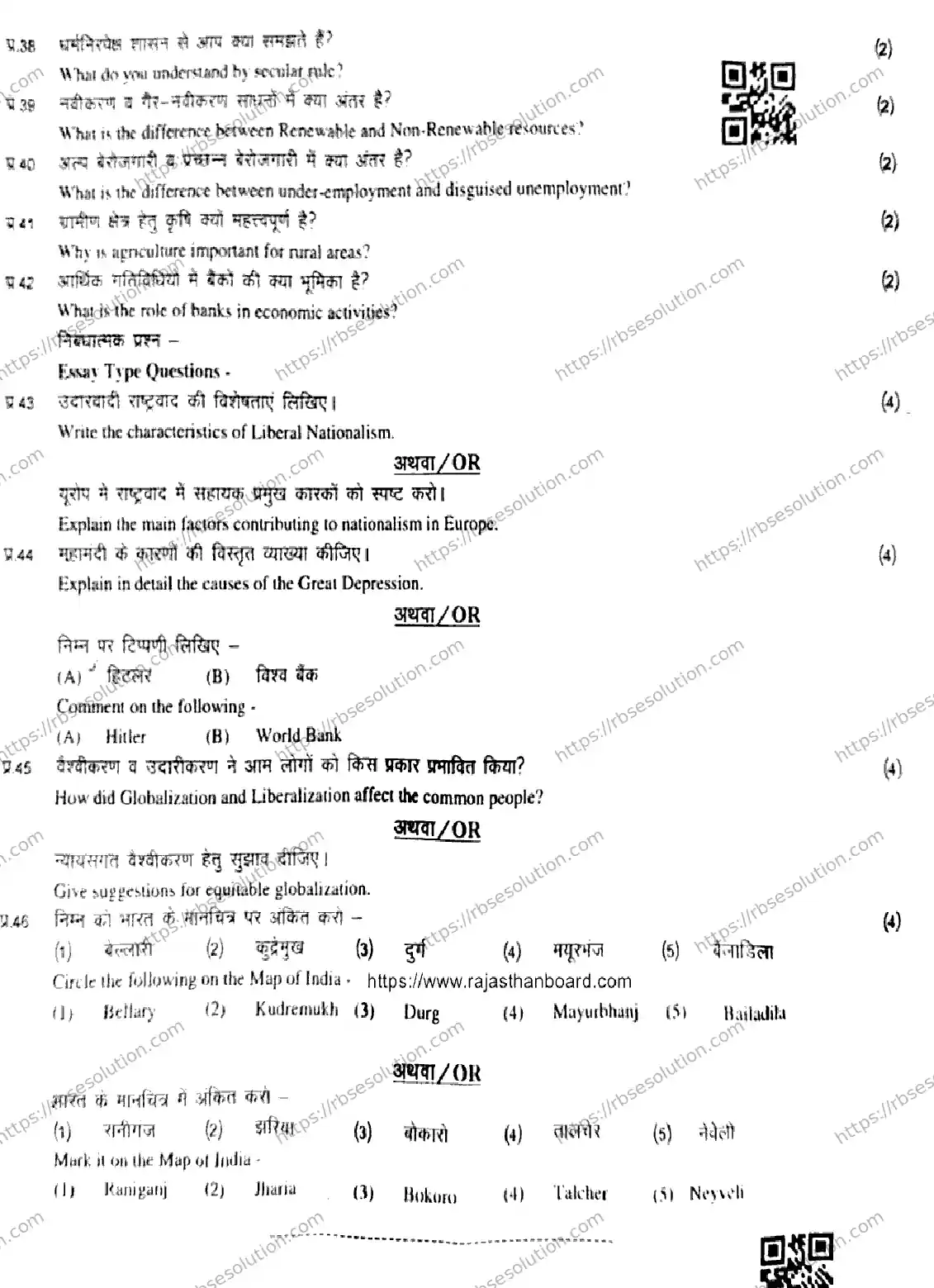
1. What do you understand by secular state? (2)
A secular state is one that does not officially promote any particular religion and treats all religions equally. It ensures freedom of religion for all citizens and maintains a separation between religious institutions and the state's political and legal systems.
2. What is the difference between Renewable and Non-Renewable resources? (2)
Renewable resources are those that can be replenished naturally over time, such as solar energy, wind, and water. Non-renewable resources are finite and cannot be replaced once used, such as coal, petroleum, and natural gas.
3. What is the difference between under-employment and disguised unemployment? (2)
Under-employment refers to a situation where a person works but at a job that does not fully utilize their skills or qualifications. Disguised unemployment occurs when more people are employed than actually needed, such as in agriculture where removing some workers does not reduce output.
4. Why is agriculture important for rural areas? (2)
Agriculture is important for rural areas because it provides livelihood to a majority of the population, ensures food security, supports allied activities like animal husbandry, and contributes to the local economy through trade and employment.
5. What is the role of banks in economic activities? (2)
Banks play a crucial role in economic activities by accepting deposits from savers and providing loans to borrowers. They facilitate transactions, promote savings, and channel funds to productive sectors like agriculture, industry, and trade, thereby supporting economic growth.
Section C: Essay Type Questions
6. Write the characteristics of Liberal Nationalism. (4)
Liberal nationalism emerged in the 19th century and emphasized individual freedom, equality, and national self-determination. Its key characteristics include:
- Belief in the sovereignty of the nation-state based on popular consent.
- Advocacy for constitutional government and civil liberties.
- Support for free trade and economic integration among nations.
- Emphasis on cultural unity and shared history as the basis of national identity.
- Rejection of absolute monarchy and feudal privileges.
OR
Explain the main factors contributing to nationalism in Europe. (4)
The main factors contributing to nationalism in Europe include:
- French Revolution: Spread ideas of liberty, equality, and fraternity, inspiring national consciousness.
- Industrial Revolution: Created economic interdependence and a middle class that sought political representation.
- Romanticism: Emphasized folk culture, language, and history, fostering national pride.
- Napoleonic Wars: Unified people against foreign domination and spread nationalist ideas.
- Liberal movements: Demanded constitutional reforms and national unification.
7. Explain in detail the causes of the Great Depression. (4)
The Great Depression (1929-1939) was caused by multiple factors:
- Stock Market Crash of 1929: Over-speculation led to a collapse in share prices, wiping out investments.
- Bank Failures: Many banks closed due to bad loans and panic withdrawals, reducing money supply.
- Reduced Purchasing Power: Falling wages and unemployment decreased consumer demand.
- Protectionist Policies: Countries imposed high tariffs, reducing international trade.
- Agricultural Overproduction: Farmers produced more than demand, causing prices to fall and rural distress.
- Gold Standard: Rigid monetary policies limited government response to the crisis.
OR
Comment on the following: (A) Hitler (B) World Bank (4)
(A) Hitler: Adolf Hitler was the leader of Nazi Germany who rose to power in 1933. He promoted aggressive nationalism, anti-Semitism, and expansionist policies that led to World War II and the Holocaust. His regime caused immense destruction and loss of life.
(B) World Bank: The World Bank is an international financial institution established in 1944 to provide loans and grants to developing countries for infrastructure, education, and poverty reduction projects. It aims to promote economic development and reduce global inequality.
8. How did Globalization and Liberalization affect the common people? (3)
Globalization and liberalization had mixed effects on common people:
- Positive effects: Increased access to a variety of goods and services, more job opportunities in IT and services, and exposure to global culture.
- Negative effects: Small farmers and local industries faced competition from imports, leading to job losses. Inequality widened as benefits concentrated among the wealthy. Traditional livelihoods were disrupted.
OR
Give suggestions for equitable globalization. (3)
Suggestions for equitable globalization include:
- Ensuring fair trade practices that protect small producers.
- Strengthening social safety nets for workers affected by global competition.
- Promoting technology transfer and skill development in developing countries.
- Regulating multinational corporations to prevent exploitation.
- Encouraging inclusive policies that benefit marginalized communities.
Section D: Map Work
9. Circle the following on the Map of India: (5)
(1) Bailadila (2) Kudremukh (3) Durg (4) Mayurbhanj (5) Bailadila
Note: On a physical map of India, mark the following locations:
- Bailadila: Located in Chhattisgarh, known for iron ore mines.
- Kudremukh: Located in Karnataka, known for iron ore deposits.
- Durg: A city in Chhattisgarh, an industrial center.
- Mayurbhanj: A district in Odisha, known for mineral resources.
- Bailadila: (Repeated) Same as above.
OR
Mark it on the Map of India: (5)
(1) Raniganj (2) Jharia (3) Bokaro (4) Talcher (5) Neyveli
Note: On a physical map of India, mark the following coal mining regions:
- Raniganj: Located in West Bengal, one of the oldest coal fields.
- Jharia: Located in Jharkhand, known for high-quality coal.
- Bokaro: Located in Jharkhand, a major coal and steel hub.
- Talcher: Located in Odisha, a large coal field.
- Neyveli: Located in Tamil Nadu, known for lignite coal.