
RBSE Class 11th 2017 -2017 Previous Year Papers
You opened the RBSE Class 11th 2017 -2017 Previous Year Papers page — a focused place to read the real previous year question paper for that subject and year. RBSE Solution keeps exam-year sets together so you can practise the same cycle your seniors faced.
Previous year papers reward patience: read instructions, note mark distribution, then attempt questions before peeking at solutions elsewhere on the site. This URL always loads the same free previous year papers content for -2017 (2017).
Use the details table to confirm class and year, then scroll to the paper images or PDF below. More subjects from 2017 are linked later on this page.
Paper details
Quick reference for this previous year papers page — confirm board, class, and year & subject before you study.
| Board | RBSE |
|---|---|
| Class | Class 11th |
| Exam year | 2017 |
| Subject | -2017 |
| Resource type | Previous Year Papers |
| Category | RBSE Previous Year Question Papers |
| Website | RBSE Solution |
The table summarises this Previous Year Papers resource. Confirm RBSE, Class 11th, year 2017, and subject -2017 before studying.
RBSE Solution organises previous year papers so each URL carries chapter-specific guidance — better for students and for search engines than one generic paragraph for the whole class.
How to practise with this question paper
Stage one: read the -2017 question paper from 2017 without a timer and highlight command words — explain, prove, calculate, discuss. Stage two: attempt selected questions closed-book. Stage three: compare with solutions or teacher feedback.
Previous Year Papers work best when you log mistakes by topic, not only by question number. That log becomes your revision index before pre-boards.
RBSE Class 11th 2017 -2017
Scroll through the Previous Year Papers pages for -2017 (2017).
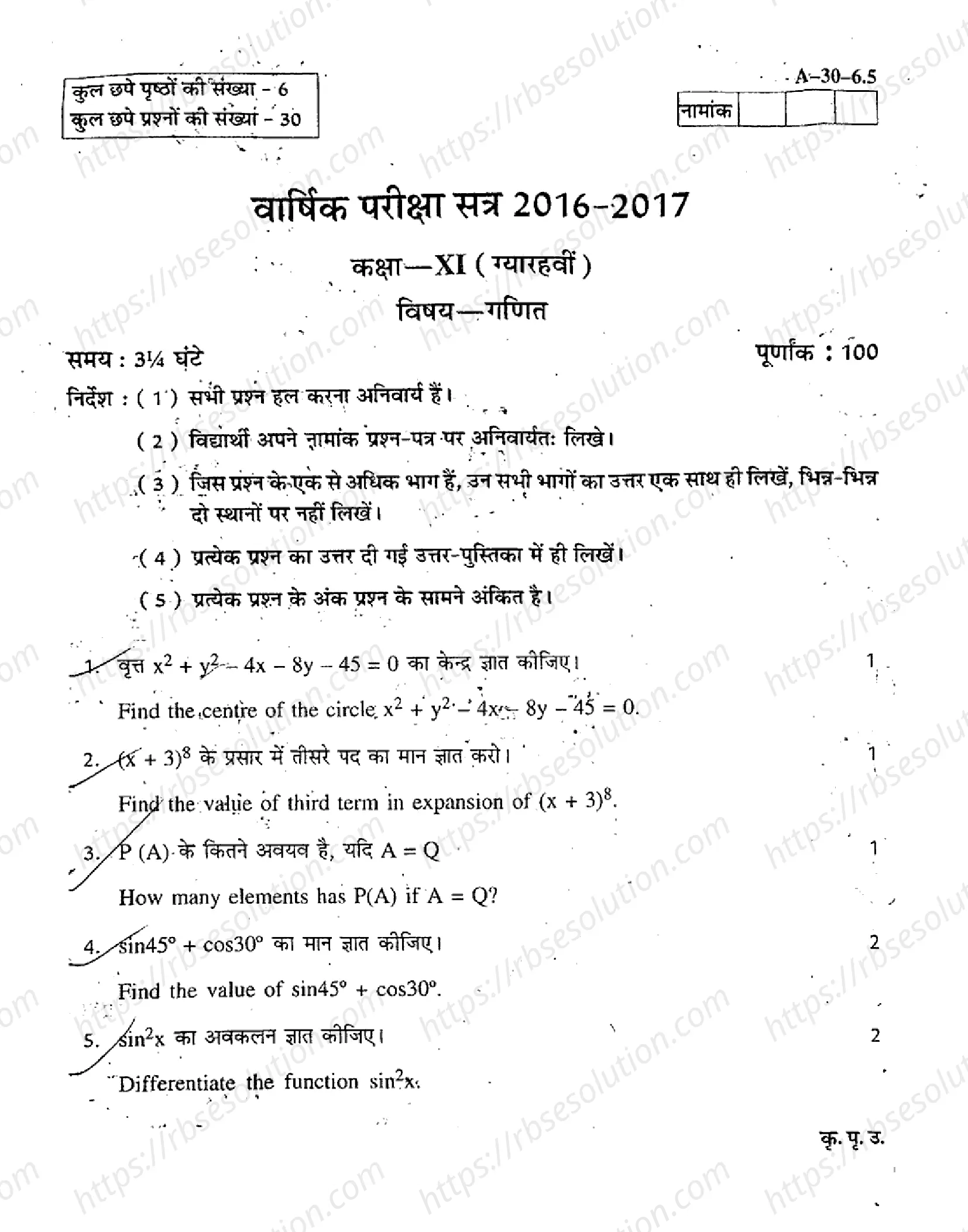


Rajasthan Board Class 11th -2017 2017 solved Previous Year Question Papers
वार्षिक परीक्षा सत्र 2016-2017
कक्षा—XI (ग्यारहवीं)
विषय—गणित
समय: 3¼ घंटे पूर्णांक: 100
निर्देश:
- सभी प्रश्न हल करना अनिवार्य हैं।
- विद्यार्थी अपना अनुक्रमांक प्रश्न-पत्र पर अनिवार्यतः लिखें।
- जिस प्रश्न के एक से अधिक भाग हैं, उन सभी भागों का उत्तर एक साथ ही लिखें, भिन्न-भिन्न दो स्थानों पर नहीं लिखें।
- प्रत्येक प्रश्न का उत्तर दी गई उत्तर-पुस्तिका में ही लिखें।
- प्रत्येक प्रश्न के अंक प्रश्न के सामने अंकित हैं।
प्रश्न 1
वृत्त \(x^2 + y^2 - 4x + 8y - 45 = 0\) का केन्द्र ज्ञात कीजिए।
Find the centre of the circle \(x^2 + y^2 - 4x + 8y - 45 = 0\).
हल: वृत्त के सामान्य समीकरण \(x^2 + y^2 + 2gx + 2fy + c = 0\) से तुलना करने पर,
\(2g = -4 \Rightarrow g = -2\)
\(2f = 8 \Rightarrow f = 4\)
केन्द्र \((-g, -f) = (2, -4)\)
उत्तर: केन्द्र \((2, -4)\) है।
प्रश्न 2
\((x + 3)^5\) के प्रसार में तीसरे पद का मान ज्ञात करो।
Find the value of the third term in the expansion of \((x + 3)^5\).
हल: द्विपद प्रसार \((a + b)^n\) में \((r+1)\)वाँ पद \(T_{r+1} = \binom{n}{r} a^{n-r} b^r\)
यहाँ \(a = x\), \(b = 3\), \(n = 5\)
तीसरे पद के लिए \(r = 2\)
\(T_3 = \binom{5}{2} x^{5-2} (3)^2 = \binom{5}{2} x^3 \cdot 9\)
\(\binom{5}{2} = \frac{5 \times 4}{2 \times 1} = 10\)
\(T_3 = 10 \times 9 \times x^3 = 90x^3\)
उत्तर: तीसरा पद \(90x^3\) है।
प्रश्न 3
P(A) में कितने अवयव हैं, यदि A = ∅?
How many elements has P(A) if A = ∅?
हल: यदि A = ∅ (रिक्त समुच्चय), तो A में अवयवों की संख्या \(n(A) = 0\)
P(A) (घात समुच्चय) में अवयवों की संख्या \(2^{n(A)} = 2^0 = 1\)
P(∅) = {∅}
उत्तर: P(A) में 1 अवयव है।
प्रश्न 4
\(\sin 45^\circ + \cos 30^\circ\) का मान ज्ञात कीजिए।
Find the value of \(\sin 45^\circ + \cos 30^\circ\).
हल: \(\sin 45^\circ = \frac{1}{\sqrt{2}}\) और \(\cos 30^\circ = \frac{\sqrt{3}}{2}\)
\(\sin 45^\circ + \cos 30^\circ = \frac{1}{\sqrt{2}} + \frac{\sqrt{3}}{2}\)
उत्तर: \(\frac{1}{\sqrt{2}} + \frac{\sqrt{3}}{2}\)
प्रश्न 5
फलन \(\sin 2x\) का अवकलन कीजिए।
Differentiate the function \(\sin 2x\).
हल: माना \(y = \sin 2x\)
श्रृंखला नियम (chain rule) से,
\(\frac{dy}{dx} = \cos 2x \cdot \frac{d}{dx}(2x) = \cos 2x \cdot 2 = 2\cos 2x\)
उत्तर: \(\frac{d}{dx}(\sin 2x) = 2\cos 2x\)
प्रश्न 7
निम्नलिखित के प्रसार में मध्य पद ज्ञात कीजिए:
\[ \left( \frac{x}{3} + 7y \right)^7 \]
Find the middle term of expansion: \(\left( \frac{x}{3} + 7y \right)^7\)
Solution: The total number of terms in the expansion is \(n+1 = 7+1 = 8\). Since 8 is even, there are two middle terms: the 4th and 5th terms (i.e., \(T_4\) and \(T_5\)).
General term: \(T_{r+1} = \binom{7}{r} \left(\frac{x}{3}\right)^{7-r} (7y)^r\)
For \(T_4\) (r=3):
\[ T_4 = \binom{7}{3} \left(\frac{x}{3}\right)^{4} (7y)^3 = 35 \cdot \frac{x^4}{81} \cdot 343 y^3 = \frac{35 \times 343}{81} x^4 y^3 = \frac{12005}{81} x^4 y^3 \]
For \(T_5\) (r=4):
\[ T_5 = \binom{7}{4} \left(\frac{x}{3}\right)^{3} (7y)^4 = 35 \cdot \frac{x^3}{27} \cdot 2401 y^4 = \frac{35 \times 2401}{27} x^3 y^4 = \frac{84035}{27} x^3 y^4 \]
Thus, the middle terms are \(\frac{12005}{81} x^4 y^3\) and \(\frac{84035}{27} x^3 y^4\).
प्रश्न 8
सिद्ध कीजिए कि \(\sum_{r=0}^{n} 3^r \cdot {}^nC_r = 4^n\)
Prove that: \(\sum_{r=0}^{n} 3^r \cdot {}^nC_r = 4^n\)
Proof: Using the binomial theorem, \((1+x)^n = \sum_{r=0}^{n} {}^nC_r x^r\).
Put \(x = 3\):
\[ (1+3)^n = \sum_{r=0}^{n} {}^nC_r \cdot 3^r \]
\[ 4^n = \sum_{r=0}^{n} 3^r \cdot {}^nC_r \]
Hence proved.
प्रश्न 9
यदि \(U = \{1, 2, 3, 4, 5, 6, 7, 8, 9\}\), \(A = \{2, 4, 6, 8\}\) और \(B = \{2, 3, 5, 7\}\), तो सत्यापित कीजिए कि \((A \cup B)' = A' \cap B'\)
If \(U = \{1, 2, 3, 4, 5, 6, 7, 8, 9\}\), \(A = \{2, 4, 6, 8\}\) and \(B = \{2, 3, 5, 7\}\), then prove that \((A \cup B)' = A' \cap B'\).
Solution:
First, find \(A \cup B = \{2, 3, 4, 5, 6, 7, 8\}\).
Then, \((A \cup B)' = U - (A \cup B) = \{1, 9\}\).
Now, \(A' = U - A = \{1, 3, 5, 7, 9\}\) and \(B' = U - B = \{1, 4, 6, 8, 9\}\).
So, \(A' \cap B' = \{1, 9\}\).
Since \((A \cup B)' = \{1, 9\}\) and \(A' \cap B' = \{1, 9\}\), we have \((A \cup B)' = A' \cap B'\). Hence verified.
प्रश्न 10
सिद्ध कीजिए: \(\tan 3x \tan 2x \tan x = \tan 3x - \tan 2x - \tan x\)
Prove that: \(\tan 3x \tan 2x \tan x = \tan 3x - \tan 2x - \tan x\)
Proof: We know that \(\tan 3x = \tan(2x + x)\).
Using the formula \(\tan(A+B) = \frac{\tan A + \tan B}{1 - \tan A \tan B}\):
\[ \tan 3x = \frac{\tan 2x + \tan x}{1 - \tan 2x \tan x} \]
Cross-multiplying:
\[ \tan 3x (1 - \tan 2x \tan x) = \tan 2x + \tan x \]
\[ \tan 3x - \tan 3x \tan 2x \tan x = \tan 2x + \tan x \]
Rearranging:
\[ \tan 3x - \tan 2x - \tan x = \tan 3x \tan 2x \tan x \]
Hence proved.
प्रश्न 11
फलब का समीकरण ज्ञात कीजिए जो \(y\)-अक्ष के परित: सममित हो और बिन्दु \((2, -3)\) से गुजरता है।
Find the equation of parabola which is symmetric about the y-axis, and passes through the point (2, -3).
Solution: A parabola symmetric about the y-axis has the equation \(x^2 = 4ay\) or \(x^2 = -4ay\). Since it passes through (2, -3), we substitute \(x=2\) and \(y=-3\).
If the parabola opens downward, the equation is \(x^2 = -4ay\). Substituting:
\[ 2^2 = -4a(-3) \implies 4 = 12a \implies a = \frac{1}{3} \]
Thus, the equation is \(x^2 = -4 \cdot \frac{1}{3} \cdot y\) or \(x^2 = -\frac{4}{3}y\).
Alternatively, if it opens upward, \(x^2 = 4ay\) gives \(4 = 4a(-3) \implies a = -\frac{1}{3}\), which is not valid for a standard parabola. So the correct equation is \(x^2 = -\frac{4}{3}y\).
प्रश्न 12
\(\frac{x^2}{16} + \frac{y^2}{7} = 1\) के नाभि, शीर्ष, उत्केन्द्रता और नाभि लम्ब जीवा की लम्बाई ज्ञात करो।
Find the foci, vertices, eccentricity, and length of latus rectum of the ellipse \(\frac{x^2}{16} + \frac{y^2}{7} = 1\).
Solution: The given ellipse is \(\frac{x^2}{16} + \frac{y^2}{7} = 1\).
Here, \(a^2 = 16\) so \(a = 4\), and \(b^2 = 7\) so \(b = \sqrt{7}\). Since \(a > b\), the major axis is along the x-axis.
Eccentricity: \(e = \sqrt{1 - \frac{b^2}{a^2}} = \sqrt{1 - \frac{7}{16}} = \sqrt{\frac{9}{16}} = \frac{3}{4}\).
Foci: \((\pm ae, 0) = (\pm 4 \cdot \frac{3}{4}, 0) = (\pm 3, 0)\).
Vertices: \((\pm a, 0) = (\pm 4, 0)\).
Length of latus rectum: \(\frac{2b^2}{a} = \frac{2 \times 7}{4} = \frac{14}{4} = \frac{7}{2}\).
Thus, foci: \((\pm 3, 0)\), vertices: \((\pm 4, 0)\), eccentricity: \(\frac{3}{4}\), length of latus rectum: \(\frac{7}{2}\).
प्रश्न 1
दीर्घवृत्त \(\frac{x^2}{25} + \frac{y^2}{9} = 1\) की नाभियों, शीर्षों, उत्केंद्रता और नाभिलंब जीवा की लंबाई ज्ञात कीजिए।
हल: दिए गए दीर्घवृत्त की तुलना \(\frac{x^2}{a^2} + \frac{y^2}{b^2} = 1\) से करने पर, \(a^2 = 25\) और \(b^2 = 9\)। अतः \(a = 5\), \(b = 3\)।
उत्केंद्रता \(e = \sqrt{1 - \frac{b^2}{a^2}} = \sqrt{1 - \frac{9}{25}} = \sqrt{\frac{16}{25}} = \frac{4}{5}\)।
नाभियाँ: \((\pm ae, 0) = (\pm 5 \times \frac{4}{5}, 0) = (\pm 4, 0)\)।
शीर्ष: \((\pm a, 0) = (\pm 5, 0)\)।
नाभिलंब जीवा की लंबाई: \(\frac{2b^2}{a} = \frac{2 \times 9}{5} = \frac{18}{5}\)।
प्रश्न 2
मान ज्ञात कीजिए: \(\lim_{x \to 0} f(x)\) जहाँ \(f(x) = \begin{cases} \frac{|x|}{x}, & x \neq 0 \\ 0, & x = 0 \end{cases}\)
हल: जब \(x \to 0^+\) (दाएँ पक्ष से), \(|x| = x\), तब \(\frac{|x|}{x} = \frac{x}{x} = 1\)।
जब \(x \to 0^-\) (बाएँ पक्ष से), \(|x| = -x\), तब \(\frac{|x|}{x} = \frac{-x}{x} = -1\)।
चूँकि दाएँ पक्ष की सीमा (1) और बाएँ पक्ष की सीमा (-1) समान नहीं हैं, अतः \(\lim_{x \to 0} f(x)\) का अस्तित्व नहीं है।
प्रश्न 3
समांतर श्रेणी के \(n\) पदों का योगफल ज्ञात कीजिए जिसका \(K\)वाँ पद \(5K + 1\) है।
हल: \(K\)वाँ पद \(a_K = 5K + 1\) है।
पहला पद \(a_1 = 5(1) + 1 = 6\)।
दूसरा पद \(a_2 = 5(2) + 1 = 11\)।
सार्व अंतर \(d = a_2 - a_1 = 11 - 6 = 5\)।
\(n\) पदों का योगफल: \(S_n = \frac{n}{2}[2a + (n-1)d] = \frac{n}{2}[2 \times 6 + (n-1)5] = \frac{n}{2}[12 + 5n - 5] = \frac{n}{2}(5n + 7)\)।
अतः अभीष्ट योगफल \(\frac{n(5n+7)}{2}\) है।
प्रश्न 4
सम्मिश्र संख्या \(Z = -\sqrt{3} + i\) का मापांक एवं कोणांक ज्ञात कीजिए।
हल: \(Z = -\sqrt{3} + i\)।
मापांक: \(|Z| = \sqrt{(-\sqrt{3})^2 + (1)^2} = \sqrt{3 + 1} = \sqrt{4} = 2\)।
कोणांक: \(\tan \theta = \frac{1}{-\sqrt{3}} = -\frac{1}{\sqrt{3}}\)।
चूँकि \(x = -\sqrt{3} < 0\) और \(y = 1 > 0\), अतः \(Z\) द्वितीय चतुर्थांश में स्थित है।
इसलिए \(\theta = \pi - \frac{\pi}{6} = \frac{5\pi}{6}\) (या \(150^\circ\))।
अतः मापांक = 2, कोणांक = \(\frac{5\pi}{6}\)।
प्रश्न 5
\(^7C_3 - ^6C_3 + ^5C_3\) का मान ज्ञात कीजिए।
हल: हम जानते हैं कि \(^nC_r = \frac{n!}{r!(n-r)!}\)।
\(^7C_3 = \frac{7!}{3!4!} = \frac{7 \times 6 \times 5}{3 \times 2 \times 1} = 35\)
\(^6C_3 = \frac{6!}{3!3!} = \frac{6 \times 5 \times 4}{3 \times 2 \times 1} = 20\)
\(^5C_3 = \frac{5!}{3!2!} = \frac{5 \times 4}{2 \times 1} = 10\)
अतः \(^7C_3 - ^6C_3 + ^5C_3 = 35 - 20 + 10 = 25\)।
प्रश्न 6
विरोधाभास द्वारा सत्यापित कीजिए कि \(\sqrt{7}\) एक अपरिमेय संख्या है।
हल: मान लीजिए कि \(\sqrt{7}\) एक परिमेय संख्या है। तब इसे \(\frac{p}{q}\) के रूप में लिखा जा सकता है, जहाँ \(p\) और \(q\) सह-अभाज्य पूर्णांक हैं और \(q \neq 0\)।
अतः \(\sqrt{7} = \frac{p}{q}\) ⇒ \(7 = \frac{p^2}{q^2}\) ⇒ \(p^2 = 7q^2\)।
इससे स्पष्ट है कि \(p^2\), 7 से विभाज्य है, अतः \(p\) भी 7 से विभाज्य होगा। माना \(p = 7m\)।
तब \((7m)^2 = 7q^2\) ⇒ \(49m^2 = 7q^2\) ⇒ \(q^2 = 7m^2\)।
इससे \(q^2\) भी 7 से विभाज्य है, अतः \(q\) भी 7 से विभाज्य होगा।
इस प्रकार \(p\) और \(q\) दोनों 7 से विभाज्य हैं, जो हमारी प्रारंभिक कल्पना (सह-अभाज्य) के विरुद्ध है। अतः \(\sqrt{7}\) परिमेय नहीं है, बल्कि अपरिमेय है।
प्रश्न 7
किसी अचर वास्तविक संख्या \(a\) के लिए \(x^n + ax^{n-1} + a^2 x^{n-2} + \ldots + a^{n-1}x + a^n\) का अवकलज ज्ञात कीजिए।
हल: माना \(f(x) = x^n + ax^{n-1} + a^2 x^{n-2} + \ldots + a^{n-1}x + a^n\)।
प्रत्येक पद का \(x\) के सापेक्ष अवकलज ज्ञात करने पर:
\(\frac{d}{dx}(x^n) = nx^{n-1}\)
\(\frac{d}{dx}(ax^{n-1}) = a(n-1)x^{n-2}\)
\(\frac{d}{dx}(a^2 x^{n-2}) = a^2 (n-2)x^{n-3}\)
इसी प्रकार, \(\frac{d}{dx}(a^{n-1}x) = a^{n-1}\)
तथा \(\frac{d}{dx}(a^n) = 0\) (क्योंकि \(a^n\) अचर है)।
अतः अभीष्ट अवकलज:
\(f'(x) = nx^{n-1} + a(n-1)x^{n-2} + a^2 (n-2)x^{n-3} + \ldots + a^{n-1}\)।
प्रश्न 18
एक विद्यालय में 20 अध्यापक हैं जो गणित या भौतिकी पढ़ाते हैं। इनमें से 12 गणित पढ़ाते हैं और 4 भौतिकी और गणित दोनों पढ़ाते हैं। कितने अध्यापक भौतिकी पढ़ाते हैं?
In a school there are 20 teachers who teach mathematics or physics. Of these, 12 teach mathematics and 4 teach both physics and mathematics. How many teach physics?
हल:
माना कि गणित पढ़ाने वाले अध्यापकों का समुच्चय M है और भौतिकी पढ़ाने वाले अध्यापकों का समुच्चय P है।
दिया है: n(M ∪ P) = 20, n(M) = 12, n(M ∩ P) = 4
सूत्र: n(M ∪ P) = n(M) + n(P) – n(M ∩ P)
⇒ 20 = 12 + n(P) – 4
⇒ 20 = 8 + n(P)
⇒ n(P) = 20 – 8 = 12
अतः भौतिकी पढ़ाने वाले अध्यापकों की संख्या = 12
प्रश्न 19
सभी n ∈ N के लिए गणितीय आगमन से सिद्ध कीजिए कि:
1/(1·2) + 1/(2·3) + 1/(3·4) + ... + 1/[n(n+1)] = n/(n+1)
For all n ∈ N, prove that by principle of mathematical induction:
1/(1·2) + 1/(2·3) + 1/(3·4) + ... + 1/[n(n+1)] = n/(n+1)
हल:
चरण 1: आधार स्थिति (n = 1)
बायाँ पक्ष = 1/(1·2) = 1/2
दायाँ पक्ष = 1/(1+1) = 1/2
अतः n = 1 के लिए कथन सत्य है।
चरण 2: आगमन परिकल्पना
माना कि n = k के लिए कथन सत्य है, अर्थात:
1/(1·2) + 1/(2·3) + ... + 1/[k(k+1)] = k/(k+1)
चरण 3: n = k+1 के लिए सिद्ध करना
बायाँ पक्ष = [1/(1·2) + 1/(2·3) + ... + 1/[k(k+1)]] + 1/[(k+1)(k+2)]
= k/(k+1) + 1/[(k+1)(k+2)]
= [k(k+2) + 1] / [(k+1)(k+2)]
= [k² + 2k + 1] / [(k+1)(k+2)]
= (k+1)² / [(k+1)(k+2)]
= (k+1)/(k+2)
= (k+1)/[(k+1)+1] = दायाँ पक्ष
अतः n = k+1 के लिए भी कथन सत्य है।
गणितीय आगमन सिद्धांत से, सभी n ∈ N के लिए कथन सत्य है।
प्रश्न 20
यदि x + iy = (a + ib)/(a – ib), तो सिद्ध कीजिए कि x² + y² = 1
If x + iy = (a + ib)/(a – ib), prove that x² + y² = 1
हल:
दिया है: x + iy = (a + ib)/(a – ib)
दोनों पक्षों का मापांक लेने पर:
|x + iy| = |(a + ib)/(a – ib)|
⇒ √(x² + y²) = |a + ib| / |a – ib|
⇒ √(x² + y²) = √(a² + b²) / √(a² + b²)
⇒ √(x² + y²) = 1
⇒ x² + y² = 1
इति सिद्धम्
प्रश्न 21
EQUATION शब्द के अक्षरों से बनने वाले क्रमचयों की संख्या ज्ञात कीजिए।
Find the permutations of the letter of the word EQUATION.
हल:
EQUATION शब्द में कुल 8 अक्षर हैं: E, Q, U, A, T, I, O, N
सभी अक्षर भिन्न-भिन्न हैं।
अतः क्रमचयों की संख्या = 8! = 8 × 7 × 6 × 5 × 4 × 3 × 2 × 1 = 40320
अतः EQUATION शब्द के अक्षरों से 40320 क्रमचय बनाए जा सकते हैं।
प्रश्न 22
एक गुणोत्तर श्रेणी का प्रथम पद a = 729 तथा 7वां पद 64 है तो S₇ ज्ञात कीजिए।
Given a G.P. with a = 729 and 7th term 64, determine S₇.
हल:
दिया है: प्रथम पद a = 729, 7वां पद = 64
गुणोत्तर श्रेणी का nवां पद: aₙ = arⁿ⁻¹
⇒ a₇ = ar⁶ = 64
⇒ 729 × r⁶ = 64
⇒ r⁶ = 64/729 = (2⁶)/(3⁶) = (2/3)⁶
⇒ r = 2/3
अब, S₇ = a(1 – r⁷)/(1 – r) = 729[1 – (2/3)⁷] / [1 – 2/3]
= 729[1 – 128/2187] / (1/3)
= 729 × 3 × [(2187 – 128)/2187]
= 2187 × (2059/2187)
= 2059
अतः S₇ = 2059
प्रश्न 23
उस त्रिभुज के केन्द्रक के निर्देशांक ज्ञात कीजिए जिसके शीर्ष (x₁, y₁, z₁), (x₂, y₂, z₂) और (x₃, y₃, z₃) हैं।
Find the coordinates of the centroid of the triangle whose vertices are (x₁, y₁, z₁), (x₂, y₂, z₂) and (x₃, y₃, z₃).
हल:
त्रिभुज के केन्द्रक के निर्देशांक शीर्षों के निर्देशांकों के मध्यमान होते हैं।
यदि त्रिभुज के शीर्ष A(x₁, y₁, z₁), B(x₂, y₂, z₂) और C(x₃, y₃, z₃) हैं, तो केन्द्रक G के निर्देशांक:
G = [(x₁ + x₂ + x₃)/3, (y₁ + y₂ + y₃)/3, (z₁ + z₂ + z₃)/3]
अतः केन्द्रक के निर्देशांक = ((x₁+x₂+x₃)/3, (y₁+y₂+y₃)/3, (z₁+z₂+z₃)/3)
प्रश्न 24
फलन \( f(x) = \sqrt{9 - x^2} \) का प्रांत और परिसर ज्ञात कीजिए।
Find the value of Domain and Range of real function \( f(x) = \sqrt{9 - x^2} \).
हल:
प्रांत (Domain) के लिए: \( 9 - x^2 \geq 0 \) ⇒ \( x^2 \leq 9 \) ⇒ \( -3 \leq x \leq 3 \)
अतः प्रांत = \( [-3, 3] \)
परिसर (Range) के लिए: जब \( x = 0 \), तब \( f(0) = \sqrt{9} = 3 \) (अधिकतम मान)
जब \( x = \pm 3 \), तब \( f(\pm 3) = 0 \) (न्यूनतम मान)
अतः परिसर = \( [0, 3] \)
प्रश्न 25
सिद्ध करो कि: \(\frac{\sin x - \sin y}{\cos x + \cos y} = \tan \frac{x - y}{2}\)
Prove that: \(\frac{\sin x - \sin y}{\cos x + \cos y} = \tan \frac{x - y}{2}\)
हल:
बायाँ पक्ष = \(\frac{\sin x - \sin y}{\cos x + \cos y}\)
सूत्रों का प्रयोग करने पर:
\(\sin x - \sin y = 2 \cos \frac{x+y}{2} \sin \frac{x-y}{2}\)
\(\cos x + \cos y = 2 \cos \frac{x+y}{2} \cos \frac{x-y}{2}\)
अतः बायाँ पक्ष = \(\frac{2 \cos \frac{x+y}{2} \sin \frac{x-y}{2}}{2 \cos \frac{x+y}{2} \cos \frac{x-y}{2}} = \frac{\sin \frac{x-y}{2}}{\cos \frac{x-y}{2}} = \tan \frac{x-y}{2}\)
अतः सिद्ध हुआ।
प्रश्न 26
निम्न असमिकाओं को लेखाचित्र विधि से हल करो:
\(2x + y \geq 8\)
\(x + 2y \geq 10\)
Solve the following inequalities with graphical method:
\(2x + y \geq 8\)
\(x + 2y \geq 10\)
हल:
पहली असमिका \(2x + y \geq 8\) के लिए:
रेखा \(2x + y = 8\) खींचिए। यह अक्षों को (4,0) और (0,8) पर काटती है।
मूल बिंदु (0,0) रखने पर: \(0 \geq 8\) असत्य है, अतः छायांकित क्षेत्र मूल बिंदु से दूर की ओर होगा।
दूसरी असमिका \(x + 2y \geq 10\) के लिए:
रेखा \(x + 2y = 10\) खींचिए। यह अक्षों को (10,0) और (0,5) पर काटती है।
मूल बिंदु (0,0) रखने पर: \(0 \geq 10\) असत्य है, अतः छायांकित क्षेत्र मूल बिंदु से दूर की ओर होगा।
दोनों असमिकाओं का हल क्षेत्र वह भाग है जहाँ दोनों छायांकित क्षेत्र एक-दूसरे को काटते हैं।
प्रश्न 27
सिद्ध कीजिए कि बिंदु \((x_1, y_1)\) से जाने वाली और रेखा \(Ax + By + C = 0\) के समांतर रेखा का समीकरण \(A(x - x_1) + B(y - y_1) = 0\) है।
Prove that the line through the point \((x_1, y_1)\) and parallel to the line \(Ax + By + C = 0\) is \(A(x - x_1) + B(y - y_1) = 0\).
हल:
दी गई रेखा \(Ax + By + C = 0\) के समांतर किसी रेखा का समीकरण \(Ax + By + k = 0\) होता है, जहाँ k एक अचर है।
यह रेखा बिंदु \((x_1, y_1)\) से गुजरती है, अतः:
\(Ax_1 + By_1 + k = 0\) ⇒ \(k = -Ax_1 - By_1\)
k का मान रखने पर:
\(Ax + By - Ax_1 - By_1 = 0\)
⇒ \(A(x - x_1) + B(y - y_1) = 0\)
अतः सिद्ध हुआ।
प्रश्न 28
\(f(x) = \frac{x^2 + 3x + 5}{x^2 - 5x + 4}\) का प्रांत ज्ञात कीजिए।
Find the domain of the function \(f(x) = \frac{x^2 + 3x + 5}{x^2 - 5x + 4}\).
हल:
प्रांत ज्ञात करने के लिए, हर को शून्य के बराबर नहीं होना चाहिए।
\(x^2 - 5x + 4 = 0\)
⇒ \((x - 1)(x - 4) = 0\)
⇒ \(x = 1\) या \(x = 4\)
अतः फलन \(x = 1\) और \(x = 4\) पर परिभाषित नहीं है।
प्रांत = \( \mathbb{R} - \{1, 4\} \)
अर्थात सभी वास्तविक संख्याएँ 1 और 4 को छोड़कर।
प्रश्न 29 (भाग 1)
एक पत्ता 52 पत्तों की भली-भांति फेंटी गई गड्डी में से निकाला गया है। यदि प्रत्येक परिणाम समप्रायिक है, तो प्रायिकता ज्ञात कीजिए कि पत्ता:
- (0) हीरा (diamond) का 8 हो
- (ii) इक्का (ace) न हो
- (iii) काले रंग का हो
हल:
कुल संभावित परिणाम = 52
(0) हीरा का 8: हीरा के 8 का एक ही पत्ता होता है। अनुकूल परिणाम = 1
प्रायिकता = 1/52
(ii) इक्का न हो: कुल इक्के = 4, अतः इक्का न होने के अनुकूल परिणाम = 52 - 4 = 48
प्रायिकता = 48/52 = 12/13
(iii) काले रंग का: काले रंग के पत्ते = 26 (हुकुम और चिड़ी)
प्रायिकता = 26/52 = 1/2
प्रश्न 29 (भाग 2) - हिंदी अनुवाद
52 पत्तों की भली-भांति फेंटी गई गड्डी में से एक पत्ता निकाला गया है। निकाले गए पत्ते की प्रायिकता ज्ञात कीजिए यदि:
- (0) पत्ता हीरा का 8 है।
- (ii) पत्ता इक्का नहीं है।
- (iii) पत्ता काले रंग का है।
हल: उपरोक्त के समान ही।
प्रश्न 30
आंकड़ों के लिए माध्य के सापेक्ष माध्य विचलन ज्ञात कीजिए:
| प्राप्तांक | 10–20 | 20–30 | 30–40 | 40–50 | 50–60 | 60–70 | 70–80 |
|---|---|---|---|---|---|---|---|
| छात्रों की संख्या | 2 | 3 | 8 | 4 | 8 | 3 | 2 |
Find the mean deviation about the mean for the following data:
| Mark obtained | 10–20 | 20–30 | 30–40 | 40–50 | 50–60 | 60–70 | 70–80 |
|---|---|---|---|---|---|---|---|
| Number of Students | 2 | 3 | 8 | 4 | 8 | 3 | 2 |
हल:
सर्वप्रथम प्रत्येक वर्ग का मध्यबिंदु (xi) ज्ञात करें:
10–20: 15, 20–30: 25, 30–40: 35, 40–50: 45, 50–60: 55, 60–70: 65, 70–80: 75
कुल छात्र (N) = 2 + 3 + 8 + 4 + 8 + 3 + 2 = 30
माध्य (x̄) = Σ(fi × xi) / N
गणना:
- 2×15 = 30
- 3×25 = 75
- 8×35 = 280
- 4×45 = 180
- 8×55 = 440
- 3×65 = 195
- 2×75 = 150
Σ(fi × xi) = 30 + 75 + 280 + 180 + 440 + 195 + 150 = 1350
माध्य (x̄) = 1350 / 30 = 45
अब प्रत्येक वर्ग के लिए |xi – x̄| ज्ञात करें:
- |15 – 45| = 30
- |25 – 45| = 20
- |35 – 45| = 10
- |45 – 45| = 0
- |55 – 45| = 10
- |65 – 45| = 20
- |75 – 45| = 30
अब fi × |xi – x̄| ज्ञात करें:
- 2×30 = 60
- 3×20 = 60
- 8×10 = 80
- 4×0 = 0
- 8×10 = 80
- 3×20 = 60
- 2×30 = 60
Σ(fi × |xi – x̄|) = 60 + 60 + 80 + 0 + 80 + 60 + 60 = 400
माध्य विचलन = Σ(fi × |xi – x̄|) / N = 400 / 30 = 13.33 (लगभग)
अतः माध्य के सापेक्ष माध्य विचलन = 13.33