
RBSE Class 11th 2017 English-A-12-28-2017 Previous Year Papers
English-A-12-28-2017 from the 2017 exam year is part of the Class 11th previous year papers archive on RBSE Solution. Many learners start here after finishing the textbook to see how questions were actually framed on the Rajasthan Board of Secondary Education (RBSE) paper.
Treat this question paper as a mock under gentle timing first, then as a marking exercise the second time. The introduction on this page is written only for this subject-and-year pair, not copied from other pages.
Bookmark the link if you coach juniors — the layout stays stable for search engines and classroom sharing.
Paper details
Quick reference for this previous year papers page — confirm board, class, and year & subject before you study.
| Board | RBSE |
|---|---|
| Class | Class 11th |
| Exam year | 2017 |
| Subject | English-A-12-28-2017 |
| Resource type | Previous Year Papers |
| Category | RBSE Previous Year Question Papers |
| Website | RBSE Solution |
The table summarises this Previous Year Papers resource. Confirm RBSE, Class 11th, year 2017, and subject English-A-12-28-2017 before studying.
RBSE Solution organises previous year papers so each URL carries chapter-specific guidance — better for students and for search engines than one generic paragraph for the whole class.
Turning 2017 papers into insight
One English-A-12-28-2017 paper reveals style; several from the same year reveal pattern. After this page, open sibling subjects listed below to see whether marks cluster in certain units.
Keep rough work dated in your notebook. Examiners in Class 11th expect clear numbering even in practice sessions.
RBSE Class 11th 2017 English-A-12-28-2017
Scroll through the Previous Year Papers pages for English-A-12-28-2017 (2017).


Rajasthan Board Class 11th English-A-12-28-2017 2017 solved Previous Year Question Papers
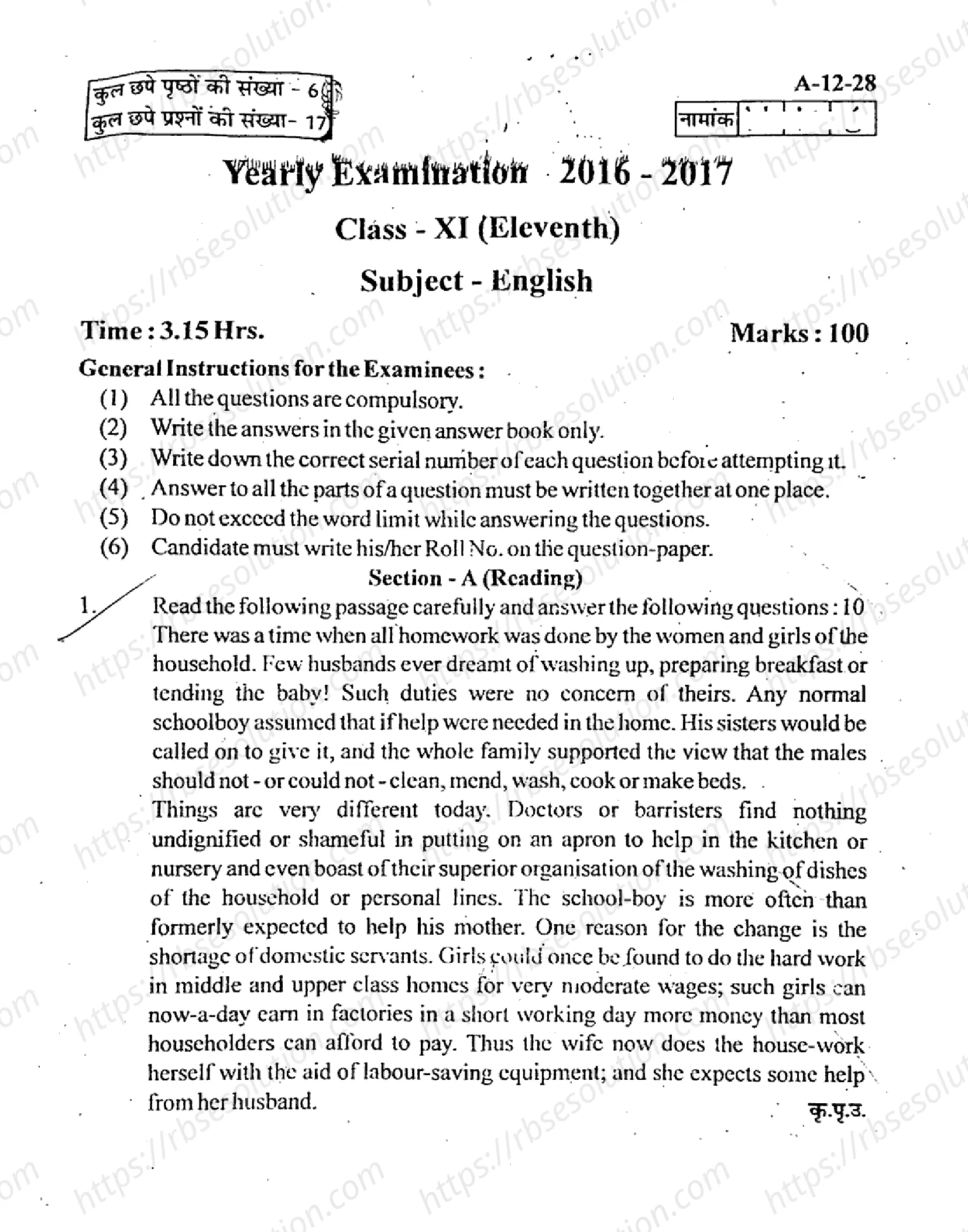
Section – A (Reading)
1. Read the following passage carefully and answer the following questions: (10 Marks)
There was a time when all homework was done by the women and girls of the household. Few husbands ever dreamt of washing up, preparing breakfast or tending the baby! Such duties were no concern of theirs. Any normal schoolboy assumed that if help were needed in the home, his sisters would be called on to give it, and the whole family supported the view that the males should not – or could not – clean, mend, wash, cook or make beds.
Things are very different today. Doctors or barristers find nothing undignified or shameful in putting on an apron to help in the kitchen or nursery and even boast of their superior organisation of the washing of dishes of the household or personal lines. The school-boy is more often than formerly expected to help his mother. One reason for the change is the shortage of domestic servants. Girls could once be found to do the hard work in middle and upper class homes for very moderate wages; such girls can now-a-day earn in factories in a short working day more money than most householders can afford to pay. Thus the wife now does the house-work herself with the aid of labour-saving equipment; and she expects some help from her husband.
Questions:
-
What was the traditional attitude of men towards household work?
Traditionally, men considered household work beneath their dignity. They never helped with washing, cooking, or childcare, believing such duties were only for women and girls.
-
How has the attitude of men changed in modern times?
Today, even professionals like doctors and barristers willingly help in the kitchen and nursery. They no longer find it shameful to do household chores and often take pride in their domestic skills.
-
What is one major reason for this change in attitude?
The shortage of domestic servants is a major reason. Earlier, girls worked as maids for low wages, but now they earn more in factories, leaving householders to do their own work with modern equipment.
-
Find words from the passage which mean the same as:
- (i) lacking in self-respect – undignified
- (ii) small in amount – moderate
Questions
- What was done by women and girls?
- What were few husbands dreamt of?
- What view was supported by the whole family?
- How are things today?
- Who find nothing undignified and shameful in helping in the kitchen etc.?
- For what is schoolboy expected?
- What is the one reason for this change?
- Where do the girls earn more money?
- How does the wife now work?
- Find the words from the passage which means:
(a) of home or household
(b) medium not extreme
Section - B (Writing)
Write a task in 100-120 words giving description of an event on ‘An Indian Wedding’ based on the hints given below:
- Attended marriage ceremony
- bridegroom on decorated mare with ‘barat’
- Barati’s danced up to the bride’s decorated house
- Garlanded each other
- Dinner
- ‘Phere’
OR
Write a task in 100-120 words giving description of an incident on ‘How You Helped Your Playmate’ based on the hints given below:
- Play evening games
- Playmate Mukesh hurt his arm
- Hospital, treatment
- Informed Mukesh’s parents
- Thanked me
Write an article on ‘Morning walk’ in about 100-120 words.
OR
Write a speech on ‘Modern Age is the age of computer’.
Section – C (Grammar)
5. In the following part of speech do as directed:
- Ramesh is working hard. (Find helping verb)
Answer: is - Sheran fast. (Find Adverb)
Answer: fast - Any dictionary can tell its meaning. (Find the determiner)
Answer: Any - The hills are above the fields. (Find the preposition)
Answer: above - She is an intelligent girl. (Find the Adjective)
Answer: intelligent
Fill in the blanks with correct form of verbs:
- We ____ the milkman for three weeks. (not pay)
Answer: have not paid - Two and two ____ four. (make)
Answer: make - Rita ____ to the radio when Rakesh called at her. (listen)
Answer: was listening - She ____ tomorrow to see her father. (go)
Answer: will go - We ____ in Amritsar when the war began. (live)
Answer: were living
Fill in the blanks with suitable modals:
- ____ you please tell me the time? (polite request)
Answer: Could - She ____ speak English well. (ability)
Answer: can - The students ____ attend the classes regularly. (compulsory)
Answer: must - If you pass, I ____ give you a watch. (promise)
Answer: will
8. Change the following sentences into Passive Voice:
- We must search your things.
Answer: Your things must be searched by us. - The Sahib liked the Indian dishes.
Answer: The Indian dishes were liked by the Sahib.
9. Rewrite the following sentences by changing them from direct to indirect speech:
- He said to the teacher, "My one question is incomplete."
Answer: He told the teacher that his one question was incomplete. - He said to me, "When will the night bus for Jaipur leave?"
Answer: He asked me when the night bus for Jaipur would leave.
10. Combine each of the following sentences into one compound sentence as directed:
- Arun switched the light off. He went out. (use and)
Answer: Arun switched the light off and went out. - Madhu can speak English. She can speak French too. (Use both-and)
Answer: Madhu can speak both English and French.
Section - 9 (Text)
Transform the following sentences into Negative:
-
Original: Gopal gave me some chocolates.
Negative: Gopal did not give me any chocolates.
-
Original: Raju is weak in English.
Negative: Raju is not strong in English.
Read the text given below and answer the questions that follow:
There is a growing solidarity among the nations of the world who believe in freedom. The human rights record of a state has become the legitimate concern of the international community. Today the human rights movement is genuinely worldwide. There is as Jerome Shestack observed 'a moral inevitability to human rights'.
To attempt to define human rights definitively would be, merely to illustrate how the human mind tries, and tries in vain, to give a more precise definition than the subject matter warrants. Human rights may be summed up in one word liberty. But Isaiah Berlin noted that there are more than 200 definitions of liberty.
In the Third World today, governments which are most successful economically are authoritarian ones and veneration for human rights promises to be a cult of slow growth.
-
Among whom is the solidarity growing?
Solidarity is growing among the nations of the world who believe in freedom.
-
What is genuinely worldwide?
The human rights movement is genuinely worldwide.
-
How may human rights be summed up?
Human rights may be summed up in one word: liberty.
-
In which world are governments authoritarian?
In the Third World, governments are authoritarian.
-
What is to be a cult of slow growth?
Veneration for human rights promises to be a cult of slow growth.
-
Find from the passage the words which mean:
- (A) valid: legitimate
- (B) respect: veneration
OR
As our story suggests, people think together best when they have something important in common. Networking technologies can often be used to create a space for communities of practice; like that photocopier technicians to think together in their own ways. This is perhaps the most common use of the Internet, discussion groups organized by people who wish to pool their information and ideas about a topic of shared interest. At the same time we should not consider the Internet in isolation. Regardless of whether they are located in the same geographic region or distributed around the world a...
4.
Read the following passage and answer the questions given below:
A community's members will typically think together using several media, such as the telephone, electronic mail, printed publications, and face-to-face meetings, and the Internet is best conceived as simply one component of this larger ecology of media.
- How do people think together best?
- What is the most common use of the Internet?
- Is the Internet the only medium to think together?
- Which other media are available to the people for exchanging ideas?
- What is the Internet at its best?
- Find out the words from the passage which mean: (a) separation (b) surroundings
Answer any four of the following questions in about 30 words:
- What according to Kalam are the challenges before us? (Vision 2020)
- What does Vivekananda ask to give up? (India: Our Motherland)
- How according to Gandhi can the poor be helped? (Technology with a Human Face)
- What is the greatest evil of advertising? (A Talk on Advertising)
- How can Internet become a tool of social progress? (Building an Internet Culture)
- With what has India been most richly endowed? (What India can teach us)
Read the following extracts and answer the following questions:
No one wanted
To touch me—except later in the autopsy room
When they knew my mouth would not search
For anything—and my head could be measured
and bent cut apart.
I looked like a sliced pomegranate—
The fruit you never touched.
- What was the girl's complaint?
- When did they touch the girl?
- How did the girl look when her head was cut apart?
- Did the mother ever touch her dead child?
Section – C (Poetry)
Read the following stanza and answer the questions that follow:
Bane I tend watermelons
And in flood I stay
Near the postman's house
I am a beggar
I am a clown
And I am shadowless
-
What does the Ganga do in summer?
In summer, the Ganga tends watermelons (i.e., its flow reduces and it becomes shallow).
-
Where does it stay in flood?
In flood, the Ganga stays near the postman's house (i.e., it overflows its banks and reaches human settlements).
-
Which different roles does the river play?
The river plays the roles of a beggar, a clown, and is shadowless, showing its changing and humble nature.
-
What does the Ganga mean by 'And I am shadowless'?
The Ganga means that it has no permanent form or identity; it is ever-changing and cannot cast a fixed shadow.
Answer any three questions in about 10-15 words:
-
Who is addressing the mother and why? (Voice of the unwanted girl)
The unwanted girl is addressing her mother, pleading for acceptance and love.
-
Why does the mother want to get rid of the girl child? (Voice of the unwanted girl)
The mother wants to get rid of the girl child due to societal pressure and the burden of dowry.
-
What kind of weather do we have around Raksha-Bandhan? (Raksha-Bandhan)
Around Raksha-Bandhan, the weather is cloudy and rainy, typical of the monsoon season.
-
Why do children, fisherman and monks seek the Ganga? (Songs of the Ganga)
Children seek the Ganga for play, fishermen for livelihood, and monks for spiritual purification.
Answer any one of the following questions in about 50-60 words:
-
Why did Sindhu hesitate to reveal the secret of the girl's hair? (The three dancing goats)
Sindhu hesitated to reveal the secret of the girl's hair because she feared that the truth would bring shame and dishonor to the family. The secret was about the girl's unnatural hair growth, which was considered a curse. Sindhu was torn between loyalty to her family and the fear of social ostracism, leading to her hesitation.
-
Why did Datta sit with both hands clutching his head? (The gold frame)
Datta sat with both hands clutching his head because he was overwhelmed with grief and frustration. He had lost the gold frame that contained his mother's photograph, which was his only memory of her. The loss symbolized the erasure of his past and his connection to his mother, leaving him in deep despair.
Answer any two of the following questions in about 30-40 words:
-
How did the mother kill the son and herself? (The mother of a traitor)
The mother poisoned her son's food to kill him, as he had become a traitor to the country. After his death, she consumed the same poison to end her own life, unable to bear the shame and grief of her son's betrayal.
-
How does the man passing help the old man? (The Refugees)
The man passing by helps the old man by giving him food and water, and by offering him a place to rest. He also provides emotional support, listening to the old man's story of displacement and loss during the partition.
-
Why did the aunt transfer her property to Jumman's name? (Panchparmeshwar)
The aunt transferred her property to Jumman's name because she trusted him and believed he would take care of her in her old age. Jumman had promised to support her, and she wanted to secure her future by making him the legal owner.