
RBSE Class 11th 2018 English-S-23-2018 Previous Year Papers
Class 11th students hunting authentic previous year papers for English-S-23-2018 (2018) land here for a reason: the paper below matches how RBSE assessments are remembered from that year. RBSE Solution does not mix years on one page; each combination gets its own notes.
Skim the overview sections, then work through the scanned pages. Pair this practice with RBSE books and solutions when you need to relearn a concept a question exposed.
Paper details
Quick reference for this previous year papers page — confirm board, class, and year & subject before you study.
| Board | RBSE |
|---|---|
| Class | Class 11th |
| Exam year | 2018 |
| Subject | English-S-23-2018 |
| Resource type | Previous Year Papers |
| Category | RBSE Previous Year Question Papers |
| Website | RBSE Solution |
The table summarises this Previous Year Papers resource. Confirm RBSE, Class 11th, year 2018, and subject English-S-23-2018 before studying.
RBSE Solution organises previous year papers so each URL carries chapter-specific guidance — better for students and for search engines than one generic paragraph for the whole class.
How to practise with this question paper
Stage one: read the English-S-23-2018 question paper from 2018 without a timer and highlight command words — explain, prove, calculate, discuss. Stage two: attempt selected questions closed-book. Stage three: compare with solutions or teacher feedback.
Previous Year Papers work best when you log mistakes by topic, not only by question number. That log becomes your revision index before pre-boards.
RBSE Class 11th 2018 English-S-23-2018
Scroll through the Previous Year Papers pages for English-S-23-2018 (2018).


Rajasthan Board Class 11th English-S-23-2018 2018 solved Previous Year Question Papers
Yearly Examination 2047
Subject: English (Code: 802) | Time: 3½ Hrs. | No. of Questions: 7
Instructions:
- All questions are compulsory.
- All marks are in front of the question.
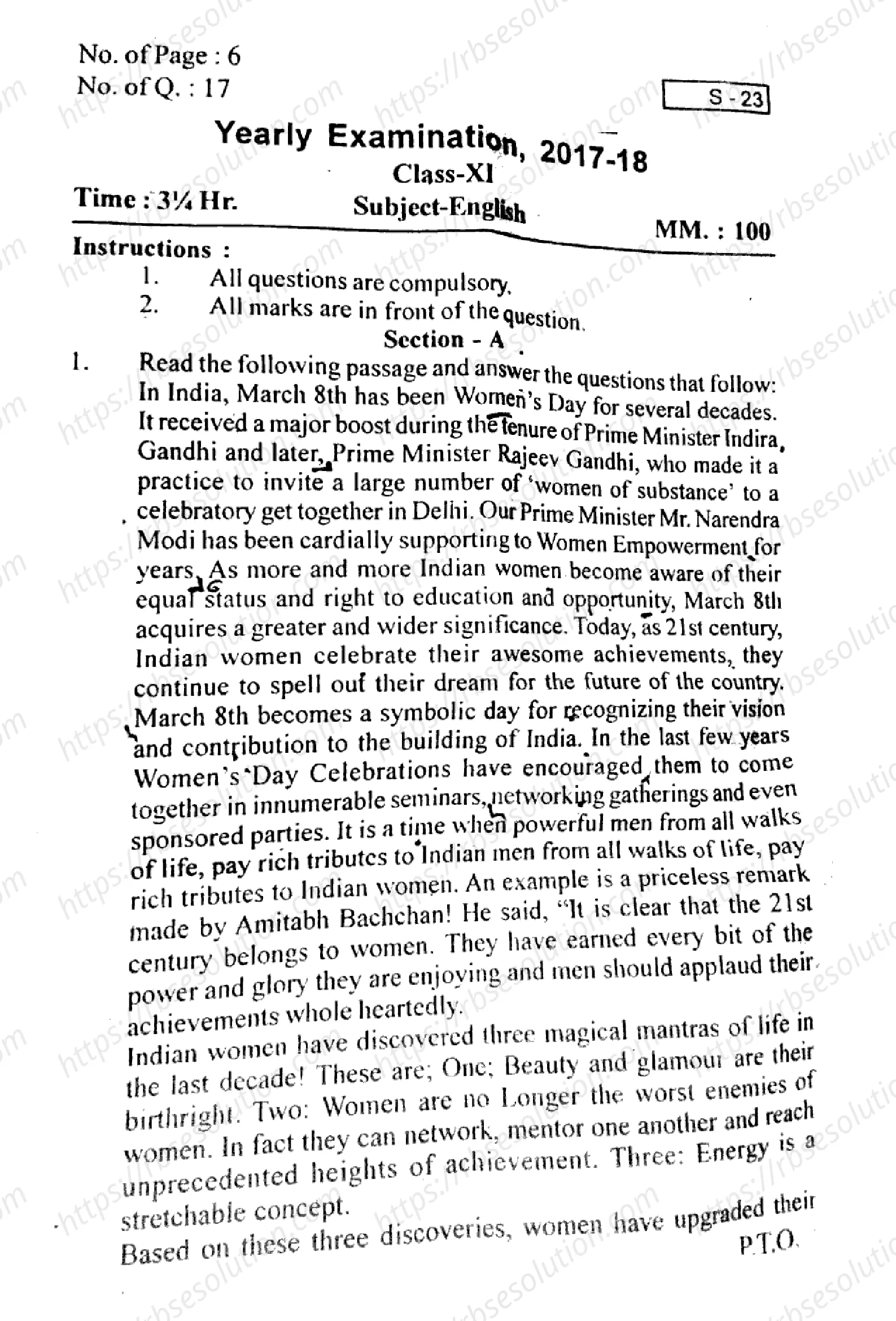
1. Read the following passage and answer the questions that follow:
In India, March 8th has been Women’s Day. It received a major boost during the tenure of several decades. Gandhi and later, Prime Minister Indira Gandhi, and Prime Minister Rajeev Gandhi made it a practice to invite a large number of women to a celebratory get together in Delhi. Our Prime Minister, Mr. Narendra Modi, has been cordially supporting Women Empowerment for years. As more and more Indian women become aware of their equal status and right to education and opportunity, March 8th acquires a greater and wider significance. Today, as Indian women celebrate their achievements, they continue to spell out their dream for the future of the country. March 8th becomes a symbolic day for recognizing their vision and contribution to the building of India. In the last few years, Women’s Day Celebrations have encouraged them to come together in innumerable seminars, networking gatherings and even sponsored parties. It is a time when powerful men from all walks of life pay rich tributes to Indian women. An example is a priceless remark made by Amitabh Bachchan! He said, “It is clear that the 21st century belongs to women. They have earned every bit of the power and glory they are enjoying and men should applaud their achievements whole heartedly.”
Indian women have discovered three magical mantras of life in the last decade! These are: One: Beauty and glamour are their birthright. Two: Women are no longer the worst enemies of women. In fact they can network, mentor one another. Three: Energy is a stretchable concept. Based on these three discoveries, women have upgraded themselves to unprecedented heights of achievement.
Questions:
-
What is the significance of March 8th in India according to the passage?
March 8th is celebrated as Women’s Day in India. It is a symbolic day for recognizing women’s vision and contribution to the building of the country. It also marks the growing awareness among Indian women about their equal status and right to education and opportunity.
-
Who among the following leaders supported Women’s Day celebrations in India?
- Mahatma Gandhi
- Indira Gandhi
- Rajeev Gandhi
- Narendra Modi
Correct Answer: All of the above (Mahatma Gandhi, Indira Gandhi, Rajeev Gandhi, and Narendra Modi)
The passage mentions that Gandhi, Indira Gandhi, Rajeev Gandhi, and Narendra Modi all supported Women’s Day celebrations in different ways.
-
What did Amitabh Bachchan say about women?
Amitabh Bachchan said, “It is clear that the 21st century belongs to women. They have earned every bit of the power and glory they are enjoying and men should applaud their achievements whole heartedly.”
-
What are the three magical mantras of life discovered by Indian women in the last decade?
- Beauty and glamour are their birthright.
- Women are no longer the worst enemies of women; they can network and mentor one another.
- Energy is a stretchable concept.
Correct Answer: These three mantras are listed in the passage.
-
Based on these three discoveries, what have women achieved?
Based on these three discoveries, women have upgraded themselves to unprecedented heights of achievement.
Section – A (Reading Comprehension)
Read the passage and answer the following questions:
...goals and literally covered every field of endeavours with glory and pride. They have shown beyond doubt that, as the world opens new windows of options and opportunities at the speed of light, they are smart, beautiful and savvy enough to rise to the occasion and turn the tide of fortune in their favour. The success of Indian beautiful women has also created a huge revolution in the fashion, fitness and beauty industries. Fashion designers of the eighties who limited their designs to various looks in the basic Salwar Kameez have acquired a splendid plumage of innovation in the last ten years.
-
(i) What is the third magical mantra discovered by Indian women?
The passage does not explicitly mention a "third magical mantra". However, based on the context, the third magical mantra could be interpreted as the ability to rise to the occasion and turn the tide of fortune in their favour by being smart, beautiful, and savvy.
-
(ii) How did women’s day receive a major boost?
The passage does not directly mention Women's Day. However, the success of Indian women in various fields and the resulting revolution in fashion, fitness, and beauty industries may have given a major boost to the celebration of Women's Day.
-
(iii) When do we celebrate Women’s Day in India?
International Women's Day is celebrated on March 8th every year in India as well as globally.
-
(iv) What is responsible for the revolution in the fashion in India?
The success of Indian beautiful women in various fields is responsible for the revolution in the fashion industry in India.
-
(v) When did the Women’s Day celebration receive a major boost?
The passage does not provide a specific date for when Women's Day celebration received a major boost. However, it can be inferred that the boost came with the success of Indian women in recent times.
-
(vi) Who has been supporting ‘Women Empowerment’?
The passage does not mention any specific supporter of women empowerment. However, it implies that the women themselves, through their achievements, have been supporting women empowerment.
-
(vii) What kind of fashion was prevalent during the eighties?
During the eighties, fashion designers limited their designs to various looks in the basic Salwar Kameez.
-
(viii) How does March 8th become a symbolic day?
March 8th is celebrated as International Women's Day, symbolizing the achievements and contributions of women worldwide.
-
(ix) Choose from the passage the word that is opposite to ‘best’.
The word opposite to 'best' in the passage is "basic" (as in "basic Salwar Kameez").
-
(x) Choose from the passage the word that means ‘factually’.
The word that means 'factually' in the passage is "literally".
Section – B (Writing)
Question 1: Write a task in about 100-120 words giving description of an event on “The Republic Day Function” based on the hints given:
- Preparation of the Function
- Purpose of the function
- Chief guest and other guests
- Prize distribution
The Republic Day Function
Our school celebrated Republic Day with great enthusiasm. The preparation began a week in advance with students decorating the auditorium and rehearsing for cultural programs. The purpose of the function was to honor the adoption of the Indian Constitution and instill patriotism among students. The chief guest was the District Magistrate, along with other dignitaries and parents. The event started with flag hoisting followed by a speech on the significance of the day. Students presented patriotic songs, dances, and a skit on the freedom struggle. The highlight was the prize distribution ceremony where students who excelled in academics, sports, and extracurricular activities were awarded certificates and trophies. The function concluded with the national anthem, leaving everyone inspired and proud.
OR
Write a task in 100-120 words giving description of a process for “Planting A Sapling” based on the hints given:
- To plant a sapling
- Dig a hole
- Treat the soil
- Fix the sapling
- Add water
- Protection from cattle
Planting A Sapling
Planting a sapling is a simple yet rewarding process. First, choose a healthy sapling and a suitable location with adequate sunlight. Dig a hole twice the size of the sapling's root ball. Treat the soil by mixing it with compost or organic manure to provide nutrients. Place the sapling gently into the hole, ensuring the roots are spread out. Fill the hole with the treated soil and press it firmly around the base to fix the sapling in place. Add water generously to help the soil settle and provide moisture. Finally, protect the sapling from cattle and animals by placing a fence or guard around it. Regular watering and care will help the sapling grow into a strong tree.
Question 2: Write a speech in about 100-120 words on ‘Importance of Good Manners’ to deliver in morning prayer in school.
Importance of Good Manners
Good morning respected teachers and dear friends. Today, I am here to speak on the importance of good manners. Good manners are the foundation of a civilized society. They reflect our character and upbringing. Simple acts like saying 'please', 'thank you', and 'sorry' can make a big difference in our relationships. Good manners help us earn respect and build trust. They create a positive environment at home, school, and in public places. In today's fast-paced world, we often forget the value of politeness and courtesy. Let us remember that good manners cost nothing but bring great rewards. So, let us practice good manners every day and inspire others to do the same. Thank you.
OR
Write an article on “Computer Education is The Need of The Present Time.” (Word Limit 100-120 words)
Computer Education is The Need of The Present Time
In the modern era, computer education has become essential for everyone. Computers are used in almost every field, from education and healthcare to business and entertainment. Learning computer skills opens up numerous career opportunities and helps individuals stay competitive in the job market. Basic knowledge of software, internet, and programming is now a necessity rather than a luxury. Schools and colleges must integrate computer education into their curriculum to prepare students for the digital world. Moreover, computer literacy bridges the gap between rural and urban areas, promoting equal opportunities. In conclusion, computer education is not just an option but a vital requirement for personal and professional growth in the present time.
Section – C
1. Name the part of speech of the underlined word in the following sentences:
(i) She drinks much milk.
(ii) I have a gold ring.
(iii) He runs fast.
(iv) She is an MLA.
(v) She told me about the function.
2. Fill in the blanks with the correct form of the verb given in brackets:
- Vinod always goes (go) to temple twice a day.
- He went to school after he had completed (complete) work.
- Sita will finish (finish) her homework by tomorrow.
- Sangeeta is tired because she has been working (work) since morning.
- Ram and Sohan are playing (play) football at this time.
3. Rewrite the following sentences using given modals:
- You are advised to take milk. (should) → You should take milk.
- I promise to help you. (will) → I will help you.
- He is able to drive a car. (can) → He can drive a car.
- It is possible for him to return today. (may) → He may return today.
4. Change the following sentences into passive voice:
- He has learnt all the lessons. → All the lessons have been learnt by him.
- Nobody can do it. → It cannot be done by anybody.
- Why should you not believe me? → Why should I not be believed by you?
- Sit down. → You are ordered to sit down. (or Let it be sat down.)
5. Change the following sentences into Indirect Speech:
- She said to her father, “Good morning”. → She wished her father good morning.
- He said to me, “You are my friend.” → He told me that I was his friend.
- Seema said, “Hurrah! We have won the match.” → Seema exclaimed with joy that they had won the match.
- Ram said to Mohan, “Where do you live?” → Ram asked Mohan where he lived.
6. Combine each set of the following sentences into one complex sentence as directed:
- I had passed. My friend told me this. (that) → My friend told me that I had passed.
- He worked very hard. He failed in the examination. (although) → Although he worked very hard, he failed in the examination.
Section- D
Read the following passage carefully and answer the questions given below:
A shoemaker gives shoes for his bread. Well, a singer sings for his supper. A farmer leads a large enterprise. Well, a pilot flies; an author tells a tale, a sailor moves things, a minister preaches, an auto worker makes cars, a painter paints pictures, a street car conductor moves people, a stenographer writes down words; a lumberjack saws and a tailor sews. The people with the victuals appreciate these services and cheerfully feed the performers. But what does an advertising man do? He induces human beings to want things they don’t want. Now I will be deeply obliged if you will tell me by what links of logic anybody can be convinced that your activity – the creation of want where want does not exist – is a useful one and should be rewarded with food. Doesn’t it seem, rather, the worst sort of mischief, deserving to be starved into extinction?
-
(i) Which useful services are done by the people to the society?
People provide various useful services to society such as shoemaking, singing, farming, piloting, storytelling, sailing, preaching, auto-making, painting, conducting street cars, stenography, lumberjacking, and tailoring. These services fulfill the needs of the community.
-
(ii) What do the performers get in return for their services?
The performers receive food (victuals) in return for their services. The people who have food appreciate these services and cheerfully feed the performers.
-
(iii) What does an advertising man do?
An advertising man induces human beings to want things they don’t want. He creates a desire for products or services where no such desire existed before.
-
(iv) Is an advertising man's activity good enough to be paid with food?
According to the writer, an advertising man's activity is not good enough to be paid with food. The writer questions the logic of rewarding someone who creates unnecessary wants, calling it a form of mischief.
-
(v) What seems to be the worst sort of mischief to the writer?
The worst sort of mischief, according to the writer, is the creation of want where want does not exist – i.e., the work of an advertising man. The writer believes such activity deserves to be starved into extinction.
-
(vi) Find out the words from the passage which mean:
- provisions – victuals
- total abolition – extinction
OR
With our incredible scientific progress we have reached a stage when the only threat to man, the only danger left to be met, is man himself. In the zoo at Lusaka, there is a cage where you see yourself. The world's most dangerous animal. Inside the cage, a mirror where you see yourself.
Section A: Reading Comprehension
Read the following passage and answer the questions:
It is difficult to measure whether repression world wide is increasing or decreasing. But awareness of that repression has undoubtedly increased, since the human rights Movement started as a world movement with the launching of Amnesty International in May 1961. The shifting hemlines of International atrocities are faithfully recorded in the annual reports of that body. The oldest human rights organization – the Anti-Slavery Society – was founded in 1839. It is still in business, because slavery is still in business. Slavery was abolished in the British Empire only in 1833 and in the United States in 1862, but bonded labour still prevails in parts of India.
-
Who is the only threat to man?
The passage does not explicitly mention who is the only threat to man. However, based on the context of repression and human rights, it can be inferred that repression itself or oppressive systems are the threat.
-
What is difficult to measure?
It is difficult to measure whether repression worldwide is increasing or decreasing.
-
Since when has the awareness against the repression increased?
Awareness against repression has increased since the launching of Amnesty International in May 1961.
-
Which organization keeps the human rights record of a nation?
Amnesty International keeps the human rights record of a nation through its annual reports.
-
Which is the oldest human rights organization?
The oldest human rights organization is the Anti-Slavery Society, founded in 1839.
-
Find from the passage the words which mean:
- (a) edges – hemlines
- (b) The act of using force to control people and restrict the freedom – repression
Section B: Short Answer Questions
Answer any four questions out of six in about 15-20 words:
-
Which, according to the girl Prakriti, is a false religion? (Chandalika)
According to Prakriti, the religion that divides people into high and low based on birth is a false religion.
-
What do you understand by Electronic-mail? (Building an internet culture)
Electronic-mail (e-mail) is a method of exchanging digital messages over the internet from one user to another.
-
What is the greatest evil of advertising? (A Talk on Advertising)
The greatest evil of advertising is that it creates false needs and promotes materialism, making people unhappy with what they have.
-
What have shaped the modern world? (Technology with a Human face)
Technology and human values together have shaped the modern world, according to the essay.
-
What are the inherent qualities of a hillman? (Eco Tourism)
The inherent qualities of a hillman include simplicity, honesty, hospitality, and a deep connection with nature.
-
Which are the two gleams of hope? (Human Rights and Legal Responsibilities)
The two gleams of hope are the growing awareness of human rights and the increasing legal responsibilities of states.
Section C: Extract Based Questions
Read the following extract and answer the questions:
Look for me, mother, look
because I won't become a flower
I won't turn into a butterfly
And I am not a part of anyone's song.
Look, mother,
Look for the place where you have sent me.
-
Why does the girl ask her mother to look for her?
The girl asks her mother to look for her because she feels lost and abandoned. She wants her mother to search for the place where she was sent, indicating she is in a difficult or unfamiliar situation and needs her mother's help to find her.