
RBSE Class 11th 2023 English-220523-2023 Previous Year Papers
Class 11th students hunting authentic previous year papers for English-220523-2023 (2023) land here for a reason: the paper below matches how RBSE assessments are remembered from that year. RBSE Solution does not mix years on one page; each combination gets its own notes.
Skim the overview sections, then work through the scanned pages. Pair this practice with RBSE books and solutions when you need to relearn a concept a question exposed.
Paper details
Quick reference for this previous year papers page — confirm board, class, and year & subject before you study.
| Board | RBSE |
|---|---|
| Class | Class 11th |
| Exam year | 2023 |
| Subject | English-220523-2023 |
| Resource type | Previous Year Papers |
| Category | RBSE Previous Year Question Papers |
| Website | RBSE Solution |
The table summarises this Previous Year Papers resource. Confirm RBSE, Class 11th, year 2023, and subject English-220523-2023 before studying.
RBSE Solution organises previous year papers so each URL carries chapter-specific guidance — better for students and for search engines than one generic paragraph for the whole class.
Turning 2023 papers into insight
One English-220523-2023 paper reveals style; several from the same year reveal pattern. After this page, open sibling subjects listed below to see whether marks cluster in certain units.
Keep rough work dated in your notebook. Examiners in Class 11th expect clear numbering even in practice sessions.
RBSE Class 11th 2023 English-220523-2023
Scroll through the Previous Year Papers pages for English-220523-2023 (2023).
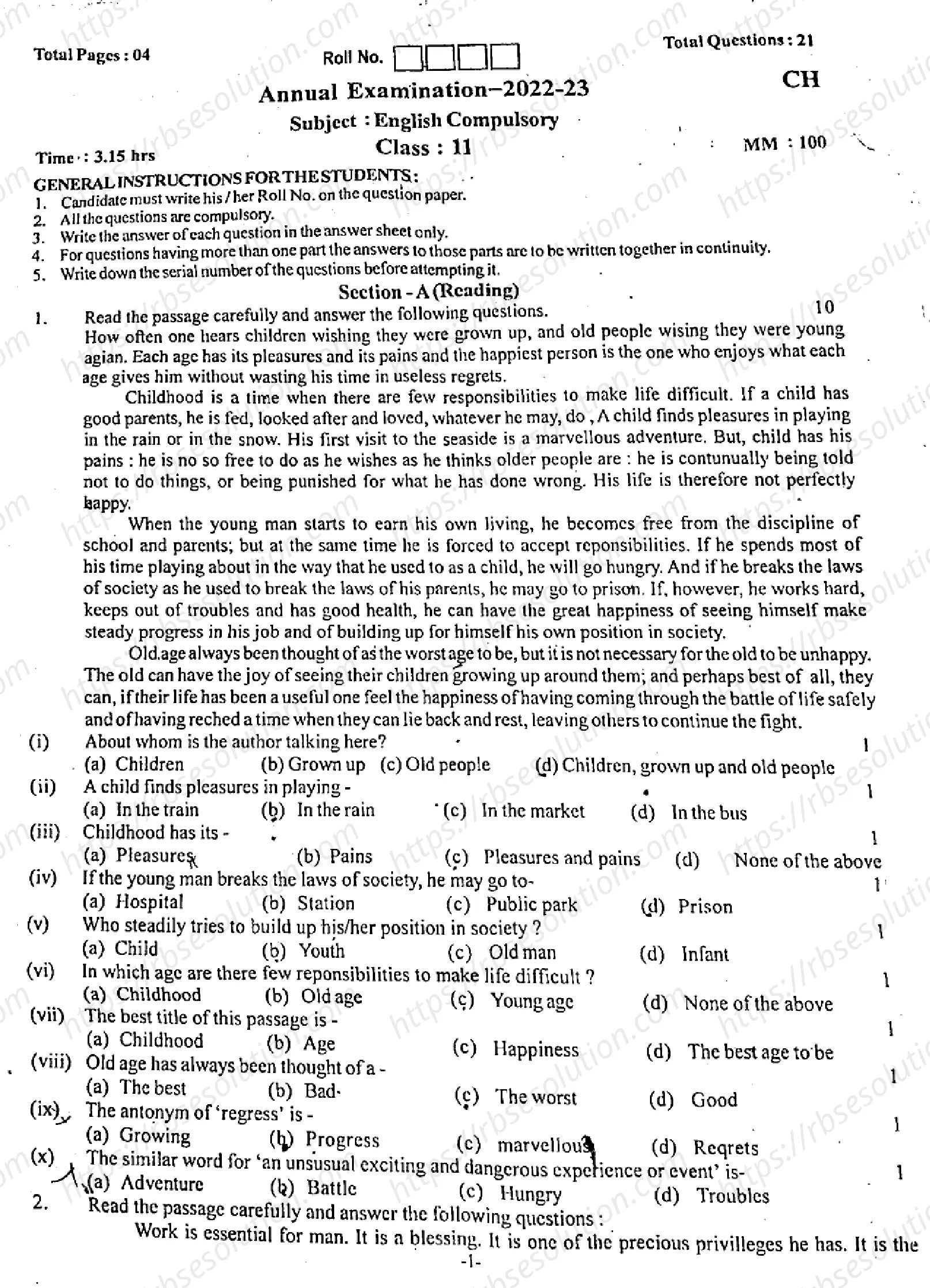


Rajasthan Board Class 11th English-220523-2023 2023 solved Previous Year Question Papers
Annual Examination—2022-23
Subject: English Compulsory
Class: 11th
Time: 3.5 hrs Total Questions: 24
General Instructions for the Students:
- Candidate must write his/her Roll No. on the question paper.
- All the questions are compulsory.
- Write the answer of each question in the answer sheet only.
- For questions having more than one part, the answers to those parts are to be written together in continuity.
- Write down the serial number of the questions before attempting it.
Section - A (Reading)
1. Read the passage carefully and answer the following questions.
How often one hears children wishing they were grown up, and old people wishing they were young again. Each age has its pleasures and its pains and the happiest person is the one who enjoys what each age gives him without wasting his time in useless regrets.
Childhood is a time when there are few responsibilities to make life difficult. If a child has good parents, he is fed, looked after and loved, whatever he may do. A child finds pleasures in playing in the rain or in the snow. His first visit to the seaside is a marvellous adventure. But, a child has his pains: he is not so free to do as he wishes as he thinks older people are; he is continually being told not to do things, or being punished for what he has done wrong. His life is therefore not perfectly happy.
When the young man starts to earn his own living, he becomes free from the discipline of school and parents; but at the same time he is forced to accept responsibilities. If he spends most of his time playing about in the way that he used to as a child, he will go hungry. And if he breaks the laws of society as he used to break the laws of his parents, he may go to prison. If, however, he works hard, keeps out of troubles and has good health, he can have the great happiness of seeing himself make steady progress in his job and of building up for himself his own position in society.
Old age has always been thought of as the worst age to be, but it is not necessary for the old to be unhappy. The old can have the joy of seeing their children growing up around them; and perhaps best of all, they can, if their life has been a useful one, feel the happiness of having come through the battle of life safely and of having reached a time when they can lie back and rest, leaving others to continue the fight.
-
About whom is the author talking here?
- (a) Children
- (b) Grown up
- (c) Old people
- (d) Children, grown up and old people
Explanation: The passage discusses the pleasures and pains of childhood, youth, and old age, so the author is talking about all three groups.
-
A child finds pleasures in playing -
- (a) In the train
- (b) In the rain
- (c) In the market
- (d) In the bus
Explanation: The passage states, "A child finds pleasures in playing in the rain or in the snow."
-
Childhood has its -
- (a) Pleasures
- (b) Pains
- (c) Pleasures and pains
- (d) None of the above
Explanation: The passage mentions both the pleasures (playing, adventure) and pains (lack of freedom, punishment) of childhood.
-
If the young man breaks the laws of society, he may go to -
- (a) Hospital
- (b) Station
- (c) Public park
- (d) Prison
Explanation: The passage says, "if he breaks the laws of society... he may go to prison."
-
Who steadily tries to build up his/her position in society?
- (a) Child
- (b) Youth
- (c) Old man
- (d) Infant
Explanation: The passage describes the young man (youth) as "building up for himself his own position in society."
-
In which age are there few responsibilities to make life difficult?
- (a) Childhood
- (b) Old age
- (c) Youth
- (d) None of the above
Explanation: The passage begins with "Childhood is a time when there are few responsibilities to make life difficult."
-
The best title of this passage is -
- (a) Childhood
- (b) Age
- (c) Happiness
- (d) None of the above
Explanation: The passage focuses on how each age brings its own happiness, making "Happiness" the most suitable title.
-
Old age has always been thought of as -
- (a) The best
- (b) Bad
- (c) The worst age to be
- (d) None of the above
Explanation: The passage states, "Old age has always been thought of as the worst age to be."
-
The antonym of 'regress' is -
- (a) Growing
- (b) Progress
- (c) Marvellous
- (d) Regrets
Explanation: 'Regress' means to go backward, so its antonym is 'progress' (to go forward).
-
A similar word for 'an unusual exciting and dangerous experience or event' is -
- (a) Adventure
- (b) Battle
- (c) Hungry
- (d) Troubles
Explanation: The passage uses 'adventure' to describe the child's first visit to the seaside, which matches the given definition.
2. Read the passage carefully and answer the following questions:
Work is essential for man. It is a blessing. It is one of the precious privileges he has. It is the...
English (Compulsory) – 2023 (Page 2 of 4)
Unseen Passage (Comprehension)
Read the following passage carefully and answer the questions given below:
Work is the source of all other rights. It brings him the good things of life and promotes his well-being. Work is an integral part of life. Without it life is deprived of its substance. According to Carlyle, work gives us happiness. It banishes vice and poverty from life. Work is the grand cure of all the maladies that beset mankind. It is key to all progress.
The prosperity of any nation depends on the work of the people there. If they remain like lotus-eaters, no nation can progress or achieve anything remarkable.
For Carlyle, work is worship. According to him, there is perennial nobleness and even sacredness in work. To work is to pray. The worker is the saviour of society, the redeemer of the world. Tagore says God is the tiller of the hard ground and the path-maker. "He is with them in sun and in shower and his garment is covered with dust." The best form of worship, according to Gurudev, is to work and serve others.
It is necessary for our young men and women to recognize the dignity of labour. Most of them prefer white collar jobs to manual work. Manual work according to Gandhiji gives opportunity to all who wish to take part in the government and the well-being of the state. We should look up to the worker who earns his livelihood by the sweat of his brow.
Questions:
-
What, according to the author, is essential for man?
- (a) Oxygen
- (b) Carbondioxide
- (c) Rest
- (d) Work
Explanation: The passage states that work is the source of all other rights and an integral part of life, making it essential for man.
-
Work banishes from life –
- (a) Poverty
- (b) Prosperity
- (c) Happiness
- (d) Progress
Explanation: The passage says, "It banishes vice and poverty from life."
-
What, according to the author, is death?
- (a) Idleness
- (b) Work
- (c) Vice
- (d) Poverty
Explanation: The passage implies that idleness is like death because work is essential for life and progress.
-
According to Tagore who is the path-maker?
- (a) The worker
- (b) God
- (c) Gandhiji
- (d) Worshipper
Explanation: The passage states, "Tagore says God is the tiller of the hard ground and the path-maker."
-
Who says that there is perennial nobleness and sacredness in work?
- (a) Jimson
- (b) Carlyle
- (c) Wordsworth
- (d) Browning
Explanation: The passage says, "According to Carlyle, there is perennial nobleness and even sacredness in work."
-
The best form of worship is to work and serve others according to –
- (a) Gandhiji
- (b) Carlyle
- (c) Gurudev R.N. Tagore
- (d) Wordsworth
Explanation: The passage states, "The best form of worship, according to Gurudev, is to work and serve others."
-
What do young men and women prefer?
- (a) White collar jobs
- (b) Black collar jobs
- (c) Grey collar jobs
- (d) Green collar jobs
Explanation: The passage says, "Most of them prefer white collar jobs to manual work."
-
Who earns his livelihood by the sweat of his brow?
- (a) The leader
- (b) The traveller
- (c) The worker
- (d) None of the above
Explanation: The passage concludes, "We should look up to the worker who earns his livelihood by the sweat of his brow."
-
Choose from the following the opposite of 'Poverty':
- (a) Disparity
- (b) Prosperity
- (c) Errand
- (d) Progress
Explanation: 'Poverty' means lack of wealth, while 'Prosperity' means wealth and success, making it the correct antonym.
-
Choose from the following the similar word for 'illness':
- (a) Livelihood
- (b) Maladies
- (c) Prosperity
- (d) Worship
Explanation: 'Maladies' means diseases or illnesses, so it is the synonym for 'illness'.
Writing Section
Question 11: Write a paragraph on 'Farewell Party' (in about 120 words) based on the hints given below:
Hints: (i) Lecturer transferred (ii) Collection, gifts (iii) Party, speeches, refreshments (iv) The Lecturer thanked
Paragraph: Farewell Party
A farewell party was organized in our college for our beloved English lecturer, Mr. Sharma, who was transferred to another city. All the students and staff members gathered in the college auditorium. A collection was taken from the students to buy a beautiful gift and a bouquet for him. The party began with a welcome speech by the class representative, followed by heartfelt speeches from students and teachers praising his dedication and teaching style. Delicious refreshments were served to everyone. In his response, Mr. Sharma thanked everyone for their love and support. He encouraged us to work hard and achieve our goals. The event ended on an emotional note with a group photograph. It was a memorable evening for all of us.
OR
Write in about 120 words giving description of a process for 'Chain Snatching' based on the hints given below:
Hints: (i) Walking on the road (ii) A chain around my neck (iii) A biker driving parallel (iv) Snatched the chain (v) Drove away
Description: A Chain Snatching Incident
Last Sunday, I was walking on a busy road near the market. I had a gold chain around my neck, which was given to me by my grandmother. Suddenly, I noticed a biker driving parallel to me at a slow speed. Before I could react, the pillion rider swiftly snatched the chain from my neck. I screamed for help, but within seconds, the biker accelerated and both of them drove away at high speed. I tried to note the bike number, but it was too fast. Some passersby gathered, but no one could catch them. I immediately reported the incident to the nearest police station. This experience taught me to be more cautious while walking on the road, especially in crowded areas.
Question 12: Write a letter to your father requesting him for the replacement of the computer you bought from his friend.
Letter to Father
123, Shanti Nagar
Jaipur
Date: 20th May 2023
Dear Father,
I hope this letter finds you in good health. I am writing to bring to your kind notice a problem with the computer that you bought from your friend, Mr. Gupta, last month. The computer has been giving frequent issues. It often hangs while working, and the screen sometimes goes blank without any reason. The keyboard also has some faulty keys. I am unable to complete my online assignments and projects on time due to these problems.
Since the computer is still under warranty, I request you to kindly contact Mr. Gupta and ask him to replace it with a new one or get it repaired as soon as possible. Your early action will help me continue my studies without any interruption.
With love,
Your son,
Rahul
OR
You are Shyam, living at Shanti Nagar, Jaipur. Write a letter to the Collector of your district complaining about the frequent electricity failure in your area.
Letter to the Collector
Shyam
45, Shanti Nagar
Jaipur
Date: 20th May 2023
To,
The Collector
Jaipur District
Jaipur
Subject: Complaint regarding frequent electricity failure in Shanti Nagar
Respected Sir,
I am a resident of Shanti Nagar, Jaipur. I wish to draw your kind attention towards the serious problem of frequent electricity failures in our locality. For the past few weeks, there have been power cuts for 4-5 hours daily, especially during the evening hours. This has caused immense inconvenience to the residents, especially students and working people. Due to the erratic power supply, our daily routines are badly affected. Students are unable to study, and household chores are hampered. Moreover, the voltage fluctuation often damages our electrical appliances.
I, on behalf of all the residents, request you to kindly look into the matter and take necessary action to ensure a regular and uninterrupted power supply in our area. We hope for an early resolution.
Thanking you,
Yours faithfully,
Shyam
Question 13: Write an article in about 120 words on 'Failure during Exam Time'.
Article: Failure during Exam Time
Examinations are a crucial part of a student's life, and facing failure during exam time can be disheartening. However, failure is not the end of the road; it is a stepping stone to success. When a student fails, it is important to analyze the reasons behind it. Lack of proper preparation, poor time management, or exam stress are common causes. Instead of losing hope, students should learn from their mistakes and work harder. They should seek guidance from teachers and parents. Failure teaches us resilience and the value of hard work. It is essential to stay positive and remember that many successful people have faced failures in their lives. With determination and consistent effort, one can overcome failure and achieve great success in future exams.
Section – C (Grammar)
Fill in the blanks with suitable determiner:
- She took off her coat and set to work. (a/an/the)
- There was a lot of traffic on the road. (प्र / 07209)
- She is an M.A. in English. (a/an/the)
- Can you give me some more information? (many/some)
- There are six pens in my bag; each one is new. (each/every)
- Few people live up to 100 years. (few/a few/the few)
- There is some milk in the cup. (many/some)
Fill in the blanks with correct forms of verbs:
- I have not finished my homework yet. (a) has finished (b) have finished (c) was finishing
- The rose smells sweet. (a) Smells (b) Smell (c) is smelling (d) are smelling
- She is writing a book nowadays. (a) was writing (b) were writing (c) is writing (d) are writing
- They often go for a walk. (a) gone (b) goes (c) going (d) go
- I bought some dresses yesterday. (a) buy (b) buys (c) bought (d) buying
- If you come, I will meet you. (a) will meet (b) shall meet (c) would meet (d) should meet
Fill in the blanks with correct modal:
- The train is late; you might miss it. (may/might)
- He could swim well in his childhood. (can/could)
- Would you help me? I am very poor. (would/should)
- She has five cars; she must be a rich woman. (must/may)
- Mohan is an old man but he may go for a long walk. (may/might)
- If you pass, I will give you a watch. (will/would)
- You should see him tomorrow. (may/should)
Section – D (Textual Questions)
Read the passage carefully and answer the following questions.
For political reasons, the Peshwas kept the puppet Mughal regime alive in Delhi in the nineteenth century. These de facto rulers from Pune were astute enough to recognise the importance of the technological age dawning in Europe. They set up their own centres for science and technology. Here, the East India Company saw another opportunity to extend its influence. It offered aid and experts. They were accepted only to make the local centres self-sufficient. The twentieth century brought about further changes inspired by the West. India moved towards a democracy. By then, the Peshwas had lost their enterprise and they were gradually replaced by democratically elected bodies. The sultanate at Delhi survived even this transition, largely because it wielded no real influence. The Shahenshah of Delhi was no more than a figurehead to rubber stamp the ‘recommendations’ made by the Central Parliament.
-
How did the Mughal emperor in Delhi become a puppet of the Peshwas?
The Peshwas kept the Mughal emperor alive in Delhi for political reasons, but he had no real power. The Peshwas were the de facto rulers, making the emperor a mere puppet.
-
What were the de facto rulers from Pune astute enough to recognise the importance in the 19th century?
They were astute enough to recognise the importance of the technological age dawning in Europe.
-
What did the Marathas do for the progress of technology in India?
The Marathas set up their own centres for science and technology to promote technological progress in India.
-
What changes in India were inspired by the West in the 20th century?
India moved towards a democracy, inspired by Western ideas.
-
What were the consequences of democracy in India?
The Peshwas lost their enterprise and were gradually replaced by democratically elected bodies. The sultanate at Delhi survived but only as a figurehead with no real influence.
-
Find out the word from the passage which means: Real.
The word is "de facto" (meaning in reality, though not officially).
OR
Fertility falls as incomes rise, education spreads, and health improves. Thus development is the best contraceptive. But development itself may not be possible if the present increase in numbers continues. The rich get richer, and the poor beget children which condemns them to remain poor. More children does not mean more workers, merely more people without work.
(Note: The OR section appears incomplete in the source; only the passage is provided without specific questions.)
Unseen Passage (Comprehension)
Read the following passage and answer the questions that follow:
... human beings be treated like cattle and compulsorily sterilised, But there is no alternative to voluntary family planning without introducing an element of coercion. The choice is really between control of population and perpetuation of poverty.
The Population of India is estimated to be 920 million today—more than the entire populations of Africa and South America put together. No one familiar with the conditions in India would doubt that the hope of the people would die in their hungry hovels unless population control is given topmost priority.
- How can development be the best contraceptive?
Development, especially in education, healthcare, and economic opportunities, naturally leads to smaller family sizes as people become more aware and empowered to make informed choices about family planning.
- What does more children mean?
More children often mean perpetuation of poverty, as families with many children struggle to provide adequate food, education, and healthcare, trapping them in a cycle of poverty.
- Does the writer favour the idea of forced sterilization?
No, the writer does not favour forced sterilization. He clearly states that there is no alternative to voluntary family planning without introducing coercion, implying he opposes forced measures.
- What will have to be done if poverty is to be finished?
If poverty is to be finished, population control must be given topmost priority, as unchecked population growth leads to perpetuation of poverty.
- What would happen unless population control is given topmost priority?
Unless population control is given topmost priority, the hope of the people would die in their hungry hovels, meaning poverty and suffering would continue.
- Find out the word from the passage which means 'Force'.
The word is "coercion".
Short Answer Questions (Any Four)
Answer any four of the following questions (4×1=4):
- What do most teachers think of students according to Toplow? (The Browning Version)
According to Toplow, most teachers think of students as "pupils" who are there to be taught, but they often fail to see them as individuals with feelings and potential.
- What was professor Gaitonde's plan of action in Bombay? (The Adventure)
Professor Gaitonde planned to go to the library in Bombay to consult historical records and verify the events that had changed in his alternate reality.
- What disappointed the author in the town of Hor? (Silk Road)
The author was disappointed to find that the town of Hor was not the spiritual and peaceful place he had imagined; instead, it was crowded, noisy, and commercialized.
- What did the grandmother think about the education at the English school? (The Portrait of a Lady)
The grandmother thought that the education at the English school was not proper because it did not teach religious scriptures or moral values, and she disapproved of the subjects taught there.
- How did the children behave during the disaster? (We're Not Afraid to Die... If We Can All Be Together)
The children behaved bravely and calmly during the disaster. They did not panic and helped their parents as much as they could, showing great courage and maturity.
- What were the things that were found in Tut's tomb? (Discovering Tut: The Saga Continues)
In Tut's tomb, archaeologists found gold, jewelry, furniture, chariots, weapons, and other artifacts that were meant to accompany the pharaoh in the afterlife.
Poetry Extract Based Questions
Read the following extracts and answer the questions that follow:
Extract 1
When did my childhood go?
Was it the day I ceased to be eleven
Was it the time I realised that
Hell and heaven
Could not be found in geography
And therefore could not be,
Was that the day!
- Name the poem and the poet.
The poem is "Childhood" and the poet is Markus Natten.
- What did he think about heaven and hell in his childhood?
In his childhood, he believed that heaven and hell were actual physical places that could be found on a map or in geography.
- What does he think of them now?
Now he realizes that heaven and hell are not geographical locations but are states of mind or spiritual concepts that cannot be found on any map.
- What idea does the poet want to convey?
The poet wants to convey that childhood is lost when we begin to question and understand the world rationally, losing the innocence and simple beliefs of childhood.
OR
Extract 2
Then sleek as a lizard, and alert and abrupt, she enters the thickness, and a machine starts up
Of chitterings, and a tremor of wings, and trillings—
The whole tree trembles and thrills.
It is the engine of her family.
- What has the Goldfinch been compared to and why?
The Goldfinch has been compared to a lizard because of its sleek, quick, and abrupt movements as it enters the thick branches of the tree.
- Where does she enter?
She enters the thickness of the tree, meaning the dense foliage or branches.
- Why has the poet used the word "machine" and no other word? Explain.
The poet uses the word "machine" to emphasize the mechanical, precise, and energetic nature of the bird's movements and sounds. It suggests that the bird's activity is like a well-oiled machine, producing a continuous, rhythmic sound.
- What makes the tree tremble and thrill?
The tree trembles and thrills because of the chitterings, tremor of wings, and trillings of the goldfinch and her family, as they move and chirp together.
Poetry Short Answer Questions (Any Three)
Answer any three of the following questions (3×2=6):
- What does the father plan to do? (Father to Son)
The father plans to build a bridge of understanding and communication with his son. He wants to forgive his son and start anew, hoping to end the silence and distance between them.
- What did the poet find about his mind? (Childhood)
The poet found that his mind was no longer innocent and childlike. He realized that he had lost his childhood when he began to think rationally and critically about the world.
- What does the rain call herself? (The Voice of the Rain)
The rain calls herself the "Poem of Earth", implying that she is a cyclical, life-giving force that returns to the earth to nourish it, just as a poem returns to its source.
- How did her mother look in the photograph? (A Photograph)
In the photograph, her mother looked young, happy, and carefree. She was standing with her cousins, enjoying a seaside holiday, and appeared to be full of life and joy.
Long Answer Questions (Any Two)
Answer any two of the following questions (2×3=6):
- What did Shahid suffer from? How did the narrator console him? (The Ghat of the Only World)
Shahid suffered from a terminal illness, likely cancer. The narrator consoled him by spending time with him, listening to his thoughts, and discussing literature, poetry, and life. He also helped Shahid with practical matters and provided emotional support, reminding him of the beauty and meaning in life despite his suffering.
- Where did the midwife place the child and why? (Birth)
The midwife placed the child on the mother's stomach immediately after birth. This was done to keep the baby warm and to allow the mother to bond with her newborn. It is also a natural practice to help the baby adjust to the outside world and to stimulate breathing and circulation.
- Who was Ratna and why was she living with Rama Rao? (Ranga's Marriage)
Ratna was a young, beautiful girl who was the niece of Rama Rao. She was living with Rama Rao because her parents had died, and she had no other family to take care of her. Rama Rao, being a kind and responsible relative, took her into his home and raised her as his own daughter.
Short Answer Questions (Any Two)
Answer any two of the following questions (2×2=4):
- What did the wisest man counsel? (The Tale of Melon City)
The wisest man counseled that the king should be hanged, as per the law, because the arch was too low and the king had hit his head. He advised that the law must be followed strictly, even if it meant punishing the king himself.
- How did Mrs. S become a victim of war? (The Address)