
RBSE Class 11th 2024 Mathematics-APS (1136)-2024 Previous Year Papers
You opened the RBSE Class 11th 2024 Mathematics-APS (1136)-2024 Previous Year Papers page — a focused place to read the real previous year question paper for that subject and year. RBSE Solution keeps exam-year sets together so you can practise the same cycle your seniors faced.
Previous year papers reward patience: read instructions, note mark distribution, then attempt questions before peeking at solutions elsewhere on the site. This URL always loads the same free previous year papers content for Mathematics-APS (1136)-2024 (2024).
Use the details table to confirm class and year, then scroll to the paper images or PDF below. More subjects from 2024 are linked later on this page.
Paper details
Quick reference for this previous year papers page — confirm board, class, and year & subject before you study.
| Board | RBSE |
|---|---|
| Class | Class 11th |
| Exam year | 2024 |
| Subject | Mathematics-APS (1136)-2024 |
| Resource type | Previous Year Papers |
| Category | RBSE Previous Year Question Papers |
| Website | RBSE Solution |
The table summarises this Previous Year Papers resource. Confirm RBSE, Class 11th, year 2024, and subject Mathematics-APS (1136)-2024 before studying.
RBSE Solution organises previous year papers so each URL carries chapter-specific guidance — better for students and for search engines than one generic paragraph for the whole class.
How to practise with this question paper
Stage one: read the Mathematics-APS (1136)-2024 question paper from 2024 without a timer and highlight command words — explain, prove, calculate, discuss. Stage two: attempt selected questions closed-book. Stage three: compare with solutions or teacher feedback.
Previous Year Papers work best when you log mistakes by topic, not only by question number. That log becomes your revision index before pre-boards.
RBSE Class 11th 2024 Mathematics-APS (1136)-2024
Scroll through the Previous Year Papers pages for Mathematics-APS (1136)-2024 (2024).
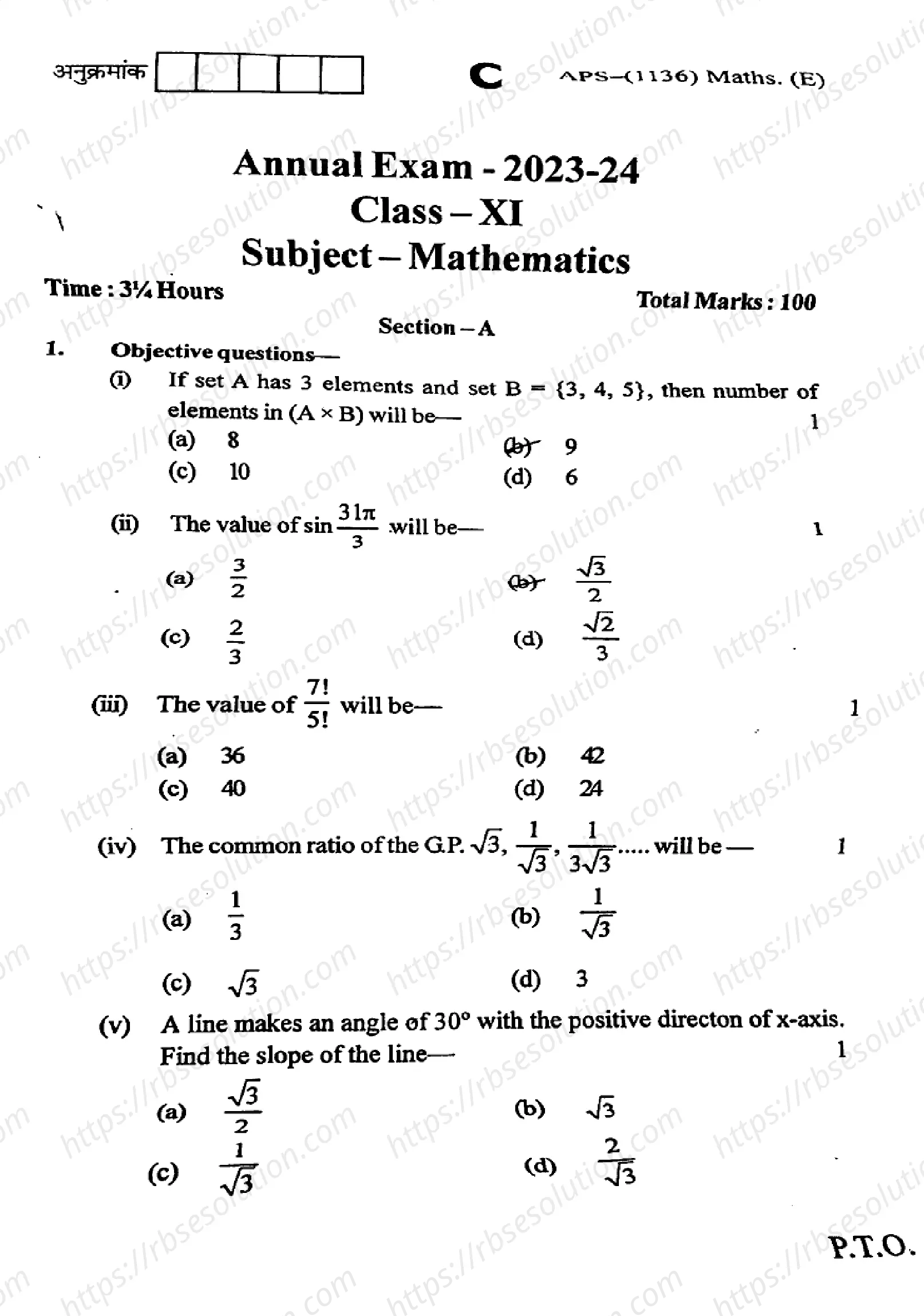


Rajasthan Board Class 11th Mathematics-APS (1136)-2024 2024 solved Previous Year Question Papers
Annual Exam - 2023-24
Class — XI
Subject — Mathematics
Time : 3½ Hours Total Marks : 80
Section—A
Objective Questions
-
If set A has 3 elements and set B = {3, 4, 5}, then number of elements in (A × B) will be—
- (a) 8
- (b) 9
- (c) 0
- (d) 6
Explanation: n(A × B) = n(A) × n(B) = 3 × 3 = 9.
-
The value of sin 60° will be—
- (a) ½
- (b) √3/2
- (c) 1/√2
- (d) 1/√3
Explanation: sin 60° = √3/2.
-
The value of 4! will be—
- (a) 36
- (b) 42
- (c) 40
- (d) 24
Explanation: 4! = 4 × 3 × 2 × 1 = 24.
-
The common ratio of the G.P. √3, 3, 3√3, ... will be—
- (a) 3
- (b) √3
- (c) 1/√3
- (d) 1/3
Explanation: Common ratio = 3 / √3 = √3.
-
A line makes an angle of 30° with the positive direction of x-axis. Find the slope of the line—
- (a) √3
- (b) 1/√3
- (c) 1
- (d) 0
Explanation: Slope = tan 30° = 1/√3.
2. Very Short Answer Type Questions
(vi) Co-ordinates of the focus of the parabola x² = –8y is—
- (a) (2, 0)
- (b) (0, 2)
- (c) (–2, 0)
- (d) (0, –2)
Explanation: The parabola x² = –8y is of the form x² = –4ay, where 4a = 8 ⇒ a = 2. Its focus is at (0, –a) = (0, –2).
2. Very Short Answer Type Questions
(i) Write the set of the letters of the word “TRIGONOMETRY”.
The letters in “TRIGONOMETRY” are: T, R, I, G, O, N, M, E, Y. The set is {T, R, I, G, O, N, M, E, Y}.
(ii) Convert 5π/6 in radian measure.
5π/6 radians is already in radian measure. In degrees: (5π/6) × (180°/π) = 150°.
(iii) Express (–5i)(⅓ i) in a + ib form.
(–5i)(⅓ i) = –5 × ⅓ × i² = –(5/3) × (–1) = 5/3. So, a + ib = 5/3 + 0i.
(iv) Expand the expression (a + b)⁵.
Using binomial theorem: (a + b)⁵ = a⁵ + 5a⁴b + 10a³b² + 10a²b³ + 5ab⁴ + b⁵.
(v) Find the equation of the circle with centre (–3, 2) and radius 4.
Equation: (x – h)² + (y – k)² = r² ⇒ (x + 3)² + (y – 2)² = 16.
(vi) Name the octants in which the points (4, –2, 3) and (–4, 2, 5) lie.
Point (4, –2, 3): x > 0, y < 0, z > 0 ⇒ Octant IV. Point (–4, 2, 5): x < 0, y > 0, z > 0 ⇒ Octant II.
(vii) If the standard deviation of obtained marks of a class students is 6, then find the variance.
Variance = (standard deviation)² = 6² = 36.
(viii) A coin is tossed thrice, then find the sample space.
Sample space S = {HHH, HHT, HTH, HTT, THH, THT, TTH, TTT}.
3. Short Answer Type Questions
(i) If U = {1, 2, 3, 4, 5, 6, 7, 8, 9}, A = {1, 2, 3, 4} and B = {2, 4, 6, 8}, then find (A ∪ B)′.
A ∪ B = {1, 2, 3, 4, 6, 8}. So, (A ∪ B)′ = U – (A ∪ B) = {5, 7, 9}.
(ii) If P = {1, 2}, then find the set P × P × P.
P × P × P = {(1,1,1), (1,1,2), (1,2,1), (1,2,2), (2,1,1), (2,1,2), (2,2,1), (2,2,2)}.
(iii) Solve the inequality 7x + 3 < 5x + 9 and show the graph of the solution on number line.
7x + 3 < 5x + 9 ⇒ 7x – 5x < 9 – 3 ⇒ 2x < 6 ⇒ x < 3. On number line, all points to the left of 3 (open circle at 3).
(iv) If ⁿC₉ = ⁿC₈, then find the value of ⁿC₁₇.
ⁿC₉ = ⁿC₈ ⇒ n = 9 + 8 = 17. So, ⁿC₁₇ = ¹⁷C₁₇ = 1.
(v) Expand the expression (x – 2y)⁵.
(x – 2y)⁵ = x⁵ – 10x⁴y + 40x³y² – 80x²y³ + 80xy⁴ – 32y⁵.
(vi) Find the 20th term of the GP: 5/2, 5/4, 5/8, …
First term a = 5/2, common ratio r = (5/4)/(5/2) = 1/2. 20th term = a r¹⁹ = (5/2) × (1/2)¹⁹ = 5 / 2²⁰.
(vii) Find the value of the limit limx→0 (sin 5x) / (bx).
limx→0 (sin 5x) / (bx) = (5/b) × limx→0 (sin 5x)/(5x) = (5/b) × 1 = 5/b.
(viii) A coin is tossed twice. Find the probability of at least one tail.
Sample space: {HH, HT, TH, TT}. Favorable outcomes (at least one tail): {HT, TH, TT} = 3. Probability = 3/4.
Section – B
4. Let A = {1, 2, 3, ..., 14}. Define a relation R from A to A by R = {(x, y): 3x – y = 0, where x, y ∈ A}. Write down its domain, codomain and range.
Relation: 3x – y = 0 ⇒ y = 3x. For x ∈ A, y must also be in A. So, x = 1, 2, 3, 4 (since 3×4 = 12 ≤ 14, but 3×5 = 15 > 14). Thus, R = {(1,3), (2,6), (3,9), (4,12)}. Domain = {1, 2, 3, 4}. Codomain = A = {1, 2, ..., 14}. Range = {3, 6, 9, 12}.
5. Prove that: 3 sin(π/6) sec(π/3) – 4 sin(5π/6) cot(π/4) = 1.
sin(π/6) = 1/2, sec(π/3) = 2, sin(5π/6) = sin(π – π/6) = sin(π/6) = 1/2, cot(π/4) = 1. LHS = 3 × (1/2) × 2 – 4 × (1/2) × 1 = 3 – 2 = 1 = RHS.
Section – B
2. Express the following complex number in the form a + ib:
\(5 + \sqrt{2}i\)
The given complex number is already in the form \(a + ib\), where \(a = 5\) and \(b = \sqrt{2}\).
Thus, \(5 + \sqrt{2}i\) is the required form.
3. Solve the following inequality and show the graph of the solution on number line:
\(\frac{3x-4}{2} \ge \frac{x+1}{4}\)
Multiply both sides by 4 (LCM of 2 and 4):
\(2(3x - 4) \ge x + 1\)
\(6x - 8 \ge x + 1\)
\(6x - x \ge 1 + 8\)
\(5x \ge 9\)
\(x \ge \frac{9}{5}\)
The solution set is \([\frac{9}{5}, \infty)\).
Graph on number line: A closed circle at \(\frac{9}{5}\) and a ray extending to the right towards infinity.
4. Using Binomial theorem, evaluate the following: \((102)^5\)
Write \(102 = 100 + 2\). Using Binomial theorem:
\((100 + 2)^5 = \sum_{k=0}^{5} \binom{5}{k} (100)^{5-k} (2)^k\)
= \(\binom{5}{0}(100)^5 + \binom{5}{1}(100)^4(2) + \binom{5}{2}(100)^3(2)^2 + \binom{5}{3}(100)^2(2)^3 + \binom{5}{4}(100)(2)^4 + \binom{5}{5}(2)^5\)
= \(1 \times 10^{10} + 5 \times 10^8 \times 2 + 10 \times 10^6 \times 4 + 10 \times 10^4 \times 8 + 5 \times 100 \times 16 + 1 \times 32\)
= \(10,000,000,000 + 1,000,000,000 + 40,000,000 + 800,000 + 8,000 + 32\)
= \(11,040,808,032\)
5. The vertices of \(\triangle PQR\) are \(P(2, 1)\), \(Q(-2, 3)\) and \(R(4, 5)\). Find the equation of the median through the vertex R.
The median through R passes through R and the midpoint of PQ.
Midpoint M of PQ: \(\left(\frac{2 + (-2)}{2}, \frac{1 + 3}{2}\right) = (0, 2)\)
Points R(4, 5) and M(0, 2). Slope of RM = \(\frac{5 - 2}{4 - 0} = \frac{3}{4}\)
Equation of line through R(4,5) with slope \(\frac{3}{4}\):
\(y - 5 = \frac{3}{4}(x - 4)\)
\(4(y - 5) = 3(x - 4)\)
\(4y - 20 = 3x - 12\)
\(3x - 4y + 8 = 0\)
6. Find the distance of the point \((3, -5)\) from the line \(3x - 4y - 26 = 0\).
Distance formula: \(d = \frac{|Ax_1 + By_1 + C|}{\sqrt{A^2 + B^2}}\)
Here, \(A = 3, B = -4, C = -26\), point \((3, -5)\):
\(d = \frac{|3(3) + (-4)(-5) - 26|}{\sqrt{3^2 + (-4)^2}} = \frac{|9 + 20 - 26|}{\sqrt{9 + 16}} = \frac{|3|}{\sqrt{25}} = \frac{3}{5}\)
7. Find the equation of the set of points which are equidistant from the points \((1, 2, 3)\) and \((3, 2, -1)\).
Let \(P(x, y, z)\) be any point equidistant from A(1,2,3) and B(3,2,-1).
\(PA = PB\)
\(\sqrt{(x-1)^2 + (y-2)^2 + (z-3)^2} = \sqrt{(x-3)^2 + (y-2)^2 + (z+1)^2}\)
Squaring both sides:
\((x-1)^2 + (y-2)^2 + (z-3)^2 = (x-3)^2 + (y-2)^2 + (z+1)^2\)
\(x^2 - 2x + 1 + z^2 - 6z + 9 = x^2 - 6x + 9 + z^2 + 2z + 1\)
\(-2x - 6z + 10 = -6x + 2z + 10\)
\(-2x + 6x - 6z - 2z = 0\)
\(4x - 8z = 0\)
\(x - 2z = 0\)
8. Evaluate the given limit: \(\lim_{x \to 0} \frac{ax + x \cos x}{b \sin x}, b \neq 0\)
\(\lim_{x \to 0} \frac{x(a + \cos x)}{b \sin x} = \frac{1}{b} \lim_{x \to 0} \frac{x}{\sin x} \cdot \lim_{x \to 0} (a + \cos x)\)
We know \(\lim_{x \to 0} \frac{x}{\sin x} = 1\) and \(\lim_{x \to 0} (a + \cos x) = a + 1\)
Thus, the limit = \(\frac{1}{b} \times 1 \times (a + 1) = \frac{a+1}{b}\)
9. Express the following expression in the form of a + ib:
\(\frac{(3 - 2i)(2 + 3i)}{(1 + 2i)(2 - i)}\)
First, simplify numerator: \((3 - 2i)(2 + 3i) = 6 + 9i - 4i - 6i^2 = 6 + 5i + 6 = 12 + 5i\)
Denominator: \((1 + 2i)(2 - i) = 2 - i + 4i - 2i^2 = 2 + 3i + 2 = 4 + 3i\)
Now, \(\frac{12 + 5i}{4 + 3i}\). Multiply numerator and denominator by conjugate of denominator \((4 - 3i)\):
= \(\frac{(12 + 5i)(4 - 3i)}{(4 + 3i)(4 - 3i)} = \frac{48 - 36i + 20i - 15i^2}{16 - 9i^2} = \frac{48 - 16i + 15}{16 + 9} = \frac{63 - 16i}{25}\)
= \(\frac{63}{25} - \frac{16}{25}i\)
Section – C
10. If \(A = \{3, 5, 7, 9, 11\}, B = \{7, 9, 11, 13\}, C = \{11, 13, 15\}, D = \{15, 17\}\), find:
(i) \(B \cap D\) (ii) \(A \cap (B \cup C)\) (iii) \(A \cap C\) (iv) \(A \cap (B \cup D)\)
(i) \(B \cap D = \{7,9,11,13\} \cap \{15,17\} = \emptyset\) (empty set)
(ii) \(B \cup C = \{7,9,11,13,15\}\); \(A \cap (B \cup C) = \{3,5,7,9,11\} \cap \{7,9,11,13,15\} = \{7,9,11\}\)
(iii) \(A \cap C = \{3,5,7,9,11\} \cap \{11,13,15\} = \{11\}\)
(iv) \(B \cup D = \{7,9,11,13,15,17\}\); \(A \cap (B \cup D) = \{3,5,7,9,11\} \cap \{7,9,11,13,15,17\} = \{7,9,11\}\)
11. Find the derivative of \(\tan x\) from first principle.
Let \(f(x) = \tan x\). By first principle:
\(f'(x) = \lim_{h \to 0} \frac{f(x+h) - f(x)}{h} = \lim_{h \to 0} \frac{\tan(x+h) - \tan x}{h}\)
= \(\lim_{h \to 0} \frac{\frac{\sin(x+h)}{\cos(x+h)} - \frac{\sin x}{\cos x}}{h}\)
= \(\lim_{h \to 0} \frac{\sin(x+h)\cos x - \cos(x+h)\sin x}{h \cos(x+h)\cos x}\)
= \(\lim_{h \to 0} \frac{\sin[(x+h) - x]}{h \cos(x+h)\cos x} = \lim_{h \to 0} \frac{\sin h}{h} \cdot \frac{1}{\cos(x+h)\cos x}\)
= \(1 \times \frac{1}{\cos x \cdot \cos x} = \sec^2 x\)
12. A committee of 3 persons is to be constituted from a group of 2 men and 3 women. In how many ways can this be done? How many of these committees would consist of 1 man and 2 women?
Total persons = 2 + 3 = 5. Number of ways to choose 3 persons from 5 = \(\binom{5}{3} = 10\).
Committees with 1 man and 2 women: Choose 1 man from 2 men = \(\binom{2}{1} = 2\) ways; choose 2 women from 3 women = \(\binom{3}{2} = 3\) ways.
Total such committees = \(2 \times 3 = 6\).
13. If \(a, b, c, d\) are in G.P., then show that \((a^2 + b^2 + c^2)(b^2 + c^2 + d^2) = (ab + bc + cd)^2\).
Let the common ratio be \(r\). Then \(b = ar, c = ar^2, d = ar^3\).
LHS: \((a^2 + a^2r^2 + a^2r^4)(a^2r^2 + a^2r^4 + a^2r^6) = a^2(1 + r^2 + r^4) \cdot a^2r^2(1 + r^2 + r^4) = a^4r^2(1 + r^2 + r^4)^2\)
RHS: \((a \cdot ar + ar \cdot ar^2 + ar^2 \cdot ar^3)^2 = (a^2r + a^2r^3 + a^2r^5)^2 = [a^2r(1 + r^2 + r^4)]^2 = a^4r^2(1 + r^2 + r^4)^2\)
Thus, LHS = RHS. Hence proved.
14. For the function \(f(x) = \frac{x^{100}}{100} + \frac{x^{99}}{99} + \cdots + \frac{x^2}{2} + x + 1\), prove that \(f'(1) = 100 f'(0)\).
\(f(x) = \sum_{n=1}^{100} \frac{x^n}{n} + 1\)
\(f'(x) = \sum_{n=1}^{100} \frac{n x^{n-1}}{n} = \sum_{n=1}^{100} x^{n-1} = 1 + x + x^2 + \cdots + x^{99}\)
\(f'(1) = 1 + 1 + 1 + \cdots\) (100 terms) = 100
\(f'(0) = 1\) (since all terms except the first become 0)
Thus, \(f'(1) = 100 = 100 \times 1 = 100 f'(0)\). Hence proved.
Section – D
15. Prove that: \(\frac{\sin 5x + \sin 3x}{\cos 5x + \cos 3x} = \tan 4x\)
Using sum-to-product formulas:
\(\sin 5x + \sin 3x = 2 \sin\left(\frac{5x+3x}{2}\right) \cos\left(\frac{5x-3x}{2}\right) = 2 \sin 4x \cos x\)
\(\cos 5x + \cos 3x = 2 \cos\left(\frac{5x+3x}{2}\right) \cos\left(\frac{5x-3x}{2}\right) = 2 \cos 4x \cos x\)
Thus, \(\frac{\sin 5x + \sin 3x}{\cos 5x + \cos 3x} = \frac{2 \sin 4x \cos x}{2 \cos 4x \cos x} = \frac{\sin 4x}{\cos 4x} = \tan 4x\)
Hence proved.
Question 20 (First Option)
Find the co-ordinates of the foci, the vertices, the lengths of major and minor axes, and the eccentricity of the ellipse 9x² + 49y² = 36.
Solution:
Given equation: 9x² + 49y² = 36
Divide both sides by 36:
x²/4 + y²/(36/49) = 1
So, a² = 4 ⇒ a = 2, b² = 36/49 ⇒ b = 6/7
Since a > b, the major axis is along the x-axis.
c² = a² – b² = 4 – 36/49 = (196 – 36)/49 = 160/49 ⇒ c = √(160)/7 = (4√10)/7
Vertices: (±a, 0) = (±2, 0)
Foci: (±c, 0) = (±4√10/7, 0)
Length of major axis: 2a = 4
Length of minor axis: 2b = 12/7
Eccentricity: e = c/a = (4√10/7)/2 = (2√10)/7
Question 20 (Second Option)
Find the co-ordinates of the foci and the vertices, the eccentricity, and the length of the latus rectum of the hyperbola x²/16 – y²/9 = 1.
Solution:
Given: x²/16 – y²/9 = 1
Here, a² = 16 ⇒ a = 4, b² = 9 ⇒ b = 3
c² = a² + b² = 16 + 9 = 25 ⇒ c = 5
Vertices: (±a, 0) = (±4, 0)
Foci: (±c, 0) = (±5, 0)
Eccentricity: e = c/a = 5/4
Length of latus rectum: 2b²/a = 2×9/4 = 18/4 = 9/2
Question 21 (First Option)
Find the mean deviation about the mean for the following data:
| Class | 0–20 | 20–30 | 30–40 | 40–50 | 50–60 | 60–70 | 70–80 |
|---|---|---|---|---|---|---|---|
| Frequency | 5 | 9 | 11 | 15 | 8 | 6 | 4 |
Solution:
First, find the mean (x̄):
Class midpoints: 10, 25, 35, 45, 55, 65, 75
Σf = 5+9+11+15+8+6+4 = 58
Σfx = (5×10)+(9×25)+(11×35)+(15×45)+(8×55)+(6×65)+(4×75) = 50+225+385+675+440+390+300 = 2465
Mean x̄ = 2465/58 ≈ 42.5
Now, calculate |xᵢ – x̄| and f|xᵢ – x̄|:
|10–42.5|=32.5, f×|d| = 5×32.5=162.5
|25–42.5|=17.5, f×|d| = 9×17.5=157.5
|35–42.5|=7.5, f×|d| = 11×7.5=82.5
|45–42.5|=2.5, f×|d| = 15×2.5=37.5
|55–42.5|=12.5, f×|d| = 8×12.5=100
|65–42.5|=22.5, f×|d| = 6×22.5=135
|75–42.5|=32.5, f×|d| = 4×32.5=130
Σf|xᵢ – x̄| = 162.5+157.5+82.5+37.5+100+135+130 = 805
Mean deviation about mean = 805/58 ≈ 13.88
Question 21 (Second Option)
Calculate the mean, variance, and standard deviation for the following distribution:
| Class | 30–40 | 40–50 | 50–60 | 60–70 | 70–80 | 80–90 | 90–100 |
|---|---|---|---|---|---|---|---|
| Frequency | 3 | 7 | 12 | 15 | 8 | 3 | 2 |
Solution:
Class midpoints (xᵢ): 35, 45, 55, 65, 75, 85, 95
Σf = 3+7+12+15+8+3+2 = 50
Σfx = (3×35)+(7×45)+(12×55)+(15×65)+(8×75)+(3×85)+(2×95) = 105+315+660+975+600+255+190 = 3100
Mean (x̄) = 3100/50 = 62
Now, calculate (xᵢ – x̄)² and f(xᵢ – x̄)²:
(35–62)² = 729, f× = 3×729 = 2187
(45–62)² = 289, f× = 7×289 = 2023
(55–62)² = 49, f× = 12×49 = 588
(65–62)² = 9, f× = 15×9 = 135
(75–62)² = 169, f× = 8×169 = 1352
(85–62)² = 529, f× = 3×529 = 1587
(95–62)² = 1089, f× = 2×1089 = 2178
Σf(xᵢ – x̄)² = 2187+2023+588+135+1352+1587+2178 = 10050
Variance (σ²) = 10050/50 = 201
Standard deviation (σ) = √201 ≈ 14.18
Question 22 (First Option)
In class XI of a school, 40% of students study Mathematics and 30% study Biology. 10% of the class study both Mathematics and Biology. If a student is selected at random from the class, find the probability that he will be studying Mathematics or Biology.
Solution:
Let M = event that a student studies Mathematics, B = event that a student studies Biology.
Given: P(M) = 40% = 0.4, P(B) = 30% = 0.3, P(M ∩ B) = 10% = 0.1
We need P(M ∪ B) = P(M) + P(B) – P(M ∩ B)
= 0.4 + 0.3 – 0.1 = 0.6
Probability = 0.6 or 60%
Question 22 (Second Option)
Three coins are tossed once. Find the probability of getting:
- 3 heads
- at least 2 heads
- exactly two tails
- at most two tails
Solution:
Sample space S = {HHH, HHT, HTH, THH, HTT, THT, TTH, TTT}, total outcomes = 8
(i) 3 heads: Only {HHH} → 1 outcome. Probability = 1/8
(ii) At least 2 heads: {HHH, HHT, HTH, THH} → 4 outcomes. Probability = 4/8 = 1/2
(iii) Exactly two tails: {HTT, THT, TTH} → 3 outcomes. Probability = 3/8
(iv) At most two tails: All outcomes except {TTT} → 7 outcomes. Probability = 7/8