
RBSE Class 11th 2025 English-(1102)-2025 Previous Year Papers
English-(1102)-2025 from the 2025 exam year is part of the Class 11th previous year papers archive on RBSE Solution. Many learners start here after finishing the textbook to see how questions were actually framed on the Rajasthan Board of Secondary Education (RBSE) paper.
Treat this question paper as a mock under gentle timing first, then as a marking exercise the second time. The introduction on this page is written only for this subject-and-year pair, not copied from other pages.
Bookmark the link if you coach juniors — the layout stays stable for search engines and classroom sharing.
Paper details
Quick reference for this previous year papers page — confirm board, class, and year & subject before you study.
| Board | RBSE |
|---|---|
| Class | Class 11th |
| Exam year | 2025 |
| Subject | English-(1102)-2025 |
| Resource type | Previous Year Papers |
| Category | RBSE Previous Year Question Papers |
| Website | RBSE Solution |
The table summarises this Previous Year Papers resource. Confirm RBSE, Class 11th, year 2025, and subject English-(1102)-2025 before studying.
RBSE Solution organises previous year papers so each URL carries chapter-specific guidance — better for students and for search engines than one generic paragraph for the whole class.
How to practise with this question paper
Stage one: read the English-(1102)-2025 question paper from 2025 without a timer and highlight command words — explain, prove, calculate, discuss. Stage two: attempt selected questions closed-book. Stage three: compare with solutions or teacher feedback.
Previous Year Papers work best when you log mistakes by topic, not only by question number. That log becomes your revision index before pre-boards.
RBSE Class 11th 2025 English-(1102)-2025
Scroll through the Previous Year Papers pages for English-(1102)-2025 (2025).
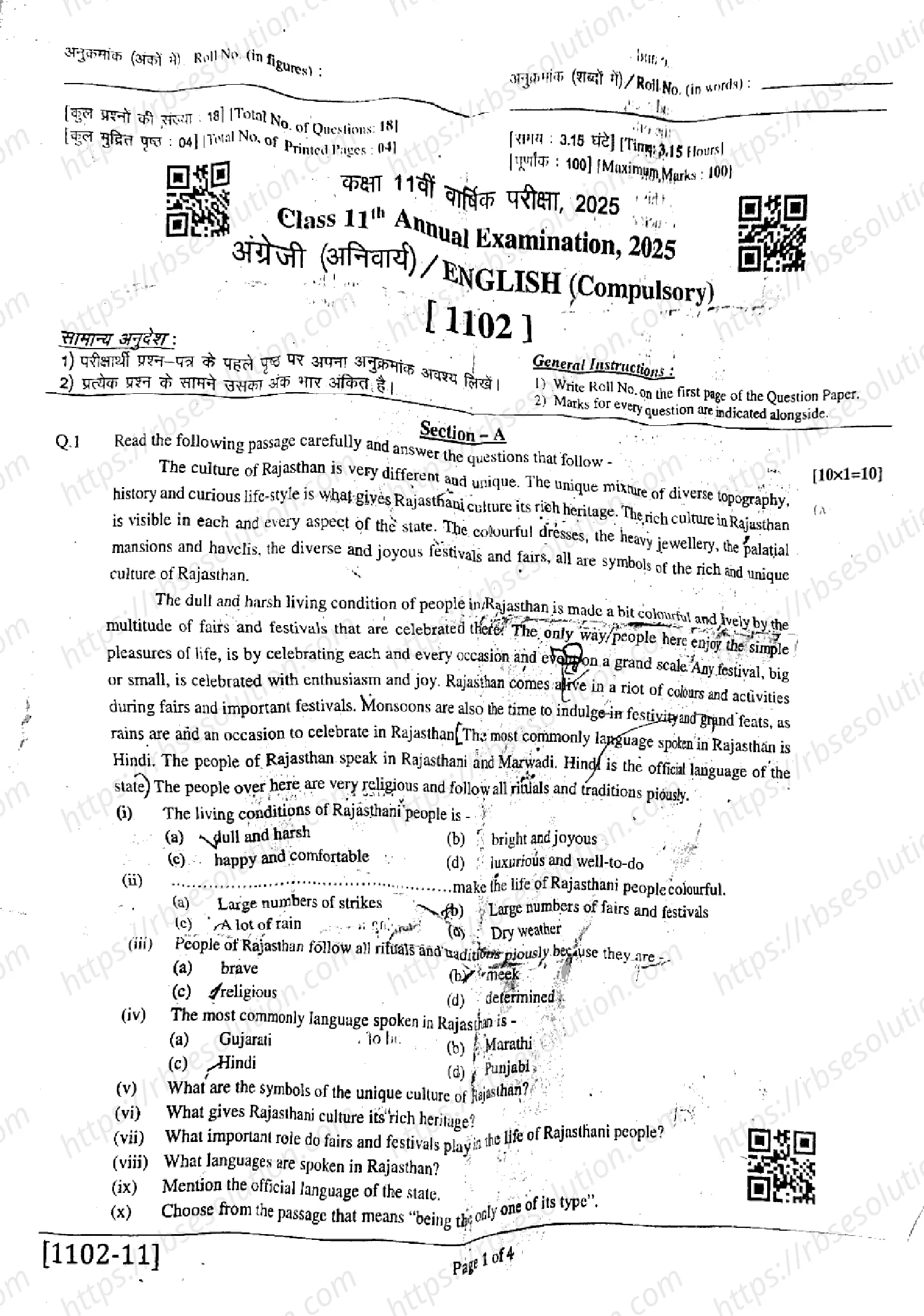


Rajasthan Board Class 11th English-(1102)-2025 2025 solved Previous Year Question Papers
वार्षिक परीक्षा, 2025
ANNUAL EXAMINATION 2025
ENGLISH (Compulsory)
Class 11th
Roll No. (in words): ____________________
Roll No. (in figures): ____________________
सामान्य निर्देश / General Instructions:
- परीक्षार्थी प्रश्न-पत्र के पहले पृष्ठ पर अपना अनुक्रमांक लिखें।
Write Roll No. on the first page of the question paper. - प्रत्येक प्रश्न के सामने उसका अंक भार अंकित है।
Marks for every question are indicated against it.
Q.1 Read the following passage carefully and answer the questions given below:
The dull and harsh living condition of people in Rajasthan is made a bit colourful and lively by a multitude of fairs and festivals that are celebrated there. The only way people here express their simple pleasures of life is by celebrating each and every occasion on a grand scale. Any festival, big or small, is celebrated with enthusiasm and joy. Rajasthan comes alive in a riot of colours and activities during fairs and important festivals. Monsoons are also the time to indulge in festivities and the rains are indeed an occasion to celebrate in Rajasthan. The most common language spoken in Rajasthan is Hindi. The people of Rajasthan speak in Rajasthani and Marwadi. Hindi is the official language of the state. The people over here are very religious and follow all rituals and traditions piously. Jewellery, the palatial mansions and havelis, the diverse and joyous festivals and fairs all are symbols of the rich and unique culture of Rajasthan.
-
The living conditions of Rajasthani people is ______.
- (a) dull and harsh
- (b) bright and joyous
- (c) happy and comfortable
- (d) luxurious and well-to-do
Correct Answer: (a) dull and harsh
Explanation: The passage states, "The dull and harsh living condition of people in Rajasthan..."
-
______ make the life of Rajasthani people colourful.
- (a) Large numbers of strikes
- (b) Large numbers of fairs and festivals
- (c) A lot of rain
- (d) Dry weather
Correct Answer: (b) Large numbers of fairs and festivals
Explanation: The passage says, "made a bit colourful and lively by a multitude of fairs and festivals."
-
People of Rajasthan follow all rituals and traditions piously because they are ______.
- (a) brave
- (b) meek
- (c) religious
- (d) determined
Correct Answer: (c) religious
Explanation: The passage mentions, "The people over here are very religious and follow all rituals and traditions piously."
-
The most commonly spoken language in Rajasthan is ______.
- (a) Gujarati
- (b) Marathi
- (c) Hindi
- (d) Punjabi
Correct Answer: (c) Hindi
Explanation: The passage states, "The most common language spoken in Rajasthan is Hindi."
-
What are the symbols of the unique culture of Rajasthan?
Answer: Jewellery, palatial mansions and havelis, and diverse and joyous festivals and fairs are the symbols of the unique culture of Rajasthan.
-
What gives Rajasthani culture its rich heritage?
Answer: The rich and unique culture of Rajasthan, including its jewellery, architecture, festivals, and traditions, gives it a rich heritage.
-
What important role do fairs and festivals play in the life of Rajasthani people?
Answer: Fairs and festivals make the dull and harsh living conditions colourful and lively. They allow people to express their simple pleasures of life and celebrate every occasion with enthusiasm and joy.
-
What languages are spoken in Rajasthan?
Answer: The languages spoken in Rajasthan are Hindi, Rajasthani, and Marwadi.
-
Mention the official language of the state.
Answer: The official language of the state is Hindi.
-
Choose from the passage the word that means "one of its type" (unique).
Answer: The word is "unique".
[02-4] Page 1 of 4
Read the following passage carefully and answer the questions that follow:
When Aurangzeb imprisoned Shivaji at Agra, he (Shivaji) made plans and escaped from there in 1666. At this, the whole of Maharashtra was filled with great joy. Aurangzeb, on the other hand, got furious and broke all the treaties made by him with Shivaji. He decided to destroy the small Maratha Kingdom in many ways. Shivaji did not watch all this quietly. He decided to take suitable steps. He consulted his brave and trusted generals, like Pratap Rao and Niraji Rao. He organized his own forces and began to recover fort after fort from the hands of Aurangzeb. The Maratha soldiers were determined even to die for Shivaji. This bravery and determination helped them to recover the forts one after another from the Mughal possession. Such was the state of affairs in January, 1667.
Though Shivaji's forces captured many forts in the Deccan, his mother Jijabai was equally anxious to get back the strategic fort – the fort of Kondana. She said to him, "Shivaji, I love the fort of Kondana because of its importance, and unless that is taken back from the Mughals, my heart will never be at rest."
Questions:
-
Where was Shivaji imprisoned by Aurangzeb?
- (a) Delhi
- (b) Agra
- (c) Madras
- (d) Lucknow
Explanation: The passage clearly states, "When Aurangzeb imprisoned Shivaji at Agra..."
-
When Aurangzeb began to trouble the small Maratha Kingdom, Shivaji –
- (a) watched all this quietly.
- (b) decided to sign a treaty with the Mughals.
- (c) decided to take suitable steps to face the Mughals.
- (d) None of the above.
Explanation: The passage says, "Shivaji did not watch all this quietly. He decided to take suitable steps."
-
Who was equally anxious to get back the strategic fort?
- (a) Pratap Rao
- (b) Niraji Rao
- (c) Jijabai
- (d) Aurangzeb
Explanation: The passage mentions, "his mother Jijabai was equally anxious to get back the strategic fort."
-
What type of King was Shivaji, the great?
Shivaji was a brave, determined, and strategic king. He did not accept defeat quietly but took suitable steps to protect his kingdom. He consulted his trusted generals, organized his forces, and recovered forts from the Mughals one by one. His soldiers were willing to die for him, showing his leadership and the loyalty he inspired.
-
How did Shivaji come out of the prison of Aurangzeb?
Shivaji made clever plans and escaped from the prison at Agra in 1666. The passage states that he "made plans and escaped from there in 1666."
-
What did Shivaji do to get back his forts?
Shivaji consulted his brave and trusted generals like Pratap Rao and Niraji Rao, organized his own forces, and began to recover fort after fort from the hands of Aurangzeb. His soldiers were determined and brave, which helped them succeed.
-
What helped the Marathas to recover the forts?
The bravery and determination of the Maratha soldiers helped them recover the forts. The passage says, "This bravery and determination helped them to recover the forts one after another from the Mughal possession."
-
Why did Shivaji and Jijabai value the fort of Kondana?
Jijabai valued the fort of Kondana because of its strategic importance. She said, "I love the fort of Kondana because of its importance, and unless that is taken back from the Mughals, my heart will never be at rest."
-
Write the opposite of the word 'Coward' from the passage:
- (a) Brave
- (b) Anxious
- (c) Trusted
- (d) Furious
Explanation: The opposite of 'coward' is 'brave', which is used in the passage to describe Shivaji and his soldiers.
-
Find from the passage, the similar word of 'Nervous':
- (a) Brave
- (b) Anxious
- (c) Trusted
- (d) Furious
Explanation: 'Anxious' is similar in meaning to 'nervous' or 'worried', and it is used in the passage to describe Jijabai's feelings.
Section-B
Write a task in 100-120 words giving description of an event on "The Prize Distribution Function" based on the hints given below:
Hints: (i) Building was decorated (ii) Cultural programme (iii) Annual report (iv) Speeches, given prizes by the Principal
The Prize Distribution Function
The annual prize distribution function of our school was held on 15th March. The school building was beautifully decorated with flowers, lights, and colourful buntings. The function began with a welcome song and a cultural programme. Students presented dances, skits, and songs that entertained everyone. The Principal read the annual report, highlighting the achievements of the school and students throughout the year. Then, the chief guest gave a motivational speech, encouraging students to work hard and aim high. Finally, the Principal distributed prizes to students who excelled in academics, sports, and other activities. The function ended with a vote of thanks. It was a memorable and inspiring event for all.
OR
Write a task in 100-120 words giving description of process of 'Planting a Sapling' based on the hints given below:
Hints: (i) Cow dung or soil (ii) dig a hole (iii) put the sapling (plant) (iv) adjust it (v) fill with soil (vi) water it
Planting a Sapling
Planting a sapling is a simple but important process. First, choose a suitable place with enough sunlight. Mix cow dung with soil to make the ground fertile. Then, dig a hole deep enough to hold the roots of the sapling. Carefully put the sapling into the hole and adjust it so that it stands straight. Fill the hole with the mixture of soil and cow dung, pressing it gently around the base. Finally, water the sapling generously. Regular watering and care will help the sapling grow into a strong tree. Planting trees is a great way to protect our environment.
Write an Article in 100-120 words under the heading, "India – The Land of Knowledge":
India – The Land of Knowledge
India has been a land of knowledge and wisdom since ancient times. From the Vedas and Upanishads to the discoveries in mathematics, astronomy, and medicine, India has contributed greatly to the world. Great scholars like Aryabhata, Chanakya, and Tagore have enriched human knowledge. Even today, India produces brilliant scientists, engineers, and thinkers. The Indian education system emphasizes both material and spiritual knowledge. With its ancient universities like Nalanda and Takshashila, India has always been a centre of learning. As the land of knowledge, India continues to inspire the world with its rich intellectual heritage and modern achievements.
OR
Write a report in 100-120 words on "Yuva Mahotsav":
Yuva Mahotsav
The Yuva Mahotsav was celebrated in our city with great enthusiasm on 12th January. Students from various schools and colleges participated in the event. The festival included cultural performances like dance, music, drama, and poetry recitation. There were also competitions in painting, essay writing, and debates. The aim of the Mahotsav was to showcase the talent and creativity of the youth. The chief guest encouraged young people to work for the nation's development. The event was a grand success and inspired everyone to participate in such activities. It was a wonderful platform for young minds to express themselves.
You are Rajesh, 16 Ashok Nagar, Udaipur. Write a letter to the Secretary, Board of Secondary Education, Rajasthan, Ajmer, asking for a duplicate copy of your mark sheet:
16, Ashok Nagar
Udaipur
15th March 2025
To,
The Secretary
Board of Secondary Education
Rajasthan, Ajmer
Subject: Request for Duplicate Mark Sheet
Respected Sir/Madam,
I, Rajesh, a student of Class XI, had appeared for the Board Examination in the year 2024. Unfortunately, I have lost my original mark sheet. I request you to kindly issue me a duplicate copy of my mark sheet. I am enclosing the necessary documents and fee as required. I shall be grateful for your kind help.
Thanking you,
Yours faithfully,
Rajesh
OR
You are Ravindra Sharma, a student of Class XI. The water tank of your school has been leaking for days. Write a letter to the Principal of your school to make arrangements to clean the water tank and repair it immediately:
Class XI
Government Senior Secondary School
Udaipur
15th March 2025
To,
The Principal
Government Senior Secondary School
Udaipur
Subject: Request for Cleaning and Repair of Water Tank
Respected Sir/Madam,
I am a student of Class XI of your school. I wish to bring to your kind notice that the water tank of our school has been leaking for several days. This is causing wastage of water and also making the area dirty. Moreover, the water may get contaminated, which can harm our health. I request you to kindly make arrangements to clean the water tank and repair it immediately. This will ensure clean drinking water for all students and staff.
Thanking you,
Yours obediently,
Ravindra Sharma
Class XI
0.6 Fill in the blanks with suitable determiners given in brackets – (a/an/the)
- I will finish this work within an hour. (a/an/the)
- There are some trees behind our school. (some/any)
- I have a few friends. (few/a few/the few)
- Many persons were invited to the party. (many/much)
0.7 Fill in the blanks with the correct form of the verbs given in brackets –
- She was watching T.V. when the doorbell rang. (watch)
- The Sun sets in the West. (set)
- They have sold their house lately. (sell)
- Sita had completed her work before I went to her. (complete)
0.8 Fill in the blanks with suitable modals given in brackets –
- You may go home. (Formal permission)
- You must not overtake from the left. (Prohibition)
- He can teach Mathematics. (Ability)
- That is a dangerous place, he should not go there. (Suggestion)
0.9 Fill in the blanks by choosing appropriate prepositions given in brackets –
- They walked slowly across the field. (across/along)
- I was born on 15th August. (in/on)
- The kite is flying above the clouds. (above/over)
- She did not agree with me. (at/with)
0.10 Read the following passage carefully and answer the questions given below –
Passage 1: She could never have been pretty, but she was always beautiful. She hobbled about the house in spotless white with one hand resting on her waist to balance her stoop and the other telling the beads of her rosary. Her silver locks were scattered untidily over her pale, puckered face, and her lips constantly moved in a prayer. Yes, she was beautiful. She was like the winter landscape in the Mountains, an expanse of pure serenity, breathing peace and contentment. My grandmother and I were good friends.
- Why did grandmother keep her one hand on her waist?
She kept one hand on her waist to balance her stoop. - What does the author compare his grandmother to?
The author compares his grandmother to the winter landscape in the Mountains, an expanse of pure serenity. - How did the author's grandmother look?
She had silver locks scattered untidily over her pale, puckered face, and she hobbled about in spotless white clothes. - How did the grandmother used to pray?
She used to pray with her lips constantly moving in a prayer while telling the beads of her rosary. - What did the grandmother have in one hand?
She had the beads of her rosary in one hand. - Give the antonym of 'never' from the passage.
The antonym of 'never' is always.
Passage 2: The population of India is estimated to be 920 million today, more than the entire populations of Africa and South America put together. No one familiar with the conditions in India would doubt that thousands of people would die in their hungry hutments unless population control is given topmost priority. For the first time in human history, we see a transcending concern — the survival not just of people, but of the planet. We have begun to take a holistic view of the very basis of our existence. The environmental problem does not necessarily signal our demise, it is our passport for the future. The emerging new world vision has ushered in the Era of Responsibility. It is a holistic view, seeing the world as an integrated whole rather than a dissociated collection of parts.
- What is surprising about the population of India?
It is surprising that India's population (920 million) is more than the entire populations of Africa and South America put together. - What would happen if the population is not controlled?
Thousands of people would die in their hungry hutments. - What is the concern seen for the first time in human history?
The concern is the survival not just of people, but of the planet. - What is the contribution of the emerging new world vision?
It has ushered in the Era of Responsibility. - What is the emerging new world vision?
It is a holistic view that sees the world as an integrated whole rather than a dissociated collection of parts. - Give the synonym of 'vision' from the passage.
The synonym of 'vision' is view.
0.11 Attempt any three questions and answer –
- What had Professor Gaitonde been doing before his collision with the truck? (The Adventure)
Professor Gaitonde had been thinking about the Battle of Panipat and the historical possibilities before his collision with the truck. - The article has been titled 'Silk Road'. Why? (Silk Road)
The article is titled 'Silk Road' because the journey described follows the ancient Silk Road route that connected China to the Mediterranean, passing through various regions of Central Asia. - Mention the turning point in the relationship between the writer and his grandmother. (The Portrait of a Lady)
The turning point was when the writer moved to the city to live with his parents, and the grandmother no longer accompanied him to school, leading to a gradual distance in their relationship. - What do you mean by 'Sustainable development'? (The Ailing Planet)
Sustainable development means meeting the needs of the present without compromising the ability of future generations to meet their own needs, ensuring a balance between economic growth, environmental protection, and social well-being.
Q.2. Answer these questions in about 50-60 words (Any Two) [2×4=8]
- How does the trip, "The Adventure", try to be a saga? (The Adventure)
- Mention the three phases of the author's relationship with his grandmother before he left the country. (The Portrait of a Lady)
- How was Norbu helpful to the author? (Silk Road)
OR
- Who was Tut? What mystery surrounded him? (Discovering Tut)
Q.3. Explain any one of the following Stanzas with reference to the context [1×4=4]
Where did my childhood go?
It went to some forgotten place,
That's hidden in an infant's face,
That's all I know. (Childhood)
OR
Silence surrounds us. I would have him prodigal
Returning to his father's house, the home he knew,
Rather than see him make any move his world,
I would forgive him too,
Shaping from sorrow a new love. (Father to Son)
Q.4. Answer any two out of the following questions in 20 to 30 words [2×2=4]
- Give the central idea of the Poem 'Father to Son'. (Father to Son)
- What did the poet realise about the adults? (Childhood)
- What happens when the goldfinch enters the thickness? (The Laburnum Top)
Q.5. Answer any one from the following questions in about 60-80 words [1×4=4]
- What is the poet's feeling towards childhood? (Childhood)
OR
- What is the agony of the father? In what way is he ready to compromise? (Father to Son)
Q.6. Answer any one from the following questions in about 50 to 60 words [1×4=4]
- "Oh God! I have done something real at last," why did Andrew utter such words? (Birth)
OR
- Narrate 'The Tale of Melon City' in your own words. (The Tale of Melon City)
Q.7. Answer any three from the following questions in about 20-30 words [3×2=6]
- What did the wisest man counsel? (The Tale of Melon City)
- Do you agree with the title "Birth"? Comment.
- How did Shahid and the narrator develop their friendship? (The Ghat of the Only World)
- Compare Mrs. Pearson and Mrs. Fitzgerald. (The Address)
Q.8. Choose the correct alternative [4×1=4]
- Who did the chief of builders blame?
- The public
- The architect
- The masons
- The workmen
- Who was the old woman mentioned here?
- The midwife
- Andrew's mother
- Morgan's mother
- Shahid passed away while he was
- driving
- sleeping
- writing
- cooking
- Mrs. Pearson's family look at and treat her
- as a servant only
- as a human being
- as a paper
- None of the above