
RBSE Class 11th 2026 AGRICULTURE-CHEMISTRY-1105 Previous Year Papers
You opened the RBSE Class 11th 2026 AGRICULTURE-CHEMISTRY-1105 Previous Year Papers page — a focused place to read the real previous year question paper for that subject and year. RBSE Solution keeps exam-year sets together so you can practise the same cycle your seniors faced.
Previous year papers reward patience: read instructions, note mark distribution, then attempt questions before peeking at solutions elsewhere on the site. This URL always loads the same free previous year papers content for AGRICULTURE-CHEMISTRY-1105 (2026).
Use the details table to confirm class and year, then scroll to the paper images or PDF below. More subjects from 2026 are linked later on this page.
Paper details
Quick reference for this previous year papers page — confirm board, class, and year & subject before you study.
| Board | RBSE |
|---|---|
| Class | Class 11th |
| Exam year | 2026 |
| Subject | AGRICULTURE-CHEMISTRY-1105 |
| Resource type | Previous Year Papers |
| Category | RBSE Previous Year Question Papers |
| Website | RBSE Solution |
The table summarises this Previous Year Papers resource. Confirm RBSE, Class 11th, year 2026, and subject AGRICULTURE-CHEMISTRY-1105 before studying.
RBSE Solution organises previous year papers so each URL carries chapter-specific guidance — better for students and for search engines than one generic paragraph for the whole class.
How to practise with this question paper
Stage one: read the AGRICULTURE-CHEMISTRY-1105 question paper from 2026 without a timer and highlight command words — explain, prove, calculate, discuss. Stage two: attempt selected questions closed-book. Stage three: compare with solutions or teacher feedback.
Previous Year Papers work best when you log mistakes by topic, not only by question number. That log becomes your revision index before pre-boards.
RBSE Class 11th 2026 AGRICULTURE-CHEMISTRY-1105
Scroll through the Previous Year Papers pages for AGRICULTURE-CHEMISTRY-1105 (2026).
Rajasthan Board Class 11th AGRICULTURE-CHEMISTRY-1105 2026 solved Previous Year Question Papers
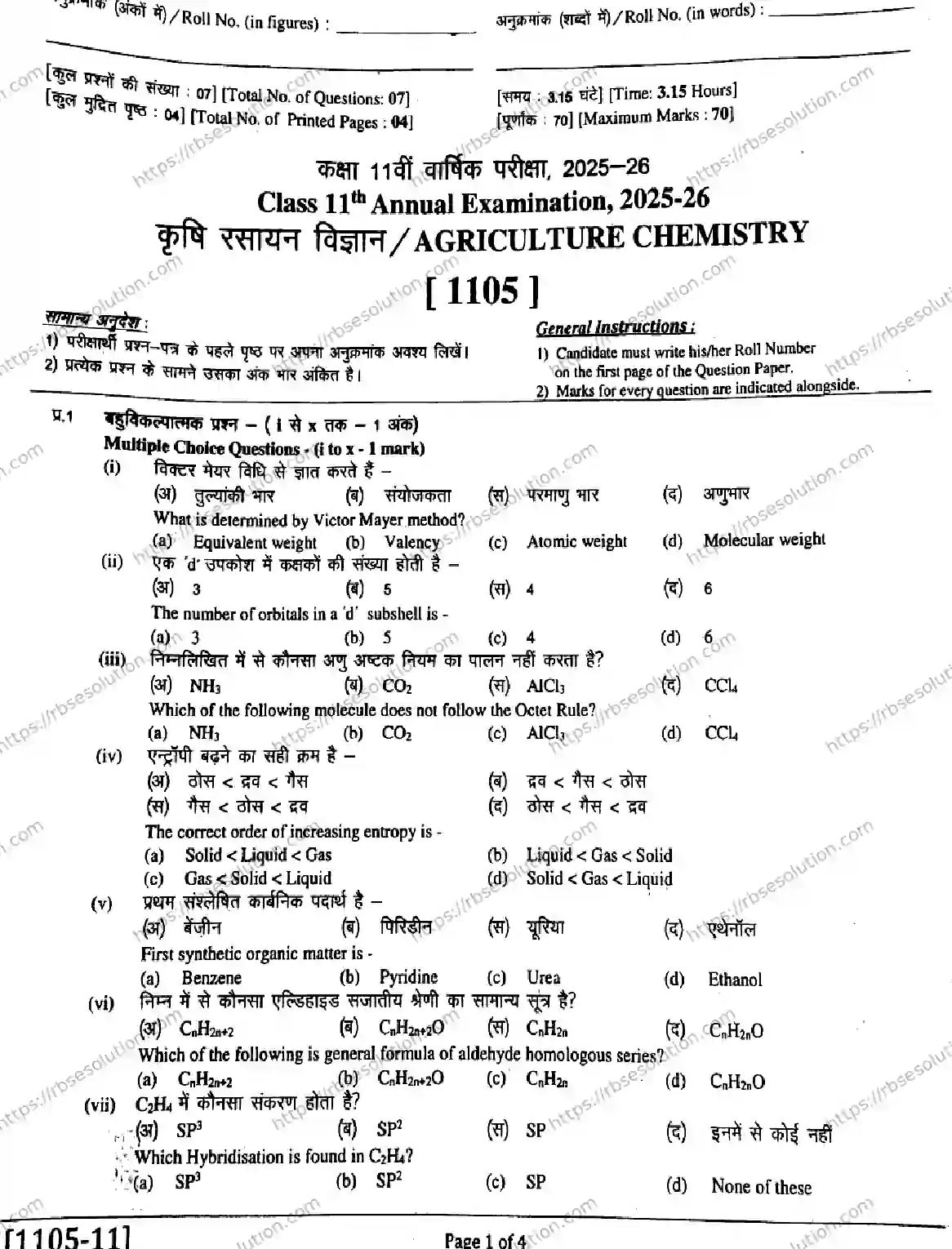
कक्षा 11वीं वार्षिक परीक्षा, 2025-26
कृषि रसायन / AGRICULTURE CHEMISTRY (1105)
समय : 3.15 घंटे | Time: 3.15 Hours
पूर्णांक : 70 | Maximum Marks : 70
सामान्य अनुदेश / General Instructions:
- परीक्षार्थी प्रत्येक प्रश्न पत्र के पहले पृष्ठ पर अपना अनुक्रमांक अवश्य लिखें।
Candidate must write his/her Roll Number on the first page of the Question Paper. - प्रत्येक प्रश्न के सामने उसका अंक भार अंकित है।
Marks for every question are indicated alongside.
बहुविकल्पात्मक प्रश्न / Multiple Choice Questions (i to x - 1 mark each)
(i) विक्टर मेयर विधि से ज्ञात किया जाता है -
What is determined by Victor Mayer method?
- (अ) तुल्यांकी भार / Equivalent weight
- (ब) संयोजकता / Valency
- (स) परमाणु भार / Atomic weight
- (द) अणु भार / Molecular weight
व्याख्या / Explanation: विक्टर मेयर विधि का उपयोग वाष्पनशील पदार्थों के अणु भार ज्ञात करने के लिए किया जाता है।
(ii) एक 'd' उपकोश में कक्षकों की संख्या होती है -
The number of orbitals in a 'd' subshell is -
- (अ) 3
- (ब) 5
- (स) 4
- (द) 6
व्याख्या / Explanation: d उपकोश में 5 कक्षक होते हैं, जिन्हें dxy, dyz, dzx, dx²-y², dz² कहा जाता है।
(iii) निम्नलिखित में से कौनसा अणु अष्टक नियम का पालन नहीं करता है?
Which of the following molecule does not follow the Octet Rule?
- (अ) NH₃
- (ब) CO₂
- (स) AlCl₃
- (द) CCl₄
व्याख्या / Explanation: AlCl₃ में एल्युमिनियम के चारों ओर केवल 6 इलेक्ट्रॉन होते हैं, अतः यह अष्टक नियम का पालन नहीं करता।
(iv) एन्ट्रॉपी बढ़ने का सही क्रम है -
The correct order of increasing entropy is -
- (अ) ठोस < द्रव < गैस / Solid < Liquid < Gas
- (ब) द्रव < गैस < ठोस / Liquid < Gas < Solid
- (स) गैस < ठोस < द्रव / Gas < Solid < Liquid
- (द) ठोस < गैस < द्रव / Solid < Gas < Liquid
व्याख्या / Explanation: एन्ट्रॉपी (अव्यवस्था) ठोस में सबसे कम, द्रव में मध्यम और गैस में सबसे अधिक होती है।
(v) प्रथम संश्लेषित कार्बनिक पदार्थ है -
First synthetic organic matter is -
- (अ) बेंजीन / Benzene
- (ब) पिरिडीन / Pyridine
- (स) यूरिया / Urea
- (द) एथेनॉल / Ethanol
व्याख्या / Explanation: फ्रेडरिक वोहलर ने 1828 में अकार्बनिक पदार्थ अमोनियम साइनेट से यूरिया का संश्लेषण किया था।
(vi) निम्न में से कौनसा एल्डिहाइड सजातीय श्रेणी का सामान्य सूत्र है?
Which of the following is general formula of aldehyde homologous series?
- (अ) CₙH₂ₙ₊₂
- (ब) CₙH₂ₙO
- (स) CₙH₂ₙ₊₁OH
- (द) CₙH₂ₙ₊₁CHO
व्याख्या / Explanation: एल्डिहाइड का सामान्य सूत्र CₙH₂ₙO है, जहाँ n = 1, 2, 3... होता है।
(vii) C₂H₄ में कौनसा संकरण पाया जाता है?
Which Hybridisation is found in C₂H₄?
- (अ) sp
- (ब) sp²
- (स) sp³
- (द) इनमें से कोई नहीं / None of these
व्याख्या / Explanation: एथीन (C₂H₄) में प्रत्येक कार्बन परमाणु sp² संकरित होता है, जिससे त्रिकोणीय समतल ज्यामिति बनती है।
प्रश्न 2 (ix)
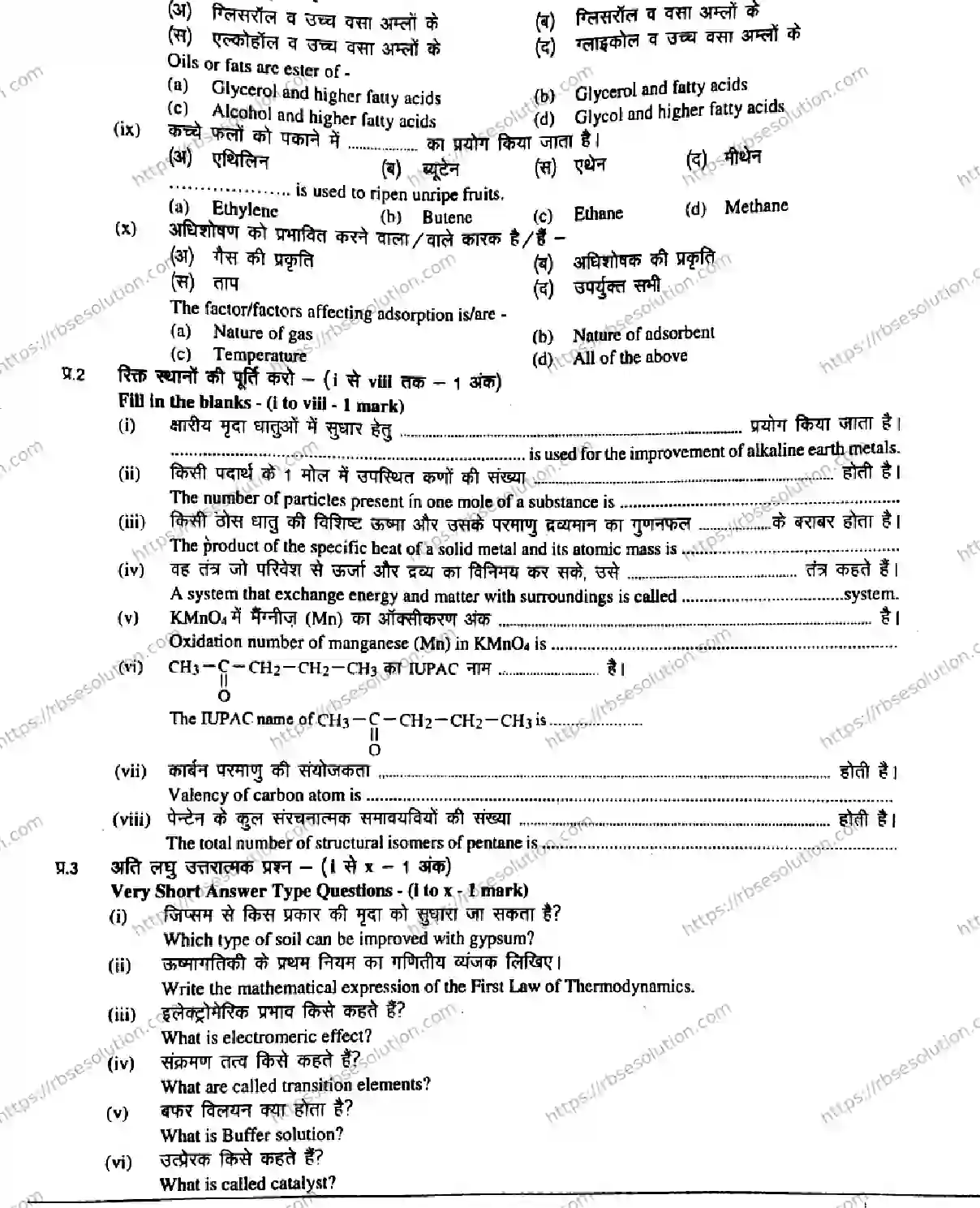
वसा किसके एस्टर होते हैं? / Fats are esters of -
- (अ) ग्लिसरॉल व उच्च वसा अम्लों के / Glycerol and higher fatty acids
- (ब) ग्लिसरॉल व वसा अम्लों के / Glycerol and fatty acids
- (स) एल्कोहॉल व उच्च वसा अम्लों के / Alcohol and higher fatty acids
- (द) ग्लाइकोल व उच्च वसा अम्लों के / Glycol and higher fatty acids
सही उत्तर: (अ) ग्लिसरॉल व उच्च वसा अम्लों के / Glycerol and higher fatty acids
वसा ग्लिसरॉल (एक ट्राइहाइड्रिक एल्कोहॉल) और उच्च वसा अम्लों के एस्टर होते हैं।
प्रश्न 2 (x)
कच्चे फलों को पकाने के लिए किस गैस का उपयोग किया जाता है? / Which gas is used to ripen raw fruits?
- (अ) एथिलीन / Ethylene
- (ब) एथेन / Ethane
- (स) मीथेन / Methane
- (द) प्रोपेन / Propane
सही उत्तर: (अ) एथिलीन / Ethylene
एथिलीन एक पादप हार्मोन है जो फलों को पकाने में सहायक होता है।
प्रश्न 3
अधिशोषण को प्रभावित करने वाले कारक हैं - / The factor/factors affecting adsorption is/are -
- (अ) गैस की प्रकृति / Nature of gas
- (ब) अधिशोषक की प्रकृति / Nature of adsorbent
- (स) ताप / Temperature
- (द) उपर्युक्त सभी / All of the above
सही उत्तर: (द) उपर्युक्त सभी / All of the above
अधिशोषण गैस की प्रकृति, अधिशोषक की प्रकृति और तापमान से प्रभावित होता है।
रिक्त स्थानों की पूर्ति करो - (i से viii तक - 1 अंक प्रत्येक) / Fill in the blanks - (i to viii - 1 mark each)
-
क्षारीय मृदा धातुओं में सुधार हेतु जिप्सम प्रयोग किया जाता है। / Gypsum is used for the improvement of alkaline earth metals.
-
किसी पदार्थ के एक मोल में उपस्थित कणों की संख्या 6.022 × 10²³ होती है। / The number of particles present in one mole of a substance is 6.022 × 10²³.
-
किसी ठोस धातु की विशिष्ट ऊष्मा और उसके परमाणु द्रव्यमान का गुणनफल लगभग 6.4 कैलोरी/डिग्री सेल्सियस होता है। / The product of the specific heat of a solid metal and its atomic mass is approximately 6.4 cal/°C.
-
वह तंत्र जो परिवेश से ऊर्जा और द्रव्य का विनिमय कर सके, उसे खुला तंत्र कहते हैं। / A system that exchanges energy and matter with surroundings is called an open system.
-
KMnO₄ में मैंगनीज (Mn) का ऑक्सीकरण अंक +7 है। / Oxidation number of manganese (Mn) in KMnO₄ is +7.
-
CH₃—CH=CH—CH₂—CH₃ का IUPAC नाम पेन्ट-2-ईन है। / The IUPAC name of CH₃—CH=CH—CH₂—CH₃ is pent-2-ene.
-
कार्बन परमाणु की संयोजकता 4 होती है। / Valency of carbon atom is 4.
-
पेन्टेन के कुल संरचनात्मक समावयवियों की संख्या 3 है। / The total number of structural isomers of pentane is 3.
अति लघु उत्तरात्मक प्रश्न - (i से x तक - 1 अंक प्रत्येक) / Very Short Answer Type Questions - (i to x - 1 mark each)
-
जिप्सम से किस प्रकार की मृदा को सुधारा जा सकता है? / Which type of soil can be improved with gypsum?
जिप्सम का उपयोग क्षारीय मृदा (alkaline soil) को सुधारने के लिए किया जाता है। यह मृदा में सोडियम की मात्रा को कम करता है।
-
ऊष्मागतिकी के प्रथम नियम का गणितीय व्यंजक लिखिए। / Write the mathematical expression of the First Law of Thermodynamics.
ऊष्मागतिकी के प्रथम नियम का गणितीय व्यंजक है: ΔU = q + w, जहाँ ΔU आंतरिक ऊर्जा में परिवर्तन, q तंत्र द्वारा अवशोषित ऊष्मा, और w तंत्र पर किया गया कार्य है।
-
इलेक्ट्रोमेरिक प्रभाव किसे कहते हैं? / What is electromeric effect?
इलेक्ट्रोमेरिक प्रभाव एक अस्थायी प्रभाव है जिसमें किसी अभिकर्मक की उपस्थिति में π-इलेक्ट्रॉनों का पूर्ण स्थानांतरण होता है, जिससे एक छोर पर आंशिक ऋणात्मक आवेश और दूसरे छोर पर आंशिक धनात्मक आवेश उत्पन्न होता है।
-
संक्रमण तत्व किसे कहते हैं? / What are called transition elements?
संक्रमण तत्व वे तत्व हैं जिनमें d-कक्षक आंशिक रूप से भरे होते हैं। ये तत्व आवर्त सारणी के d-ब्लॉक में स्थित होते हैं और इनके यौगिक प्रायः रंगीन होते हैं।
-
बफर विलयन क्या होता है? / What is Buffer solution?
बफर विलयन वह विलयन है जो तनुकरण या अल्प मात्रा में अम्ल या क्षार मिलाने पर अपने pH मान में परिवर्तन का प्रतिरोध करता है।
-
उत्प्रेरक किसे कहते हैं? / What is called catalyst?
उत्प्रेरक वह पदार्थ है जो रासायनिक अभिक्रिया की दर को बढ़ाता है लेकिन स्वयं अभिक्रिया के अंत में अपरिवर्तित रहता है।
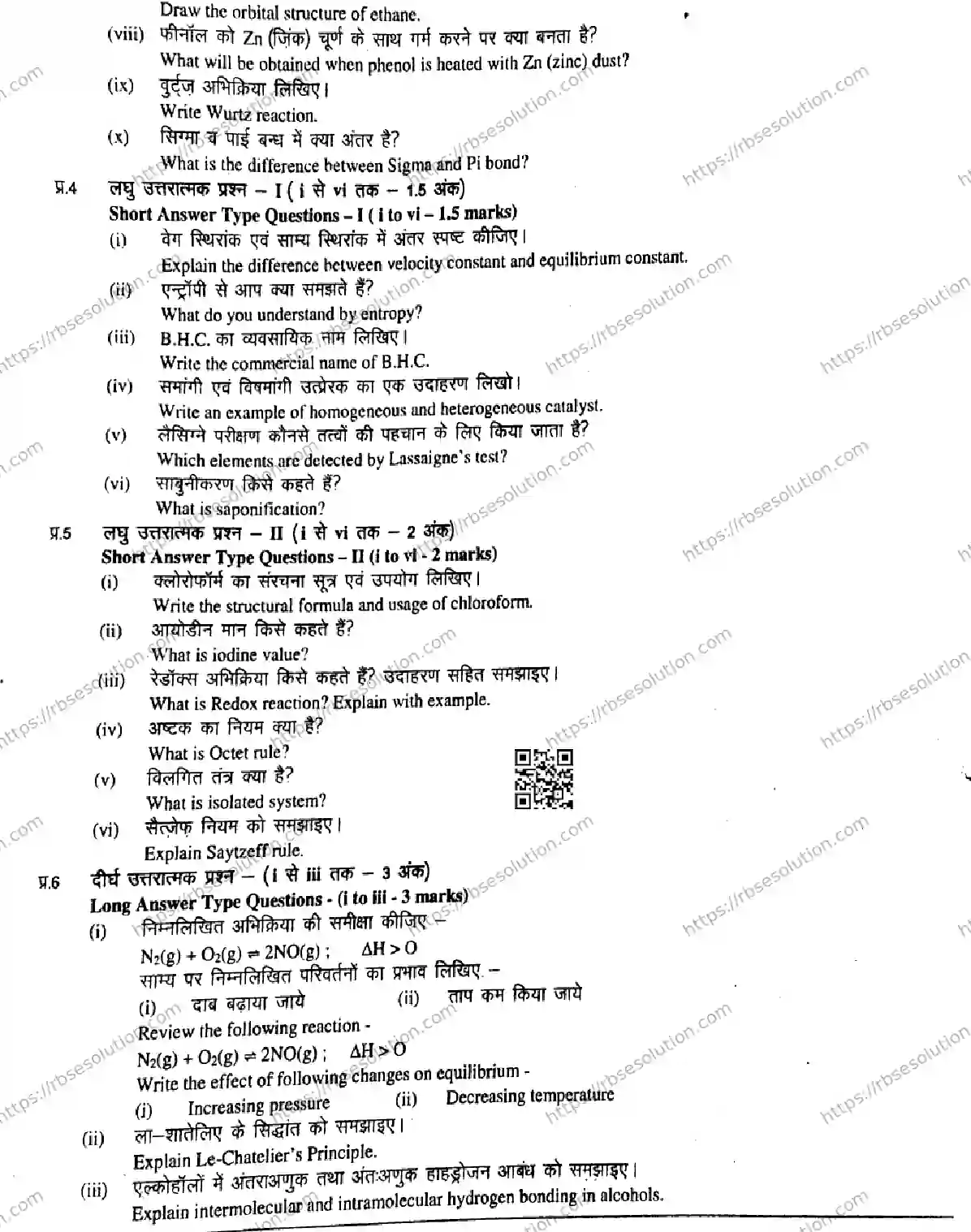
(viii) Draw the orbital structure of ethane.
Orbital structure of ethane (C₂H₆):
In ethane, each carbon atom undergoes sp³ hybridization. Each carbon forms four sigma (σ) bonds: one C–C bond and three C–H bonds. The orbital structure shows:
- Each carbon has four sp³ hybrid orbitals arranged tetrahedrally.
- One sp³ orbital of each carbon overlaps to form the C–C σ bond.
- The remaining three sp³ orbitals of each carbon overlap with 1s orbitals of hydrogen atoms to form C–H σ bonds.
- All bond angles are approximately 109.5°.
(Diagram: Two carbon atoms connected by a single line, each with three hydrogen atoms attached, showing tetrahedral geometry.)
(ix) फीनॉल को Zn (जिंक) चूर्ण के साथ गर्म करने पर क्या बनता है? / What will be obtained when phenol is heated with Zn (zinc) dust?
Answer: When phenol is heated with zinc dust, benzene is obtained.
Reaction:
C₆H₅OH + Zn → C₆H₆ + ZnO
Explanation: Zinc dust acts as a reducing agent. It removes the oxygen atom (as part of the –OH group) from phenol, replacing it with hydrogen, thus forming benzene.
(x) Write Wurtz reaction. / वुर्ट्ज अभिक्रिया लिखिए।
Wurtz reaction: When alkyl halides are treated with sodium metal in dry ether, higher alkanes (with double the number of carbon atoms) are formed.
General reaction:
2R–X + 2Na → R–R + 2NaX
Example:
2CH₃–Br + 2Na → CH₃–CH₃ (ethane) + 2NaBr
(xi) सिग्मा एवं पाई बन्ध में क्या अंतर है? / What is the difference between Sigma and Pi bond?
| Sigma (σ) Bond | Pi (π) Bond |
|---|---|
| Formed by end-to-end (head-on) overlap of orbitals. | Formed by side-to-side (lateral) overlap of orbitals. |
| Stronger bond. | Weaker bond. |
| Free rotation is possible around the bond axis. | Free rotation is not possible. |
| Can exist independently. | Always exists along with a sigma bond. |
| Electron density is concentrated along the internuclear axis. | Electron density is above and below the internuclear axis. |
लघु उत्तरात्मक प्रश्न - I (i से vi तक - ½ अंक) / Short Answer Type Questions - I (i to vi - ½ mark)
(i) वेग स्थिरांक एवं साम्य स्थिरांक में अंतर स्पष्ट कीजिए। / Explain the difference between velocity constant and equilibrium constant.
| Velocity Constant (k) | Equilibrium Constant (K) |
|---|---|
| It is the rate of reaction when the concentration of each reactant is 1 mol/L. | It is the ratio of product concentrations to reactant concentrations at equilibrium. |
| Depends on temperature and nature of reactants. | Depends only on temperature. |
| Unit varies with order of reaction. | No unit (dimensionless) for equal number of moles. |
(ii) एन्ट्रॉपी से आप क्या समझते हैं? / What do you understand by entropy?
Entropy (S) is a thermodynamic quantity that measures the degree of randomness or disorder in a system. The higher the entropy, the greater the disorder. For example, gases have higher entropy than liquids, and liquids have higher entropy than solids. In spontaneous processes, the total entropy of the universe always increases.
(iii) B.H.C. का व्यवसायिक नाम लिखिए। / Write the commercial name of B.H.C.
B.H.C. (Benzene Hexachloride) is commercially known as Gammexane or Lindane. It is used as an insecticide.
(iv) समांगी एवं विषमांगी उत्प्रेरक का एक उदाहरण लिखो। / Write an example of homogeneous and heterogeneous catalyst.
- Homogeneous catalyst: Example – Acid (H₂SO₄) in the esterification reaction (both catalyst and reactants are in the same phase, liquid).
- Heterogeneous catalyst: Example – Iron (Fe) in the Haber process for ammonia synthesis (catalyst is solid, reactants are gases).
(v) लैसिग्ने परीक्षण कौनसे तत्वों की पहचान के लिए किया जाता है? / Which elements are detected by Lassaigne’s test?
Lassaigne’s test is used to detect the presence of nitrogen (N), sulfur (S), and halogens (Cl, Br, I) in organic compounds.
(vi) साबुनीकरण किसे कहते हैं? / What is saponification?
Saponification is the process of hydrolysis of an ester (usually a fat or oil) with an alkali (like NaOH or KOH) to produce soap (salt of fatty acid) and glycerol. For example:
Fat + NaOH → Soap + Glycerol
लघु उत्तरात्मक प्रश्न - II (i से vi तक - 2 अंक) / Short Answer Type Questions - II (i to vi - 2 marks)
(i) क्लोरोफॉर्म का संरचना सूत्र एवं उपयोग लिखिए। / Write the structural formula and usage of chloroform.
Structural formula of chloroform: CHCl₃
Structure:
H – C(Cl)₃ (tetrahedral, with three chlorine atoms and one hydrogen atom attached to carbon)
Uses:
- Used as an anesthetic (historically).
- Used as a solvent for fats, oils, and rubber.
- Used in the preparation of chloramphenicol (an antibiotic).
(ii) आयोडीन मान किसे कहते हैं? / What is iodine value?
Iodine value is the number of grams of iodine absorbed by 100 grams of a fat or oil. It indicates the degree of unsaturation (number of double bonds) in the fat or oil. Higher iodine value means more unsaturation.
(iii) रेडॉक्स अभिक्रिया किसे कहते हैं? उदाहरण सहित समझाइए। / What is Redox reaction? Explain with example.
Redox reaction (Reduction-Oxidation reaction) is a chemical reaction in which both oxidation and reduction occur simultaneously. Oxidation involves loss of electrons (increase in oxidation number), while reduction involves gain of electrons (decrease in oxidation number).
Example: Reaction between zinc and copper sulfate:
Zn + CuSO₄ → ZnSO₄ + Cu
Here, Zn is oxidized (Zn → Zn²⁺ + 2e⁻) and Cu²⁺ is reduced (Cu²⁺ + 2e⁻ → Cu).
(iv) अष्टक का नियम क्या है? / What is Octet rule?
Octet rule states that atoms tend to gain, lose, or share electrons in order to achieve a stable configuration of 8 electrons in their outermost shell (like noble gases). For example, sodium loses one electron to achieve the neon configuration, while chlorine gains one electron to achieve the argon configuration.
(v) विलगित तंत्र क्या है? / What is isolated system?
Isolated system is a thermodynamic system that does not exchange matter or energy with its surroundings. For example, a perfectly insulated thermos flask containing hot coffee is an isolated system (ideally, no heat or mass transfer).
(vi) सैत्ज़ेफ नियम को समझाइए। / Explain Saytzeff rule.
Saytzeff rule (Zaitsev rule) states that in elimination reactions, the more substituted alkene (with more alkyl groups attached to the double bond) is the major product. For example, when 2-bromobutane is treated with alcoholic KOH, the major product is 2-butene (more substituted) rather than 1-butene.
दीर्घ उत्तरात्मक प्रश्न - (i से iii तक - 3 अंक) / Long Answer Type Questions - (i to iii - 3 marks)
(i) निम्नलिखित अभिक्रिया की समीक्षा कीजिए: N₂(g) + O₂(g) ⇌ 2NO(g); ΔH > 0. साम्य पर निम्नलिखित परिवर्तनों का प्रभाव लिखिए: (अ) दाब बढ़ाया जाये (ब) ताप कम किया जाये। / Review the following reaction: N₂(g) + O₂(g) ⇌ 2NO(g); ΔH > 0. Write the effect of following changes on equilibrium: (i) Increasing pressure (ii) Decreasing temperature.
Reaction: N₂(g) + O₂(g) ⇌ 2NO(g); ΔH > 0 (endothermic)
Effect of changes:
- (अ) दाब बढ़ाने पर (Increasing pressure): The number of moles of reactants (1+1=2) equals the number of moles of products (2). Therefore, there is no change in the total number of moles. According to Le-Chatelier's principle, a change in pressure has no effect on the equilibrium position.
- (ब) ताप कम करने पर (Decreasing temperature): Since the reaction is endothermic (ΔH > 0), decreasing temperature favors the reverse (exothermic) reaction. Thus, the equilibrium will shift to the left (towards reactants), producing less NO.
(ii) ला-शातेलिए के सिद्धांत को समझाइए। / Explain Le-Chatelier’s Principle.
Le-Chatelier’s Principle states that if a system at equilibrium is subjected to a change in concentration, temperature, or pressure, the equilibrium shifts in a direction that tends to counteract the effect of the change.
Explanation with examples:
- Effect of concentration: If the concentration of a reactant is increased, the equilibrium shifts to the right (towards products) to use up the added reactant.
- Effect of temperature: For an exothermic reaction (ΔH < 0), increasing temperature shifts equilibrium to the left (reverse reaction). For an endothermic reaction (ΔH > 0), increasing temperature shifts equilibrium to the right.
- Effect of pressure: Increasing pressure favors the side with fewer moles of gas. If the number of moles is equal, pressure has no effect.
(iii) एल्कोहॉलों में
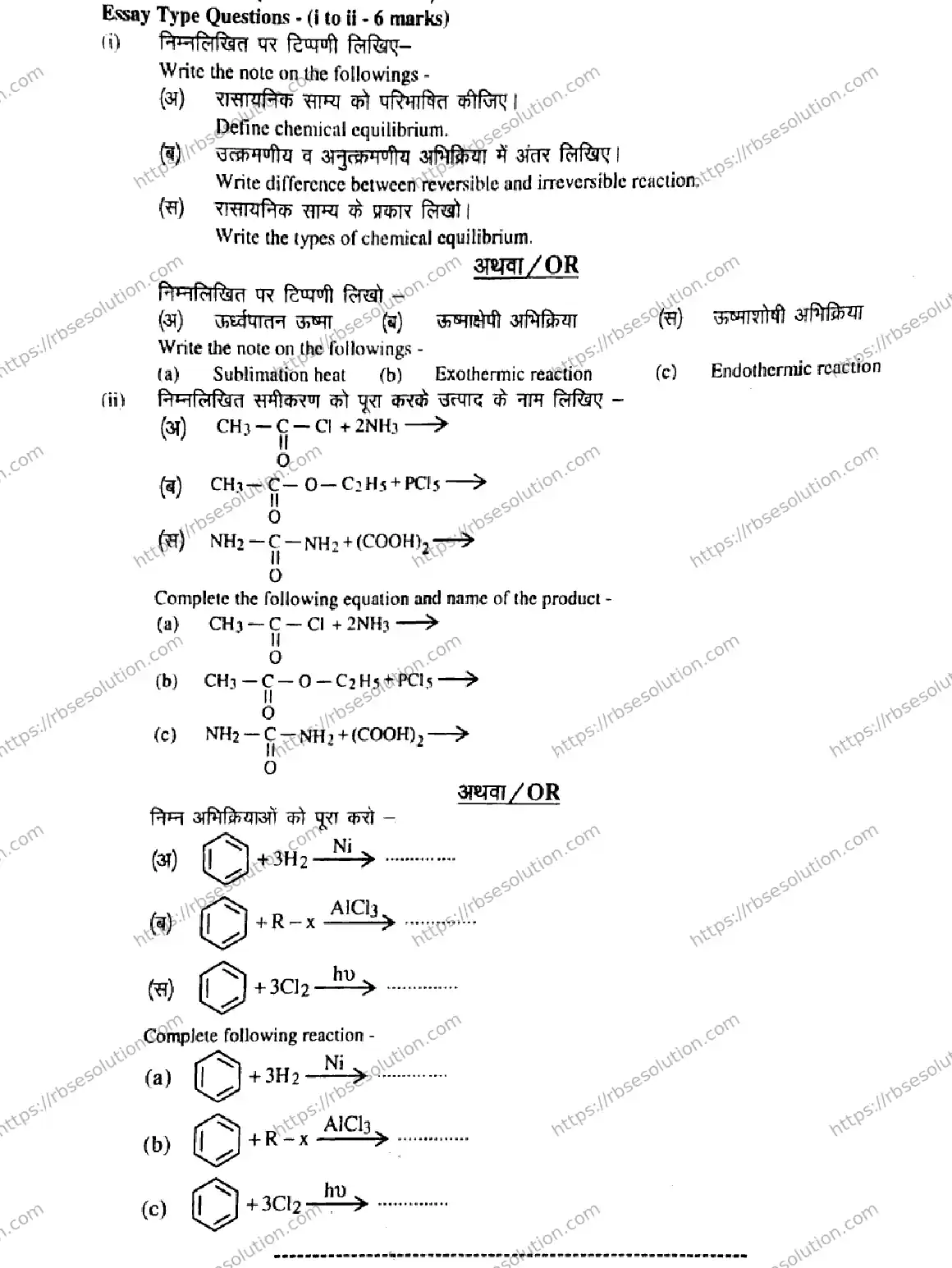
Essay Type Questions - (i to if - 6 marks)
(४) निम्नलिखित पर टिप्पणी लिखिए-
Write the note on the followings -
(अ) रासायनिक साम्य को परिभाषित कीजिए।
Define chemical equilibrium.
रासायनिक साम्य (Chemical Equilibrium): वह अवस्था जिसमें अभिक्रिया में अग्र एवं प्रतिवर्ती अभिक्रिया की दरें समान हो जाती हैं तथा अभिकारकों एवं उत्पादों की सांद्रताएँ समय के साथ स्थिर रहती हैं, रासायनिक साम्य कहलाती है। यह केवल उत्क्रमणीय अभिक्रियाओं में प्राप्त होता है।
(ब) उत्क्रमणीय व अनुत्क्रमणीय अभिक्रिया में अंतर लिखिए।
Write difference between reversible and irreversible reaction:
| क्रम | उत्क्रमणीय अभिक्रिया (Reversible Reaction) | अनुत्क्रमणीय अभिक्रिया (Irreversible Reaction) |
|---|---|---|
| 1. | अभिक्रिया दोनों दिशाओं में हो सकती है। | अभिक्रिया केवल एक दिशा में होती है। |
| 2. | अभिकारक पूर्णतः उत्पादों में नहीं बदलते। | अभिकारक पूर्णतः उत्पादों में बदल जाते हैं। |
| 3. | साम्य स्थापित होता है। | साम्य स्थापित नहीं होता। |
| 4. | उदाहरण: N₂ + 3H₂ ⇌ 2NH₃ | उदाहरण: 2KClO₃ → 2KCl + 3O₂ |
(स) रासायनिक साम्य के प्रकार लिखो।
Write the types of chemical equilibrium.
रासायनिक साम्य दो प्रकार का होता है:
- सजातीय साम्य (Homogeneous Equilibrium): जब अभिकारक एवं उत्पाद सभी एक ही प्रावस्था में होते हैं। उदाहरण: N₂(g) + 3H₂(g) ⇌ 2NH₃(g)
- विषमांगी साम्य (Heterogeneous Equilibrium): जब अभिकारक एवं उत्पाद भिन्न-भिन्न प्रावस्थाओं में होते हैं। उदाहरण: CaCO₃(s) ⇌ CaO(s) + CO₂(g)
अथवा / OR
निम्नलिखित पर टिप्पणी लिखिए-
Write the note on the followings -
(अ) ऊर्ध्वपातन (Sublimation)
ऊर्ध्वपातन (Sublimation): वह प्रक्रिया जिसमें कोई ठोस पदार्थ बिना द्रव अवस्था में परिवर्तित हुए सीधे गैस में बदल जाता है, ऊर्ध्वपातन कहलाती है। उदाहरण: कपूर, नेफ्थलीन, आयोडीन, अमोनियम क्लोराइड।
(ब) ऊष्माक्षेपी अभिक्रिया (Exothermic reaction)
ऊष्माक्षेपी अभिक्रिया (Exothermic Reaction): वह अभिक्रिया जिसमें ऊर्जा (ऊष्मा) मुक्त होती है, ऊष्माक्षेपी अभिक्रिया कहलाती है। इसमें अभिकारकों की कुल ऊर्जा उत्पादों की कुल ऊर्जा से अधिक होती है। उदाहरण: C + O₂ → CO₂ + ऊष्मा
(स) ऊष्माशोषी अभिक्रिया (Endothermic reaction)
ऊष्माशोषी अभिक्रिया (Endothermic Reaction): वह अभिक्रिया जिसमें ऊर्जा (ऊष्मा) अवशोषित होती है, ऊष्माशोषी अभिक्रिया कहलाती है। इसमें अभिकारकों की कुल ऊर्जा उत्पादों की कुल ऊर्जा से कम होती है। उदाहरण: N₂ + O₂ + ऊष्मा → 2NO
निम्नलिखित समीकरण को पूरा करके उत्पाद के नाम लिखिए -
Complete the following equation and name of the product -
(a) CH₃—C—Cl + 2NH₃ →
पूर्ण समीकरण: CH₃—C—Cl + 2NH₃ → CH₃—C—NH₂ + NH₄Cl
उत्पाद का नाम: एसीटामाइड (Acetamide) एवं अमोनियम क्लोराइड
(b) CH₃—C—O—C₂H₅ + PCl₅ →
पूर्ण समीकरण: CH₃—C—O—C₂H₅ + PCl₅ → CH₃—C—Cl + C₂H₅Cl + POCl₃
उत्पाद का नाम: एसीटाइल क्लोराइड, एथिल क्लोराइड एवं फॉस्फोरस ऑक्सीक्लोराइड
(c) NH₂—C—NH₂ + (COOH)₂ →
पूर्ण समीकरण: NH₂—C—NH₂ + (COOH)₂ → NH₂—C—NH—C—COOH + H₂O
उत्पाद का नाम: यूरिया-ऑक्सैलिक अम्ल संघनन उत्पाद (यूरिडोएसिटिक अम्ल)
अथवा / OR
निम्न अभिक्रियाओं को पूरा करो -
Complete following reaction -
(अ) CO + 3H₂ → (Ni/Δ)
पूर्ण समीकरण: CO + 3H₂ → CH₄ + H₂O (Ni उत्प्रेरक, ताप)
उत्पाद का नाम: मीथेन (Methane) एवं जल
(ब) C₆H₆ + R—X → (AlCl₃)
पूर्ण समीकरण: C₆H₆ + R—X → C₆H₅—R + HX (AlCl₃ उत्प्रेरक)
उत्पाद का नाम: एल्किल बेंजीन (Alkyl benzene) एवं हाइड्रोजन हैलाइड
(स) C₆H₆ + 3Cl₂ → (hv)
पूर्ण समीकरण: C₆H₆ + 3Cl₂ → C₆H₆Cl₆ (प्रकाश की उपस्थिति में)
उत्पाद का नाम: बेंजीन हेक्साक्लोराइड (BHC) या गैमेक्सीन