
RBSE Class 11th 2026 ENGLISH-1102 Previous Year Papers
Class 11th students hunting authentic previous year papers for ENGLISH-1102 (2026) land here for a reason: the paper below matches how RBSE assessments are remembered from that year. RBSE Solution does not mix years on one page; each combination gets its own notes.
Skim the overview sections, then work through the scanned pages. Pair this practice with RBSE books and solutions when you need to relearn a concept a question exposed.
Paper details
Quick reference for this previous year papers page — confirm board, class, and year & subject before you study.
| Board | RBSE |
|---|---|
| Class | Class 11th |
| Exam year | 2026 |
| Subject | ENGLISH-1102 |
| Resource type | Previous Year Papers |
| Category | RBSE Previous Year Question Papers |
| Website | RBSE Solution |
The table summarises this Previous Year Papers resource. Confirm RBSE, Class 11th, year 2026, and subject ENGLISH-1102 before studying.
RBSE Solution organises previous year papers so each URL carries chapter-specific guidance — better for students and for search engines than one generic paragraph for the whole class.
Turning 2026 papers into insight
One ENGLISH-1102 paper reveals style; several from the same year reveal pattern. After this page, open sibling subjects listed below to see whether marks cluster in certain units.
Keep rough work dated in your notebook. Examiners in Class 11th expect clear numbering even in practice sessions.
RBSE Class 11th 2026 ENGLISH-1102
Scroll through the Previous Year Papers pages for ENGLISH-1102 (2026).
Rajasthan Board Class 11th ENGLISH-1102 2026 solved Previous Year Question Papers
कक्षा 11वीं वार्षिक परीक्षा, 2025-26
Class 11th Annual Examination, 2025-26
अंग्रेजी (अनिवार्य) / English (Compulsory) [1102]
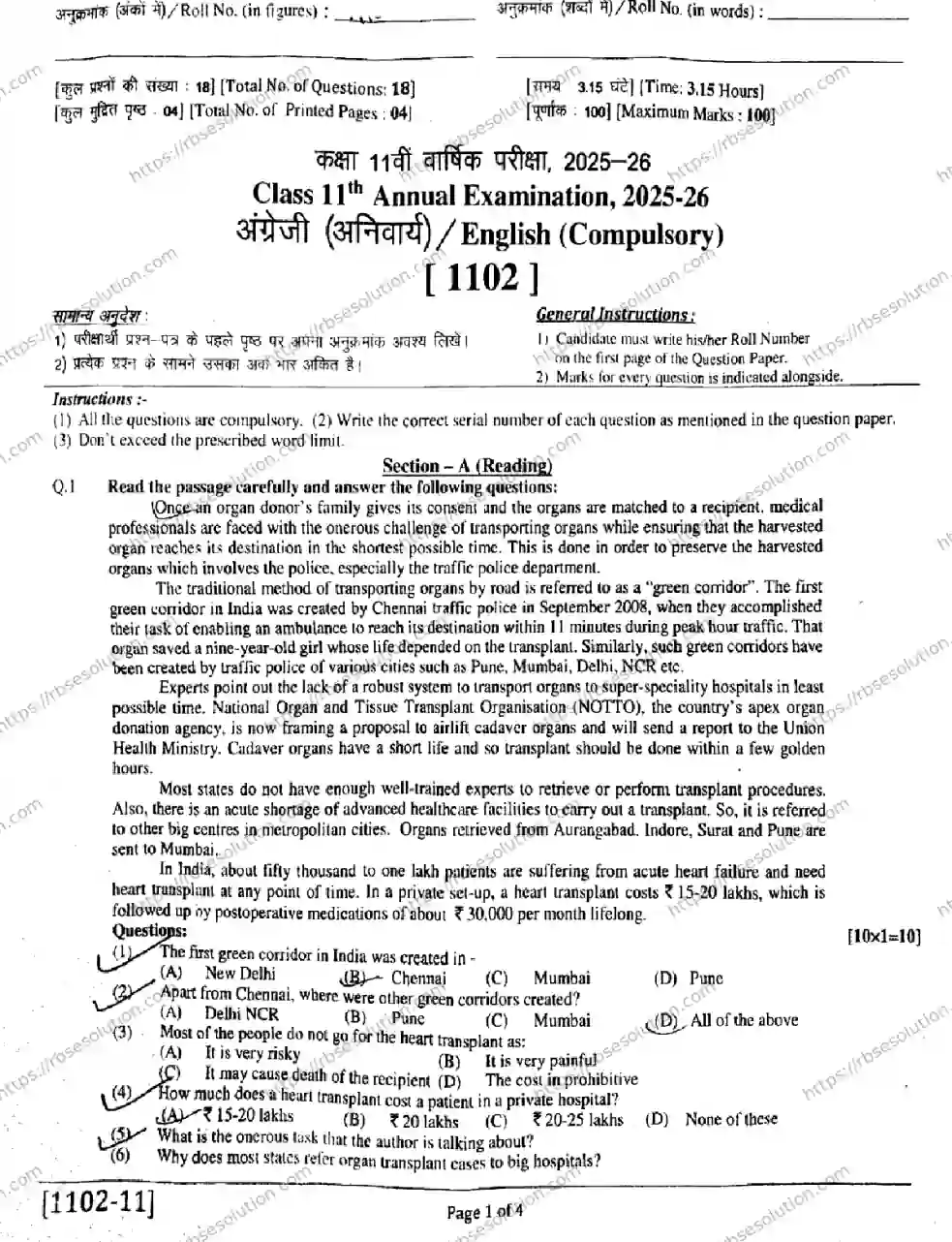
अनुक्रमांक (अंकों में)/Roll No. (in figures): ___________ अनुक्रमांक (शब्दों में)/Roll No. (in words): ___________
कुल प्रश्नों की संख्या : 48 | Total No. of Questions : 48
समय : 3.15 घंटे | Time : 3.15 Hours
कुल मुद्रित पृष्ठ : 04 | Total No. of Printed Pages : 04
पूर्णांक : 80 | Maximum Marks : 80
सामान्य निर्देश / General Instructions :
- परीक्षार्थी प्रश्न-पत्र के पहले पृष्ठ पर अपना अनुक्रमांक अवश्य लिखें। Candidate must write his/her Roll Number on the first page of the Question Paper.
- प्रत्येक प्रश्न के सामने उसका अंक भार अंकित है। Marks for every question is indicated alongside.
Instructions :
- All the questions are compulsory.
- Write the correct serial number of each question as mentioned in the question paper.
- Don't exceed the prescribed word limit.
Section - A (Reading)
Q.1] Read the passage carefully and answer the following questions:
Once an organ donor's family gives its consent and the organs are matched to a recipient, medical professionals are faced with the onerous challenge of transporting organs while ensuring that the harvested organ reaches its destination in the shortest possible time. This is done in order to preserve the harvested organs which involves the police, especially the traffic police department.
The traditional method of transporting organs by road is referred to as a "green corridor". The first green corridor in India was created by Chennai traffic police in September 2008, when they accomplished their task of enabling an ambulance to reach its destination within 11 minutes during peak hour traffic. That organ saved a nine-year-old girl whose life depended on the transplant. Similarly, such green corridors have been created by traffic police of various cities such as Pune, Mumbai, Delhi, NCR etc.
Experts point out the lack of a robust system to transport organs to super-speciality hospitals in least possible time. National Organ and Tissue Transplant Organisation (NOTTO), the country's apex organ donation agency, is now framing a proposal to airlift cadaver organs and will send a report to the Union Health Ministry. Cadaver organs have a short life and so transplant should be done within a few golden hours.
Most states do not have enough well-trained experts to retrieve or perform transplant procedures. Also, there is an acute shortage of advanced healthcare facilities to carry out a transplant. So, it is referred to other big centres in metropolitan cities. Organs retrieved from Aurangabad, Indore, Surat and Pune are sent to Mumbai.
In India, about fifty thousand to one lakh patients are suffering from acute heart failure and need heart transplant at any point of time. In a private set-up, a heart transplant costs ₹ 5-20 lakhs, which is followed up by postoperative medications of about ₹ 30,000 per month lifelong.
-
The first green corridor in India was created in -
- (A) New Delhi
- (B) Chennai
- (C) Mumbai
- (D) Pune
Explanation: The passage clearly states that the first green corridor in India was created by Chennai traffic police in September 2008.
-
Apart from Chennai, where were other green corridors created?
- (A) Pune
- (B) Mumbai
- (C) Delhi NCR
- (D) All of these
Explanation: The passage mentions that green corridors have been created in Pune, Mumbai, Delhi, NCR, etc., so all the given options are correct.
-
Most of the people do not opt for the heart transplant as -
- (A) It is very risky
- (B) It is very painful
- (C) It may cause death of the recipient
- (D) The cost is prohibitive
Explanation: The passage states that a heart transplant costs ₹5-20 lakhs with lifelong postoperative medications of ₹30,000 per month, making it very expensive for most people.
-
How much does a heart transplant cost a patient in a private hospital?
- (A) ₹5-20 lakhs
- (B) ₹20 lakhs
- (C) ₹20-25 lakhs
- (D) None of these
Explanation: The passage clearly mentions that in a private set-up, a heart transplant costs ₹5-20 lakhs.
-
What is the onerous task that the author is talking about?
Answer: The onerous task is the challenge of transporting harvested organs to their destination in the shortest possible time to preserve them, which involves coordinating with the police, especially the traffic police department.
-
Why do most states refer organ transplant cases to big hospitals?
Answer: Most states refer organ transplant cases to big hospitals because they lack enough well-trained experts to retrieve or perform transplant procedures, and there is an acute shortage of advanced healthcare facilities to carry out a transplant.
Page 1 of 4
Section – A (Reading Comprehension)
Q1. Read the following passage carefully and answer the questions that follow:
(Note: The passage for Q1 is not provided in the given text. The questions are answered based on the context.)
-
What does the author mean by “a few golden hours”?
The phrase “a few golden hours” refers to a short period of time that is extremely precious, valuable, and memorable, often associated with happiness or a special experience.
-
Pick out the word from the passage which is similar in meaning to “save”.
The word similar in meaning to “save” is “preserve” (or “rescue”, depending on the passage).
-
Which agency is at work to airlift cadaver organs?
The agency responsible for airlifting cadaver organs is typically the National Organ and Tissue Transplant Organisation (NOTTO) or a similar government health agency.
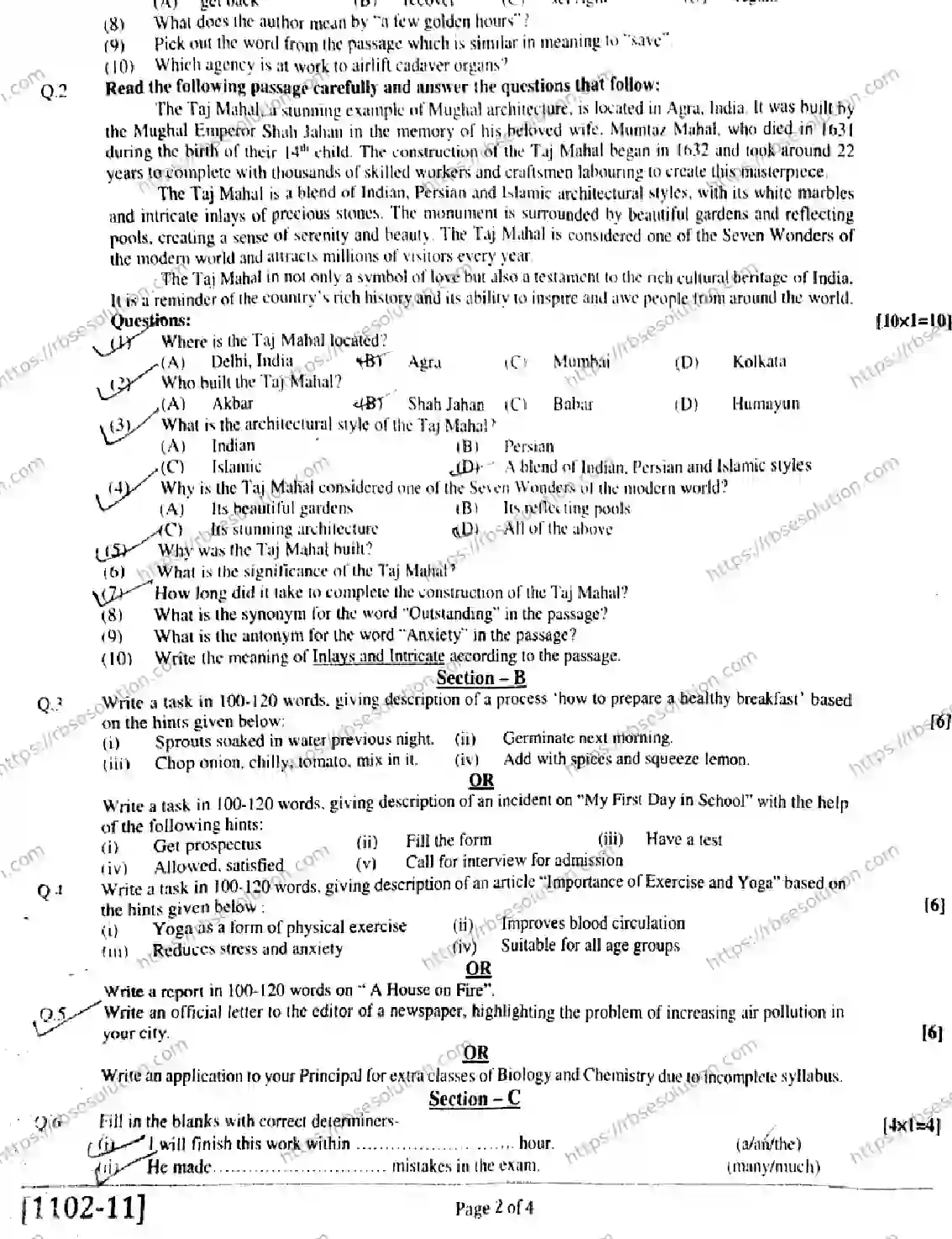
Q2. Read the following passage carefully and answer the questions that follow:
The Taj Mahal, a stunning example of Mughal architecture, is located in Agra, India. It was built by the Mughal Emperor Shah Jahan in memory of his beloved wife, Mumtaz Mahal, who died in 1631 during the birth of their 14th child. The construction of the Taj Mahal began in 1632 and took around 22 years to complete with thousands of skilled workers and craftsmen labouring to create this masterpiece. The Taj Mahal is a blend of Indian, Persian and Islamic architectural styles, with its white marble and intricate inlays of precious stones. The monument is surrounded by beautiful gardens and reflecting pools, creating a sense of serenity and beauty. The Taj Mahal is considered one of the Seven Wonders of the modern world and attracts millions of visitors every year. The Taj Mahal is not only a symbol of love but also a testament to the rich cultural heritage of India. It is a reminder of the country's rich history and its ability to inspire and awe people from around the world.
-
Where is the Taj Mahal located?
- (A) Delhi, India
- (B) Agra
- (C) Mumbai
- (D) Kolkata
Explanation: The passage clearly states, "The Taj Mahal... is located in Agra, India."
-
Who built the Taj Mahal?
- (A) Akbar
- (B) Shah Jahan
- (C) Babar
- (D) Humayun
Explanation: The passage mentions, "It was built by the Mughal Emperor Shah Jahan."
-
What is the architectural style of the Taj Mahal?
- (A) Indian
- (B) Persian
- (C) Islamic
- (D) A blend of Indian, Persian and Islamic styles
Explanation: The passage says, "The Taj Mahal is a blend of Indian, Persian and Islamic architectural styles."
-
Why is the Taj Mahal considered one of the Seven Wonders of the modern world?
- (A) Its beautiful gardens
- (B) Its reflecting pools
- (C) Its stunning architecture
- (D) All of the above
Explanation: The passage highlights its stunning architecture, beautiful gardens, and reflecting pools as reasons for its wonder status.
-
Why was the Taj Mahal built?
The Taj Mahal was built by Emperor Shah Jahan in memory of his beloved wife, Mumtaz Mahal, who died in 1631.
-
What is the significance of the Taj Mahal?
The Taj Mahal is a symbol of love and a testament to India's rich cultural heritage. It reminds people of the country's history and its ability to inspire awe.
-
How long did it take to complete the construction of the Taj Mahal?
It took around 22 years to complete the construction of the Taj Mahal.
-
What is the synonym for the word “Outstanding” in the passage?
The synonym for “Outstanding” in the passage is “stunning”.
-
What is the antonym for the word “Anxiety” in the passage?
The antonym for “Anxiety” in the passage is “serenity” (meaning calmness and peace).
-
Write the meaning of “Inlays” and “Intricate” according to the passage.
Inlays: Pieces of precious stones set into the surface of the marble for decoration.
Intricate: Very detailed and complicated in design.
Section – B (Writing)
Q3. Write a task in 100-120 words, giving description of a process ‘how to prepare a healthy breakfast’ based on the hints given below:
How to Prepare a Healthy Breakfast
To prepare a healthy breakfast, start by soaking sprouts in water the previous night. The next morning, you will see they have germinated. Now, take a bowl and chop some onion, green chilly, and tomato into small pieces. Mix these chopped vegetables with the germinated sprouts. Add spices like salt, black pepper, and chaat masala according to your taste. Finally, squeeze the juice of half a lemon over the mixture and toss everything well. Your healthy and tasty sprout salad is ready to eat. This breakfast is rich in proteins and vitamins, giving you energy for the day.
OR
Write a task in 100-120 words, giving description of an incident on “My First Day in School” with the help of the following hints:
My First Day in School
My first day in school was a memorable experience. First, my parents got the prospectus from the school office. Then, we filled the admission form with all the necessary details. After that, I had to take a small test to check my knowledge. I was nervous but I tried my best. Later, I was called for an interview with the principal. The principal asked me a few simple questions and I answered them confidently. Finally, I was allowed admission and I felt very satisfied and happy. I made new friends and my teachers were very kind. That day marked the beginning of a wonderful journey in my school life.
Q4. Write a task in 100-120 words, giving description of an article “Importance of Exercise and Yoga” based on the hints given below:
Importance of Exercise and Yoga
Exercise and yoga are very important for a healthy life. Yoga is a form of physical exercise that helps in keeping the body fit and flexible. It improves blood circulation, which ensures that all organs get enough oxygen and nutrients. Regular practice of yoga reduces stress and anxiety, making the mind calm and peaceful. It is suitable for all age groups, from children to old people. Even simple exercises like walking, stretching, and breathing exercises can make a big difference. Therefore, everyone should include exercise and yoga in their daily routine to stay healthy, happy, and active.
OR
Write a report in 100-120 words on “A House on Fire”.
A House on Fire
Last Sunday, a terrible fire broke out in a house in our neighbourhood. It started in the kitchen due to a gas cylinder leak. Soon, the flames spread to other rooms. People from nearby houses gathered and called the fire brigade. The fire engines arrived within ten minutes. The firefighters worked hard to control the fire. Fortunately, all the family members were safely evacuated. However, the house was badly damaged and many belongings were burnt. The neighbours helped the family with food and shelter. This incident taught us the importance of fire safety and being careful with gas appliances.
Q5. Write an official letter to the editor of a newspaper, highlighting the problem of increasing air pollution in your city.
To,
The Editor,
The Times of India,
Jaipur
Subject: Increasing Air Pollution in Our City
Sir,
Through the columns of your esteemed newspaper, I wish to draw the attention of the authorities towards the serious problem of increasing air pollution in our city. The air quality has become very poor due to vehicle emissions, factory smoke, and dust from construction sites. People are facing breathing problems and other health issues. The situation is especially bad during the morning and evening hours. I request the municipal corporation to take strict action against polluting industries, promote public transport, and plant more trees. The public should also be made aware of the harmful effects of pollution. I hope you will publish this letter to create awareness among the citizens.
Yours faithfully,
Rahul Sharma
Jaipur
OR
Write an application to your Principal for extra classes of Biology and Chemistry due to incomplete syllabus.
To,
The Principal,
Government Senior Secondary School,
Jaipur
Subject: Request for Extra Classes in Biology and Chemistry
Respected Sir/Madam,
I am a student of Class 11 (Science) in your school. I humbly request you to arrange extra classes for Biology and Chemistry subjects. Due to some unavoidable reasons, the syllabus of these subjects could not be completed on time. The annual examinations are approaching, and we are worried about covering the remaining topics. Extra classes will help us understand the difficult concepts and complete the syllabus. I, on behalf of all the science students, request you to kindly arrange these extra classes at a convenient time. We will be very grateful for your kind consideration.
Yours obediently,
Amit Kumar
Class 11 (Science)
Roll No. 25
Section – C (Grammar)
Q6. Fill in the blanks with correct determiners:
-
I will finish this work within an hour. (a/an/the)
Explanation: 'Hour' begins with a vowel sound, so we use 'an'.
-
He made many mistakes in the exam. (many/much)
Explanation: 'Mistakes' is a countable noun, so we use 'many'.
Section - C
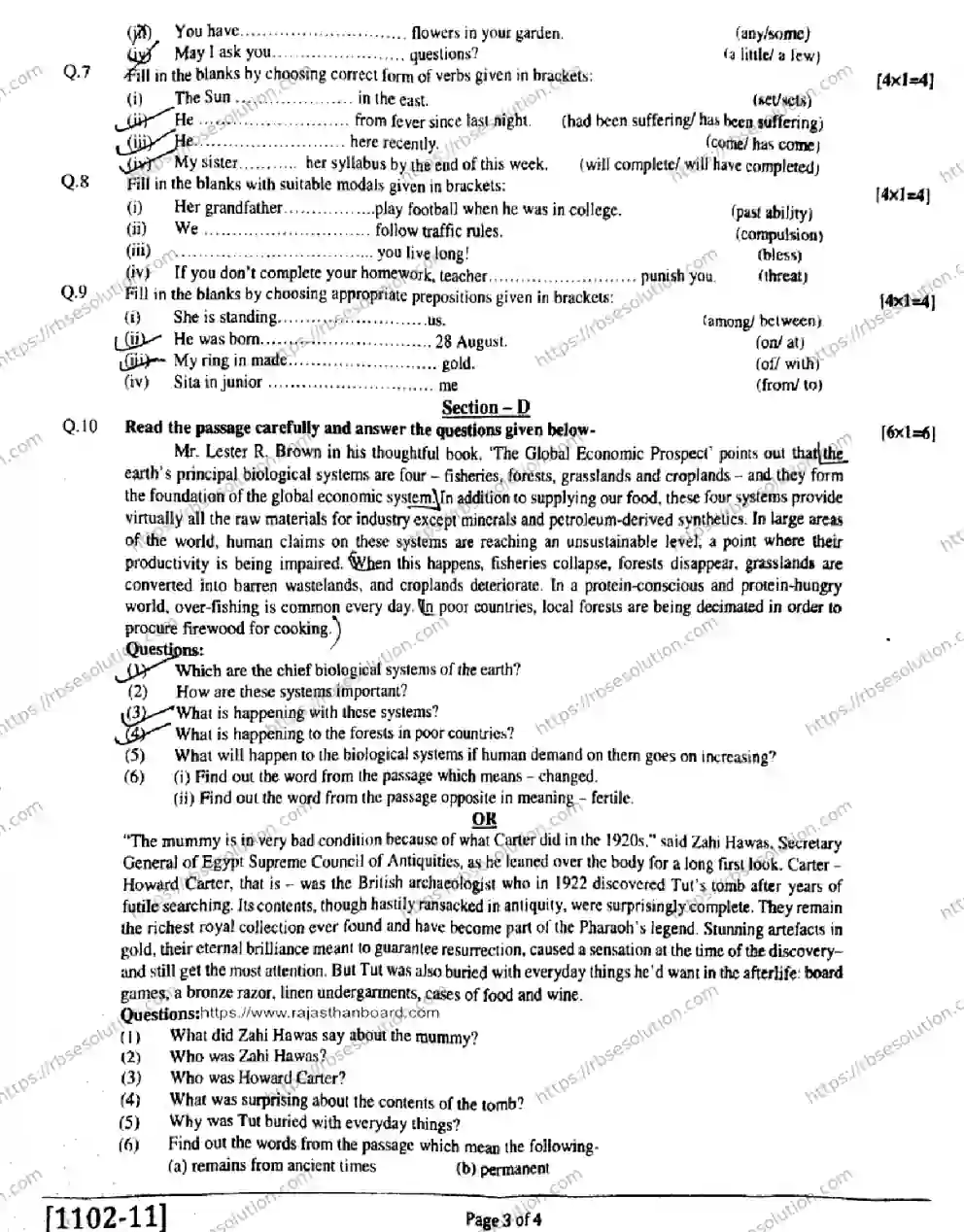
Q.7 Fill in the blanks by choosing the correct form of verbs given in brackets: [4×1=4]
-
The Sun rises in the east. (rise)
Explanation: The sun rises in the east is a universal truth, so the simple present tense is used.
-
He has been suffering from fever since last night. (had been suffering / has been suffering)
Explanation: 'Since last night' indicates an action that started in the past and is still continuing, so the present perfect continuous tense is used.
-
He has come here recently. (come / has come)
Explanation: 'Recently' is used with the present perfect tense.
-
My sister will have completed her syllabus by the end of this week. (will complete / will have completed)
Explanation: 'By the end of this week' indicates a future time by which the action will be finished, so the future perfect tense is used.
Q.8 Fill in the blanks with suitable modals given in brackets: [4×1=4]
-
Her grandfather could play football when he was in college. (past ability)
Explanation: 'Could' is used to express past ability.
-
We must follow traffic rules. (compulsion)
Explanation: 'Must' is used to express strong obligation or compulsion.
-
May you live long! (bless)
Explanation: 'May' is used to express a wish or blessing.
-
If you don't complete your homework, the teacher will punish you. (threat)
Explanation: 'Will' is used to express a future threat or warning.
Q.9 Fill in the blanks by choosing appropriate prepositions given in brackets: [4×1=4]
-
She is standing among us. (among / between)
Explanation: 'Among' is used when referring to more than two people or things.
-
He was born on 28 August. (on / at)
Explanation: 'On' is used with specific dates.
-
My ring is made of gold. (off / of)
Explanation: 'Made of' is used to indicate the material something is composed of.
-
Sita is junior to me. (to / for)
Explanation: 'Junior to' is the correct prepositional phrase for comparison.
Section - D
Q.10 Read the passage carefully and answer the questions given below: [6×1=6]
Mr. Lester R. Brown in his thoughtful book, 'The Global Economic Prospect' points out that the earth's principal biological systems are four — fisheries, forests, grasslands and croplands — and they form the foundation of the global economic system. In addition to supplying our food, these four systems provide virtually all the raw materials for industry except minerals and petroleum-derived synthetics. In large areas of the world, human claims on these systems are reaching an unsustainable level, a point where their productivity is being impaired. When this happens, fisheries collapse, forests disappear, grasslands are converted into barren wastelands, and croplands deteriorate. In a protein-conscious and protein-hungry world, over-fishing is common every day. In poor countries, local forests are being decimated in order to procure firewood for cooking.
-
Which are the chief biological systems of the earth?
The four chief biological systems of the earth are fisheries, forests, grasslands, and croplands.
-
How are these systems important?
These systems form the foundation of the global economic system. They supply our food and provide virtually all the raw materials for industry, except minerals and petroleum-derived synthetics.
-
What is happening with these systems?
Human claims on these systems are reaching an unsustainable level, impairing their productivity. As a result, fisheries are collapsing, forests are disappearing, grasslands are turning into barren wastelands, and croplands are deteriorating.
-
What is happening to the forests in poor countries?
In poor countries, local forests are being decimated (destroyed) in order to procure firewood for cooking.
-
What will happen to the biological systems if human demand on them goes on increasing?
If human demand continues to increase, the productivity of these systems will be further impaired, leading to the collapse of fisheries, disappearance of forests, conversion of grasslands into barren wastelands, and deterioration of croplands.
-
(i) Find out the word from the passage which means - changed.
The word is "converted".
(ii) Find out the word from the passage opposite in meaning - fertile.
The opposite word is "barren".
OR
"The mummy is in very bad condition because of what Carter did in the 1920s." said Zahi Hawas, Secretary General of Egypt Supreme Council of Antiquities, as he leaned over the body for a long first look. Carter — Howard Carter, that is — was the British archaeologist who in 1922 discovered Tut's tomb after years of futile searching. Its contents, though hastily ransacked in antiquity, were surprisingly complete. They remain the richest royal collection ever found and have become part of the Pharaoh's legend. Stunning artefacts in gold, their eternal brilliance meant to guarantee resurrection, caused a sensation at the time of the discovery and still get the most attention. But Tut was also buried with everyday things he'd want in the afterlife: board games, a bronze razor, linen undergarments, cases of food and wine.
-
What did Zahi Hawas say about the mummy?
Zahi Hawas said that the mummy is in very bad condition because of what Carter did in the 1920s.
-
Who was Zahi Hawas?
Zahi Hawas was the Secretary General of the Egypt Supreme Council of Antiquities.
-
Who was Howard Carter?
Howard Carter was a British archaeologist who discovered Tut's tomb in 1922 after years of futile searching.
-
What was surprising about the contents of the tomb?
The contents, though hastily ransacked in antiquity, were surprisingly complete. They remain the richest royal collection ever found.
-
Why was Tut buried with everyday things?
Tut was buried with everyday things because he would want them in the afterlife. These included board games, a bronze razor, linen undergarments, and cases of food and wine.
-
Find out the words from the passage which mean the following:
(a) remains from ancient times
The word is "antiquities".
(b) permanent
The word is "eternal".
Section: Long Answer Questions (Any Three)
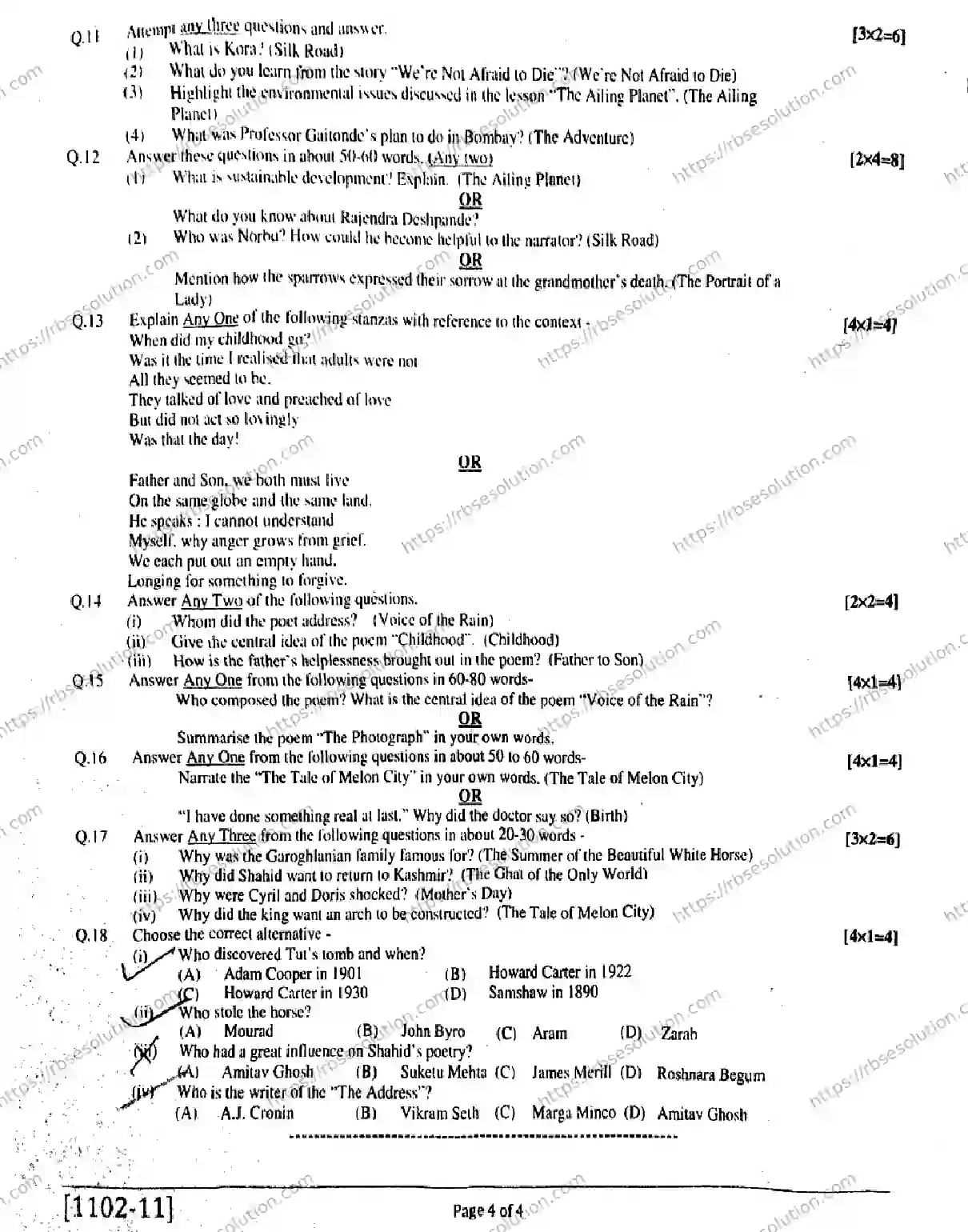
Q.9 Answer any three of the following questions: (3×2=6)
-
What is Kora? (Silk Road)
Kora is a ritual circumambulation (walking around) of a sacred place or object, often performed by Tibetan Buddhists. In the lesson "Silk Road," the narrator and his companions undertake a kora around Mount Kailash as a spiritual journey.
-
What do you learn from the story "We're Not Afraid to Die"?
The story teaches us courage, resilience, and the power of teamwork in the face of extreme adversity. Despite a life-threatening storm at sea, the family remains determined and optimistic, showing that human spirit can overcome even the most dangerous situations.
-
Highlight the environmental issues discussed in the lesson "The Ailing Planet".
The lesson discusses issues like deforestation, loss of biodiversity, overexploitation of natural resources, pollution, and the greenhouse effect. It emphasizes that the planet is "ailing" due to human activities and calls for sustainable development to protect the environment.
-
What was Professor Gaitonde's plan to do in Bombay? (The Adventure)
Professor Gaitonde planned to go to Bombay to visit the library and research historical records. He wanted to understand the alternate reality he had experienced and find evidence to confirm his theories about historical events.
Section: Short Answer Questions (Any Two)
Q.10 Answer these questions in about 50-60 words: (2×4=8)
-
What is sustainable development? Explain. (The Ailing Planet)
Sustainable development means meeting the needs of the present without compromising the ability of future generations to meet their own needs. It involves using resources wisely, protecting the environment, and ensuring economic growth that does not harm the planet. It balances ecological, social, and economic factors for long-term well-being.
-
What do you know about Rajendra Deshpande? (The Adventure)
Rajendra Deshpande is a historian and friend of Professor Gaitonde. He is knowledgeable about history and helps the professor understand the alternate reality he experienced. He represents the rational, analytical mind that tries to make sense of extraordinary events through logic and historical evidence.
-
Who was Norbu? How could he become helpful to the narrator? (Silk Road)
Norbu was a Tibetan Buddhist monk who joined the narrator's journey to Mount Kailash. He became helpful because he knew the local terrain, customs, and rituals. He guided the narrator through difficult paths, helped with language barriers, and provided spiritual support during the kora.
-
Mention how the sparrows expressed their sorrow at the grandmother's death. (The Portrait of a Lady)
When the grandmother died, thousands of sparrows gathered around her body. They sat silently, not chirping or eating the breadcrumbs offered. After the body was taken away, they flew away quietly, showing their deep sorrow and respect for the grandmother who had fed them daily.
Section: Stanza Explanation
Q.11 Explain any one of the following stanzas with reference to the context: (4×1=4)
-
Stanza 1: "When did my childhood go? / Was it the time I realised that adults were not / All they seemed to be. / They talked of love and preached of love / But did not act so lovingly / Was that the day!"
Context: This stanza is from the poem "Childhood" by Markus Natten. The poet reflects on the loss of childhood innocence.
Explanation: The poet questions when his childhood ended. He realizes that adults are hypocritical—they talk about love but do not practice it. This realization marks the end of his childhood, as he loses his innocent trust in adults. The stanza highlights the theme of disillusionment that comes with growing up.
-
Stanza 2: "Father and Son, we both must live / On the same globe and the same land, / He speaks: I cannot understand / Myself, why anger grows from grief. / We each put out an empty hand / Longing for something to forgive."
Context: This stanza is from the poem "Father to Son" by Elizabeth Jennings. It deals with the generation gap between a father and his son.
Explanation: The father expresses his helplessness and desire to reconnect with his son. They live together but are emotionally distant. The father cannot understand why his grief turns into anger. Both stretch out "empty hands," symbolizing their longing for forgiveness and reconciliation. The stanza shows the pain of miscommunication and the need for mutual understanding.
Section: Short Answer Questions (Any Two)
Q.12 Answer any two of the following questions: (2×2=4)
-
Whom did the poet address? (Voice of the Rain)
In the poem "Voice of the Rain," the poet addresses the rain itself. The rain speaks to the poet, explaining its cyclical journey from the earth to the sky and back again, symbolizing the eternal process of nature.
-
Give the central idea of the poem "Childhood". (Childhood)
The central idea of the poem "Childhood" is the loss of innocence and the transition from childhood to adulthood. The poet reflects on when his childhood ended—when he realized adults are hypocritical, when he gained his own identity, and when he understood the concept of hell and heaven. The poem explores the bittersweet nature of growing up.
-
How is the father's helplessness brought out in the poem? (Father to Son)
The father's helplessness is shown through his inability to communicate with his son. He says, "I cannot understand myself, why anger grows from grief." Both father and son stretch out "empty hands," longing for forgiveness but unable to bridge the gap. The father feels like a stranger in his own home, highlighting his emotional isolation and powerlessness.
Section: Long Answer Questions (Any One)
Q.13 Answer any one from the following questions in 60-80 words: (4×1=4)
-
Who composed the poem? What is the central idea of the poem "Voice of the Rain"?
The poem "Voice of the Rain" is composed by Walt Whitman. The central idea is the eternal, cyclical nature of rain. The rain describes its journey: it rises from the earth as vapor, forms clouds, and then falls back to earth to nourish the land. This cycle symbolizes the continuous process of birth, death, and rebirth in nature. The rain is portrayed as a life-giving force that connects the earth and sky.
-
Summarise the poem "The Photograph" in your own words.
The poem "The Photograph" by Shirley Toulson is about a photograph of the poet's mother as a young girl at the beach with her cousins. The poet remembers her mother's laughter and joy in that moment. Years later, after her mother's death, the poet looks at the photograph and feels a sense of loss. The poem reflects on the passage of time, the permanence of memories, and the pain of losing loved ones. The sea in the photograph remains unchanged, symbolizing the eternal nature of nature compared to human life.
Section: Short Answer Questions (Any One)
Q.14 Answer any one from the following questions in about 50 to 60 words: (4×1=4)
-
Narrate "The Tale of Melon City" in your own words.
"The Tale of Melon City" is a humorous story by Vikram Seth. A king orders an arch to be built, but it is too low, causing him to hit his head. He blames the architect, who blames the workmen, who blame the king's orders. The king decides to hang the first person who passes by, who happens to be a fool. The fool says the king should be hanged first. The king agrees, but no one can hang him. Finally, they hang a melon instead, and the people declare the melon their new king.
-
"I have done something real at last." Why did the doctor say so? (Birth)
In the story "Birth" by A.J. Cronin, Dr. Andrew Manson successfully revives a stillborn baby using artificial respiration and other medical techniques. After the baby starts breathing and crying, Andrew feels a deep sense of accomplishment. He says, "I have done something real at last," because this was his first major success as a doctor—saving a life. It gives him confidence and a sense of purpose in his medical career.
Section: Very Short Answer Questions (Any Three)
Q.15 Answer any three from the following questions in about 20-30 words: (3×2=6)
-
Why was the Garoghlanian family famous for? (The Summer of the Beautiful White Horse)
The Garoghlanian family was famous for their honesty and integrity. They were known as a poor but proud family that never stole anything, which makes the horse theft ironic.
-
Why did Shahid want to return to Kashmir? (The Ghat of the Only World)
Shahid wanted to return to Kashmir because he felt a deep emotional and cultural connection to his homeland. He missed the beauty, peace, and sense of belonging that Kashmir provided.
-
Why were Cyril and Doris shocked? (Mother's Day)
Cyril and Doris were shocked when their mother, Mrs. Pearson, suddenly became assertive and spoke her mind. She refused to be treated as a servant and demanded respect, which was completely unexpected.
-
Why did the king want an arch to be constructed? (The Tale of Melon City)
The king wanted an arch to be constructed to celebrate his reign and to show his power. However, the arch was built too low, leading to the humorous chain of events in the story.
Section: Multiple Choice Questions
Q.16 Choose the correct alternative: (4×1=4)
-
Who discovered Tut's tomb and when?
- A. Adam Cooper in 1900
- B. Howard Carter in 1922
- C. Howard Carter in 1930
- D. Samshaw in 1890
Explanation: Howard Carter discovered Tutankhamun's tomb in the Valley of the Kings in 1922.
-
Who stole the horse?
- A. Mourad
- B