
RBSE Class 11th 2026 HALF-YEARLY-BUSINESS-STUDIES-1124 Previous Year Papers
You opened the RBSE Class 11th 2026 HALF-YEARLY-BUSINESS-STUDIES-1124 Previous Year Papers page — a focused place to read the real previous year question paper for that subject and year. RBSE Solution keeps exam-year sets together so you can practise the same cycle your seniors faced.
Previous year papers reward patience: read instructions, note mark distribution, then attempt questions before peeking at solutions elsewhere on the site. This URL always loads the same free previous year papers content for HALF-YEARLY-BUSINESS-STUDIES-1124 (2026).
Use the details table to confirm class and year, then scroll to the paper images or PDF below. More subjects from 2026 are linked later on this page.
Paper details
Quick reference for this previous year papers page — confirm board, class, and year & subject before you study.
| Board | RBSE |
|---|---|
| Class | Class 11th |
| Exam year | 2026 |
| Subject | HALF-YEARLY-BUSINESS-STUDIES-1124 |
| Resource type | Previous Year Papers |
| Category | RBSE Previous Year Question Papers |
| Website | RBSE Solution |
The table summarises this Previous Year Papers resource. Confirm RBSE, Class 11th, year 2026, and subject HALF-YEARLY-BUSINESS-STUDIES-1124 before studying.
RBSE Solution organises previous year papers so each URL carries chapter-specific guidance — better for students and for search engines than one generic paragraph for the whole class.
How to practise with this question paper
Stage one: read the HALF-YEARLY-BUSINESS-STUDIES-1124 question paper from 2026 without a timer and highlight command words — explain, prove, calculate, discuss. Stage two: attempt selected questions closed-book. Stage three: compare with solutions or teacher feedback.
Previous Year Papers work best when you log mistakes by topic, not only by question number. That log becomes your revision index before pre-boards.
RBSE Class 11th 2026 HALF-YEARLY-BUSINESS-STUDIES-1124
Scroll through the Previous Year Papers pages for HALF-YEARLY-BUSINESS-STUDIES-1124 (2026).
Rajasthan Board Class 11th HALF-YEARLY-BUSINESS-STUDIES-1124 2026 solved Previous Year Question Papers
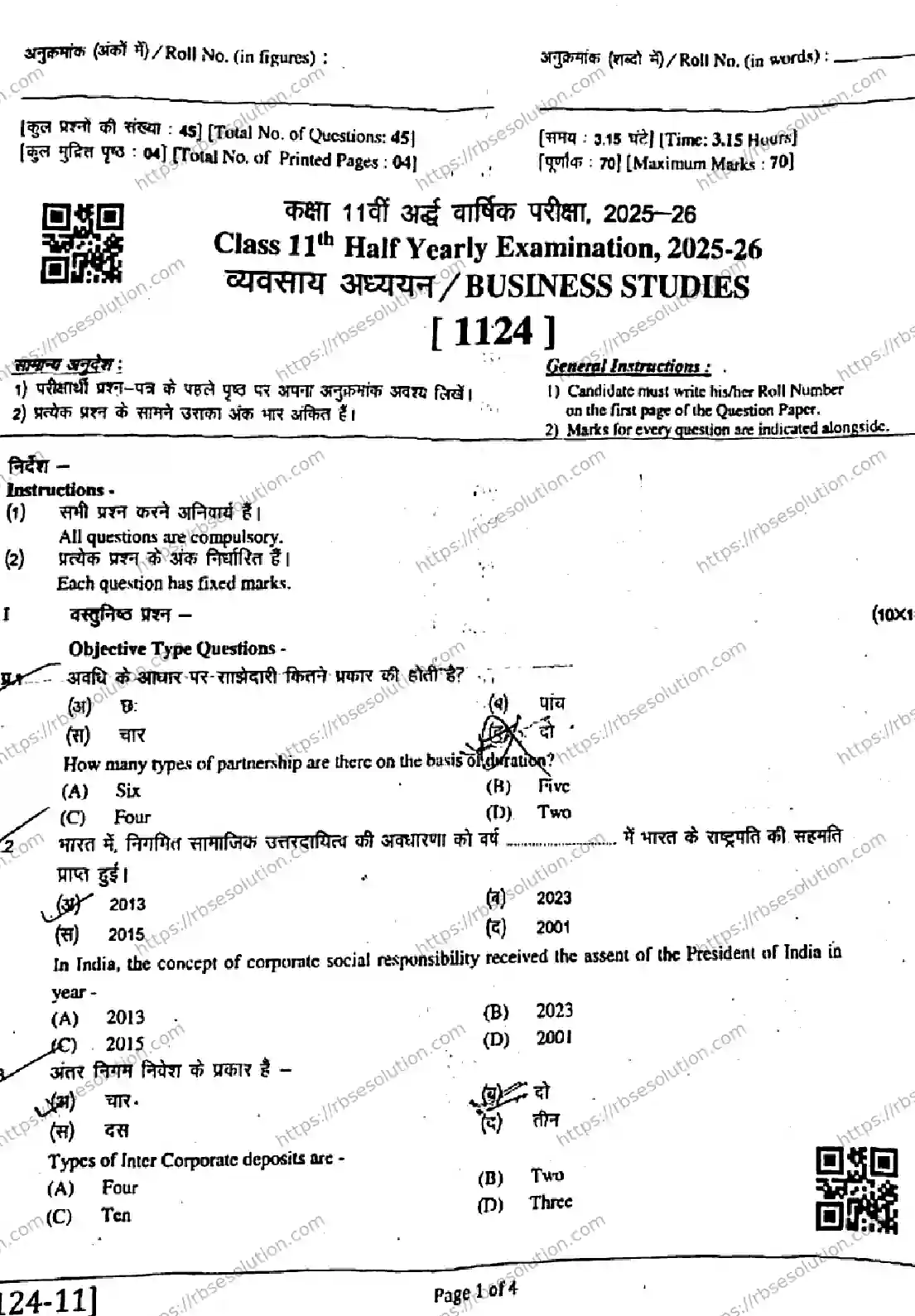
कक्षा 11वीं अर्द्ध वार्षिक परीक्षा, 2025-26
Class 11th Half Yearly Examination, 2025-26
व्यवसाय अध्ययन / BUSINESS STUDIES
अनुक्रमांक (अंकों में) / Roll No. (in figures) : _________________________
अनुक्रमांक (शब्दों में) / Roll No. (in words) : _________________________
[कुल प्रश्नों की संख्या : 45] [Total No. of Questions: 45]
[कुल मुद्रित पृष्ठ : 04] [Total No. of Printed Pages : 04]
[समय : 3.45 घंटे] [Time: 3.5 Hours]
[पूर्णांक : 70] [Maximum Marks : 70]
निर्देश - Instructions -
- सभी प्रश्न करने अनिवार्य हैं।
All questions are compulsory. - प्रत्येक प्रश्न के अंक निर्धारित हैं।
Each question has fixed marks.
खण्ड - अ / Section - A
वस्तुनिष्ठ प्रश्न - Objective Type Questions
प्रश्न 1. अवधि के आधार पर साझेदारी कितने प्रकार की होती है?
How many types of partnership are there on the basis of duration?
- (A) छः (Six)
- (B) पाँच (Five)
- (C) चार (Four)
- (D) दो (Two)
व्याख्या: अवधि के आधार पर साझेदारी दो प्रकार की होती है: (1) एकल साझेदारी (Partnership at will) और (2) निश्चित अवधि की साझेदारी (Particular partnership)।
प्रश्न 2. भारत में, निगमित सामाजिक उत्तरदायित्व की अवधारणा को वर्ष ____ में भारत के राष्ट्रपति की सहमति प्राप्त हुई।
In India, the concept of corporate social responsibility received the assent of the President of India in year ____.
- (A) 2013
- (B) 2023
- (C) 2015
- (D) 2001
व्याख्या: भारत में कॉर्पोरेट सामाजिक उत्तरदायित्व (CSR) की अवधारणा को कंपनी अधिनियम 2013 के तहत शामिल किया गया, जिसे 2015 में राष्ट्रपति की सहमति प्राप्त हुई और यह 1 अप्रैल 2014 से लागू हुआ।
प्रश्न 3. अंतर-निगम निवेश के प्रकार हैं -
Types of Inter Corporate deposits are -
- (A) चार (Four)
- (B) पाँच (Five)
- (C) दस (Ten)
- (D) तीन (Three)
व्याख्या: अंतर-निगम निवेश (Inter Corporate Deposits) पाँच प्रकार के होते हैं: (1) कॉल डिपॉजिट, (2) तीन माह की अवधि, (3) छह माह की अवधि, (4) नौ माह की अवधि, और (5) बारह माह की अवधि।
Page 1 of 4
Page 2 of 4
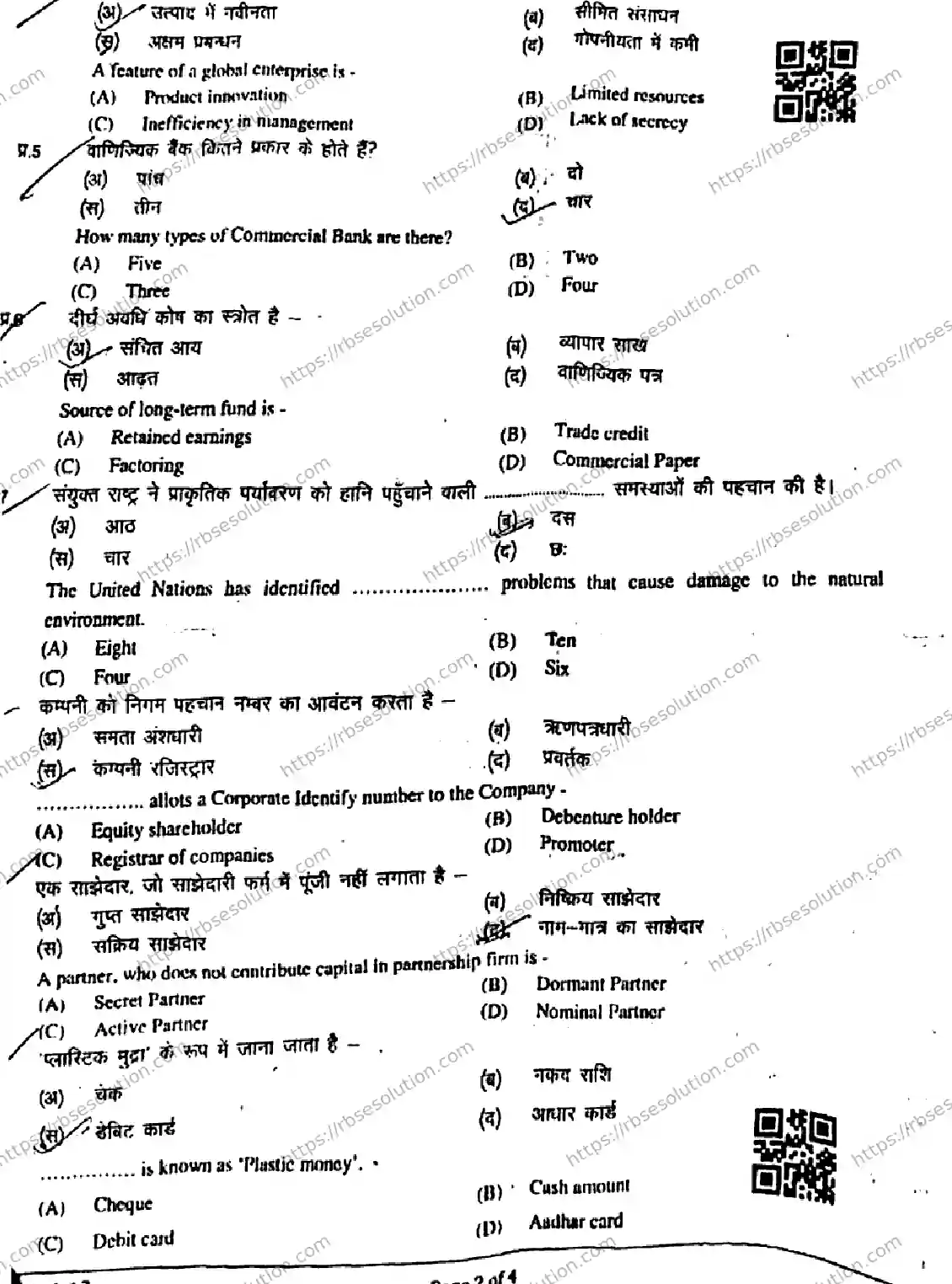
वैश्विक उद्यम की एक विशेषता है -
A feature of a global enterprise is -
- (A) उत्पाद में नवीनता (Product innovation)
- (B) सीमित संसाधन (Limited resources)
- (C) प्रबंध में अक्षमता (Inefficiency in management)
- (D) गोपनीयता में कमी (Lack of secrecy)
Explanation: वैश्विक उद्यमों में गोपनीयता की कमी एक सामान्य विशेषता है, क्योंकि वे विभिन्न देशों में काम करते हैं और उनकी जानकारी सार्वजनिक होती है।
वाणिज्यिक बैंक कितने प्रकार के होते हैं?
How many types of Commercial Bank are there?
- (A) पाँच (Five)
- (B) दो (Two)
- (C) तीन (Three)
- (D) चार (Four)
Explanation: वाणिज्यिक बैंक चार प्रकार के होते हैं: सार्वजनिक क्षेत्र के बैंक, निजी क्षेत्र के बैंक, विदेशी बैंक, और सहकारी बैंक।
दीर्घ अवधि कोष का स्रोत है -
Source of long-term fund is -
- (A) संचित आय (Retained earnings)
- (B) व्यापार साख (Trade credit)
- (C) आढ़त (Factoring)
- (D) वाणिज्यिक पत्र (Commercial Paper)
Explanation: संचित आय दीर्घ अवधि के लिए उपलब्ध आंतरिक स्रोत है, जबकि व्यापार साख, आढ़त, और वाणिज्यिक पत्र अल्पकालिक स्रोत हैं।
संयुक्त राष्ट्र ने प्राकृतिक पर्यावरण को हानि पहुँचाने वाली कितनी समस्याओं की पहचान की है?
The United Nations has identified how many problems that cause damage to the natural environment?
- (A) आठ (Eight)
- (B) दस (Ten)
- (C) चार (Four)
- (D) छह (Six)
Explanation: संयुक्त राष्ट्र ने पर्यावरण को नुकसान पहुँचाने वाली छह प्रमुख समस्याओं की पहचान की है, जैसे जलवायु परिवर्तन, प्रदूषण, आदि।
कौन कंपनी को निगम पहचान नम्बर (CIN) आवंटित करता है?
Who allots a Corporate Identity Number to the Company?
- (A) समता अंशधारी (Equity shareholder)
- (B) ऋणपत्रधारी (Debenture holder)
- (C) प्रवर्तक (Promoter)
- (D) कंपनी रजिस्ट्रार (Registrar of companies)
Explanation: कंपनी रजिस्ट्रार (ROC) कंपनी अधिनियम के तहत कंपनियों को निगम पहचान नम्बर (CIN) आवंटित करता है।
एक साझेदार, जो साझेदारी फर्म में पूंजी नहीं लगाता है -
A partner, who does not contribute capital in partnership firm is -
- (A) गुप्त साझेदार (Secret Partner)
- (B) निष्क्रिय साझेदार (Dormant Partner)
- (C) सक्रिय साझेदार (Active Partner)
- (D) नाम-मात्र का साझेदार (Nominal Partner)
Explanation: निष्क्रिय साझेदार फर्म में पूंजी नहीं लगाता है और प्रबंधन में भाग नहीं लेता, लेकिन लाभ-हानि में हिस्सेदार होता है।
किसे 'प्लास्टिक मनी' के रूप में जाना जाता है?
What is known as 'Plastic money'?
- (A) चेक (Cheque)
- (B) नकद राशि (Cash)
- (C) डेबिट कार्ड (Debit Card)
- (D) आधार कार्ड (Aadhaar Card)
Explanation: डेबिट कार्ड और क्रेडिट कार्ड को 'प्लास्टिक मनी' कहा जाता है क्योंकि ये प्लास्टिक से बने होते हैं और भुगतान के लिए उपयोग होते हैं। यहाँ डेबिट कार्ड सही विकल्प है।
रिक्त स्थानों की पूर्ति कीजिए / Fill in the blanks
-
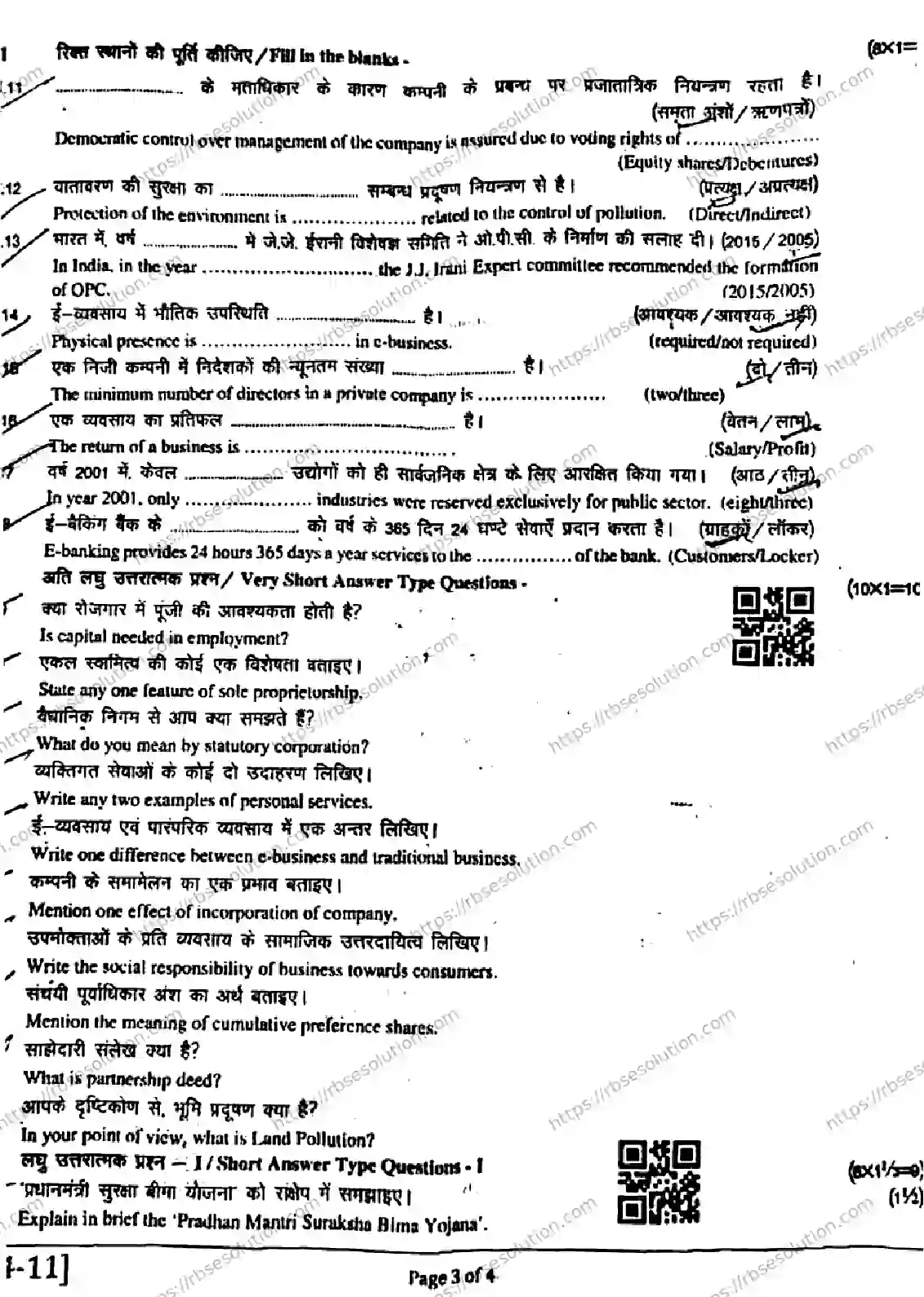
…… के मताधिकार के कारण कम्पनी के प्रबन्ध पर प्रजातान्त्रिक नियन्त्रण रहता है।
Democratic control over management of the company is assured due to voting rights of ……….
Equity shareholders (Equity shares / Debentures)
-
पर्यावरण की सुरक्षा का ……… सम्बन्ध प्रदूषण नियन्त्रण से है।
Protection of the environment is ……… related to the control of pollution.
Direct (Direct / Indirect)
-
भारत में, वर्ष ……… में जे.जे. ईरानी विशेषज्ञ समिति ने ओ.पी.सी. के निर्माण की सलाह दी।
In India, in the year ……… the J.J. Irani Expert committee recommended the formation of OPC.
2005 (2005 / 2008)
-
ई-व्यवसाय में भौतिक उपस्थिति ……… है।
Physical presence is ……… in e-business.
not required (required / not required)
-
एक निजी कम्पनी में निदेशकों की न्यूनतम संख्या ……… है।
The minimum number of directors in a private company is ……….
two (two / three)
-
एक व्यवसाय का प्रतिफल ……… है।
Return of a business is ……….
Profit (Salary / Profit)
-
वर्ष 2000 में, केवल ……… उद्योगों को ही सार्वजनिक क्षेत्र के लिए आरक्षित किया गया।
In the year 2000, only ……… industries were reserved exclusively for public sector.
eight (eight / three)
-
ई-बैंकिंग बैंक के ……… को वर्ष के 365 दिन 24 घण्टे सेवाएँ प्रदान करता है।
E-banking provides 24 hours 365 days a year services to the ……… of the bank.
Customers (Customers / Locker)
अति लघु उत्तरात्मक प्रश्न / Very Short Answer Type Questions
-
क्या रोजगार में पूंजी की आवश्यकता होती है?
Is capital needed in employment?
नहीं, रोजगार में पूंजी की आवश्यकता नहीं होती है। रोजगार में व्यक्ति किसी नियोक्ता के अधीन कार्य करता है और उसे वेतन या मजदूरी मिलती है।
No, capital is not needed in employment. In employment, a person works under an employer and receives salary or wages.
-
एकल स्वामित्व की कोई एक विशेषता बताइए।
State any one feature of sole proprietorship.
एकल स्वामित्व की एक विशेषता यह है कि इसमें केवल एक ही मालिक होता है, जो व्यवसाय के सभी लाभों का एकमात्र हकदार होता है और सभी हानियों के लिए असीमित दायित्व वहन करता है।
One feature of sole proprietorship is that there is only one owner, who is the sole claimant of all profits and bears unlimited liability for all losses.
-
वैधानिक निगम से आप क्या समझते हैं?
What do you mean by statutory corporation?
वैधानिक निगम एक ऐसा उद्यम है जिसे संसद या राज्य विधानमंडल के एक विशेष अधिनियम द्वारा स्थापित किया जाता है। यह सरकारी स्वामित्व वाला होता है और इसे वित्तीय एवं प्रशासनिक स्वायत्तता प्राप्त होती है। उदाहरण: भारतीय रिज़र्व बैंक, जीवन बीमा निगम।
A statutory corporation is an enterprise established by a special act of Parliament or state legislature. It is government-owned and enjoys financial and administrative autonomy. Example: Reserve Bank of India, Life Insurance Corporation.
-
व्यक्तिगत सेवाओं के कोई दो उदाहरण लिखिए।
Write any two examples of personal services.
व्यक्तिगत सेवाओं के दो उदाहरण हैं: (1) डॉक्टर द्वारा चिकित्सा सेवा, (2) वकील द्वारा कानूनी सलाह सेवा।
Two examples of personal services are: (1) Medical service by a doctor, (2) Legal advice service by a lawyer.
-
ई-व्यवसाय एवं पारंपरिक व्यवसाय में एक अन्तर लिखिए।
Write one difference between e-business and traditional business.
ई-व्यवसाय में लेन-देन इंटरनेट के माध्यम से किया जाता है, जबकि पारंपरिक व्यवसाय में लेन-देन भौतिक रूप से किसी दुकान या कार्यालय में होता है।
In e-business, transactions are conducted through the internet, whereas in traditional business, transactions take place physically in a shop or office.
-
कम्पनी के समामेलन का एक प्रभाव बताइए।
Mention one effect of incorporation of company.
समामेलन का एक प्रभाव यह है कि कम्पनी एक अलग कानूनी इकाई बन जाती है, जो अपने सदस्यों से भिन्न होती है। इसका अर्थ है कि कम्पनी अपने नाम से संपत्ति रख सकती है, मुकदमा कर सकती है और उस पर मुकदमा चलाया जा सकता है।
One effect of incorporation is that the company becomes a separate legal entity distinct from its members. This means the company can hold property, sue, and be sued in its own name.
-
उपभोक्ताओं के प्रति व्यवसाय के सामाजिक उत्तरदायित्व लिखिए।
Write the social responsibility of business towards consumers.
उपभोक्ताओं के प्रति व्यवसाय का सामाजिक उत्तरदायित्व है कि वह सुरक्षित और गुणवत्तापूर्ण उत्पाद उचित मूल्य पर उपलब्ध कराए, सही जानकारी प्रदान करे, और शिकायतों का समय पर समाधान करे।
The social responsibility of business towards consumers is to provide safe and quality products at fair prices, give accurate information, and resolve complaints promptly.
-
संचयी पूर्वाधिकार अंश का अर्थ बताइए।
Mention the meaning of cumulative preference shares.
संचयी पूर्वाधिकार अंश वे अंश हैं जिन पर यदि किसी वर्ष लाभ न होने के कारण लाभांश नहीं दिया जाता है, तो वह लाभांश अगले वर्षों में संचित होता जाता है और लाभ होने पर पहले चुकाया जाता है।
Cumulative preference shares are those shares on which if dividend is not paid in a year due to lack of profits, the dividend accumulates and is paid first in subsequent years when profits are available.
-
साझेदारी संलेख क्या है?
What is partnership deed?
साझेदारी संलेख एक लिखित दस्तावेज है जिसमें साझेदारों के बीच आपसी अधिकारों, कर्तव्यों, लाभ-हानि के बंटवारे, पूंजी योगदान आदि की शर्तों का उल्लेख होता है। यह साझेदारी फर्म का संविधान होता है।
A partnership deed is a written document that contains the terms and conditions regarding mutual rights, duties, profit-loss sharing, capital contribution, etc., among partners. It is the constitution of the partnership firm.
-
आपके दृष्टिकोण से, भूमि प्रदूषण क्या है?
In your point of view, what is Land Pollution?
भूमि प्रदूषण का अर्थ है भूमि की गुणवत्ता का ह्रास होना, जो रासायनिक उर्वरकों, कीटनाशकों, औद्योगिक कचरे, प्लास्टिक और अन्य ठोस अपशिष्टों के जमीन पर गिरने या मिलने से होता है। इससे मिट्टी की उर्वरता कम हो जाती है और पर्यावरण को नुकसान पहुँचता है।
Land pollution means the degradation of land quality, caused by the dumping or mixing of chemical fertilizers, pesticides, industrial waste, plastic, and other solid wastes on the ground. This reduces soil fertility and harms the environment.
लघु उत्तरात्मक प्रश्न - I / Short Answer Type Questions - I
-
'प्रधानमंत्री सुरक्षा बीमा योजना' को संक्षेप में समझाइए।
Explain in brief the 'Pradhan Mantri Suraksha Bima Yojana'.
प्रधानमंत्री सुरक्षा बीमा योजना (PMSBY) भारत सरकार की एक दुर्घटना बीमा योजना है। इसके अंतर्गत 18 से 70 वर्ष के व्यक्ति को नाममात्र प्रीमियम (₹12 प्रति वर्ष) पर दुर्घटना में मृत्यु या स्थायी विकलांगता होने पर ₹2 लाख का बीमा कवर मिलता है। यह योजना बैंक खाताधारकों के लिए उपलब्ध है और इसमें ऑटो-डेबिट की सुविधा है।
Pradhan Mantri Suraksha Bima Yojana (PMSBY) is an accident insurance scheme of the Government of India. Under this, individuals aged 18 to 70 years get an insurance cover of ₹2 lakh for accidental death or permanent disability at a nominal premium of ₹12 per year. The scheme is available to bank account holders and has auto-debit facility.
Short Answer Type Questions - I
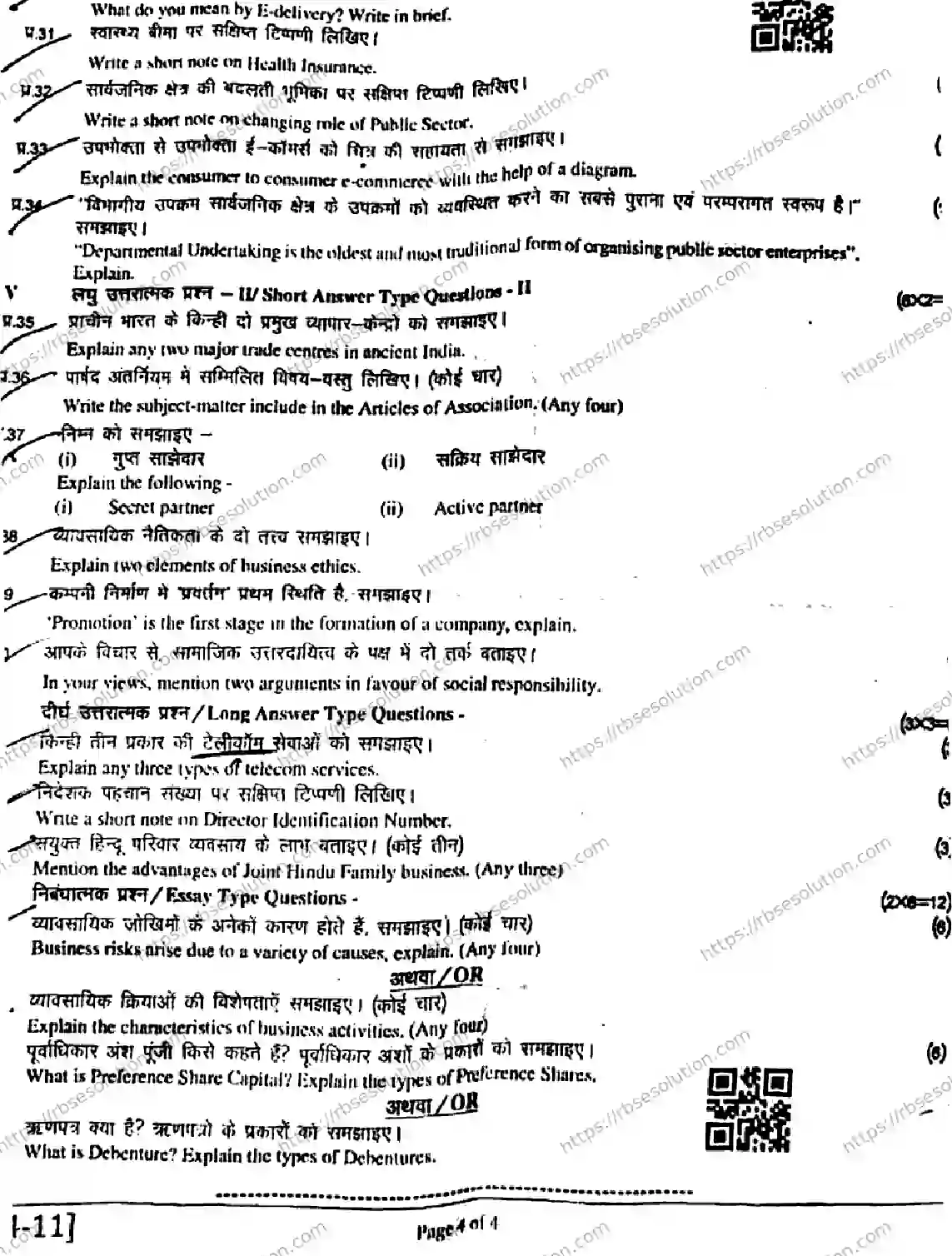
प्रश्न 1. 'What do you mean by E-delivery? Write in brief.
प्रश्न 2. स्वास्थ्य बीमा पर संक्षिप्त टिप्पणी लिखिए।
Write a short note on Health Insurance.
प्रश्न 3. सार्वजनिक क्षेत्र की बदलती भूमिका पर संक्षिप्त टिप्पणी लिखिए।
Write a short note on changing role of Public Sector.
प्रश्न 4. उपभोक्ता से उपभोक्ता ई-कॉमर्स को चित्र की सहायता से समझाइए।
Explain consumer to consumer e-commerce with the help of a diagram.
प्रश्न 5. "विभागीय उपक्रम सार्वजनिक क्षेत्र के उपक्रमों को व्यवस्थित करने का सबसे पुराना एवं परम्परागत स्वरूप है।" समझाइए।
"Departmental Undertaking is the eldest and most traditional form of organising public sector enterprises." Explain.
Short Answer Type Questions - II
प्रश्न 6. प्राचीन भारत के किन्हीं दो प्रमुख व्यापार-केन्द्रों को समझाइए।
Explain any two major trade centres in ancient India.
- Pataliputra (Patna): A major political and commercial hub on the Ganges, known for trade in textiles, spices, and precious stones.
- Ujjain: A key centre on the trade route connecting North and South India, famous for its cotton and metalwork.
प्रश्न 7. पार्षद अंतर्नियम में सम्मिलित विषय-वस्तु लिखिए। (कोई चार)
Write the subject-matter included in the Articles of Association. (Any four)
- Share capital and rights of shareholders
- Appointment and powers of directors
- Procedure for meetings and voting
- Dividend distribution rules
प्रश्न 8. निम्न को समझाइए —
(i) गुप्त साझेदार (ii) सक्रिय साझेदार
Explain the following —
(i) Secret partner (ii) Active partner
- Secret partner: A partner whose association with the firm is not disclosed to the public. They contribute capital and share profits but remain unknown to outsiders.
- Active partner: A partner who actively participates in the day-to-day management and operations of the business. They have unlimited liability and are known to the public.
प्रश्न 9. व्यावसायिक नैतिकता के दो तत्त्व समझाइए।
Explain two elements of business ethics.
- Honesty and Transparency: Businesses must be truthful in advertising, financial reporting, and dealings with stakeholders.
- Fairness: Treating employees, customers, and competitors with equity, avoiding discrimination and exploitation.
प्रश्न 10. कंपनी निर्माण में 'प्रवर्तन' प्रथम स्थिति है, समझाइए।
'Promotion' is the first stage in the formation of a company, explain.
प्रश्न 11. आपके विचार में, सामाजिक उत्तरदायित्व के पक्ष में दो तर्क बताइए।
In your views, mention two arguments in favour of social responsibility.
- Long-term sustainability: Businesses that contribute to society (e.g., environmental protection, community welfare) build goodwill and ensure long-term success.
- Ethical obligation: Businesses use societal resources and should give back by addressing social issues like poverty, education, and health.
Long Answer Type Questions
प्रश्न 12. किन्हीं तीन प्रकार की टेलीकॉम सेवाओं को समझाइए।
Explain any three types of telecom services.
- Voice Communication Services: Includes landline and mobile phone services for voice calls.
- Data Services: Internet access, broadband, and mobile data for browsing, email, and streaming.
- Value-Added Services: SMS, MMS, video calling, and mobile banking that enhance basic communication.
प्रश्न 13. निर्देशक पहचान संख्या पर संक्षिप्त टिप्पणी लिखिए।
Write a short note on Director Identification Number.
प्रश्न 14. हिन्दू परिवार व्यवसाय के लाभ बताइए। (कोई तीन)
Mention the advantages of Joint Hindu Family business. (Any three)
- Continuity: The business continues even after the death of the head (Karta) as the next generation takes over.
- Unified Management: Decisions are made by the Karta, ensuring quick and efficient management.
- Limited Liability for Members: Only the Karta has unlimited liability; other members have limited liability up to their share.
Essay Type Questions
प्रश्न 15. व्यावसायिक जोखिमों के अनेकों कारण होते हैं, समझाइए। (कोई चार)
Business risks arise due to a variety of causes, explain. (Any four)
- Economic Causes: Changes in demand, inflation, recession, or interest rates affect profitability.
- Natural Causes: Floods, earthquakes, pandemics, or other natural disasters disrupt operations.
- Human Causes: Employee strikes, negligence, theft, or mismanagement lead to losses.
- Technological Causes: Obsolescence, cyberattacks, or failure of machinery can cause business risks.
अथवा
प्रश्न 15 (वैकल्पिक). व्यावसायिक क्रियाओं की विशेषताएँ समझाइए। (कोई चार)
Explain the characteristics of business activities. (Any four)
- Economic Activity: Business involves production or exchange of goods/services for profit.
- Risk and Uncertainty: Business always involves risk of loss due to market changes or unforeseen events.
- Regularity: Business activities are conducted on a regular basis, not as one-time transactions.
- Profit Motive: The primary goal is to earn profit by satisfying customer needs.
प्रश्न 16. पूर्वाधिकार अंश पूंजी किसे कहते हैं? पूर्वाधिकार अंशों के प्रकारों को समझाइए।
What is Preference Share Capital? Explain the types of Preference Shares.
- Cumulative Preference Shares: Unpaid dividends accumulate and are paid later before equity dividends.
- Non-Cumulative Preference Shares: Dividends are paid only if profits are available; no accumulation.
- Participating Preference Shares: Entitled to additional dividends after equity shareholders receive a fixed amount.
- Non-Participating Preference Shares: Only entitled to fixed dividend, no extra share in profits.
- Convertible Preference Shares: Can be converted into equity shares after a specified period.
- Non-Convertible Preference Shares: Cannot be converted into equity shares.
अथवा
प्रश्न 16 (वैकल्पिक). ऋणपत्र क्या है? ऋणपत्र के प्रकारों को समझाइए।
What is Debenture? Explain the types of Debentures.
- Secured Debentures: Backed by a charge on company assets; safer for investors.
- Unsecured Debentures: Not backed by any collateral; higher risk.
- Convertible Debentures: Can be converted into equity shares after a specified period.
- Non-Convertible Debentures: Cannot be converted into shares; redeemed at maturity.
- Registered Debentures: Company maintains a register of debenture holders; transfer requires registration.
- Bearer Debentures: Transferable by delivery; company pays interest to the bearer.