
RBSE Class 11th 2026 HALF-YEARLY-ENGLISH-1102-211125 Previous Year Papers
Class 11th students hunting authentic previous year papers for HALF-YEARLY-ENGLISH-1102-211125 (2026) land here for a reason: the paper below matches how RBSE assessments are remembered from that year. RBSE Solution does not mix years on one page; each combination gets its own notes.
Skim the overview sections, then work through the scanned pages. Pair this practice with RBSE books and solutions when you need to relearn a concept a question exposed.
Paper details
Quick reference for this previous year papers page — confirm board, class, and year & subject before you study.
| Board | RBSE |
|---|---|
| Class | Class 11th |
| Exam year | 2026 |
| Subject | HALF-YEARLY-ENGLISH-1102-211125 |
| Resource type | Previous Year Papers |
| Category | RBSE Previous Year Question Papers |
| Website | RBSE Solution |
The table summarises this Previous Year Papers resource. Confirm RBSE, Class 11th, year 2026, and subject HALF-YEARLY-ENGLISH-1102-211125 before studying.
RBSE Solution organises previous year papers so each URL carries chapter-specific guidance — better for students and for search engines than one generic paragraph for the whole class.
Turning 2026 papers into insight
One HALF-YEARLY-ENGLISH-1102-211125 paper reveals style; several from the same year reveal pattern. After this page, open sibling subjects listed below to see whether marks cluster in certain units.
Keep rough work dated in your notebook. Examiners in Class 11th expect clear numbering even in practice sessions.
RBSE Class 11th 2026 HALF-YEARLY-ENGLISH-1102-211125
Scroll through the Previous Year Papers pages for HALF-YEARLY-ENGLISH-1102-211125 (2026).
Rajasthan Board Class 11th HALF-YEARLY-ENGLISH-1102-211125 2026 solved Previous Year Question Papers
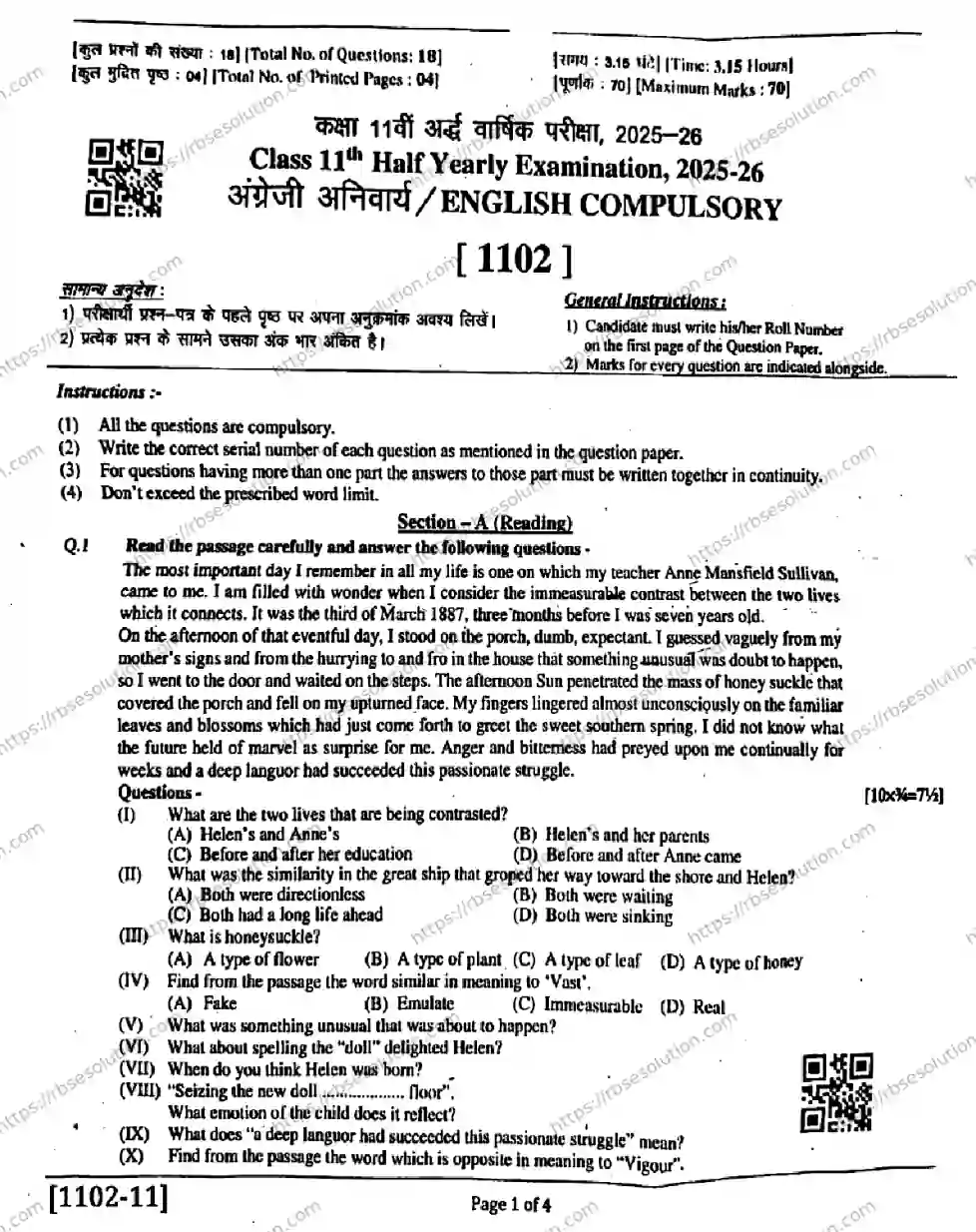
कुल प्रश्नों की संख्या : 48 | Total No. of Questions: 48
समय : 3 घंटे 15 मिनट | Time: 3:15 Hours
कुल मुद्रित पृष्ठ : 04 | Total No. of Printed Pages: 04
पूर्णांक : 70 | Maximum Marks: 70
कक्षा 11 अर्द्ध वार्षिक परीक्षा, 2025-26
Class 11 Half Yearly Examination, 2025-26
अंग्रेजी अनिवार्य / ENGLISH COMPULSORY
[ 1102 ]
सामान्य निर्देश: General Instructions:
- परीक्षार्थी प्रश्नपत्र के पहले पृष्ठ पर अपना अनुक्रमांक अवश्य लिखें। Candidate must write his/her Roll Number on the first page of the Question Paper.
- प्रत्येक प्रश्न के सामने उसका अंक भार अंकित है। Marks for every question are indicated alongside.
Instructions:
- All the questions are compulsory.
- Write the correct serial number of each question as mentioned in the question paper.
- For questions having more than one part the answers to those parts must be written together in continuity.
- Don't exceed the prescribed word limit.
Section – A (Reading)
Q1. Read the passage carefully and answer the following questions:
"The most important day I remember in all my life is the one on which my teacher Anne Mansfield Sullivan came to me. I am filled with wonder when I consider the immeasurable contrast between the two lives which it connects. It was the third of March 1887, three months before I was seven years old."
On the afternoon of that eventful day, I stood on the porch, dumb, expectant. I guessed vaguely from my mother's signs and from the hurrying to and fro in the house that something unusual was about to happen, so I went to the door and waited on the steps. The afternoon sun penetrated the mass of honeysuckle that covered the porch and fell on my upturned face. My fingers lingered almost unconsciously on the familiar leaves and blossoms which had just come forth to greet the sweet southern spring. I did not know what the future held of marvel or surprise for me. Anger and bitterness had preyed upon me continually for weeks and a deep languor had succeeded this passionate struggle.
Questions [5×2=10]
-
What are the two lives that are being contrasted?
- (A) Helen's and Anne's
- (B) Helen's and her parents
- (C) Before and after her education
- (D) Before and after Anne came
Explanation: The passage contrasts Helen's life before and after Anne Sullivan's arrival, describing the "immeasurable contrast" between the two lives that Anne's coming connected.
-
What was the similarity in the great ship that groped her way toward the shore and Helen?
- (A) Both were directionless
- (B) Both were waiting
- (C) Both had a long life ahead
- (D) Both were sinking
Explanation: Helen compares herself to a great ship groping its way in a fog, indicating both were without direction or guidance before Anne came.
-
What is honeysuckle?
- (A) A type of flower
- (B) A type of plant
- (C) A type of leaf
- (D) A type of honey
Explanation: Honeysuckle is a climbing plant with fragrant flowers, described in the passage as covering the porch.
-
Find from the passage the word similar in meaning to 'Vast'.
- (A) Fake
- (B) Emulate
- (C) Immeasurable
- (D) Real
Explanation: 'Immeasurable' means too large or vast to be measured, similar in meaning to 'vast'.
-
What was something unusual that was about to happen?
Answer: Something unusual that was about to happen was the arrival of Anne Mansfield Sullivan, who would become Helen Keller's teacher and change her life forever.
-
What about spelling the "doll" delighted Helen?
Answer: Helen was delighted that she could spell the word "d-o-l-l" with her fingers, as it was her first experience of learning language through finger spelling, which gave her a sense of achievement and connection.
-
When do you think Helen was born?
Answer: Helen was born around June 1880, because the passage states that Anne Sullivan came on March 3, 1887, three months before Helen was seven years old.
-
"Seizing the new doll ... floor". What emotion of the child does it reflect?
Answer: This action reflects the child's frustration, anger, and helplessness. Helen, unable to communicate, expressed her pent-up emotions by throwing the doll on the floor.
-
What does "a deep languor had succeeded this passionate struggle" mean?
Answer: It means that after weeks of intense anger and bitterness (the passionate struggle), Helen became exhausted and fell into a state of deep tiredness or lethargy (languor).
-
Find from the passage the word which is opposite in meaning to "Vigour".
Answer: The word opposite in meaning to "Vigour" (energy/strength) is "Languor", which means tiredness or lack of energy.
[02-07] | Page 1 of 4
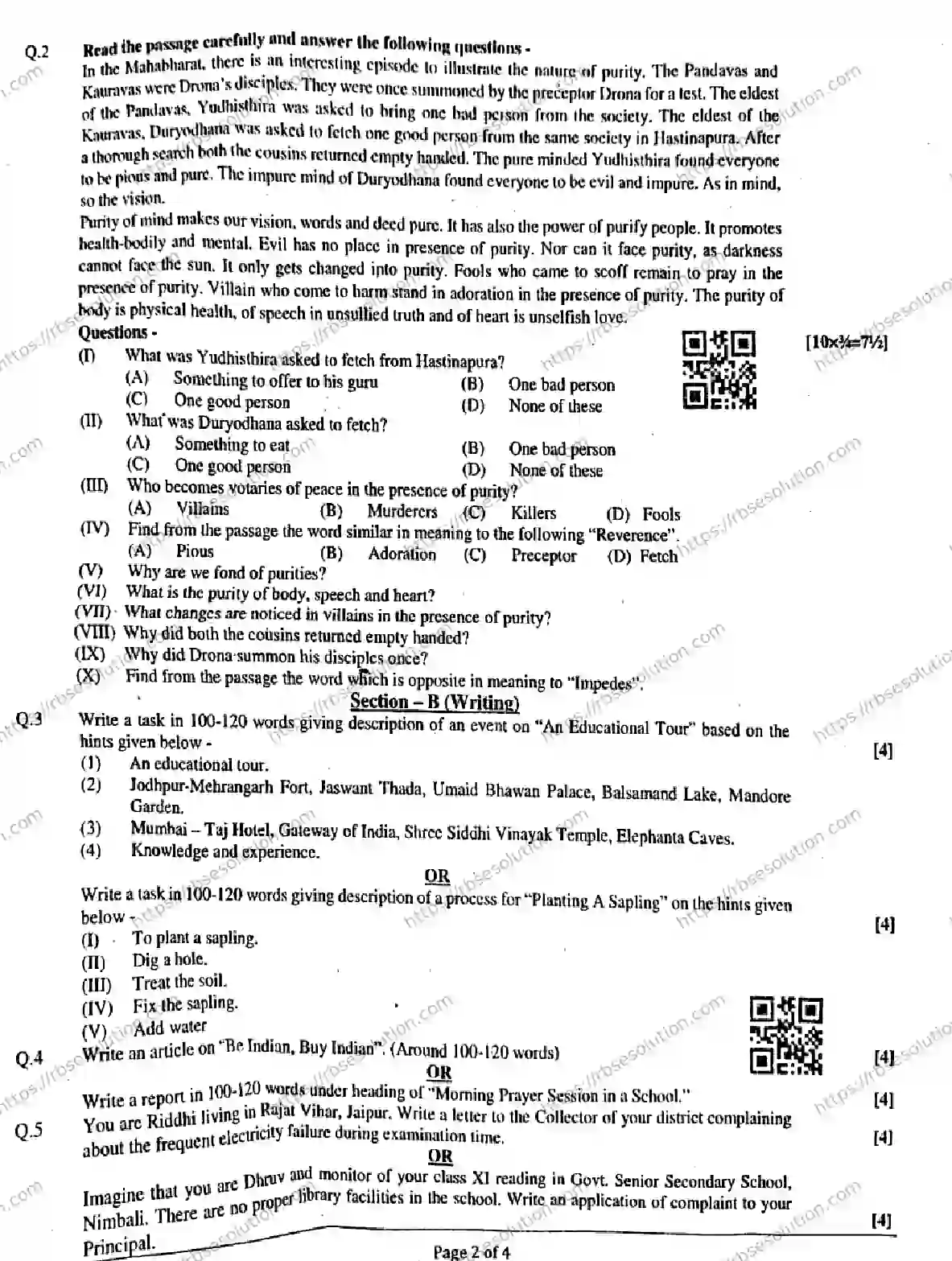
Read the passage carefully and answer the following questions -
In the Mahabharat, there is an interesting episode to illustrate the nature of purity. The Pandavas and Kauravas were Drona's disciples. They were once summoned by the preceptor Drona for a test. The eldest of the Pandavas, Yudhisthira was asked to bring one bad person from the society. The eldest of the Kauravas, Duryodhana was asked to fetch one good person from the same society in Hastinapura. After a thorough search both the cousins returned empty handed. The pure minded Yudhisthira found everyone to be pious and pure. The impure mind of Duryodhana found everyone to be evil and impure. As in mind, so the vision.
Purity of mind makes our vision, words and deed pure. It has also the power to purify people. It promotes health - bodily and mental. Evil has no place in presence of purity. Nor can it face purity, as darkness cannot face the sun. It only gets changed into purity. Fools who came to scoff remain to pray in the presence of purity. Villains who come to harm stand in adoration in the presence of purity. The purity of body is physical health, of speech is unsullied truth and of heart is unselfish love.
Questions - [10×3½=7½]
-
What was Yudhisthira asked to fetch from Hastinapura?
- (A) Something to offer to his guru
- (B) One bad person
- (C) One good person
- (D) None of these
Explanation: The passage states, "Yudhisthira was asked to bring one bad person from the society."
-
What was Duryodhana asked to fetch?
- (A) Something to eat
- (B) One bad person
- (C) One good person
- (D) None of these
Explanation: The passage says, "Duryodhana was asked to fetch one good person from the same society."
-
Who becomes votaries of peace in the presence of purity?
- (A) Villains
- (B) Murderers
- (C) Killers
- (D) Fools
Explanation: The passage mentions, "Fools who came to scoff remain to pray in the presence of purity," meaning they become peaceful.
-
Find from the passage the word similar in meaning to the following "Reverence".
- (A) Pious
- (B) Adoration
- (C) Preceptor
- (D) Fetch
Explanation: "Adoration" means deep love and respect, similar to "reverence." The passage uses "adoration" for villains.
-
Why are we fond of purities?
We are fond of purities because purity of mind makes our vision, words, and deeds pure. It promotes both bodily and mental health, and it has the power to purify others. Evil cannot exist in the presence of purity, just as darkness cannot face the sun.
-
What is the purity of body, speech and heart?
The purity of body is physical health, the purity of speech is unsullied truth, and the purity of heart is unselfish love.
-
What changes are noticed in villains in the presence of purity?
Villains who come to harm stand in adoration in the presence of purity. Instead of causing harm, they are filled with respect and reverence.
-
Why did both the cousins return empty handed?
Yudhisthira returned empty handed because his pure mind found everyone to be pious and pure, so he could not find a bad person. Duryodhana returned empty handed because his impure mind found everyone to be evil and impure, so he could not find a good person.
-
Why did Drona summon his disciples once?
Drona summoned his disciples for a test to illustrate the nature of purity. He wanted to show how a person's mind affects their vision and perception of others.
-
Find from the passage the word which is Opposite in meaning to "Impedes".
The word opposite in meaning to "impedes" (which means hinders or obstructs) is "promotes" (as in "It promotes health").
Section - B (Writing)
Write a task in 80-120 words giving description of an event on "An Educational Tour" based on the hints given below - [4]
(1) An educational tour.
(2) Jodhpur - Mehrangarh Fort, Jaswant Thada, Umaid Bhawan Palace, Balsamand Lake, Mandore Garden.
(3) Mumbai - Taj Hotel, Gateway of India, Shree Siddhi Vinayak Temple, Elephanta Caves.
(4) Knowledge and experience.
An Educational Tour
Our school organized an educational tour to Jodhpur and Mumbai. In Jodhpur, we visited the majestic Mehrangarh Fort, the beautiful Jaswant Thada, the grand Umaid Bhawan Palace, the serene Balsamand Lake, and the historic Mandore Garden. In Mumbai, we saw the iconic Taj Hotel, the Gateway of India, the sacred Shree Siddhi Vinayak Temple, and the ancient Elephanta Caves. This tour was a wonderful blend of history, architecture, and culture. We gained immense knowledge about our heritage and had unforgettable experiences. It was truly a learning journey outside the classroom.
OR
Write a task in 80-120 words giving description of a process for "Planting A Sapling" on the hints given below - [4]
(i) To plant a sapling.
(ii) Dig a pit.
(iii) Treat the soil.
(iv) Fix the sapling.
Planting A Sapling
Planting a sapling is a simple yet important process. First, choose a suitable location with enough sunlight. Dig a pit about two feet deep and one foot wide. Next, treat the soil by mixing it with compost or organic manure to provide nutrients. Place the sapling gently in the pit, ensuring its roots are spread out. Fill the pit with the treated soil, pressing it lightly around the base. Finally, water the sapling generously. Regular watering and care will help it grow into a strong tree. This small act contributes greatly to our environment.
Write an article on "Be Indian, Buy Indian" (in 80-120 words) [4]
Be Indian, Buy Indian
"Be Indian, Buy Indian" is a call to support our nation's economy. When we buy Indian products, we help local businesses, artisans, and farmers thrive. It creates jobs and reduces unemployment. Indian goods are often of high quality and reflect our rich cultural heritage. By choosing Indian brands, we also reduce our dependence on foreign imports, strengthening our country's self-reliance. Every rupee spent on Indian products contributes to the growth of our nation. Let us take pride in our own products and make India prosperous. Remember, buying Indian is not just a choice, it is a responsibility.
Write a description in 80-120 words under the heading of "Morning Prayer Session in a School" [4]
Morning Prayer Session in a School
The morning prayer session in our school begins at 8:00 AM sharp. All students and teachers assemble in the school ground in neat rows. The session starts with a prayer song, followed by a thought for the day. A student reads a short passage from a holy book or a motivational quote. Then, we recite the national anthem with pride. The principal addresses us with important announcements and words of encouragement. This daily ritual instills discipline, unity, and a positive mindset. It sets a calm and focused tone for the entire day. The morning prayer is the heart of our school life.
You are Rajat Vihor, Jaipur. Write a letter to the Collector of your district complaining about the frequent electricity failure during examination time [4]
Letter to the Collector
Rajat Vihor
123, Gandhi Nagar
Jaipur, Rajasthan
Date: 25 November 2025
To,
The Collector
Jaipur District
Jaipur
Subject: Complaint regarding frequent electricity failure during examination time
Respected Sir/Madam,
I am a resident of Jaipur and a student of Class 11. I wish to draw your attention to the serious problem of frequent electricity failures in our area, especially during the ongoing examination period. These power cuts disrupt our study schedule and cause immense stress. Students are unable to study at night, and many rely on electric lights and fans. The situation is unbearable and is affecting our performance in exams.
I request you to kindly take immediate action to ensure uninterrupted power supply, at least during the examination hours. Your prompt intervention will be highly appreciated.
Thanking you,
Yours faithfully,
Rajat Vihor
OR
Imagine that you are the prefect and monitor of your class XI reading in Govt. Senior Secondary School, Nimbali. There are poor library facilities in the school. Write an application of complaint to your Principal [4]
Application to the Principal
To,
The Principal
Govt. Senior Secondary School
Nimbali
Date: 25 November 2025
Subject: Complaint regarding poor library facilities
Respected Sir/Madam,
I am the prefect and monitor of Class XI. On behalf of the students, I wish to bring to your notice the inadequate library facilities in our school. The library has very few books, and many are outdated. There is no proper seating arrangement, and the library remains closed most of the time. Students who wish to read and study are unable to do so. This is affecting our academic progress and interest in reading.
I humbly request you to improve the library by adding new books, extending the timings, and providing a comfortable reading environment. Your kind attention to this matter will greatly benefit all students.
Thanking you,
Yours obediently,
[Your Name]
Prefect, Class XI
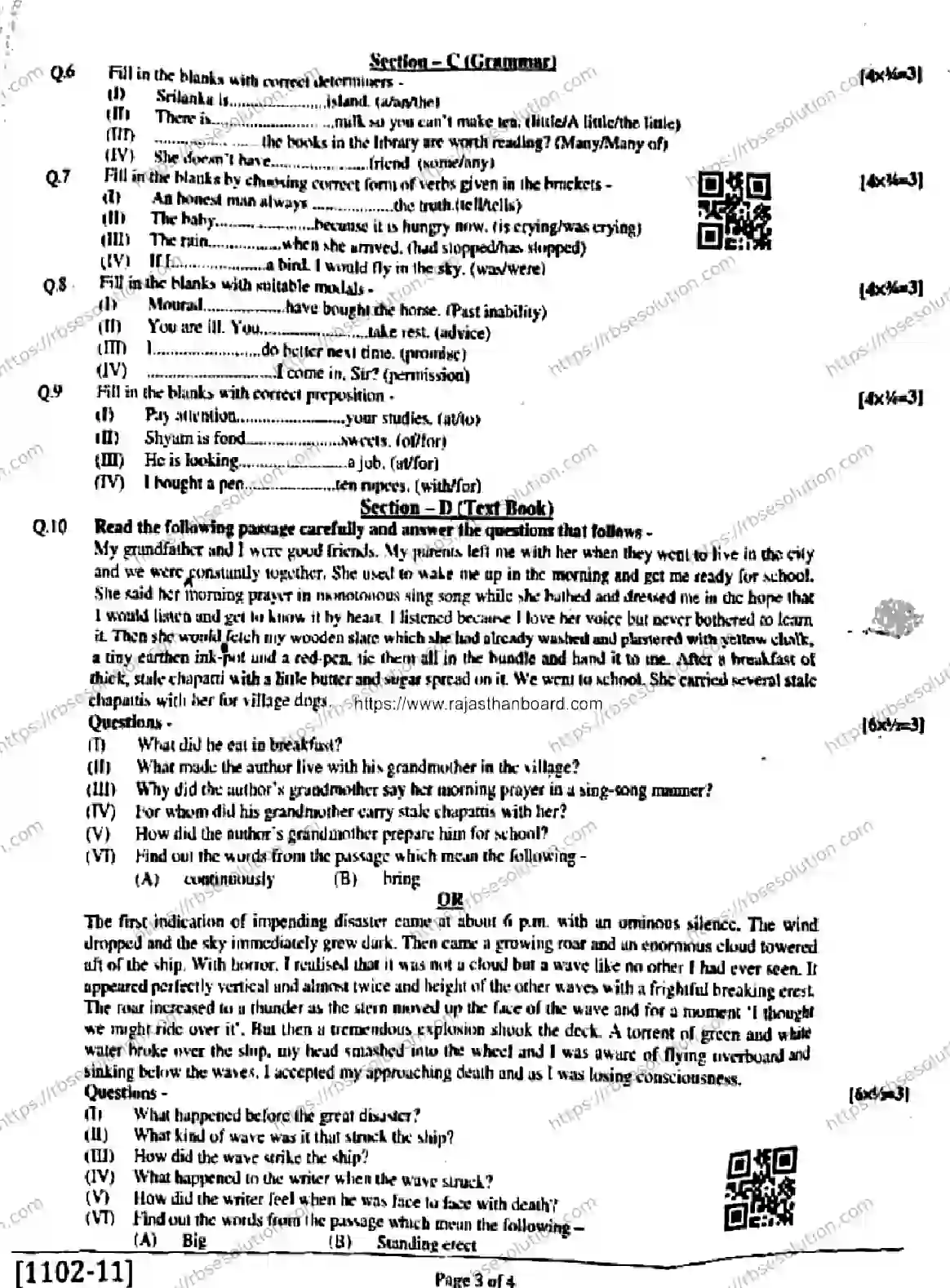
Section - C (Grammar)
Q6. Fill in the blanks with correct determiners:
- Srilanka is an island. (a/an/the)
- There is little oil, so you can't make tea. (little/a little/the little)
- Many of the books in the library are worth reading. (Many/Many of)
- She wore a ring on her finger. (a/an/the)
Q7. Fill in the blanks by choosing the correct form of verbs given in the brackets:
- An honest man always speaks the truth. (speak/speaks)
- The baby is crying because it is hungry now. (is crying/was crying)
- The train had stopped when she arrived. (had stopped/has stopped)
- If I were a bird, I would fly in the sky. (was/were)
Q8. Fill in the blanks with suitable modals:
- You need not have bought the horse. (Past inability)
- You should take rest. (advice)
- I will do better next time. (promise)
- May I come in, Sir? (permission)
Q9. Fill in the blanks with correct preposition:
- Pay attention to your studies. (to/for)
- Shyam is fond of sweets. (of/off)
- He is looking for a job. (at/for)
- I bought a pen for ten rupees. (with/for)
Section - D (Text Book)
Q10. Read the following passage carefully and answer the questions that follow:
Passage 1:
My grandfather and I were good friends. My parents left me with her when they went to live in the city, and we were constantly together. She used to wake me up in the morning and get me ready for school. She said her morning prayer in a monotonous sing-song while she bathed and dressed me in the hope that I would listen and get to know it by heart. I listened because I loved her voice but never bothered to learn it. Then she would fetch my wooden slate which she had already washed and plastered with yellow chalk, a tiny earthen ink-pot and a red-pen, tie them all in a bundle and hand it to me. After a breakfast of thick, stale chapatti with a little butter and sugar spread on it, we went to school. She carried several stale chapattis with her for the village dogs.
Questions:
-
What did he eat in breakfast?
He ate thick, stale chapatti with a little butter and sugar spread on it.
-
What made the author live with his grandmother in the village?
The author's parents left him with his grandmother when they went to live in the city.
-
Why did the author's grandmother say her morning prayer in a sing-song manner?
She said her morning prayer in a sing-song manner in the hope that the author would listen and get to know it by heart.
-
For whom did his grandmother carry stale chapattis with her?
She carried stale chapattis for the village dogs.
-
How did the author's grandmother prepare him for school?
She woke him up, bathed and dressed him, said her morning prayer, fetched his wooden slate (already washed and plastered with yellow chalk), a tiny earthen ink-pot and a red-pen, tied them in a bundle, and gave it to him. Then she gave him breakfast and they went to school together.
-
Find out the words from the passage which mean the following:
- (A) continuously - constantly
- (B) bring - fetch
OR
Passage 2:
The first indication of impending disaster came at about 4 p.m. with an ominous silence. The wind dropped and the sky immediately grew dark. Then came a growing roar and an enormous cloud towered aft of the ship. With horror, I realised that it was not a cloud but a wave like no other I had ever seen. It appeared perfectly vertical and almost twice the height of the other waves with a frightful breaking crest. The roar increased to a thunder as the stern moved up the face of the wave and for a moment I thought we might ride over it. But then a tremendous explosion shook the deck. A torrent of green and white water broke over the ship, my head smashed into the wheel and I was aware of flying overboard and sinking below the waves. I accepted my approaching death and was losing consciousness.
Questions:
-
What happened before the great disaster?
Before the great disaster, at about 4 p.m., there was an ominous silence. The wind dropped and the sky grew dark. Then a growing roar was heard and an enormous cloud towered aft of the ship.
-
What kind of wave was it that struck the ship?
It was a huge, terrifying wave that appeared perfectly vertical and almost twice the height of the other waves, with a frightful breaking crest.
-
How did the wave strike the ship?
The wave struck the ship with a tremendous explosion that shook the deck. A torrent of green and white water broke over the ship.
-
What happened to the writer when the wave struck?
The writer's head smashed into the wheel, and he was thrown overboard and sank below the waves.
-
How did the writer feel when he was face to face with death?
The writer accepted his approaching death and was losing consciousness.
-
Find out the words from the passage which mean the following:
- (A) Big - enormous
- (B) Standing erect - vertical
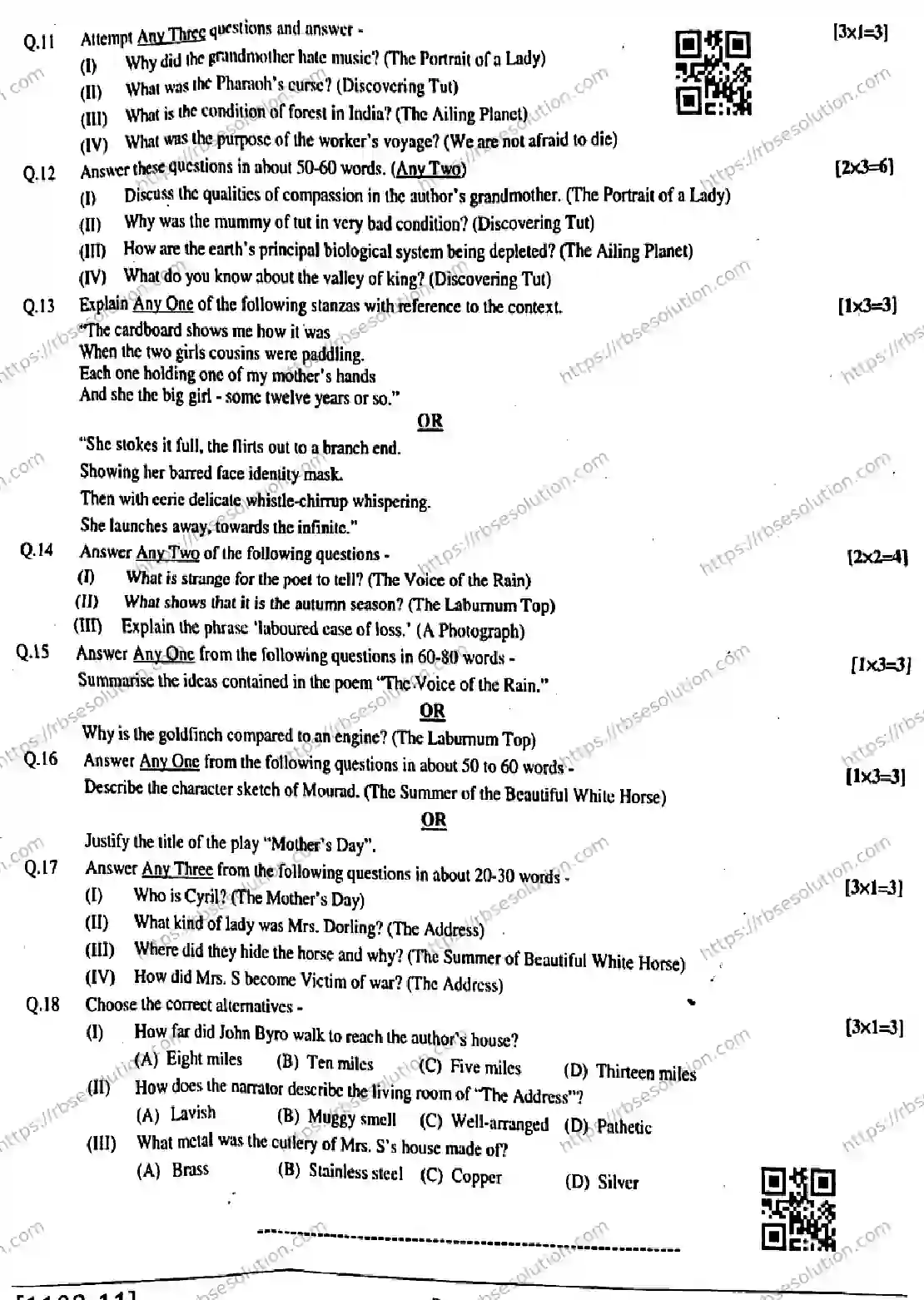
Section A: Attempt Any Three Questions and Answer
-
Why did the grandmother hate music? (The Portrait of a Lady)
The grandmother hated music because she associated it with the lives of beggars and prostitutes, not with gentlefolk. She believed that music was meant for people of low status and was not a suitable pursuit for a well-bred woman. This reflected her traditional and conservative mindset.
-
What was the Pharaoh's curse? (Discovering Tut)
The Pharaoh's curse was a supposed ancient curse that would bring misfortune, illness, or death to anyone who disturbed the tomb of an Egyptian pharaoh. In the context of Tutankhamun, it was believed that those involved in the discovery and examination of his mummy would suffer from the curse.
-
What is the condition of forests in India? (The Ailing Planet)
The condition of forests in India is alarming. They are being depleted at an unsustainable rate due to deforestation for agriculture, urbanization, and industrial needs. This loss of forest cover is a major factor in the degradation of the earth's principal biological systems, leading to soil erosion, loss of biodiversity, and climate change.
-
What was the purpose of the workers' voyage? (We are not afraid to die)
The purpose of the workers' voyage was to attempt a round-the-world sea voyage, following the footsteps of the famous explorer Captain James Cook. The narrator and his crew aimed to replicate Cook's journey, facing the challenges of the sea and testing their endurance and seamanship.
Section B: Answer These Questions in About 50-60 Words (Any Two)
-
Discuss the qualities of compassion in the author's grandmother. (The Portrait of a Lady)
The author's grandmother was a deeply compassionate woman. She spent her days feeding sparrows and dogs, showing kindness to all creatures. She was patient and loving with her grandson, teaching him prayers and stories. Her compassion was also evident in her silent, selfless service to the family, never complaining and always caring for others.
-
Why was the mummy of Tut in very bad condition? (Discovering Tut)
The mummy of Tutankhamun was in very bad condition primarily because of the hasty and careless handling during its initial discovery by Howard Carter in 1922. Carter used brutal methods, including chisels and heat, to remove the mummy from its coffin, causing significant damage. Additionally, the resins used in the mummification process had hardened over time, making the body brittle and fragile.
-
How are the earth's principal biological systems being depleted? (The Ailing Planet)
The earth's principal biological systems—fisheries, forests, grasslands, and croplands—are being depleted through overexploitation and unsustainable practices. Overfishing depletes marine life, deforestation destroys forests, overgrazing degrades grasslands, and intensive farming exhausts croplands. This depletion is driven by human population growth and increasing consumption, leading to a decline in the planet's ability to sustain life.
-
What do you know about the valley of kings? (Discovering Tut)
The Valley of the Kings is a valley in Egypt where, for a period of nearly 500 years from the 16th to 11th century BC, tombs were constructed for the pharaohs and powerful nobles of the New Kingdom. It is located on the west bank of the Nile, opposite Thebes (modern Luxor). The valley is famous for being the burial site of Tutankhamun, among many other pharaohs.
Section C: Explain Any One of the Following Stanzas with Reference to the Context
Stanza: "The cardboard shows me how it was / When the two girls cousins were paddling. / Each one holding one of my mother's hands / And she the big girl - some twelve years or so."
Reference to Context: This stanza is from the poem "A Photograph" by Shirley Toulson. The poet is looking at an old photograph of her mother as a young girl. The cardboard refers to the photograph's mount. The scene shows the poet's mother (the big girl, about twelve years old) with her two cousins, all paddling in the sea. The image captures a moment of innocent joy and childhood, frozen in time.
Section D: Answer Any Two of the Following Questions
-
What is strange for the poet to tell? (The Voice of the Rain)
The poet finds it strange to tell the rain about its own origin and cycle. The rain itself explains that it rises from the land and sea as vapor, ascends to the sky, forms clouds, and then falls back to earth to wash the dry dust and give life. The poet is surprised that he is recounting this natural process to the very entity that embodies it.
-
What shows that it is the autumn season? (The Laburnum Top)
The poem "The Laburnum Top" shows it is autumn through several details. The laburnum tree is described as "silent" and "still," with its leaves turning yellow and beginning to fall. The tree is "barren" and "empty" of life, except for the brief visit of the goldfinch. The overall mood is one of decay and the end of the growing season, typical of autumn.
-
Explain the phrase 'laboured ease of loss' (A Photograph)
The phrase 'laboured ease of loss' from the poem "A Photograph" refers to the poet's attempt to come to terms with her mother's death. The "ease" suggests a superficial acceptance, but the word "laboured" indicates the deep effort and pain involved in that acceptance. It captures the paradox of grief: the loss is permanent, and the poet must work hard to find a semblance of peace, which feels forced and unnatural.
Section E: Answer Any One from the Following Questions in 60-80 Words
Summarise the ideas contained in the poem "The Voice of the Rain."
The poem "The Voice of the Rain" presents a dialogue between the poet and the rain. The rain personifies itself, explaining its eternal cycle: it rises from the land and sea as vapor, ascends to the sky, forms clouds, and then falls back to earth to nourish and purify it. The rain describes itself as the "Poem of Earth," suggesting that it is a creative, life-giving force. The poet draws a parallel between the rain's cycle and the creation of a poem, which originates from the poet's soul, is shared with the world, and returns to its source. The central idea is the interconnectedness of all natural processes and the cyclical nature of life and art.
Section F: Answer Any One from the Following Questions in About 50 to 60 Words
Describe the character sketch of Mourad. (The Summer of the Beautiful White Horse)
Mourad is a passionate, impulsive, and kind-hearted Armenian boy. He is known for his love of horses and his adventurous spirit. Despite coming from a poor family, he is honest and has a strong sense of right and wrong. He steals a horse not out of malice but out of a deep desire to ride and care for it. He is also protective of his younger cousin, Aram, and ensures the horse is well-treated before returning it.
Section G: Answer Any Three from the Following Questions in About 20-30 Words
-
Who is Cyril? (The Mother's Day)
Cyril is the son of Mrs. Pearson and Mr. George Pearson. He is a young man who is disrespectful and takes his mother for granted, expecting her to serve him without gratitude.
-
What kind of lady was Mrs. Dorling? (The Address)
Mrs. Dorling was a greedy and opportunistic woman. She took advantage of the war situation to acquire the narrator's family's valuable possessions under the pretense of safekeeping, but later refused to return them.
-
Where did they hide the horse and why? (The Summer of Beautiful White Horse)
They hid the horse in a deserted barn on a remote farm. They hid it to keep it safe and secret from John Byro, the owner, and from their own family, who would have disapproved of the theft.
-
How did Mrs. S become a victim of war? (The Address)
Mrs. S, the narrator's mother, became a victim of war because she lost her life during the conflict. Her home was destroyed, and her valuable possessions were looted or taken by people like Mrs. Dorling, leaving her family with nothing.
Section H: Choose the Correct Alternatives
-
How far did John Byro walk to reach the author's house?
- Correct Answer: (B) Ten miles
- (A) Eight miles
- (C) Five miles
- (D) Thirteen miles
Explanation: In the story, John Byro mentions that he walked ten miles to reach the author's house to complain about his missing horse.
-
How does the narrator describe the living room of "The Address"?
- Correct Answer: (B) Muggy smell
- (A) Lavish
- (C) Well-arranged
- (D) Pathetic
Explanation: The narrator describes the living room as having a "muggy smell," indicating a stale, damp, and unpleasant atmosphere, which contrasts with the memories of her own home.
-
What metal was the cutlery of Mrs. S's house made of?
- Correct Answer: (D) Silver
- (A) Brass
- (B) Stainless steel
- (C) Copper
Explanation: The narrator remembers that the cutlery in her mother's house was made of silver, which was one of the valuable items Mrs. Dorling took.