
RBSE Class 11th 2026 HALF-YEARLY-ENGLISH-LITERATURE-1113-041225 Previous Year Papers
HALF-YEARLY-ENGLISH-LITERATURE-1113-041225 from the 2026 exam year is part of the Class 11th previous year papers archive on RBSE Solution. Many learners start here after finishing the textbook to see how questions were actually framed on the Rajasthan Board of Secondary Education (RBSE) paper.
Treat this question paper as a mock under gentle timing first, then as a marking exercise the second time. The introduction on this page is written only for this subject-and-year pair, not copied from other pages.
Bookmark the link if you coach juniors — the layout stays stable for search engines and classroom sharing.
Paper details
Quick reference for this previous year papers page — confirm board, class, and year & subject before you study.
| Board | RBSE |
|---|---|
| Class | Class 11th |
| Exam year | 2026 |
| Subject | HALF-YEARLY-ENGLISH-LITERATURE-1113-041225 |
| Resource type | Previous Year Papers |
| Category | RBSE Previous Year Question Papers |
| Website | RBSE Solution |
The table summarises this Previous Year Papers resource. Confirm RBSE, Class 11th, year 2026, and subject HALF-YEARLY-ENGLISH-LITERATURE-1113-041225 before studying.
RBSE Solution organises previous year papers so each URL carries chapter-specific guidance — better for students and for search engines than one generic paragraph for the whole class.
Turning 2026 papers into insight
One HALF-YEARLY-ENGLISH-LITERATURE-1113-041225 paper reveals style; several from the same year reveal pattern. After this page, open sibling subjects listed below to see whether marks cluster in certain units.
Keep rough work dated in your notebook. Examiners in Class 11th expect clear numbering even in practice sessions.
RBSE Class 11th 2026 HALF-YEARLY-ENGLISH-LITERATURE-1113-041225
Scroll through the Previous Year Papers pages for HALF-YEARLY-ENGLISH-LITERATURE-1113-041225 (2026).
Rajasthan Board Class 11th HALF-YEARLY-ENGLISH-LITERATURE-1113-041225 2026 solved Previous Year Question Papers
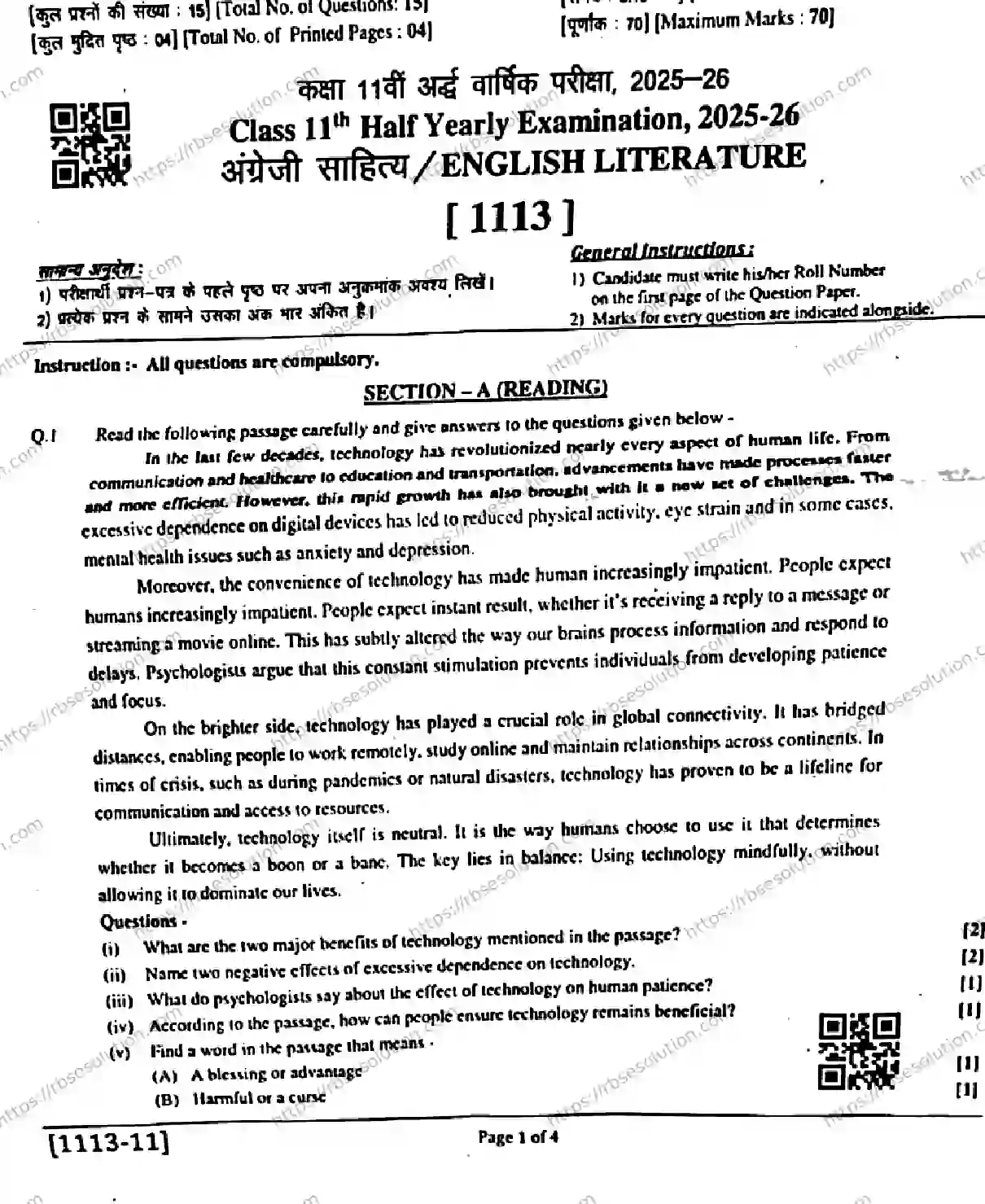
कुल प्रश्नों की संख्या : 45
Total No. of Questions : 45
कुल मुद्रित पृष्ठ : 04
Total No. of Printed Pages : 04
पूर्णांक : 70
Maximum Marks : 70
कक्षा 11वीं अर्द्ध वार्षिक परीक्षा, 2025-26
Class 11th Half Yearly Examination, 2025-26
अंग्रेजी साहित्य / ENGLISH LITERATURE
सामान्य निर्देश :
- परीक्षार्थी प्रश्न-पत्र के पहले पृष्ठ पर अपना अनुक्रमांक अवश्य लिखें। Candidate must write his/her Roll Number on the first page of the Question Paper.
- प्रत्येक प्रश्न के सामने उसका अंक भार अंकित है। Marks for every question are indicated alongside.
निर्देश : सभी प्रश्न अनिवार्य हैं।
SECTION - A (READING)
Q1. Read the following passage carefully and give answers to the questions given below -
In the last few decades, technology has revolutionized nearly every aspect of human life. From communication and healthcare to education and transportation, advancements have made processes faster and more efficient. However, this rapid growth has also brought with it a new set of challenges. The excessive dependence on digital devices has led to reduced physical activity, eye strain and in some cases, mental health issues such as anxiety and depression.
Moreover, the convenience of technology has made humans increasingly impatient. People expect instant results, whether it's receiving a reply to a message or streaming a movie online. This has subtly altered the way our brains process information and respond to delays. Psychologists argue that this constant stimulation prevents individuals from developing patience and focus.
On the brighter side, technology has played a crucial role in global connectivity. It has bridged distances, enabling people to work remotely, study online and maintain relationships across continents. In times of crisis, such as during pandemics or natural disasters, technology has proven to be a lifeline for communication and access to resources.
Ultimately, technology itself is neutral. It is the way humans choose to use it that determines whether it becomes a boon or a bane. The key lies in balance: Using technology mindfully, without allowing it to dominate our lives.
Questions -
-
(i) What are the two major benefits of technology mentioned in the passage?
Answer: The two major benefits of technology mentioned in the passage are: (1) making processes faster and more efficient in fields like communication, healthcare, education, and transportation; (2) enabling global connectivity by bridging distances, allowing remote work, online study, and maintaining relationships across continents.
-
(ii) Name two negative effects of excessive dependence on technology.
Answer: Two negative effects of excessive dependence on technology are: (1) reduced physical activity and eye strain; (2) mental health issues such as anxiety and depression.
-
(iii) What do psychologists say about the effect of technology on human patience?
Answer: Psychologists say that the constant stimulation from technology prevents individuals from developing patience and focus. It makes people increasingly impatient as they expect instant results, which subtly alters how the brain processes information and responds to delays.
-
(iv) According to the passage, how can people ensure technology remains beneficial?
Answer: According to the passage, people can ensure technology remains beneficial by using it mindfully and maintaining a balance, without allowing it to dominate their lives.
-
(v) Find a word in the passage that means -
- (A) A blessing or advantage : Boon
- (B) Harmful or a curse : Bane
Page 1 of 4
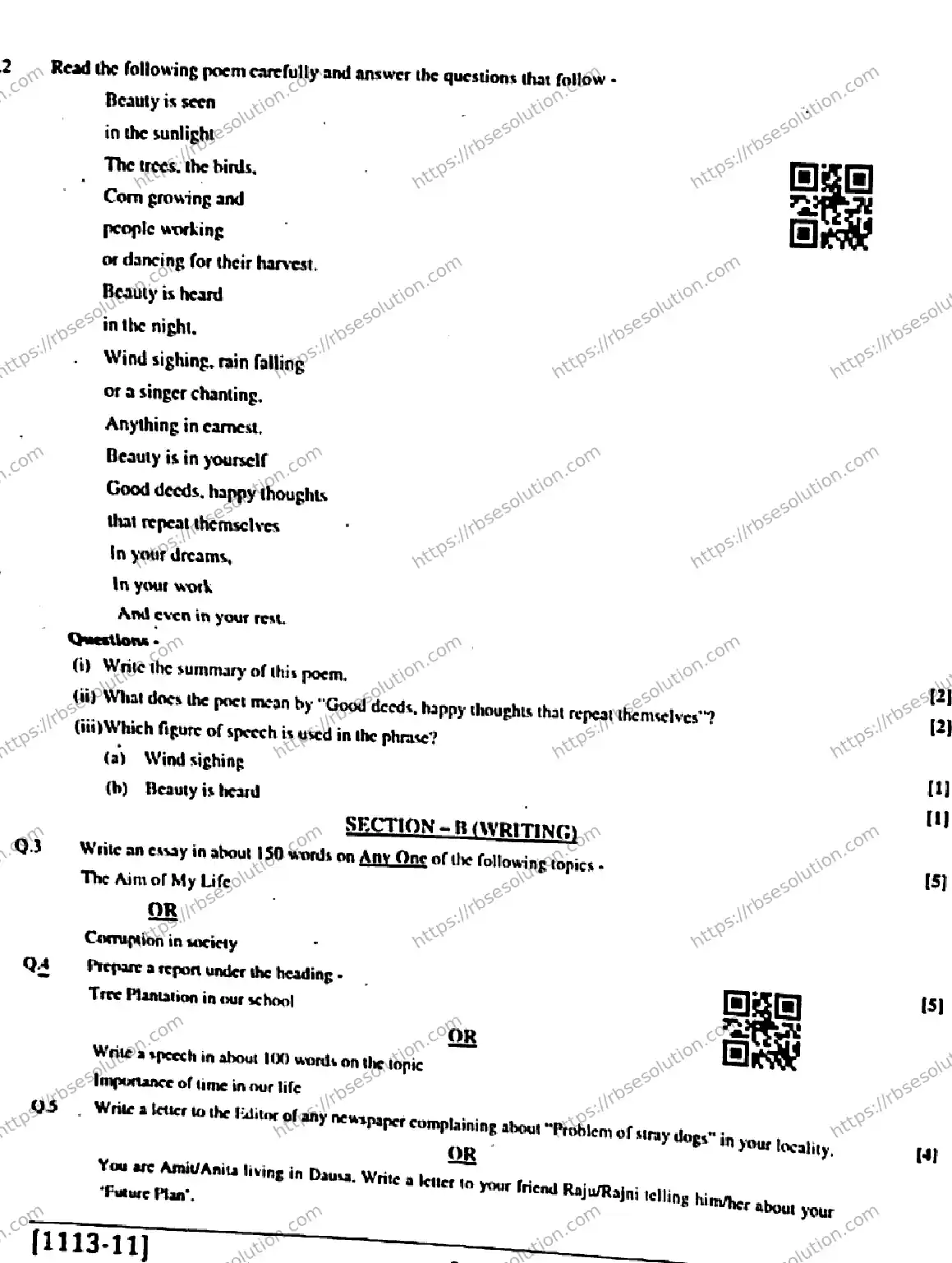
Read the following poem carefully and answer the questions that follow –
Beauty is seen
in the sunlight,
The trees, the birds,
Corn growing and
People working
or dancing for their harvest.
Beauty is heard
in the night,
Wind sighing, rain falling,
Of a singer chanting,
Anything in earnest.
Beauty is in yourself.
Good deeds, happy thoughts
that repeat themselves
In your dreams,
In your work,
And even in your rest.
Questions:
-
(i) Write the summary of this poem.
The poem "Beauty" by E-Yeh-Shure describes that beauty is not only seen in nature like sunlight, trees, birds, and harvest but also heard in the sounds of wind, rain, and singing. Most importantly, beauty lies within ourselves through good deeds, happy thoughts, dreams, work, and even rest. The poem teaches that beauty is everywhere and within everyone.
-
(ii) What does the poet mean by “Good deeds, happy thoughts that repeat themselves”?
The poet means that when we do good actions and have positive thoughts, they keep coming back to us. These good deeds and happy thoughts become a part of our dreams, work, and rest. They create inner beauty that stays with us always and makes our life beautiful from within.
-
(iii) Which figure of speech is used in the phrase?
-
(a) Wind sighing
Personification – The wind is given the human quality of sighing.
-
(b) Beauty is heard
Synesthesia – A figure of speech where one sense (beauty, usually seen) is described in terms of another sense (heard).
-
SECTION – I (WRITING) – 8
Q3. Write an essay in about 150 words on any one of the following topics:
OR
- The Aim of My Life
- Corruption in Society
Q4. Prepare a report under the heading – “Tree Plantation in our School”
OR
Write a speech in about 100 words on the topic – “Importance of Time in our Life”
Q5. Write a notice to the...
(The remaining content of this question appears incomplete in the source.)
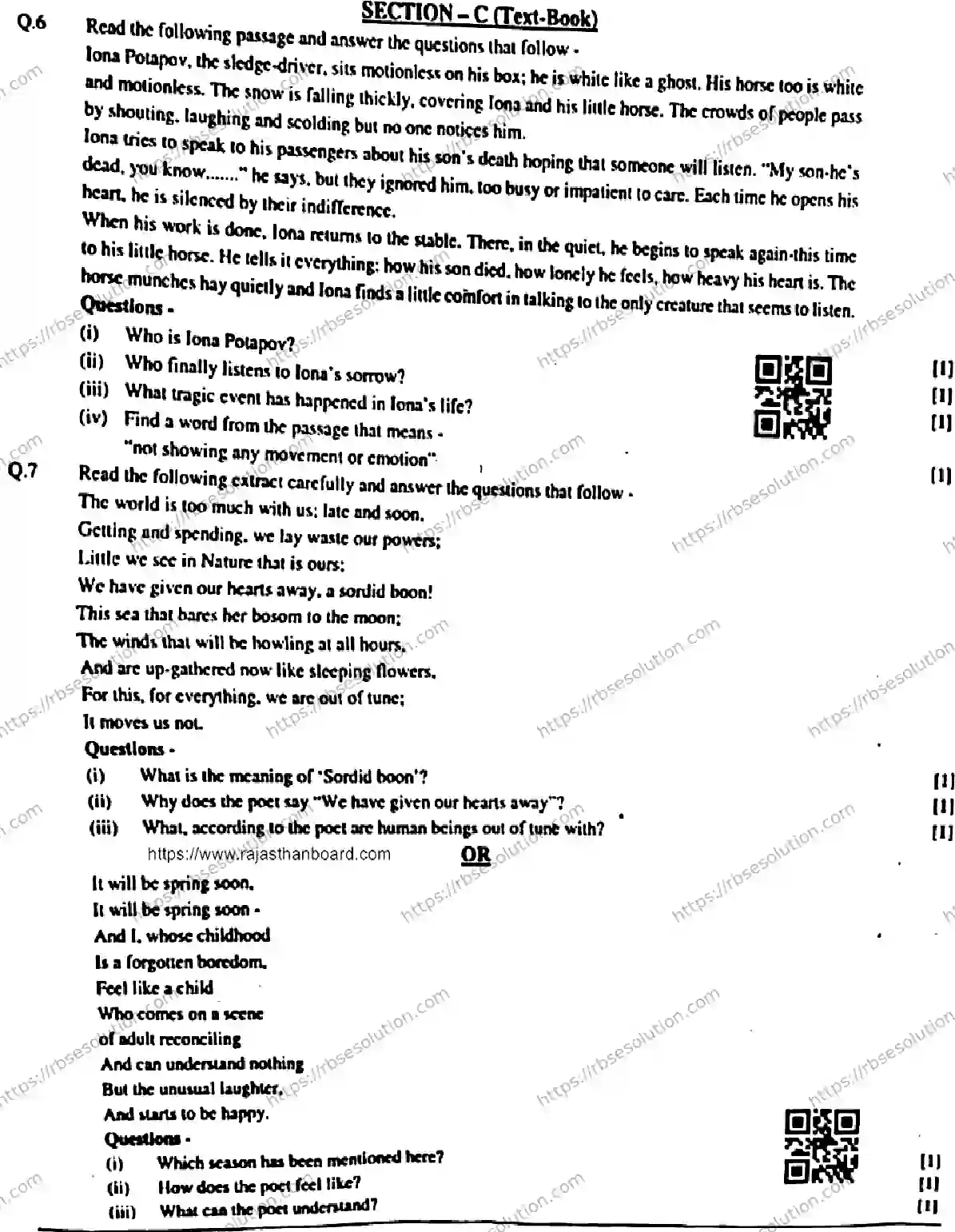
SECTION - C (Text-Book)
Read the following passage and answer the questions that follow:
Iona Potapov, the sledge-driver, sits motionless on his box; he is white like a ghost. His horse too is white and motionless. The snow is falling thickly, covering Iona and his horse. People pass by, laughing and scolding, but no one notices him. He tries to speak to his passengers about his son's death, hoping that someone will listen. "My son—he's dead," he says, but they ignore him, too busy or impatient to care. Each time he opens his mouth, they turn away.
- Who is Iona Potapov?
- Who finally listens to Iona's sorrow?
- What tragic event has happened in Iona's life?
- Find a word from the passage that means "not showing any movement of emotion".
Answers:
- Iona Potapov is a sledge-driver (a cab driver) who is grieving the death of his son.
- No one listens to Iona's sorrow in the passage; he is ignored by all passengers.
- The tragic event is the death of Iona's son.
- The word is "motionless" (or "white like a ghost" – but "motionless" directly means not showing any movement of emotion).
Read the following extract carefully and answer the questions that follow:
The world is too much with us: late and soon,
Getting and spending, we lay waste our powers;
Little we see in Nature that is ours:
We have given our hearts away, a sordid boon!
This sea that bares her bosom to the moon;
The winds that will be howling at all hours,
And are up-gathered now like sleeping flowers,
For this, for everything, we are out of tune;
It moves us not.
- What is the meaning of "sordid boon"?
- Why does the poet say "We have given our hearts away"?
- What, according to the poet, are human beings out of tune with?
Answers:
- "Sordid boon" means a dirty or shameful gift. Here, it refers to the materialistic gains that people have exchanged for their hearts and souls.
- The poet says "We have given our hearts away" because people have become so obsessed with earning money and material possessions that they have lost their emotional connection to nature and to themselves.
- According to the poet, human beings are out of tune with nature—the sea, the winds, and the natural world around them.
Read the following extract carefully and answer the questions that follow:
It will be spring soon,
It will be spring soon –
And I, whose childhood
Is a forgotten boredom,
Feel like a child
Who comes on a scene
Of adult reconciling
And can understand nothing
But the unusual laughter,
And starts to be happy.
- Which season has been mentioned here?
- How does the poet feel like?
- What can the poet understand?
Answers:
- The season mentioned is spring.
- The poet feels like a child who comes upon a scene of adult reconciliation and cannot understand it, but starts to feel happy because of the unusual laughter.
- The poet can understand nothing except the unusual laughter, which makes him/her happy.
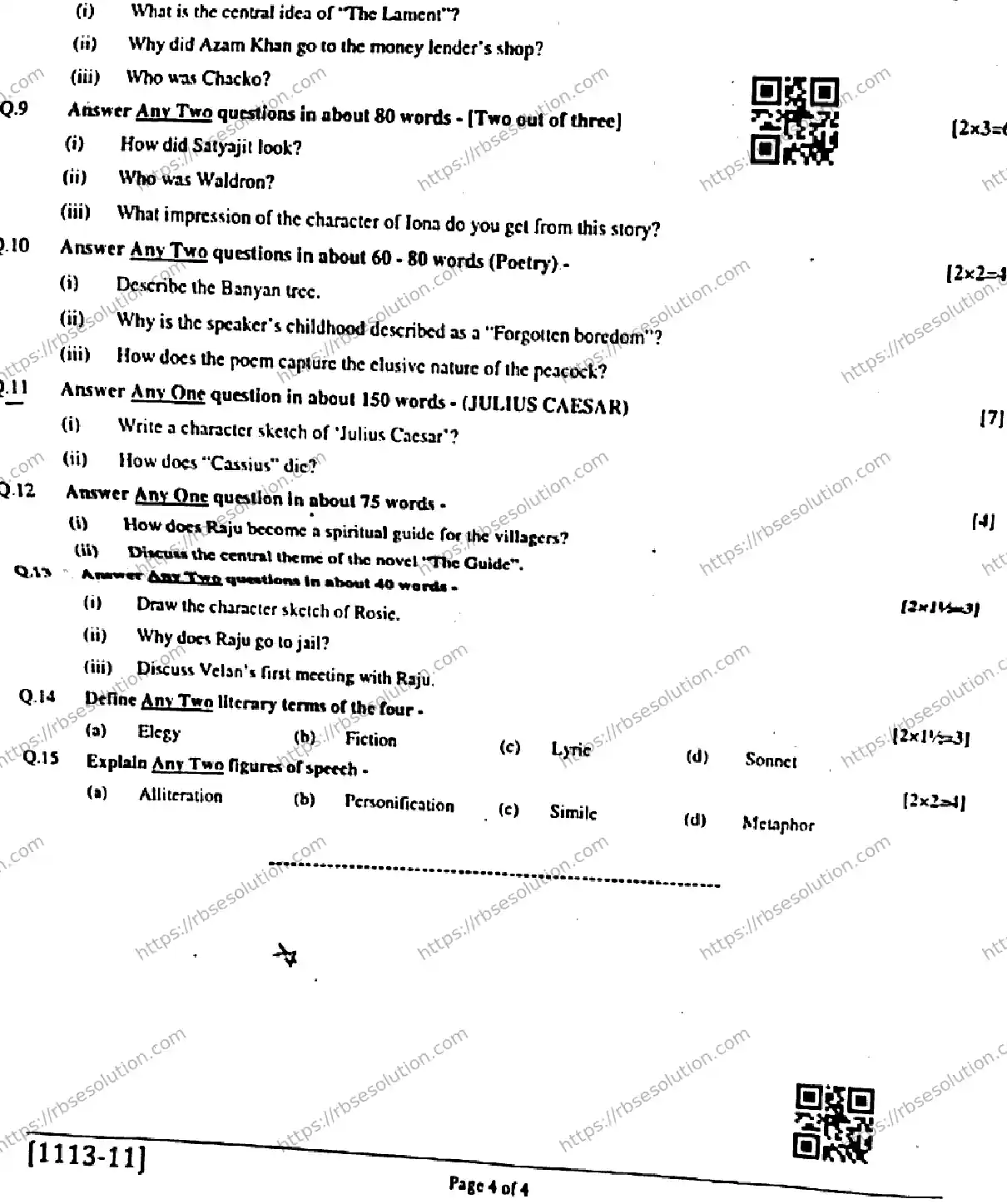
Section A: Prose (The Lament, Azam Khan, Chacko)
Answer Any Two questions in about 80 words – [Two out of three]
-
(i) What is the central idea of “The Lament”?
The central idea of “The Lament” revolves around the theme of grief, loss, and the human condition. It explores how individuals cope with profound sorrow and the inevitability of death. The story highlights the emotional journey of a character who laments not just personal loss but also the broader suffering and transience of life. Through this lament, the narrative underscores the universal experience of pain and the search for meaning amidst despair, ultimately reflecting on the fragility of human existence and the need for compassion.
-
(ii) Why did Azam Khan go to the money lender's shop?
Azam Khan went to the money lender's shop to borrow money. He was in urgent need of funds, likely to meet some pressing financial obligation or to support his family. The money lender was known in the community for providing loans, though often at high interest rates. Azam Khan's visit reflects the common plight of the poor who have to rely on such sources due to lack of other options, highlighting themes of economic hardship and dependency.
-
(iii) Who was Chacko?
Chacko was a character in the story, often depicted as a simple, hardworking individual. He might have been a laborer or a common man facing the challenges of daily life. His role in the narrative typically illustrates the struggles of the working class, their resilience, and their interactions with other characters. Chacko's character serves to highlight social realities and human relationships within the context of the story.
Section B: Prose (Satyajit, Waldron, Iona)
Answer Any Two questions in about 60-80 words – [Two out of three]
-
(i) How did Satyajit look?
Satyajit is described as having a distinctive appearance. He likely had sharp features, a thoughtful expression, and a calm demeanor. His eyes might have reflected intelligence and curiosity. The description of his look often emphasizes his observant nature and his ability to notice details that others miss. His overall appearance suggests a person who is introspective, creative, and deeply engaged with the world around him.
-
(ii) Who was Waldron?
Waldron was a character in the story, possibly a teacher, mentor, or an authoritative figure. He played a significant role in the narrative, influencing the protagonist or other characters. Waldron might have been known for his strictness, wisdom, or a particular philosophy. His interactions with others reveal aspects of human nature, such as respect, fear, or admiration. The character of Waldron adds depth to the plot and helps drive the story forward.
-
(iii) What impression of the character of Iona do you get from this story?
From the story, Iona emerges as a deeply sorrowful and lonely character. He is a cab driver who has recently lost his son and is overwhelmed by grief. Iona desperately seeks someone to share his pain with, but everyone he encounters is indifferent or dismissive. His character evokes sympathy as he represents the universal human need for connection and understanding in times of suffering. Iona's silent endurance and longing for empathy make him a poignant figure.
Section C: Poetry (Banyan Tree, Forgotten Boredom, Peacock)
Answer Any Two questions in about 60-80 words – [Two out of three]
-
(i) Describe the Banyan tree.
The Banyan tree is described as a majestic, ancient tree with sprawling branches and aerial roots that create a vast canopy. It stands as a symbol of strength, endurance, and timelessness. The tree provides shade and shelter to many creatures, and its presence evokes a sense of awe and reverence. In the poem, the Banyan tree is often associated with memories, childhood, and the passage of time, representing a connection between nature and human experience.
-
(ii) Why is the speaker's childhood described as a “Forgotten boredom”?
The speaker's childhood is described as a “Forgotten boredom” to emphasize the monotony and lack of excitement that characterized those early years. The phrase suggests that the days were filled with repetitive routines and a sense of ennui, which have now faded from memory. This description highlights how childhood can sometimes feel dull and uneventful, yet those moments are later forgotten or romanticized. It reflects the contrast between the perceived boredom of the past and the nostalgia of adulthood.
-
(iii) How does the poem capture the elusive nature of the peacock?
The poem captures the elusive nature of the peacock through vivid imagery and sensory details. The peacock is portrayed as a fleeting, almost mythical creature that appears suddenly and disappears just as quickly. Its vibrant colors and graceful movements are described in a way that emphasizes its beauty and mystery. The poem uses metaphors and similes to convey the peacock's shyness and its tendency to remain hidden, making it a symbol of the unattainable and the transient.
Section D: Julius Caesar
Answer Any One question in about 150 words – [One out of two]
-
(i) Write a character sketch of “Julius Caesar”.
Julius Caesar is portrayed as a powerful and ambitious Roman leader. He is confident, charismatic, and possesses a strong sense of destiny. Caesar is shown as a military genius who has conquered many lands and earned the loyalty of his soldiers. However, he also displays arrogance and a tendency to ignore warnings, which ultimately leads to his downfall. He is superstitious yet dismissive of omens, believing himself to be invincible. Caesar's character embodies both greatness and hubris. His assassination highlights the conflict between personal ambition and the welfare of the state. Despite his flaws, Caesar's legacy as a transformative figure in Roman history is undeniable. His character serves as a cautionary tale about the dangers of unchecked power and the fragility of human life.
-
(ii) How does “Cassius” die?
Cassius dies by suicide after mistakenly believing that his friend Titinius has been captured by the enemy. During the Battle of Philippi, Cassius sends Titinius to check on nearby troops. When he sees Titinius surrounded by horsemen and hears shouts of joy, he assumes the worst. In despair, Cassius orders his servant Pindarus to kill him with the same sword he used to stab Caesar. Ironically, Titinius was actually being greeted by friendly forces. Cassius's death is a tragic result of miscommunication and his own impulsive nature. It reflects themes of honor, guilt, and the consequences of political conspiracy. His end also marks a turning point in the play, leading to the eventual defeat of the conspirators.
Section E: The Guide
Answer Any One question in about 75 words – [One out of two]
-
(i) How does Raju become a spiritual guide for the villagers?
Raju becomes a spiritual guide for the villagers almost by accident. After being released from prison, he seeks refuge in an abandoned temple near a village. The villagers mistake him for a holy man, and Raju, initially amused, begins to play along. He starts giving advice and performing rituals, and the villagers begin to revere him as a swami. Over time, Raju embraces the role, finding purpose and redemption in helping others. His transformation from a conman to a spiritual leader is central to the novel's theme of self-discovery.
-
(ii) Discuss the central theme of the novel “The Guide”.
The central theme of “The Guide” is the journey of self-discovery and transformation. The novel explores how a person can change from being a selfish guide to a selfless spiritual leader. It delves into themes of identity, redemption, and the conflict between appearance and reality. Raju's evolution from a tourist guide to a revered saint highlights the power of circumstances and human resilience. The novel also examines the nature of faith, the role of destiny, and the search for meaning in life. Ultimately, it is a story about finding one's true self through service and sacrifice.
Section F: The Guide (Short Answers)
Answer Any Two questions in about 40 words – [Two out of three]
-
(i) Draw the character sketch of Rosie.
Rosie is a beautiful, talented, and ambitious woman. She is a dancer who seeks freedom and recognition. She is married to a wealthy but controlling husband. Rosie is passionate about her art and eventually finds love and support in Raju. Her character represents the struggle for independence and self-expression.
-
(ii) Why does Raju go to jail?
Raju goes to jail because he is convicted of forgery. He had signed a document to help Rosie, but it was later discovered to be fake. Raju takes the blame to protect Rosie, showing his love and sacrifice. His imprisonment becomes a turning point in his life, leading to his eventual transformation.
-
(iii) Discuss Velan's first meeting with Raju.
Velan first meets Raju when he comes to the temple where Raju is staying. Velan is a simple villager who mistakes Raju for a holy man. He seeks Raju's advice about his family problems. Raju, initially surprised, plays along and gives him guidance. This meeting marks the beginning of Raju's new life as a spiritual guide.
Section G: Literary Terms
Define Any Two Literary terms of the four – [2x2=4]
-
(a) Elegy
An elegy is a poem of serious reflection, typically a lament for the dead. It expresses sorrow, mourning, and often meditates on the nature of death and loss. Elegies are characterized by their solemn tone and formal structure. Examples include Thomas Gray's "Elegy Written in a Country Churchyard."
-
(b) Fiction
Fiction is a literary genre that involves imaginative or invented stories, as opposed to factual accounts. It includes novels, short stories, and novellas. Fiction can be based on real events but is primarily created from the author's imagination. It explores themes, characters, and plots to entertain, inform, or provoke thought.
-
(c) Lyric
A lyric is a short poem that expresses personal emotions, thoughts, or feelings, often in a musical style. Unlike narrative poetry, lyrics focus on the speaker's inner state. They are characterized by their subjective, emotional content and rhythmic language. Sonnets and odes are common forms of lyric poetry.
-
(d) Sonnet
A sonnet is a 14-line poem, typically written in iambic pentameter. It follows a specific rhyme scheme, such as the Shakespearean (abab cdcd efef gg) or Petrarchan (abba abba cde cde) form. Sonnets often explore themes of love, beauty, time, and mortality. They are known for their concise and structured expression of complex ideas.
Section H: Figures of Speech
Explain Any Two figures of speech – [2x2=4]
-
(a) Alliteration
Alliteration is the repetition of the same initial consonant sound in a sequence of words. It is used to create rhythm, emphasis, and musicality in writing. For example, "Peter Piper picked a peck of pickled peppers." The repetition of the 'p' sound makes the phrase memorable and rhythmic.
-
(b) Personification
Personification is a figure of speech where human qualities are attributed to non-human objects, animals, or abstract ideas. It makes descriptions more vivid and relatable. For example, "The wind whispered through the trees." Here, the wind is given the human action of whispering, creating a gentle, evocative image.
-
(c) Simile
A simile is a figure of speech that compares two different things using the words "like" or "as". It helps create vivid imagery and clarify meaning. For example, "Her eyes shone like stars." This comparison emphasizes the brightness and beauty of her eyes by likening them to stars.
-
(d) Metaphor
A metaphor is a figure of speech that directly compares two unlike things without using "like" or "as". It states that one thing is another, creating a strong image or idea. For example, "Time is a thief." This metaphor suggests that time steals moments from our lives, implying loss and the passage of time.