
RBSE Class 11th 2026 HALF-YEARLY-MATHEMATICS-1104 Previous Year Papers
HALF-YEARLY-MATHEMATICS-1104 from the 2026 exam year is part of the Class 11th previous year papers archive on RBSE Solution. Many learners start here after finishing the textbook to see how questions were actually framed on the Rajasthan Board of Secondary Education (RBSE) paper.
Treat this question paper as a mock under gentle timing first, then as a marking exercise the second time. The introduction on this page is written only for this subject-and-year pair, not copied from other pages.
Bookmark the link if you coach juniors — the layout stays stable for search engines and classroom sharing.
Paper details
Quick reference for this previous year papers page — confirm board, class, and year & subject before you study.
| Board | RBSE |
|---|---|
| Class | Class 11th |
| Exam year | 2026 |
| Subject | HALF-YEARLY-MATHEMATICS-1104 |
| Resource type | Previous Year Papers |
| Category | RBSE Previous Year Question Papers |
| Website | RBSE Solution |
The table summarises this Previous Year Papers resource. Confirm RBSE, Class 11th, year 2026, and subject HALF-YEARLY-MATHEMATICS-1104 before studying.
RBSE Solution organises previous year papers so each URL carries chapter-specific guidance — better for students and for search engines than one generic paragraph for the whole class.
How to practise with this question paper
Stage one: read the HALF-YEARLY-MATHEMATICS-1104 question paper from 2026 without a timer and highlight command words — explain, prove, calculate, discuss. Stage two: attempt selected questions closed-book. Stage three: compare with solutions or teacher feedback.
Previous Year Papers work best when you log mistakes by topic, not only by question number. That log becomes your revision index before pre-boards.
RBSE Class 11th 2026 HALF-YEARLY-MATHEMATICS-1104
Scroll through the Previous Year Papers pages for HALF-YEARLY-MATHEMATICS-1104 (2026).
Rajasthan Board Class 11th HALF-YEARLY-MATHEMATICS-1104 2026 solved Previous Year Question Papers
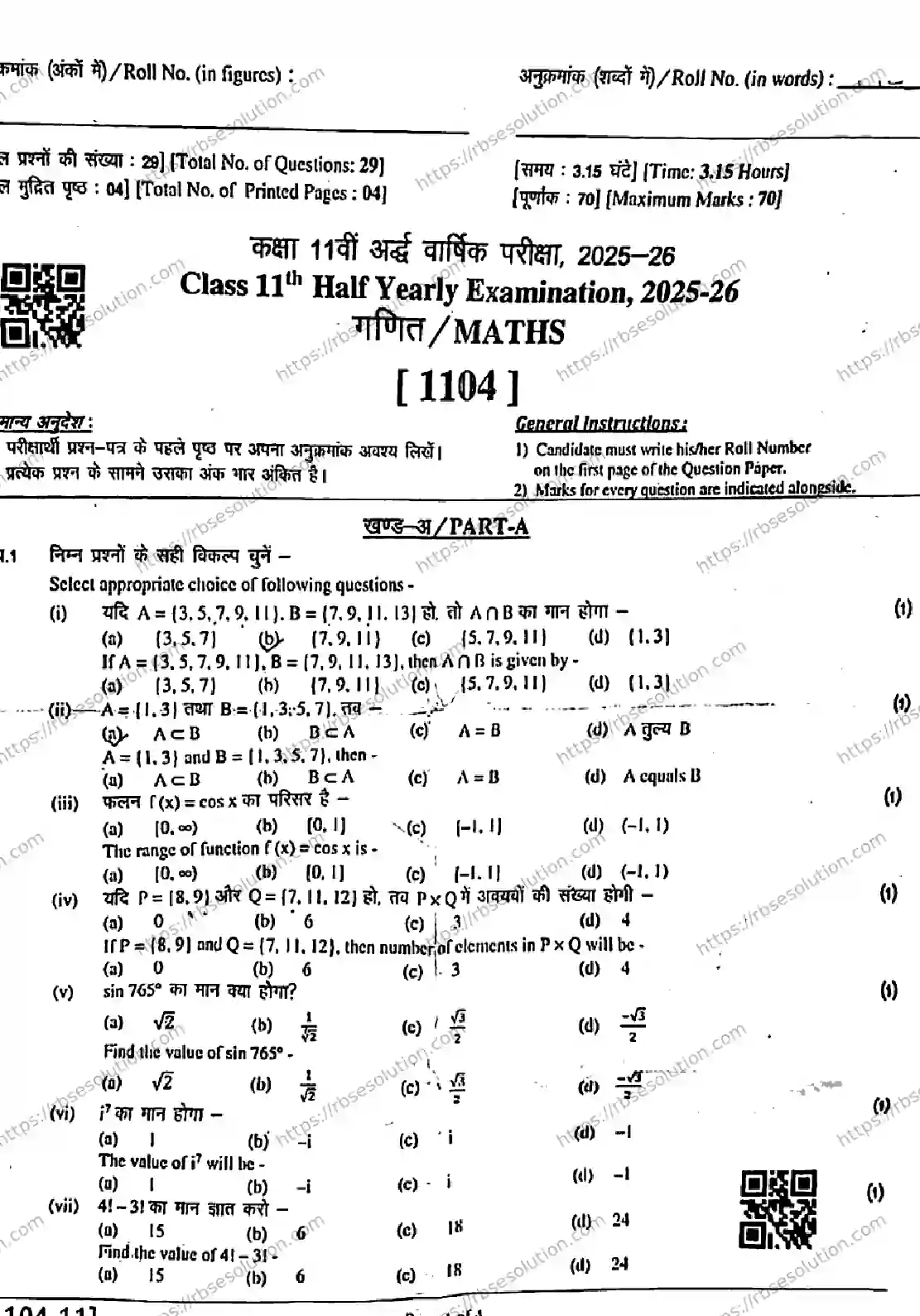
खण्ड-अ / PART-A
प्रत्येक प्रश्न के सामने उसका अंक भार अंकित है।
निम्नलिखित प्रश्नों के सही विकल्प चुनें -
Select appropriate choice of following questions -
-
यदि A = {3, 5, 7, 9, 11}, B = {7, 9, 11, 13} हो, तो A ∩ B का मान होगा -
- (a) {3, 5, 7}
- (b) {5, 7, 9}
- (c) {7, 9, 11}
- (d) {11, 13}
Explanation: A ∩ B = {7, 9, 11} (common elements in both sets).
-
A = {1, 3} तथा B = {1, 3, 5, 7}, तब -
- (a) A ⊂ B
- (b) B ⊂ A
- (c) A = B
- (d) A equals B
Explanation: All elements of A (1, 3) are in B, so A is a subset of B.
-
फलन f(x) = cos x का परिसर है -
- (a) [0, 2]
- (b) (0, 1)
- (c) [-1, 1]
- (d) (-1, 1)
Explanation: The range of cos x is [-1, 1] for all real x.
-
यदि P = {8, 9} और Q = {7, 11, 12} हो, तो P × Q में अवयवों की संख्या होगी -
- (a) 5
- (b) 6
- (c) 3
- (d) 4
Explanation: Number of elements in P × Q = |P| × |Q| = 2 × 3 = 6.
-
sin 765° का मान क्या होगा?
- (a) √2
- (b) 1/√2
- (c) 1/2
- (d) 1
Explanation: sin 765° = sin(720° + 45°) = sin 45° = 1/√2.
-
i7 का मान होगा -
- (a) 1
- (b) i
- (c) -i
- (d) -1
Explanation: i7 = i4 × i3 = 1 × (-i) = -i.
-
4! - 3! का मान ज्ञात करो -
- (a) 5
- (b) 6
- (c) 8
- (d) 18
Explanation: 4! = 24, 3! = 6, so 24 - 6 = 18.
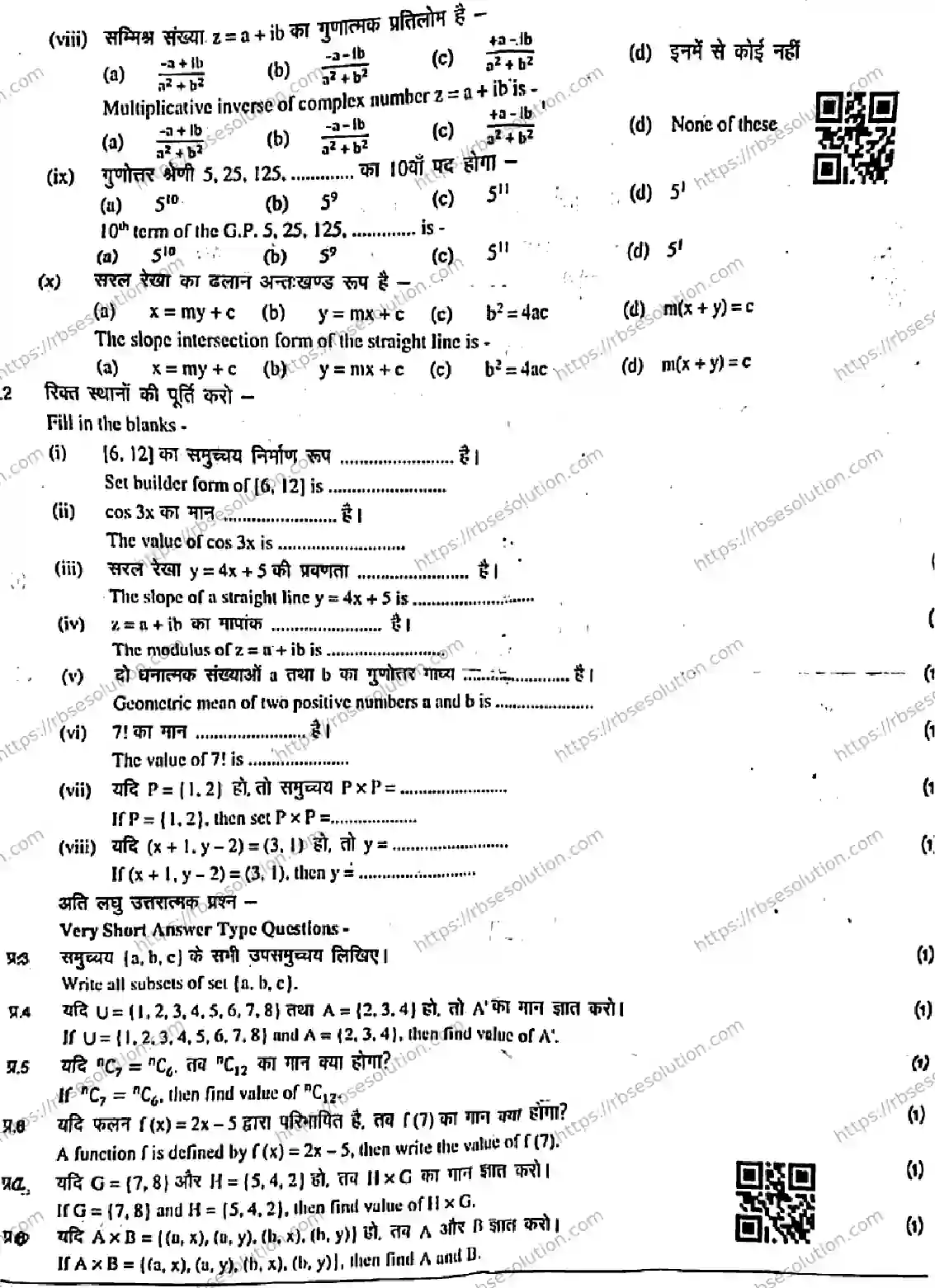
गुणात्मक प्रतिलोम (Multiplicative Inverse)
प्रश्न: सम्मिश्र संख्या z = a + ib का गुणात्मक प्रतिलोम है -
The multiplicative inverse of complex number z = a + ib is -
- a - ib
- a + ib
- a/(a² + b²) - ib/(a² + b²)
- None of these
व्याख्या: सम्मिश्र संख्या z = a + ib का गुणात्मक प्रतिलोम 1/z = 1/(a+ib) = (a-ib)/(a²+b²) = a/(a²+b²) - ib/(a²+b²) होता है।
प्रश्न: गुणोत्तर श्रेणी 5, 25, 125, ........... का 20वाँ पद होगा -
20th term of the G.P. 5, 25, 125, ........... is -
- 5⁵⁰
- 5²⁰
- 5¹⁹
- None of these
व्याख्या: गुणोत्तर श्रेणी का प्रथम पद a = 5, सार्व अनुपात r = 25/5 = 5. nवाँ पद = a rⁿ⁻¹ = 5 × 5¹⁹ = 5²⁰.
प्रश्न: सरल रेखा का ढलान अन्तःखण्ड रूप है -
The slope intersection form of the straight line is -
- x = my + c
- y = mx + c
- b = dac
- None of these
व्याख्या: सरल रेखा का ढलान अन्तःखण्ड रूप y = mx + c है, जहाँ m ढलान और c y-अन्तःखण्ड है।
रिक्त स्थानों की पूर्ति करो (Fill in the blanks)
(i) {6, 12} का समुच्चय निर्माण रूप है -
Set builder form of {6, 12} is -
उत्तर: {x : x = 6n, n ∈ N, 1 ≤ n ≤ 2}
(ii) cos 3x का मान है -
The value of cos 3x is -
उत्तर: cos 3x = 4 cos³ x - 3 cos x
(iii) रेखा y = 4x + 5 की प्रवणता -
The slope of a straight line y = 4x + 5 is -
उत्तर: 4
(iv) z = 0 + ib का मापांक -
The modulus of z = 0 + ib is -
उत्तर: |b|
(v) दो धनात्मक संख्याओं a तथा b का गुणोत्तर माध्य -
Geometric mean of two positive numbers a and b is -
उत्तर: √(ab)
(vi) 7! का मान -
The value of 7! is -
उत्तर: 5040
(vii) यदि P = {1, 2}, तो समुच्चय P × P =
If P = {1, 2}, then set P × P =
उत्तर: {(1,1), (1,2), (2,1), (2,2)}
(viii) यदि (x + 1, y - 2) = (3, 1) हो, तो x और y के मान -
If (x + 1, y - 2) = (3, 1), then values of x and y are -
उत्तर: x = 2, y = 3
अति लघु उत्तरात्मक प्रश्न (Very Short Answer Type Questions)
प्रश्न 3: समुच्चय {a, b, c} के सभी उपसमुच्चय लिखिए।
Write all subsets of set {a, b, c}.
उत्तर: ∅, {a}, {b}, {c}, {a,b}, {a,c}, {b,c}, {a,b,c}
प्रश्न 4: यदि U = {1, 2, 3, 4, 5, 6, 7, 8} तथा A = {2, 3, 4} हो, तो A' का मान ज्ञात करो।
If U = {1, 2, 3, 4, 5, 6, 7, 8} and A = {2, 3, 4}, then find value of A'.
उत्तर: A' = U - A = {1, 5, 6, 7, 8}
प्रश्न 5: यदि ⁿC₈ = ⁿC₆, तब ⁿC₂ का मान क्या होगा?
If ⁿC₈ = ⁿC₆, then find value of ⁿC₂.
उत्तर: ⁿC₈ = ⁿC₆ ⇒ n = 8 + 6 = 14. अतः ¹⁴C₂ = 14!/(2! × 12!) = (14 × 13)/2 = 91.
प्रश्न 6: यदि फलन f(x) = 2x - 5 द्वारा परिभाषित है, तो f(7) का मान क्या होगा?
A function f is defined by f(x) = 2x - 5, then write the value of f(7).
उत्तर: f(7) = 2(7) - 5 = 14 - 5 = 9.
प्रश्न 7: यदि G = {7, 8} और H = {5, 4, 2} हो, तब H × G का मान ज्ञात कीजिए।
If G = {7, 8} and H = {5, 4, 2}, then find value of H × G.
उत्तर: H × G = {(5,7), (5,8), (4,7), (4,8), (2,7), (2,8)}
प्रश्न 8: यदि A × B = {(a, x), (a, y), (b, x), (b, y)} हो, तब A और B ज्ञात करो।
If A × B = {(a, x), (a, y), (b, x), (b, y)}, then find A and B.
उत्तर: A = {a, b}, B = {x, y}
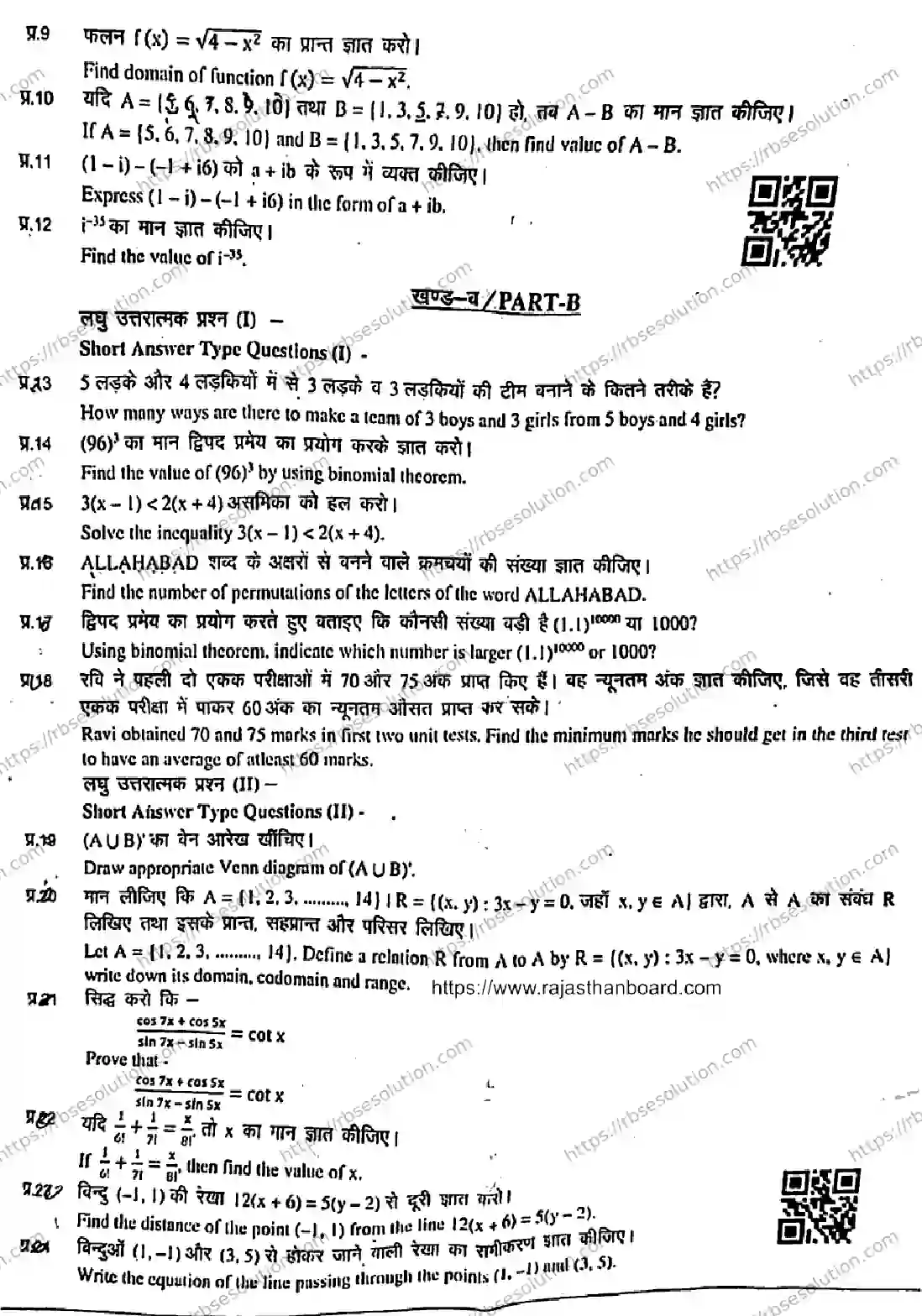
प्र.9
फलन f(x) = √(4 - x²) का प्रान्त ज्ञात करो।
हल: फलन f(x) = √(4 - x²) के लिए, 4 - x² ≥ 0 होना चाहिए।
⇒ x² ≤ 4
⇒ -2 ≤ x ≤ 2
अतः प्रान्त = [-2, 2]
प्र.10
यदि A = {5, 6, 7, 8, 9, 10} तथा B = {1, 3, 5, 7, 9, 0}, तो A - B का मान ज्ञात कीजिए।
हल: A - B = {x : x ∈ A और x ∉ B}
A = {5, 6, 7, 8, 9, 10}, B = {0, 1, 3, 5, 7, 9}
A में उपस्थित तथा B में अनुपस्थित अवयव: 6, 8, 10
अतः A - B = {6, 8, 10}
प्र.11
(1 - i) - (-1 + 6i) को a + ib के रूप में व्यक्त कीजिए।
हल: (1 - i) - (-1 + 6i) = 1 - i + 1 - 6i = 2 - 7i
अतः a + ib के रूप में = 2 + (-7)i
प्र.12
2⁰ का मान ज्ञात कीजिए।
हल: किसी भी संख्या की घात 0 होने पर उसका मान 1 होता है।
अतः 2⁰ = 1
लघु उत्तरात्मक प्रश्न (I)
प्र.13
5 लड़के और 4 लड़कियों में से 3 लड़के व 3 लड़कियों की टीम बनाने के कितने तरीके हैं?
हल: 5 लड़कों में से 3 लड़के चुनने के तरीके = ⁵C₃ = 10
4 लड़कियों में से 3 लड़कियाँ चुनने के तरीके = ⁴C₃ = 4
कुल तरीके = 10 × 4 = 40
प्र.14
(96)³ का मान द्विपद प्रमेय का प्रयोग करके ज्ञात करो।
हल: (96)³ = (100 - 4)³
द्विपद प्रमेय से: (a - b)³ = a³ - 3a²b + 3ab² - b³
= 100³ - 3(100²)(4) + 3(100)(4²) - 4³
= 1000000 - 120000 + 4800 - 64
= 884736
प्र.15
3(x - 1) < 2(x + 4) असमिका को हल करो।
हल: 3(x - 1) < 2(x + 4)
⇒ 3x - 3 < 2x + 8
⇒ 3x - 2x < 8 + 3
⇒ x < 11
अतः हल समुच्चय = {x : x < 11}
प्र.16
ALLAHABAD शब्द के अक्षरों से बनने वाले क्रमचयों की संख्या ज्ञात कीजिए।
हल: ALLAHABAD में कुल 9 अक्षर हैं।
A = 4 बार, L = 2 बार, H = 1 बार, B = 1 बार, D = 1 बार
क्रमचयों की संख्या = 9! / (4! × 2!)
= 362880 / (24 × 2) = 362880 / 48 = 7560
प्र.17
द्विपद प्रमेय का प्रयोग करते हुए बताइए कि कौनसी संख्या बड़ी है (1.1)¹⁰⁰⁰⁰ या 1000?
हल: (1.1)¹⁰⁰⁰⁰ = (1 + 0.1)¹⁰⁰⁰⁰
द्विपद प्रमेय से: (1 + 0.1)¹⁰⁰⁰⁰ = 1 + ¹⁰⁰⁰⁰C₁(0.1) + ¹⁰⁰⁰⁰C₂(0.1)² + ...
= 1 + 1000 + ¹⁰⁰⁰⁰C₂(0.01) + ...
यह स्पष्टतः 1000 से बड़ा है।
अतः (1.1)¹⁰⁰⁰⁰ बड़ी संख्या है।
प्र.18
रवि ने पहली दो एकक परीक्षाओं में 70 और 75 अंक प्राप्त किए हैं। वह न्यूनतम अंक ज्ञात कीजिए, जिसे वह तीसरी एकक परीक्षा में पाकर 60 अंक का न्यूनतम औसत प्राप्त कर सके।
हल: माना तीसरी परीक्षा में x अंक प्राप्त करने हैं।
औसत ≥ 60
⇒ (70 + 75 + x)/3 ≥ 60
⇒ 145 + x ≥ 180
⇒ x ≥ 35
अतः न्यूनतम अंक = 35
लघु उत्तरात्मक प्रश्न (II)
प्र.19
(A ∪ B)' का वेन आरेख खींचिए।
हल: (A ∪ B)' का अर्थ है A ∪ B का पूरक, अर्थात वह क्षेत्र जो न तो A में है और न ही B में।
वेन आरेख में, दो वृत्त A और B को दर्शाते हैं। (A ∪ B)' वह भाग है जो दोनों वृत्तों के बाहर है, लेकिन आयत (सार्वत्रिक समुच्चय) के अंदर है।
प्र.20
मान लीजिए कि A = {1, 2, 3, ..., 14} तथा R = {(x, y) : 3x - y = 0, जहाँ x, y ∈ A} एक संबंध R, A से A में परिभाषित कीजिए। इसके प्रांत, सहप्रांत और परिसर लिखिए।
हल: R = {(x, y) : 3x - y = 0, x, y ∈ A}
⇒ y = 3x
x = 1 ⇒ y = 3 ∈ A
x = 2 ⇒ y = 6 ∈ A
x = 3 ⇒ y = 9 ∈ A
x = 4 ⇒ y = 12 ∈ A
x = 5 ⇒ y = 15 ∉ A (अतः यह संबंध में नहीं होगा)
अतः R = {(1,3), (2,6), (3,9), (4,12)}
प्रांत: {1, 2, 3, 4}
सहप्रांत: A = {1, 2, 3, ..., 14}
परिसर: {3, 6, 9, 12}
प्र.21
सिद्ध कीजिए कि (sin 7x + sin 5x) / (cos 7x + cos 5x) = cot x
हल: sin C + sin D = 2 sin((C+D)/2) cos((C-D)/2)
cos C + cos D = 2 cos((C+D)/2) cos((C-D)/2)
बायाँ पक्ष = [2 sin(6x) cos(x)] / [2 cos(6x) cos(x)]
= sin(6x) / cos(6x) = tan(6x)
यहाँ प्रश्न में त्रुटि प्रतीत होती है। वास्तविक सर्वसमिका है:
(sin 7x + sin 5x) / (cos 7x + cos 5x) = tan 6x
अतः दिया गया कथन cot x के लिए सत्य नहीं है।
प्र.22
यदि a + 1/a = 2, तो x का मान ज्ञात कीजिए।
हल: a + 1/a = 2
⇒ a² + 1 = 2a
⇒ a² - 2a + 1 = 0
⇒ (a - 1)² = 0
⇒ a = 1
यदि प्रश्न में x का मान a के रूप में है, तो x = 1
प्र.23
बिंदु (-1, 1) की रेखा 12(x + 6) = 5(y - 2) से दूरी ज्ञात कीजिए।
हल: रेखा का समीकरण: 12(x + 6) = 5(y - 2)
⇒ 12x + 72 = 5y - 10
⇒ 12x - 5y + 82 = 0
बिंदु (-1, 1) से दूरी = |12(-1) - 5(1) + 82| / √(12² + (-5)²)
= |-12 - 5 + 82| / √(144 + 25)
= |65| / √169 = 65/13 = 5 इकाई
प्र.24
बिंदु (-1, -4) और (3, 5) से होकर जाने वाली रेखा का समीकरण ज्ञात कीजिए।
हल: दो बिंदुओं से जाने वाली रेखा का समीकरण:
(y - y₁) / (y₂ - y₁) = (x - x₁) / (x₂ - x₁)
⇒ (y + 4) / (5 + 4) = (x + 1) / (3 + 1)
⇒ (y + 4) / 9 = (x + 1) / 4
⇒ 4(y + 4) = 9(x + 1)
⇒ 4y + 16 = 9x + 9
⇒ 9x - 4y - 7 = 0
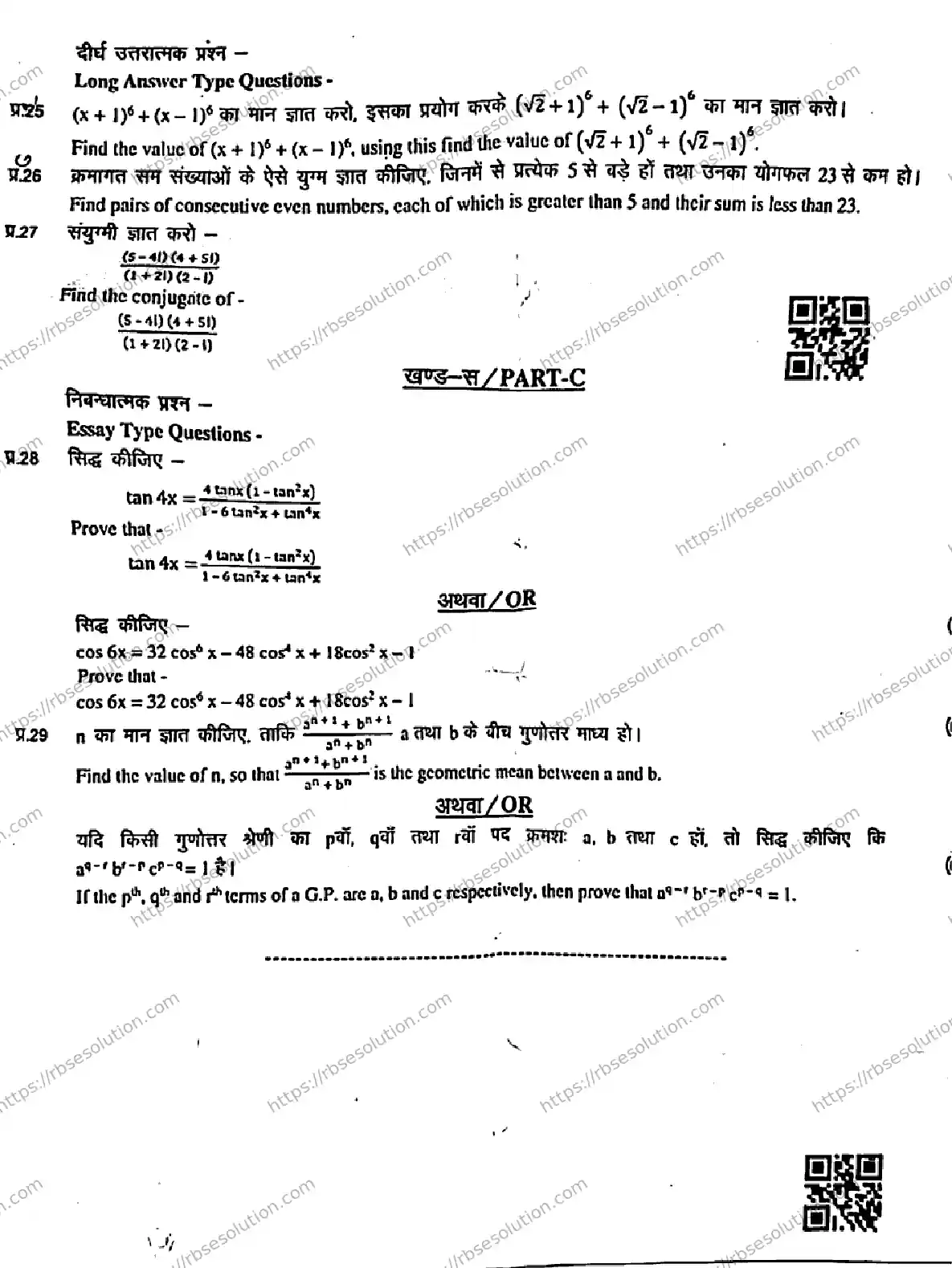
दीर्घ उत्तरात्मक प्रश्न - Long Answer Type Questions
प्र. 26
(x + 1)6 + (x – 1)6 का मान ज्ञात करो, इसका प्रयोग करके (√2 + 1)6 + (√2 – 1)6 का मान ज्ञात करो।
Find the value of (x + 1)6 + (x – 1)6, using this find the value of (√2 + 1)6 + (√2 – 1)6.
हल:
द्विपद प्रमेय का प्रयोग करने पर:
(x + 1)6 = 6C0x6 + 6C1x5 + 6C2x4 + 6C3x3 + 6C4x2 + 6C5x + 6C6
(x – 1)6 = 6C0x6 – 6C1x5 + 6C2x4 – 6C3x3 + 6C4x2 – 6C5x + 6C6
दोनों को जोड़ने पर:
(x + 1)6 + (x – 1)6 = 2[6C0x6 + 6C2x4 + 6C4x2 + 6C6]
= 2[x6 + 15x4 + 15x2 + 1]
अब x = √2 रखने पर:
(√2 + 1)6 + (√2 – 1)6 = 2[(√2)6 + 15(√2)4 + 15(√2)2 + 1]
= 2[8 + 15(4) + 15(2) + 1]
= 2[8 + 60 + 30 + 1]
= 2 × 99 = 198
प्र. 27
क्रमागत सम संख्याओं के ऐसे युग्म ज्ञात कीजिए, जिनमें से प्रत्येक 5 से बड़े हों तथा उनका योगफल 23 से कम हों।
Find pairs of consecutive even numbers, each of which is greater than 5 and their sum is less than 23.
हल:
माना क्रमागत सम संख्याएँ x और x + 2 हैं।
प्रश्नानुसार:
x > 5 ...(i)
x + (x + 2) < 23
⇒ 2x + 2 < 23
⇒ 2x < 21
⇒ x < 10.5 ...(ii)
(i) और (ii) से: 5 < x < 10.5
चूँकि x एक सम संख्या है, अतः x = 6, 8, 10
अतः अभीष्ट युग्म: (6, 8), (8, 10), (10, 12)
प्र. 28
संयुग्मी ज्ञात करो -
(5 – 4i)(4 + 5i)
Find the conjugate of - (5 – 4i)(4 + 5i)
हल:
पहले गुणा करते हैं:
(5 – 4i)(4 + 5i) = 5(4) + 5(5i) – 4i(4) – 4i(5i)
= 20 + 25i – 16i – 20i²
= 20 + 9i – 20(-1) [∵ i² = -1]
= 20 + 9i + 20
= 40 + 9i
अतः संयुग्मी = 40 – 9i
निबन्धात्मक प्रश्न - Essay Type Questions / PART-C
प्र. 29
सिद्ध कीजिए -
tan 4x = (4 tan x – 4 tan³ x) / (1 – 6 tan² x + tan⁴ x)
Prove that - tan 4x = (4 tan x – 4 tan³ x) / (1 – 6 tan² x + tan⁴ x)
हल:
tan 4x = tan(2x + 2x)
= (2 tan 2x) / (1 – tan² 2x)
अब tan 2x = (2 tan x) / (1 – tan² x) रखने पर:
tan 4x = [2 × (2 tan x)/(1 – tan² x)] / [1 – (2 tan x/(1 – tan² x))²]
= [4 tan x/(1 – tan² x)] / [1 – (4 tan² x/(1 – tan² x)²)]
= [4 tan x/(1 – tan² x)] / [( (1 – tan² x)² – 4 tan² x )/(1 – tan² x)²]
= [4 tan x/(1 – tan² x)] × [(1 – tan² x)²/(1 – 2 tan² x + tan⁴ x – 4 tan² x)]
= [4 tan x (1 – tan² x)] / [1 – 6 tan² x + tan⁴ x]
= (4 tan x – 4 tan³ x) / (1 – 6 tan² x + tan⁴ x)
इति सिद्धम्।
अथवा / OR
सिद्ध कीजिए -
cos 6x = 32 cos⁶ x – 48 cos⁴ x + 18 cos² x – 1
Prove that - cos 6x = 32 cos⁶ x – 48 cos⁴ x + 18 cos² x – 1
हल:
cos 6x = cos(3x + 3x) = 2 cos² 3x – 1
cos 3x = 4 cos³ x – 3 cos x
अतः cos 6x = 2(4 cos³ x – 3 cos x)² – 1
= 2(16 cos⁶ x – 24 cos⁴ x + 9 cos² x) – 1
= 32 cos⁶ x – 48 cos⁴ x + 18 cos² x – 1
इति सिद्धम्।
प्र. 30
n का मान ज्ञात कीजिए, ताकि (an+1 + bn+1) / (an + bn) , a तथा b के बीच गुणोत्तर माध्य हो।
Find the value of n, so that (an+1 + bn+1) / (an + bn) is the geometric mean between a and b.
हल:
a और b के बीच गुणोत्तर माध्य = √(ab)
प्रश्नानुसार:
(an+1 + bn+1) / (an + bn) = √(ab)
दोनों पक्षों का वर्ग करने पर:
(an+1 + bn+1)² / (an + bn)² = ab
⇒ (an+1 + bn+1)² = ab(an + bn)²
⇒ a2n+2 + 2an+1bn+1 + b2n+2 = ab(a2n + 2anbn + b2n)
⇒ a2n+2 + 2an+1bn+1 + b2n+2 = a2n+1b + 2an+1bn+1 + ab2n+1
⇒ a2n+2 + b2n+2 = a2n+1b + ab2n+1
⇒ a2n+1(a – b) = b2n+1(a – b)
⇒ (a – b)(a2n+1 – b2n+1) = 0
यदि a ≠ b, तो a2n+1 – b2n+1 = 0
⇒ a2n+1 = b2n+1
⇒ (a/b)2n+1 = 1
⇒ 2n + 1 = 0
⇒ n = -1/2
अथवा / OR
यदि किसी गुणोत्तर श्रेणी का pवाँ, qवाँ तथा rवाँ पद क्रमशः a, b तथा c हों, तो सिद्ध कीजिए कि aq–r br–p cp–q = 1
If the pth, qth and rth terms of a G.P. are a, b and c respectively, then prove that aq–r br–p cp–q = 1
हल:
माना गुणोत्तर श्रेणी का प्रथम पद A और सार्व अनुपात R है।
तब pवाँ पद: a = ARp–1
qवाँ पद: b = ARq–1
rवाँ पद: c = ARr–1
अब, aq–r br–p cp–q
= (ARp–1)q–r × (ARq–1)r–p × (ARr–1)p–q
= A(q–r)+(r–p)+(p–q) × R(p–1)(q–r) + (q–1)(r–p) + (r–1)(p–q)
= A0 × R0
= 1 × 1 = 1
इति सिद्धम्।