
RBSE Class 12th 2013 English Stenography-SS-33-2013 Previous Year Papers
English Stenography-SS-33-2013 from the 2013 exam year is part of the Class 12th previous year papers archive on RBSE Solution. Many learners start here after finishing the textbook to see how questions were actually framed on the Rajasthan Board of Secondary Education (RBSE) paper.
Treat this question paper as a mock under gentle timing first, then as a marking exercise the second time. The introduction on this page is written only for this subject-and-year pair, not copied from other pages.
Bookmark the link if you coach juniors — the layout stays stable for search engines and classroom sharing.
Paper details
Quick reference for this previous year papers page — confirm board, class, and year & subject before you study.
| Board | RBSE |
|---|---|
| Class | Class 12th |
| Exam year | 2013 |
| Subject | English Stenography-SS-33-2013 |
| Resource type | Previous Year Papers |
| Category | RBSE Previous Year Question Papers |
| Website | RBSE Solution |
The table summarises this Previous Year Papers resource. Confirm RBSE, Class 12th, year 2013, and subject English Stenography-SS-33-2013 before studying.
RBSE Solution organises previous year papers so each URL carries chapter-specific guidance — better for students and for search engines than one generic paragraph for the whole class.
Turning 2013 papers into insight
One English Stenography-SS-33-2013 paper reveals style; several from the same year reveal pattern. After this page, open sibling subjects listed below to see whether marks cluster in certain units.
Keep rough work dated in your notebook. Examiners in Class 12th expect clear numbering even in practice sessions.
RBSE Class 12th 2013 English Stenography-SS-33-2013
Scroll through the Previous Year Papers pages for English Stenography-SS-33-2013 (2013).


Rajasthan Board Class 12th English Stenography-SS-33-2013 2013 solved Previous Year Question Papers
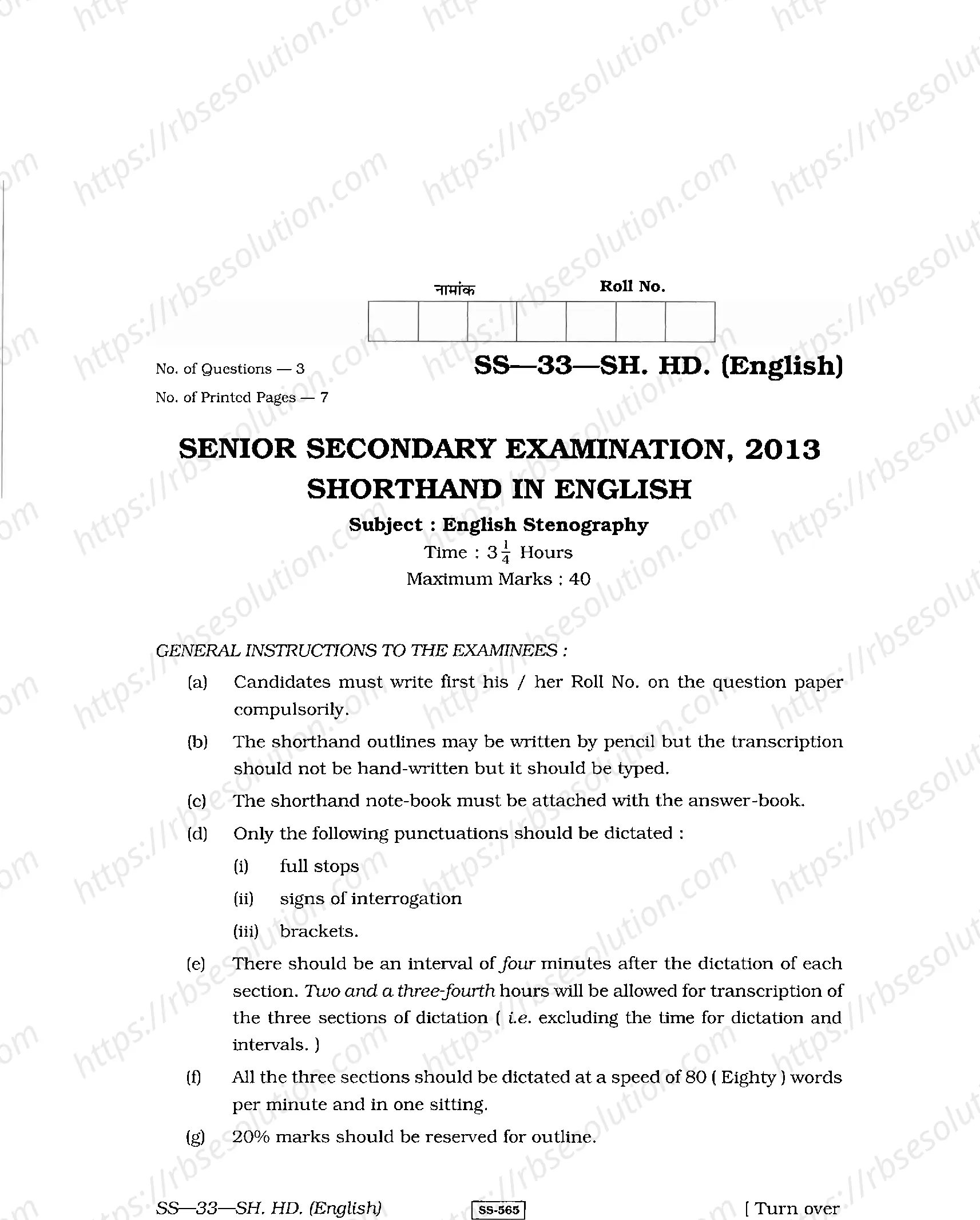
SENIOR SECONDARY EXAMINATION, 2013
SHORTHAND IN ENGLISH
Subject: English Stenography
Time: 3½ Hours
Maximum Marks: 40
GENERAL INSTRUCTIONS TO THE EXAMINEES:
- Candidates must write first his/her Roll No. on the question paper compulsorily.
- The shorthand outlines may be written by pencil but the transcription should not be hand-written but it should be typed.
- The shorthand note-book must be attached with the answer-book.
- Only the following punctuations should be dictated:
- (i) full stops
- (ii) signs of interrogation
- (iii) brackets.
- There should be an interval of four minutes after the dictation of each section. Two and three-fourth hours will be allowed for transcription of the three sections of dictation (i.e. excluding the time for dictation and intervals).
- All the three sections should be dictated at a speed of 80 (Eighty) words per minute and in one sitting.
- 20% marks should be reserved for outline.
Page 1 of 7
Section - 4
Marks: 10
Suresh Rathi Commodities Pvt. Ltd.
3, J. 8. Nagar,
Andheri (E),
Mumbai - 400 059
Date: 23rd Jan., 2013
To,
Messrs Hari Om Trading Co.,
Station Road,
Jaipur - Raj.
Sub: Letter of Authority NCDEX and others.
Dear Sirs,
We authorized you to set off outstanding in our accounts / credits available or arising in any other accounts maintained with you irrespective of the fact that such credit in the accounts may pertain to transactions in any of the exchange and or against the value of cash margin or collateral / securities provided to you by us.
We authorise you to transfer funds to our account maintained with M/s Suresh Rathi Commodities Pvt. Ltd. against our obligation arising for our traders in our commodities.
We request you to retain / credit balance in any of our account and to use the idle funds towards our margin future obligation of both the exchange unless we instruct you otherwise.
We agree not to hold you liable or responsible for delay or default in performance of your obligations due to contingencies beyond your control such as fire, flood, civil commotion, earthquake, riots, war, strikes, failure of systems, failure of internet links, Government / regulatory actions or any such other contingencies which may be beyond your control.
Yours faithfully,
For Suresh Rathi Commodities Pvt. Ltd.
SS—33—SH, HD, (English) [ss-s6s]
Section - 8
Marks: 10
Letter 1
We confirm that you have agreed to enter order in commodity forward contract, commodity derivatives for us as your clients on NCDEX only on the basis of our above assurances and undertaking. Kindly send your comments on this proposal.
Meanwhile we are sending you per separate post a statement of your account containing the particulars about the transactions that you have with us. Kindly confirm at your end, and if there is any correction please intimate.
Yours faithfully,
Ramanand
Manager
Dated - 2 July, 2012
Letter 2
From
K. R. Meena,
Collector,
Jodhpur (Raj.)
To
The Commissioner,
Jodhpur Division,
Jaipur (Raj.)
Sub: Detail information of damage caused by rain flood.
Dear Sir,
With reference to your letter No. 250-F/202 of July 0, 202 regarding the damage caused by heavy rains and floods in the Luni Nadi, I have the honour to inform you that I have received detailed reports from Patwaris of several villages.
Page 4 of 7
The damage inflicted is so considerable that about half the huts of the village Samdari have disappeared and about one quarter of the populated part of the village Mokalasar is buried under water. These two villages have suffered the greatest damages, though reports from other six villages are also very pathetic. Five hundred and forty persons are reported as dead, eighty six missing while two hundred and seventy nine have been admitted to local hospitals. The poor cultivators have lost their huts, standing crops and cattle and are now in a miserable state. Relief camps have been opened in all these villages and rescue work is on in full swing. Free distribution of food and clothes has also been undertaken, but the resources are not in proportion to the need.
I have been also directed by Government to postpone the payment of levy for this year. Please inform the patawari of all Tehsils that the levy will be collected next year.
I therefore, request you to kindly pass necessary orders sanctioning the following exemptions to the farmers:
- 100% exemption from levy.
- An interest free loan up to Rs. 10,000/- to every farmer who is interested to avail the facility.
I am also directed by the Government to open relief camps and helping centres for the help and guidance of the farmers. Besides the programme of the free distribution of food and clothes to poor farmers be started soon. For this purpose a sum of rupees five lakhs to rupees ten lakhs may be spent in each Tehsil.
I am of the opinion that the government machinery should be moved to launch a more vigorous relief campaign without loss of time.
Yours faithfully,
K. R. Meena
Collector
SS—33—SH. HD. (English) [SS-565]
Section - 0
Marks : 20
TIME MANAGEMENT
Time is a scarce commodity. Since the study time at the disposal of a student is scarce, it is valuable. The individual student should make most efficient use of available study time by being swift, punctual and regular in his study activities. He has to be always conscious of time and its sanctity.
He has to prepare a budget for allocation of time for completion of study of the various subjects together with a time schedule. He/she has to do at least two or three rounds of study and revision of the course material. He/she has to prepare brief notes while studying. He may use charts, diagrams, mini maps, tables etc. to get the concepts imprinted in the mind. It is better to use a combination of various methods of study—group discussion, use of audio-visual CDs, referring to e-learning modules etc. He/she has to undertake some self-assessment exercise to get a glimpse of his state of preparedness in terms of knowledge as well as actually writing in exam conditions. He/she has to maintain a study momentum throughout the study period. He/she has to be ruthless or hard on himself/herself; nothing is to be taken for granted; nothing is to be left to chance; no selective study is to be done.
SS—33—SH. HD. (English) [ ss-565 ] [ Turn over
Time Budget and Study Planning
The student must prepare a written time budget. This involves making a rough estimate of the total time available in terms of number of days or hours that can be spared for the project. While the number of days is a fixed stock between the starting date of preparation and the examination commencement date, the number of hours is flexible. They vary depending on how many hours the student can squeeze from each day for studies and related activities.
The student has to allocate the total available time among the various subjects for which they decide to appear in the examinations. Students differ widely in their perception of the amount of time required for preparation in each subject and make allocative decisions accordingly. They may focus on subjects they think will fetch more marks or which are somewhat difficult to understand and remember. Practical subjects need more time, since several problems and illustrations have to be repeatedly worked out to gain familiarity.
Key Points:
- No shortcuts, no dark or grey areas, and no compromise on reaching the required level of basic/working/expert knowledge.
- Time budget must be in written form.
- Total time is estimated in days or hours.
- Hours are flexible; days are fixed.
- Allocate time among subjects based on difficulty and potential marks.
- Practical subjects require more time for repeated practice.
— Page 6 of 7 —
Time Management Strategy for Examinations
Relatively complex and tough subjects deserve to be given more time and attention. It is desirable to give equitable, if not equal, attention to each subject and to allocate time accordingly, so as to prepare well in all the subjects.
To be more specific, students should consider the time period between the date of commencement of studies and one or two days prior to the date of commencement of examinations as the resource of time.
Key Points:
- Prioritize difficult subjects by allocating more study time.
- Distribute study hours fairly across all subjects for balanced preparation.
- Plan the entire study period from the start of preparation until 1-2 days before exams begin.
- Use this time resource effectively to cover all topics thoroughly.
— End of page —