
RBSE Class 12th 2016 Typewriting In English-SS-35-2-2016 Previous Year Papers
Class 12th students hunting authentic previous year papers for Typewriting In English-SS-35-2-2016 (2016) land here for a reason: the paper below matches how RBSE assessments are remembered from that year. RBSE Solution does not mix years on one page; each combination gets its own notes.
Skim the overview sections, then work through the scanned pages. Pair this practice with RBSE books and solutions when you need to relearn a concept a question exposed.
Paper details
Quick reference for this previous year papers page — confirm board, class, and year & subject before you study.
| Board | RBSE |
|---|---|
| Class | Class 12th |
| Exam year | 2016 |
| Subject | Typewriting In English-SS-35-2-2016 |
| Resource type | Previous Year Papers |
| Category | RBSE Previous Year Question Papers |
| Website | RBSE Solution |
The table summarises this Previous Year Papers resource. Confirm RBSE, Class 12th, year 2016, and subject Typewriting In English-SS-35-2-2016 before studying.
RBSE Solution organises previous year papers so each URL carries chapter-specific guidance — better for students and for search engines than one generic paragraph for the whole class.
How to practise with this question paper
Stage one: read the Typewriting In English-SS-35-2-2016 question paper from 2016 without a timer and highlight command words — explain, prove, calculate, discuss. Stage two: attempt selected questions closed-book. Stage three: compare with solutions or teacher feedback.
Previous Year Papers work best when you log mistakes by topic, not only by question number. That log becomes your revision index before pre-boards.
RBSE Class 12th 2016 Typewriting In English-SS-35-2-2016
Scroll through the Previous Year Papers pages for Typewriting In English-SS-35-2-2016 (2016).
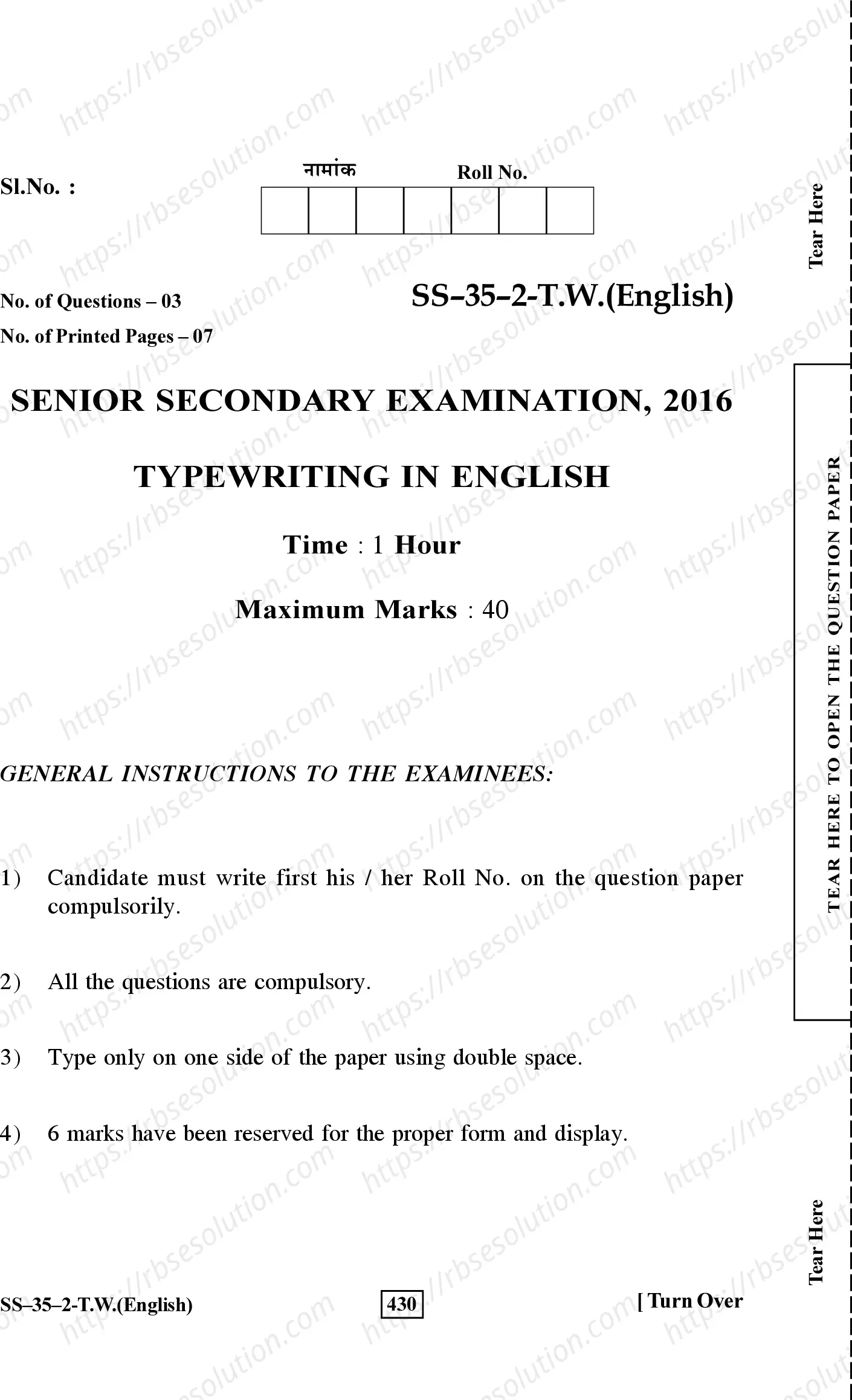


Rajasthan Board Class 12th Typewriting In English-SS-35-2-2016 2016 solved Previous Year Question Papers
नामांक Roll No.
SI.No. : maar
No. of Questions — 03 SS-35-2-T.W. (English)
No. of Printed Pages — 07
SENIOR SECONDARY EXAMINATION, 2016
TYPEWRITING IN ENGLISH
Time : 1 Hour
Maximum Marks : 40
GENERAL INSTRUCTIONS TO THE EXAMINEES:
- Candidate must write first his / her Roll No. on the question paper compulsorily.
- All the questions are compulsory.
- Type only on one side of the paper using double space.
- 6 marks have been reserved for the proper form and display.
SS-35-2-T.W.(English) 430 [ Turn Over
Tear Here
TEAR HERE TO OPEN THE QUESTION PAPER
Tear Here
PRANAYAMA
Prana is the sum total of all energy that is manifested in the universe. It is the vital force, Sukshma. Breath is the external manifestation of Prana. By exercising control over this gross breath, you can control the subtle Prana inside. Control of Prana means control of Mind. Mind can not operate without the help of Prana. It is the Sukshma Prana that is intimately connected with the mind. Prana is the sum total of all latent forces which are hidden in men and which lie everywhere around us. Heat, light, electricity, magnetism are all the manifestations of Prana. Prana is related to mind; through mind to the will; through will to the individual soul, and through this to the Supreme Being.
The seat of Prana is the heart. Prana is one; but it has many functions to do. Hence it assumes five names according to the different functions it performs, Viz., Prana, Apana, Samana, Udana and Vyana. According to the different functions they perform, they occupy certain places in the body. The table given in the following pages will give you a clear idea.
Marks: 8 | Display: 02 | Total: 20
Breath and Prana in Yogic Philosophy
Breath directed by thought under the control of the will is a vitalising, regenerated force which can be utilised consciously for self development, for healing many incurable diseases and for many other useful purposes. Hatha Yogins consider that Prana Tattva is superior to Manas Tattva (Mind), as Prana is present even when mind is absent during deep sleep. Hence Prana plays a more vital part than mind.
If you know how to control the little waves of Prana working through mind, then the secret of subjugating the universal Prana will be known to you. The Yogin who becomes an expert in the knowledge of this secret, will have no fear from any power, because he has mastery over all manifestations of power in the Universe. What is commonly known as power of personality is nothing more than the natural capacity of a person to wield his Prana. Some people are more powerful in life, more influential and fascinating than others. It is all through this Prana, which the Yogin uses consciously by the command of his will.
Having acquired a thorough knowledge of the seat of Nadis and of the Vayus with their functions, one should begin with the purification of Nadis. A person possessed of Yama and Niyama, avoiding all company, having finished his course of study, delighting in Truth and virtues, having conquered his anger, being engaged in the service of his spiritual instructor and well instructed in all the religious practices, should go to a secluded place for Yoga Abhyasa.
Nadi Suddhi (Purification of Nadi) is an important matter in the early stage of Yoga. If there are impurities in the Nadis, the ascent of Kundalini in the Sushumna is seriously retarded. Purity in the Nadis facilitates the ascent of Kundalini. Pranayama brings about quick purification of the Nadis.
SS_35-2-T.W.(English) 430 [ Turn Over
Pranayama and the Control of Prana
Nadi Suddhi is the basis of Yoga. It is the foundation of Yoga. It is the first part of Yoga.
Just as you can stop all the other wheels of the factory if you can stop the important fly-wheel of the engine, so also if you can stop the functions of all other organs of the body, you can get control of the subtle, psychic Prana by restraining the breath. That is the reason why Pranayama is prescribed for controlling Prana.
Prana is the over-coat of the mind. If you can control Prana, you can control mind and Veerya also, because Prana, Veerya and mind are under one Sambandha. If you can control mind, breath stops by itself. Prana comes under control. Just as you have a nervous system in the gross physical body, so also there is a nervous system in the astral body. The nervous system of the physical body is the Sthoola Prana. The nervous system of the astral body is the Sukshma Prana. There is intimate connection between these two Pranas. There is inter-action between these two Pranas.
By controlling the act of breathing, you can efficiently control all the various functions in the body. You can very easily and quickly control and develop the body, mind and soul. Psychic cure, Telepathy, Television, thought reading and other Siddhis are the effects of the control of Prana. The process by which the Prana is controlled by regulation of breath is termed ‘Pranayama’. It is through Pranayama that you can control your circumstances.
Explanation: This passage explains the foundational role of Nadi Suddhi (purification of energy channels) in Yoga and the importance of Pranayama (breath control) for mastering the subtle life force (Prana). It draws an analogy between stopping a factory's flywheel and controlling bodily functions through breath restraint. The text highlights the interconnectedness of Prana, mind, and Veerya (vital energy), and describes how controlling breath leads to control over the body, mind, and even psychic abilities (Siddhis).
2) Type the following letter in proper form and display:
Marks: 08 Display: 02 Total: 10
Office of the Executive Engineer
Water Resources Division, Ratalam
No: _______________ Date: 30 June, 5
To,
The _______________
_______________
Sub.: Inspection of Daksh RWR on 9.6.5 & 27.06.5
Sir,
With reference to the subject & referred letter, the point wise reply is as under: -
- Compliance has been made by contract and Mortar for Masonry and others works is being mixed in RMC plant.
- Adequate care is being taken for filling of joints with Bitumen. Same has been got tested from M.B.M.E.C.
- At same places, hair cracks observed and same shall be treated with adequate means.
- Compliance has been made.
- Defective portion has been rectified & field staff is being directed to follow your instructions strictly.
Yours faithfully,
(Executive Engineer)
Water Resources Division, Ratalam
Note: The letter should be typed in a proper business letter format with appropriate spacing, alignment, and punctuation. The display (layout) should include the sender's address, date, recipient's address, subject line, salutation, body with numbered points, complimentary close, and signature block. Proper indentation and line spacing should be used for a professional appearance.
Page 6 of 7
-
The work is being executed as per the revised proposal approved by L.D. & R. Unit Jabalpur vide no. 8 dated 22.05.205. The same was forwarded by your good office too.
-
Same as (6).
-
The defective portion removed & base concrete (1 : 3 : 6) has been re-laid as per specifications.
-
Sampling & Testing is being regularly done.
-
Special care is being taken for proper finishing on top surface of C.C. lining in side slope.
-
The Executive Engineer PHED Project Div IV have been informed to expedite the work of inlet & intake structures so as to complete work within stipulated time of contract.
-
Field officers have been directed to follow your instructions.
Executive Engineer
Water Resources Div., Ratalam
Copy to Addl. Chief Engineer Resources Zone, Ratalam.
Executive Engineer
Water Resources Division, Ratalam
SS-35-2-T.W.(English) 430
3) Type the following table in proper order & display:
Marks : 08
Display : 02
Total : 10
| Liabilities | A Ltd. | B Ltd. | Assets | A Ltd. | B Ltd. | ||
|---|---|---|---|---|---|---|---|
| Share Capital: | Fixed Assets | 6,50,000 | 4,05,000 | ||||
| Share @ ₹10 each | 10,00,000 | 5,00,000 | Investment: | ||||
| (8,000 shares in B Ltd.) | 8,00,000 | - | In B Ltd. | 8,00,000 | - | ||
| (500 Deb.) | - | - | In B Ltd. | - | 1,50,000 | ||
| Reserve & Surplus | 4,50,000 | 2,05,000 | Current Assets: | ||||
| Secured Loan: | Inventory | 2,00,000 | 3,50,000 | ||||
| 3% Deb. (₹100 each) | - | 3,00,000 | Trade Receivable | 1,50,000 | 2,65,000 | ||
| Current Liabilities: | Cash at Bank | 80,000 | 1,05,000 | ||||
| Trade Payable | 3,80,000 | 80,000 | |||||
| Other Liabilities | 2,00,000 | 40,000 | |||||
| Total | 20,30,000 | 11,25,000 | Total | 20,30,000 | 11,25,000 | ||
Explanation: The above table is the Balance Sheet of A Ltd. and B Ltd. as on 31st March, 2015. It is arranged in proper order with Liabilities on the left side and Assets on the right side. The totals of both sides match for each company (A Ltd.: ₹20,30,000; B Ltd.: ₹11,25,000), ensuring the accounting equation is balanced.