
RBSE Class 12th 2023 English-VU-02-2023 Previous Year Papers
English-VU-02-2023 from the 2023 exam year is part of the Class 12th previous year papers archive on RBSE Solution. Many learners start here after finishing the textbook to see how questions were actually framed on the Rajasthan Board of Secondary Education (RBSE) paper.
Treat this question paper as a mock under gentle timing first, then as a marking exercise the second time. The introduction on this page is written only for this subject-and-year pair, not copied from other pages.
Bookmark the link if you coach juniors — the layout stays stable for search engines and classroom sharing.
Paper details
Quick reference for this previous year papers page — confirm board, class, and year & subject before you study.
| Board | RBSE |
|---|---|
| Class | Class 12th |
| Exam year | 2023 |
| Subject | English-VU-02-2023 |
| Resource type | Previous Year Papers |
| Category | RBSE Previous Year Question Papers |
| Website | RBSE Solution |
The table summarises this Previous Year Papers resource. Confirm RBSE, Class 12th, year 2023, and subject English-VU-02-2023 before studying.
RBSE Solution organises previous year papers so each URL carries chapter-specific guidance — better for students and for search engines than one generic paragraph for the whole class.
How to practise with this question paper
Stage one: read the English-VU-02-2023 question paper from 2023 without a timer and highlight command words — explain, prove, calculate, discuss. Stage two: attempt selected questions closed-book. Stage three: compare with solutions or teacher feedback.
Previous Year Papers work best when you log mistakes by topic, not only by question number. That log becomes your revision index before pre-boards.
RBSE Class 12th 2023 English-VU-02-2023
Scroll through the Previous Year Papers pages for English-VU-02-2023 (2023).
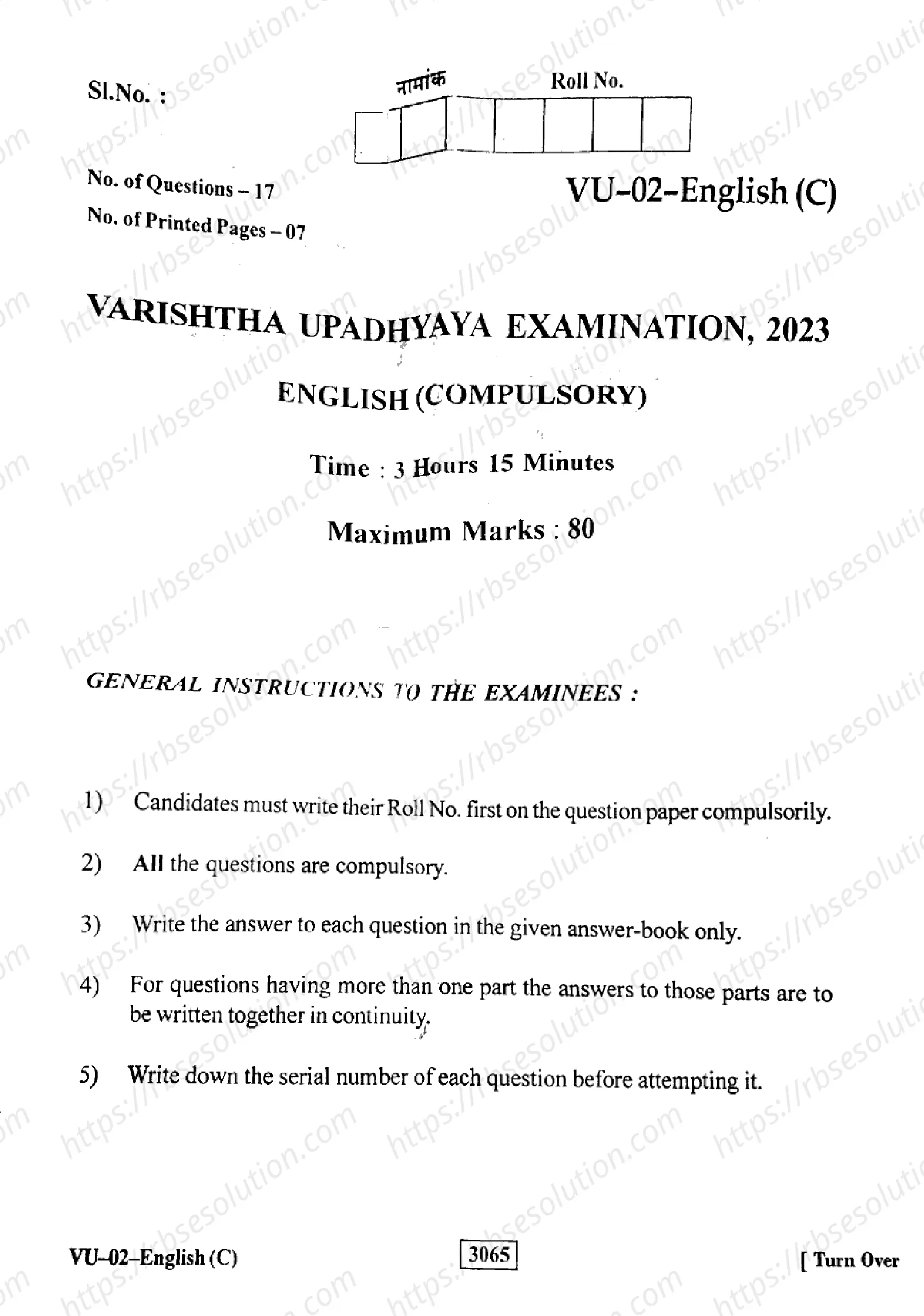


Rajasthan Board Class 12th English-VU-02-2023 2023 solved Previous Year Question Papers
VARISHTHA UPADHYAYA EXAMINATION, 2023
ENGLISH (COMPULSORY)
Time: 3 Hours 5 Minutes Maximum Marks: 80
SI.No.: Td TT LE No. of Questions: 47 VU-02-English (C)
No. of Printed Pages: 07
GENERAL INSTRUCTIONS TO THE EXAMINEES:
- Candidates must write their Roll No. first on the question paper compulsorily.
- All the questions are compulsory.
- Write the answer to each question in the given answer-book only.
- For questions having more than one part, the answers to those parts are to be written together in continuity.
- Write down the serial number of each question before attempting it.
SECTION - A
Read the following passage carefully and answer the questions that follow: [9×1=9]
There was another Indian with the Professor and his troupe who took no part in the strongman acts but spent the entire time digging a shallow trench about ten feet long and two or three feet wide. By the time Professor had finished his act, this trench had been filled with red-hot coals from the cook-house. There was no funny business about this fire-trench either — we gathered around it and the heat from it was intense. This Indian, rather an elderly gentleman, then stood at one end of the trench, splashed water from a nearby bucket over his bare feet, and then proceeded to walk over the red-hot coals along the whole length of the trench. It was an incredible spectacle — we could see the low flames from the red-hot coals licking around his bare feet as he slowly walked to the end of the trench. When he reached it, as if not satisfied, he turned around and walked back the same way. He then squatted down on the ground, gestured to his feet, and invited us all to inspect them. We did, and there was not so much as a blister anywhere to be seen. I had pushed forward through the crowd to get a closer look at this amazing character's feet, and as I knelt down beside him I felt something thrust into my hand. It was a handkerchief, and it was then that I recognised him.
He had looked at me once, briefly, as he passed the handkerchief to me, but when I went to speak to him he looked away again so I kept my mouth shut. If he wanted to pretend that he didn't understand English then, that was all right by me. Obviously it amused him to listen to the comments of the admiring crowd gathered around him. The Professor by now had recovered from his encounter with the five-ton truck and he came over to say in halting English that the fire-walker would take a volunteer with him across the fire-trench. This, of course, produced a big laugh, but I didn't join in. I knew then that I was going across the fire-trench, although the very thought of it made me go ice cold with fear.
Questions:
-
What size was the trench? [1]
The trench was about ten feet long and two or three feet wide.
-
What did the elderly person do before walking over the red-hot coals? [1]
He stood at one end of the trench and splashed water from a nearby bucket over his bare feet.
-
What harm was caused to the elderly gentleman by this action? [1]
No harm was caused to him; there was not even a blister anywhere on his feet.
-
When did the narrator recognise the man? [1]
The narrator recognised the man when he felt something thrust into his hand — it was a handkerchief.
-
What did the crowd do to amuse the man? [1]
The crowd gathered around him and made admiring comments, which amused him.
-
Who was heading the troupe? [1]
The Professor was heading the troupe.
VU-02-English (C) 3065
Read the following passage carefully and choose the correct answer: [6×1=6]
For three days Inspector Robinson had been completely in the dark. A man had been found unconscious in the car park of the Swan Hotel. He had been robbed and his car had been stolen. The police had no idea of his identity until at last the man was able to tell them who he was and what had happened. He was also able to give them a description of the man, which the police sent to all the newspapers.
The next day Inspector Robinson got a message to say that the man had been seen in a small sea-side town. Inspector Robinson immediately went there. When he reached the police-station, the inspector in charge had a second message for him. The owner of a small restaurant on the seafront had just telephoned. According to him, a person like the wanted man was having dinner in his restaurant.
The police at once rushed round to the restaurant. Two policemen stayed outside the front entrance, while Inspector Robinson and another man entered through the kitchen. Very excited, the owner of the restaurant showed Inspector Robinson the man he had been watching. He was sitting at a corner table, reading a newspaper. Without doubt it was the right man.
Inspector Robinson did not want to disturb the other people in the restaurant. He let the man finish his meal. Then, as he left the restaurant, Inspector Robinson followed him into the street and arrested him.
Questions:
-
Inspector Robinson had been completely in the dark. The underlined phrase means:
- (A) happy
- (B) curious
- (C) confusion
- (D) unhappy
Explanation: The phrase "in the dark" means being unaware or confused about something. Here, Inspector Robinson had no information about the case, so he was in a state of confusion.
-
The robbed man was found unconscious in:
- (A) hotel
- (B) the room
- (C) car park
- (D) the middle of the road
Explanation: The passage states: "A man had been found unconscious in the car park of the Swan Hotel."
-
The police gave the description to the:
- (A) manager
- (B) newspapers
- (C) man
- (D) inspector in charge
Explanation: The passage says: "He was also able to give them a description of the man, which the police sent to all the newspapers."
Find out the word from the passage which means:
- not very deep – shallow (not found in the given passage; the passage does not contain this word)
- scene – place/spot (the passage mentions "car park", "restaurant", "seafront", etc.)
- opposite of fluent – halting/stammering (not found in the given passage)
4.
iv) The restaurant owner found “the wanted man”
- at the sea-side
- in the village
- in the car park
- at the dining table of his restaurant
Explanation: The restaurant owner found the wanted man sitting at the dining table of his restaurant, as per the story.
v) Inspector Robinson entered the restaurant through
- the kitchen
- the front side
- the corridor
- the backyard
Explanation: Inspector Robinson entered the restaurant from the front side to avoid being noticed.
vi) Inspector arrested “the wanted man”
- at the corner table
- at the kitchen gate
- into the street
- in the car park
Explanation: The inspector arrested the wanted man as he tried to escape into the street.
SECTION - B
3-7. The eco-club of GSSS Rangpur has proposed a tree plantation camp. Write a notice for the school notice board appealing students to take part. Give necessary details. Sign yourself as Shubhi/Shubhash. [4]
GSSS Rangpur
Notice
Date: 15th March 2023
Tree Plantation Camp
This is to inform all students that the Eco-Club of our school is organizing a Tree Plantation Camp on 22nd March 2023, from 8:00 AM to 12:00 PM in the school premises. The aim is to promote environmental awareness and increase greenery. Students interested in participating are requested to register their names with the undersigned by 20th March 2023. Bring your own saplings and gardening tools. For any queries, contact the Eco-Club room.
Let us all contribute to a greener future!
Shubhi/Shubhash
Secretary, Eco-Club
OR
Rakhi/Rakesh intends to sell her/his old motorcycle. Draft an advertisement to be published in a daily newspaper giving necessary details. [4]
FOR SALE
Old Motorcycle (Hero Honda Splendor) in good condition, model 2018, single owner, well-maintained, new tyres, valid insurance and registration. Running smoothly. Price: ₹25,000 (negotiable). Interested buyers may contact Rakhi/Rakesh at 9876543210 or email: rakhirakesh@email.com. Location: Jaipur. First come, first served.
You went to the nearby hospital of your locality. The conditions there were miserable. Write a report to be published in the local daily newspaper to draw the attention of the authorities. Sign it as Geeta/Gopal. [5]
Report: Miserable Conditions at Local Hospital
By Geeta/Gopal
I recently visited the Government Hospital in our locality and was shocked to see the deplorable conditions. The wards were dirty, with broken beds and no clean linen. Patients were lying on the floor due to lack of space. There was a severe shortage of medicines and basic facilities like drinking water and clean toilets. The staff seemed overworked and understaffed. Many patients complained of long waiting hours and neglect. The situation is alarming and requires immediate attention from the health authorities. I urge the concerned officials to take swift action to improve the infrastructure, provide adequate staff and supplies, and ensure proper hygiene. The health of our community is at stake.
Geeta/Gopal
Concerned Citizen
OR
Translate the following passage into Hindi:
“When I arrived there was no one in sight but a girl of about twelve. Her eyes were covered with a bandage and she was being led carefully between the flower-beds by a little boy, who was about four years younger. She stopped, and it looked like she asked him who had come. He seemed to be describing me to her. Then they passed on.
Miss Beam was all that I had expected - middle aged, full authority, yet kind and understanding. Her hair was beginning to turn grey, and she had the kind of plump figure that is likely to be comforting to a homesick child. I asked her some questions about her teaching methods, which I had heard were simple.”
हिंदी अनुवाद:
जब मैं वहाँ पहुँचा, तो एक बारह वर्ष की लड़की के अलावा कोई दिखाई नहीं दिया। उसकी आँखों पर पट्टी बँधी हुई थी और एक छोटा लड़का, जो उससे लगभग चार वर्ष छोटा था, उसे फूलों की क्यारियों के बीच सावधानी से ले जा रहा था। वह रुकी, और ऐसा लगा कि उसने उससे पूछा कि कौन आया है। वह उसे मेरा वर्णन कर रहा था। फिर वे आगे बढ़ गए।
मिस बीम बिल्कुल वैसी ही थीं जैसी मैंने उम्मीद की थी - अधेड़ उम्र की, पूर्ण अधिकार वाली, फिर भी दयालु और समझदार। उनके बाल सफेद होने लगे थे, और उनका शरीर कुछ मोटा था, जो घर से दूर किसी बच्चे को सांत्वना देने वाला होता है। मैंने उनसे उनकी शिक्षण विधियों के बारे में कुछ प्रश्न पूछे, जिनके बारे में मैंने सुना था कि वे सरल हैं।
SECTION - B
5. Write a business letter to Messers Prashant and Company, New Delhi stating that the sports items supplied by their company were not of good quality, so the payments will be made only after replacement. Sign yourself as head clerk of Global School. [6]
OR
You are Amita/Amit. Write a job application for the post of a clerk with your resume.
SECTION - C
6. Join the following sentences using the connectives given in brackets: [2×1=2]
-
Vipin sold the painting. He painted it overnight. (Which)
Answer: Vipin sold the painting which he painted overnight.
-
She put off the lights. The children had slept. (When)
Answer: She put off the lights when the children had slept.
7. Combine each set of sentences into one sentence as directed: [2×1=2]
-
Sushil was punished. Sushil was fined. (Compound sentence)
Answer: Sushil was punished and fined.
-
The earth is round. Everyone knows it. (Complex sentence)
Answer: Everyone knows that the earth is round.
8. Fill in the blanks by choosing words given in brackets: [4×1=4]
-
Rich tributes are paid ______ the great men. (for/to/beyond)
Correct Answer: to
Explanation: The phrase "paid to" is used with tributes, meaning given to someone.
-
The feminine world has created a huge revolution ______ the fashion arena. (up/in/on)
Correct Answer: in
Explanation: "In the fashion arena" is the correct prepositional phrase.
-
Priyanka opted for mathematics group. She ______ with her decision. (gets out/gets on/gets along)
Correct Answer: gets on
Explanation: "Gets on" means continues or proceeds, fitting the context of sticking with a decision.
-
I must ______ my visit till next week. (put out/put off)
Correct Answer: put off
Explanation: "Put off" means to postpone or delay something.
Section B (Reading Comprehension & Literature)
9. Read the following passage carefully and answer the questions that follow: [6×1=6]
"I used every way I knew to overcome this fear, but it held me firmly in its grip. Finally, one October, I decided to get an instructor and learn to swim. I went to a pool for five days a week, an hour each day. The instructor put a belt around me. A rope attached to the belt went through a pulley that ran on an overhead cable. He held on to the end of the rope, and we went back and forth, back and forth across the pool, hour after hour, day after day, week after week. On each trip across the pool a bit of the panic seized me. Each time the instructor relaxed his hold on the rope and I went under. Some of the old terror returned and my legs froze; It was three months before the tension began to slack. Then he taught me to put my face under water and exhale and to raise my nose and inhale. I repeated the exercise hundreds of times. Bit by bit I shed part of the panic that seized me when my head went under water."
Questions:
-
(i) What was the narrator's fear?
The narrator's fear was of water and drowning. He felt panic whenever his head went under water.
-
(ii) What decision did the narrator take?
The narrator decided to get an instructor and learn to swim to overcome his fear.
-
(iii) What tip was given to the narrator?
The instructor taught the narrator to put his face under water and exhale, then raise his nose and inhale. He repeated this exercise hundreds of times.
-
(iv) How long did the narrator take to slack his fear?
It took the narrator three months before the tension began to slack.
-
(v) What is the opposite of 'exhale'?
The opposite of 'exhale' is inhale.
-
(vi) One word for 'sudden uncontrollable fear' is ________.
One word for 'sudden uncontrollable fear' is panic.
10. Answer the following questions in about 80 words: [1×4=4]
What different things did Franz notice in the school that day? (The Last Lesson)
On the day of the last lesson, Franz noticed several unusual things in the school. There was no noise of opening and closing of desks or the usual commotion. The school was unusually quiet and solemn. He saw the village elders sitting at the back of the classroom, including old Hauser and the former mayor. M. Hamel was wearing his fine Sunday clothes. Most importantly, Franz noticed that everyone looked sad and serious, and M. Hamel announced that this was their last lesson in French because the Germans had ordered that only German would be taught in Alsace and Lorraine.
OR
What were the feelings of Edla and her father when they got the news about the peddler? (The Rattrap)
When Edla and her father received the news about the peddler, they had mixed feelings. Edla felt sad and disappointed because she had trusted the peddler and believed he would change. Her father, the ironmaster, was angry and felt betrayed because he had been kind to the peddler. However, when they later received the letter from the peddler along with the stolen money and the rattrap, they felt relieved and happy. Edla was especially pleased that her kindness had touched the peddler's heart and brought about a change in him.
11. Answer the following questions in 20-25 words: [2×2=4]
-
(i) Write down some qualities of Subbu. (Poets and Pancakes)
Subbu was a talented, loyal, and versatile person. He was a good actor, writer, and poet. He was also humble, helpful, and always ready to assist others without any jealousy.
-
(ii) Who was Rajkumar Shukla? Why was he described as 'resolute'? (Indigo)
Rajkumar Shukla was a poor peasant from Champaran, Bihar. He was described as 'resolute' because he persistently followed Mahatma Gandhi until he agreed to visit Champaran and help the indigo farmers.
12. Explain any one of the following stanzas with reference to context: [1×6=6]
(i)
"Fishermen in the cold sea
would not harm whales
and the man gathering salt
would look at his hurt hands,"
Reference: These lines are from the poem "Keeping Quiet" by Pablo Neruda.
Context: The poet is advocating for a moment of silence and introspection to bring about peace and understanding in the world.
Explanation: In these lines, the poet imagines a world where people pause and reflect. Fishermen would stop harming whales, showing respect for all living creatures. The salt gatherer, who works hard and suffers from hurt hands, would take a moment to look at his wounds and perhaps realize the pain of his labor. This pause would lead to compassion and a deeper understanding of the suffering of others. The poet suggests that a moment of quiet reflection can transform human behavior and create a more harmonious world.
OR
(ii)
"Aunt Jennifer's tigers prance across a screen,
Bright topaz denizens of a world of green.
They do not fear the men beneath the tree:
They pace in sleek chivalric certainty."
Reference: These lines are from the poem "Aunt Jennifer's Tigers" by Adrienne Rich.
Context: The poem describes Aunt Jennifer's embroidery of tigers on a screen, which contrasts with her own oppressed life.
Explanation: In these lines, the poet describes the tigers that Aunt Jennifer has embroidered on a screen. The tigers are bright topaz in color and live in a green world. They prance fearlessly and do not fear the men beneath the tree. They move with sleek, chivalric certainty. These tigers symbolize freedom, strength, and fearlessness—qualities that Aunt Jennifer herself lacks in her real life. The contrast between the bold tigers and the timid, oppressed aunt highlights her desire for liberation from the constraints of her marriage and society.
Section 6.3: Answer the following questions in about 80 words: [1×4=4]
Question: What theme has been taken by the poet in ‘An Elementary School Classroom in a Slum’?
OR
Write a short summary of ‘My Mother at Sixty-six’.
Solution (First Option): The poem ‘An Elementary School Classroom in a Slum’ by Stephen Spender highlights the theme of social inequality and the deprivation faced by slum children. The poet contrasts their bleak, confined world with the bright, open world of privileged children. He criticizes the education system that fails to uplift these children and calls for a change to give them hope, freedom, and a chance to dream beyond their narrow streets and polluted surroundings.
Solution (Second Option): ‘My Mother at Sixty-six’ by Kamala Das is a poignant poem about the poet’s fear of losing her aging mother. While driving to the airport, the poet notices her mother’s pale, weak face, resembling a corpse. She is reminded of her mother’s mortality. To distract herself, she looks at the lively, young trees and children outside. At the airport, she bids farewell with a smile, hiding her pain and fear of separation.
Section a: Answer the following questions in 20-25 words: [2×2=4]
i) ‘Of twisted bones,’ what does this symbolize? (An Elementary School Classroom in a Slum)
Answer: The phrase ‘twisted bones’ symbolizes the physical and mental deformities caused by poverty, malnutrition, and the harsh, cramped conditions of slum life. It reflects the stunted growth and hopelessness of the children.
ii) What beautiful things are depicted in the poem ‘A Thing of Beauty’?
Answer: The poem depicts beautiful things like the sun, the moon, young trees, clear streams, daffodils, green forests, and tales of heroic deeds. These natural and imaginative beauties provide joy and relief from life’s sorrows.
Section 45: Answer the following questions in about 80 words: [1×4=4]
Question: How was the hundredth tiger arranged for the Maharaja’s target? (The Tiger King)
OR
How did Mr. Lamb motivate Derry? (On the Face of It)
Solution (First Option): To fulfill the prophecy of killing a hundred tigers, the Maharaja needed one more tiger. However, no tigers were left in his kingdom. The Dewan arranged a tiger from the Madras Zoo, brought it in a cage, and released it near the Maharaja’s hunting ground. The tiger was old and weak. The Maharaja shot it, believing it was the hundredth tiger, but the bullet only stunned it. Later, a wooden toy tiger killed the Maharaja ironically.
Solution (Second Option): Mr. Lamb motivated Derry by accepting him despite his burnt face. He told Derry that everyone has some disability, and one should focus on abilities, not limitations. He encouraged Derry to see the world positively, to listen to the sounds of nature, and to not let others’ opinions define him. Mr. Lamb’s kindness and wisdom gave Derry confidence and a new perspective on life.
Section 26: Answer the following questions in 20-25 words: [2×2=4]
i) Why were Dr. Sadao and his wife afraid? (The Enemy)
Answer: Dr. Sadao and his wife Hana were afraid because they were sheltering an escaped American prisoner of war in their house. If discovered, they would be arrested as traitors to Japan during World War II.
ii) What kind of person was Evans? (Evans Tries an O-level)
Answer: Evans was a clever, cunning, and resourceful prisoner. He was a master of disguise and deception. He planned his escape meticulously, using his intelligence to outwit the prison authorities and the Governor.
Section: Choose the correct alternative: [6×1=6]
i) The astrologer vowed to cut off his tuft if
- (A) he lied
- (B) the hundredth tiger was killed
- (C) books were false
- (D) rewarded
Correct Answer: (A) he lied
Explanation: In the story ‘The Tiger King’, the astrologer predicted the Maharaja’s death by a tiger. The Maharaja vowed to kill a hundred tigers, and the astrologer vowed to cut off his tuft if his prediction was false.
ii) We must visit Antarctica if we want to study and examine the earth’s
- (A) nature
- (B) structure
- (C) temperature
- (D) present, past and future
Correct Answer: (D) present, past and future
Explanation: Antarctica’s ice cores contain records of Earth’s climate history, helping scientists study the planet’s past, present, and future environmental changes.
iii) How long has Jack been telling stories to his daughter?
- (A) 2 years
- (B) 3 years
- (C) 4 years
- (D) 5 years
Correct Answer: (C) 4 years
Explanation: In the story ‘Should Wizard Hit Mommy?’, Jack has been telling his daughter Jo bedtime stories for four years, since she was two years old.
iv) ______ had an ugly face.
- (A) Derry
- (B) Lamb
- (C) Joe
- (D) Jack
Correct Answer: (A) Derry
Explanation: In the play ‘On the Face of It’, Derry is a young boy whose face is disfigured by acid, making him feel self-conscious and isolated.
v) What language exam was Evans appearing for?
- (A) English
- (B) French
- (C) German
- (D) Spanish
Correct Answer: (C) German
Explanation: In ‘Evans Tries an O-level’, the prisoner Evans appears for a German language O-level exam as part of his escape plan.
vi) How was the narrator able to win many friends?
- (A) watching market eagerly
- (B) studying hard
- (C) sleeping well
- (D) standing first in class
Correct Answer: (A) watching market eagerly
Explanation: In the story ‘The Third Level’, the narrator, Charley, claims he won many friends by watching the market eagerly, as it made him seem interesting and approachable.