
RBSE Class 12th 2024 Chemistry-SS-41-2024 Previous Year Papers
Chemistry-SS-41-2024 from the 2024 exam year is part of the Class 12th previous year papers archive on RBSE Solution. Many learners start here after finishing the textbook to see how questions were actually framed on the Rajasthan Board of Secondary Education (RBSE) paper.
Treat this question paper as a mock under gentle timing first, then as a marking exercise the second time. The introduction on this page is written only for this subject-and-year pair, not copied from other pages.
Bookmark the link if you coach juniors — the layout stays stable for search engines and classroom sharing.
Paper details
Quick reference for this previous year papers page — confirm board, class, and year & subject before you study.
| Board | RBSE |
|---|---|
| Class | Class 12th |
| Exam year | 2024 |
| Subject | Chemistry-SS-41-2024 |
| Resource type | Previous Year Papers |
| Category | RBSE Previous Year Question Papers |
| Website | RBSE Solution |
The table summarises this Previous Year Papers resource. Confirm RBSE, Class 12th, year 2024, and subject Chemistry-SS-41-2024 before studying.
RBSE Solution organises previous year papers so each URL carries chapter-specific guidance — better for students and for search engines than one generic paragraph for the whole class.
Turning 2024 papers into insight
One Chemistry-SS-41-2024 paper reveals style; several from the same year reveal pattern. After this page, open sibling subjects listed below to see whether marks cluster in certain units.
Keep rough work dated in your notebook. Examiners in Class 12th expect clear numbering even in practice sessions.
RBSE Class 12th 2024 Chemistry-SS-41-2024
Scroll through the Previous Year Papers pages for Chemistry-SS-41-2024 (2024).








Rajasthan Board Class 12th Chemistry-SS-41-2024 2024 solved Previous Year Question Papers
उच्च माध्यमिक परीक्षा, 2024
SENIOR SECONDARY EXAMINATION, 2024
रसायन विज्ञान
CHEMISTRY
समय: 3 घण्टे 45 मिनट पूर्णांक: 56
परीक्षार्थियों के लिए सामान्य निर्देश:
GENERAL INSTRUCTIONS TO THE EXAMINEES:
- परीक्षार्थी सर्वप्रथम अपने प्रश्न पत्र पर नामांक अनिवार्यतः लिखें।
Candidates must write first his / her Roll No. on the question paper compulsorily. - सभी प्रश्न अनिवार्य हैं।
All the questions are compulsory. - प्रत्येक प्रश्न का उत्तर दी गई उत्तर-पुस्तिका में ही लिखें।
Write the answer to each question in the given answer-book only. - जिन प्रश्नों के आन्तरिक खण्ड हैं, उन सभी के उत्तर एक साथ ही लिखें।
For questions having more than one part, the answers to those parts are to be written together in continuity. - प्रश्न पत्र के हिन्दी व अंग्रेजी रूपान्तरण में किसी प्रकार की त्रुटि, अन्तर, विरोधाभास होने पर हिन्दी भाषा के प्रश्न को ही सही मानें।
If there is any error/difference/contradiction in Hindi & English versions of the question paper, the question of Hindi version should be treated valid. - प्रश्न का उत्तर लिखने से पूर्व प्रश्न का क्रमांक अवश्य लिखें।
Write down the serial number of each question before attempting it. - प्रश्न क्रमांक 46 से 20 में आन्तरिक विकल्प हैं।
Question No. 46 to 20 have internal choices.
Roll No.: _______________ SI. No.: 226649
No. of Questions: 20 No. of Printed Pages: 5 SS—4—Chem.
खण्ड-अ (SECTION - A)
निम्नांकित प्रश्नों में दिए गए सही विकल्प का चयन कर उत्तर पुस्तिका में लिखिए : [8]
Write the answer of following multiple choice questions in the given answer book :
-
SI unit of conductivity is -
चालकता का मात्रक है-- (A) S
- (B) Ω
- (C) S cm⁻¹
- (D) S m⁻¹
Explanation: The SI unit of conductivity (κ) is siemens per meter (S m⁻¹). It is the reciprocal of resistivity (Ω m).
-
Element showing the highest number of oxidation states is -
सर्वाधिक संख्या में ऑक्सीकरण अवस्थाएँ प्रदर्शित करने वाला तत्व है -- (A) Mn
- (B) Ni
- (C) Fe
- (D) Cr
Explanation: Manganese (Mn) shows the highest number of oxidation states among the given options, ranging from +2 to +7 (e.g., +2, +3, +4, +6, +7).
-
Oxidation state of Fe in [Fe(CO)₅] is -
[Fe(CO)₅] में Fe की ऑक्सीकरण अवस्था है -- (A) 0
- (B) +2
- (C) +3
- (D) +4
Explanation: Carbonyl (CO) is a neutral ligand. Since there are 5 neutral CO ligands, the overall charge on the complex is zero, so Fe must be in the 0 oxidation state.
-
The chemical formula of chromite ore is -
क्रोमाइट अयस्क का रासायनिक सूत्र है -- (A) MnO₂
- (B) Na₂Cr₂O₄
- (C) FeCr₂O₄
- (D) Na₂CrO₄
Explanation: Chromite ore is an iron chromium oxide with the formula FeCr₂O₄. It is the primary ore of chromium.
-
Number of moles precipitated AgCl on adding excess silver nitrate solution in the solution of one mole of CoCl₃·5NH₃ is -
एक मोल CoCl₃·5NH₃ विलयन में अधिक्य AgNO₃ विलयन मिलाने पर अवक्षेपित AgCl के मोलों की संख्या है -- (A) 1
- (B) 2
- (C) 3
- (D) 5
Explanation: The complex CoCl₃·5NH₃ is [Co(NH₃)₅Cl]Cl₂. It ionizes to give 2 Cl⁻ ions outside the coordination sphere. Thus, 1 mole of the complex gives 2 moles of Cl⁻, which precipitate 2 moles of AgCl with excess AgNO₃.
-
Metal present in haemoglobin is -
हीमोग्लोबीन में उपस्थित धातु है -- (A) Mn
- (B) Fe
- (C) Co
- (D) Ni
Explanation: Haemoglobin contains iron (Fe) at its core, which binds oxygen and gives blood its red color.
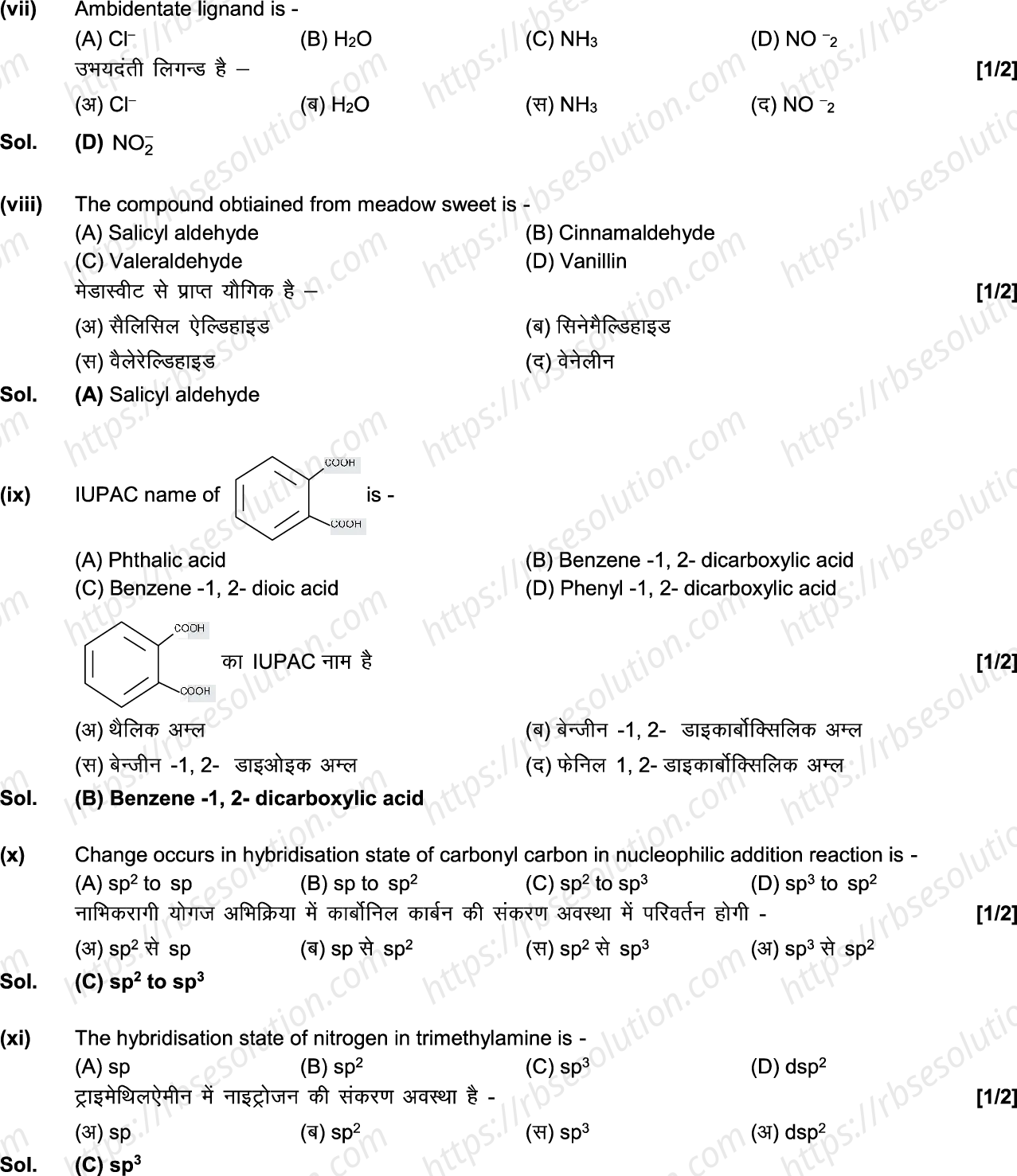
(vii) Ambidentate ligand is –
- (A) NH₃
- (B) H₂O
- (C) NH₃
- (D) NO₂⁻
Explanation: An ambidentate ligand has two different donor atoms that can coordinate to a metal ion. NO₂⁻ can bind through either nitrogen (nitro) or oxygen (nitrito), making it ambidentate.
(viii) The compound obtained from meadow sweet is –
- (A) Salicylaldehyde
- (B) Cinnamaldehyde
- (C) Valeraldehyde
- (D) Vanillin
Explanation: Meadow sweet (Spiraea ulmaria) contains salicylaldehyde, which is responsible for its characteristic fragrance.
(ix) IUPAC name of COOH
|
COOH is –
- (A) Phthalic acid
- (B) Benzene-1,2-dicarboxylic acid
- (C) Benzene-4,2-dioic acid
- (D) Phenyl-1,2-dicarboxylic acid
Explanation: The compound has two carboxylic acid groups at positions 1 and 2 on a benzene ring. The correct IUPAC name is benzene-1,2-dicarboxylic acid.
(x) Change occurs in hybridisation state of carbonyl carbon in nucleophilic addition reaction is –
- (A) sp² to sp
- (B) sp to sp²
- (C) sp² to sp³
- (D) sp² to sp³
Explanation: In a nucleophilic addition reaction, the carbonyl carbon (sp² hybridized) gains a new bond and becomes sp³ hybridized (tetrahedral intermediate).
(xi) The hybridisation state of nitrogen in trimethylamine is –
- (A) sp
- (B) sp²
- (C) sp³
- (D) dsp²
Explanation: In trimethylamine (N(CH₃)₃), nitrogen is bonded to three methyl groups and has one lone pair. The steric number is 4, so the hybridisation is sp³ (trigonal pyramidal geometry).
प्रश्न एवं समाधान (Questions and Solutions)
बहुविकल्पीय प्रश्न (Multiple Choice Questions)
(xii) जलीय विलयन में सर्वाधिक क्षारकीय प्राबल्य दर्शाने वाला यौगिक है –
The compound showing highest basic strength in aqueous solution is –
- (C₂H₅)₃N
- (C₂H₅)₂NH
- C₂H₅NH₂
- NH₃
सही उत्तर: (B) (C₂H₅)₂NH
व्याख्या: जलीय विलयन में द्वितीयक ऐमीन (R₂NH) प्राथमिक और तृतीयक ऐमीनों की तुलना में अधिक क्षारकीय होती है, क्योंकि इसमें +I प्रभाव और जलयोजन का संतुलन सर्वोत्तम होता है। (C₂H₅)₂NH में दो एथिल समूहों का +I प्रभाव और जलयोजन क्षमता इसे सबसे अधिक क्षारकीय बनाती है।
(xiii) निम्नलिखित में से द्वितीयक ऐमीन है –
Secondary amine among the following is –
- प्रोपेन-2-ऐमीन (Propan-2-amine)
- पेन्टेन-3-ऐमीन (Pentan-3-amine)
- N-मेथिलएथेनेमीन (N-Methylethanamine)
- N,N-डाइमेथिलमेथेनेमीन (N,N-Dimethylmethanamine)
सही उत्तर: (C) N-मेथिलएथेनेमीन
व्याख्या: द्वितीयक ऐमीन में नाइट्रोजन पर दो कार्बन समूह जुड़े होते हैं। N-मेथिलएथेनेमीन (CH₃NHCH₂CH₃) में नाइट्रोजन से एक मिथाइल और एक एथिल समूह जुड़ा है, अतः यह द्वितीयक ऐमीन है।
(xiv) गोलिकाकार प्रोटीन है –
Globular protein is –
- इन्सुलिन (Insulin)
- किरेटिन (Keratin)
- मायोसिन (Myosin)
- कोलाजन (Collagen)
सही उत्तर: (A) इन्सुलिन
व्याख्या: गोलिकाकार प्रोटीन (Globular protein) जल में विलेय होते हैं और इनकी संरचना गोलाकार होती है। इन्सुलिन एक गोलिकाकार प्रोटीन है, जबकि किरेटिन, मायोसिन और कोलाजन रेशेदार प्रोटीन हैं।
(xv) ग्लुकोस है –
Glucose is –
- एक ऐल्डोपेन्टोस (An aldopentose)
- एक कीटोपेन्टोस (A ketopentose)
- एक ऐल्डोहैक्सोस (An aldohexose)
- एक कीटोहैक्सोस (A ketohexose)
सही उत्तर: (C) एक ऐल्डोहैक्सोस
व्याख्या: ग्लुकोस में छह कार्बन परमाणु होते हैं (हेक्सोस) और इसमें एक एल्डिहाइड समूह (-CHO) उपस्थित होता है, अतः यह एक ऐल्डोहैक्सोस है।
(xvi) दुग्ध शर्करा है –
Milk sugar is –
- सूक्रोस (Sucrose)
- लैक्टोस (Lactose)
- माल्टोस (Maltose)
- गैलैक्टोस (Galactose)
सही उत्तर: (B) लैक्टोस
व्याख्या: दुग्ध शर्करा (Milk sugar) लैक्टोस होती है, जो ग्लुकोस और गैलैक्टोस से बना एक डाइसैकेराइड है।
रिक्त स्थानों की पूर्ति (Fill in the Blanks)
(i) मोलरता की इकाई _______ है।
The unit of molarity is _______.
उत्तर: मोल प्रति लीटर (mol L⁻¹) या M (मोलर)
स्पष्टीकरण: मोलरता (Molarity) = विलेय के मोलों की संख्या / विलयन का आयतन (लीटर में)। इसकी इकाई mol/L या M होती है।
(ii) हेनरी के नियम का गणितीय रूप _______ है।
The mathematical form of Henry's Law is _______.
उत्तर: p = KH × x
स्पष्टीकरण: हेनरी के नियम के अनुसार, किसी ताप पर किसी गैस का आंशिक दाब (p) उस गैस के विलयन में मोल अंश (x) के समानुपाती होता है। इसे p = KH × x द्वारा व्यक्त किया जाता है, जहाँ KH हेनरी स्थिरांक है।
Fill in the Blanks
(iii) The kinetic energy of maximum fraction of reactant molecules is called probable kinetic energy.
अभिकारक अणुओ के सर्वाधिक अंश की गतिज ऊर्जा को प्रायिक गतिज ऊर्जा कहते है।
(iv) Lanthanoids and actinoids are called as inner transition elements.
लैन्थेनॉयड और ऐक्टिनॉयड आंतरिक संक्रमण तत्व कहलाते है।
(v) [Fe(CN)6]3– is coordination sphere in K3[Fe(CN)6].
K3[Fe(CN)6] में [Fe(CN)6]3– समन्वय मंडल है।
(vi) In benzylic alcohols —OH group is bonded with sp3 hybridised carbon.
बेन्जिलिक ऐल्कोहॉलों में -OH समूह sp3 संकरित कार्बन से बंधित होता है।
(vii) Glucose is converted to ethanol in presence of enzyme Zymase.
एन्जाइम जाइमेज की उपस्थिति में ग्लूकोस, एथेनॉल में परिवर्तित हो जाता है।
(viii) Sodium benzoate is used as food preservative.
सोडियम बेन्जोएट का उपयोग खाद्य परिरक्षक के रूप में होता है।
(ix) Deficiency of vitamin B1 causes Beri-Beri disease.
विटामिन B1 की कमी से बेरी-बेरी रोग हो जाता है।
(x) The name of Sugar present in RNA is β-D-ribose.
RNA में उपस्थित शर्करा का नाम β-D-राइबोस है।
Very Short Answer Questions
(i) Define saturated solution.
संतृप्त विलयन को परिभाषित कीजिए।
Solution: A saturated solution is a solution that contains the maximum amount of solute that can be dissolved under the conditions at which the solution exists.
(ii) Write name of solute and solvent present in sodium amalgam solution.
सोडियम अमलगम विलयन में उपस्थित विलेय तथा विलायक के नाम लिखिए।
Solution: In sodium amalgam solution, mercury (Hg) is the solute and sodium (Na) is the solvent.
(iii)
Question: Rate = K[A]½[B]³⁄₂. Calculate the overall order of a reaction which has the above rate expression.
वेग = K[A]½[B]³⁄₂. उपरोक्त वेग व्यंजक वाली अभिक्रिया की कुल कोटि परिकलित कीजिए।
Solution: Overall order = ½ + ³⁄₂ = ⁴⁄₂ = 2
(iv)
Question: Write directive influence of -OCH₃ group present in anisole for electrophilic substitution reaction.
इलेक्ट्रॉनरागी प्रतिस्थापन अभिक्रिया के लिए ऐनिसॉल में उपस्थित -OCH₃ समूह का निर्देशी प्रभाव लिखिए।
Solution: -OCH₃ is an ortho, para directing group.
(v)
Question: Write chemical name of white precipitate obtained on the reaction of phenol with bromine water.
फीनॉल की ब्रोमीन जल के साथ अभिक्रिया से प्राप्त श्वेत अवक्षेप का रासायनिक नाम लिखिए।
Solution: 2,4,6-Tribromophenol
(vi)
Question: Write chemical name of NH₂NHCONH₂.
NH₂-NHCONH₂ का रासायनिक नाम लिखिए।
Solution: Semicarbazide
(vii)
Question: Write name of the product obtained from the reaction between benzenediazonium chloride and phenol.
बेन्जीनडाइऐजोनियम क्लोराइड और फीनॉल के मध्य अभिक्रिया से बने उत्पाद का नाम लिखिए।
Solution: p-Hydroxyazobenzene
(viii)
Question: Write isocyanide test for primary amines.
प्राथमिक ऐमीनों के लिए आइसोसायनाइड परीक्षण लिखिए।
Solution: In this test, the test substance is heated with chloroform and alcoholic potassium hydroxide. In the case of the presence of a primary amine, there will occur a formation of isocyanide (carbylamine) which can be easily identified by its extremely foul smell.
RNH₂ + CHCl₃ + KOH → RNC + KCl + H₂O
खण्ड-ब (SECTION - B)
लघुत्तरात्मक प्रश्न:
Short answer type questions: [7½ × 2 = 8]
4. Calculate the mole fraction of gas A in the solution made on mixing 0.5 moles of gas A and 4.5 moles of gas B.
गैस A के 0.5 मोल तथा गैस B के 4.5 मोल को मिश्रित करने पर बने विलयन में गैस A के मोल अंश की गणना कीजिए।
Solution:
Moles of A = 0.5
Moles of B = 4.5
Total number of moles = Moles of A + Moles of B = 0.5 + 4.5 = 5
Mole fraction of A = Moles of A / Total number of moles = 0.5 / 5 = 0.1
प्रश्न एवं हल (Questions & Solutions)
प्रश्न 1
0.05 moles of ethanoic acid is dissolved in 250g benzene. Calculate the molality of the solution.
0.05 मोल एथेनोइक अम्ल 250 ग्राम बेन्जीन में घुलित है। विलयन की मोललता की गणना कीजिए।
हल (Solution):
दिया गया है:
- एथेनोइक अम्ल के मोलों की संख्या = 0.05
- बेन्जीन का द्रव्यमान = 250 g
मोललता (m) = (विलेय के मोलों की संख्या) / (विलायक का द्रव्यमान kg में)
विलायक का द्रव्यमान kg में = 250 / 1000 = 0.25 kg
अतः, मोललता (m) = 0.05 / 0.25 = 0.2 mol/kg
प्रश्न 2
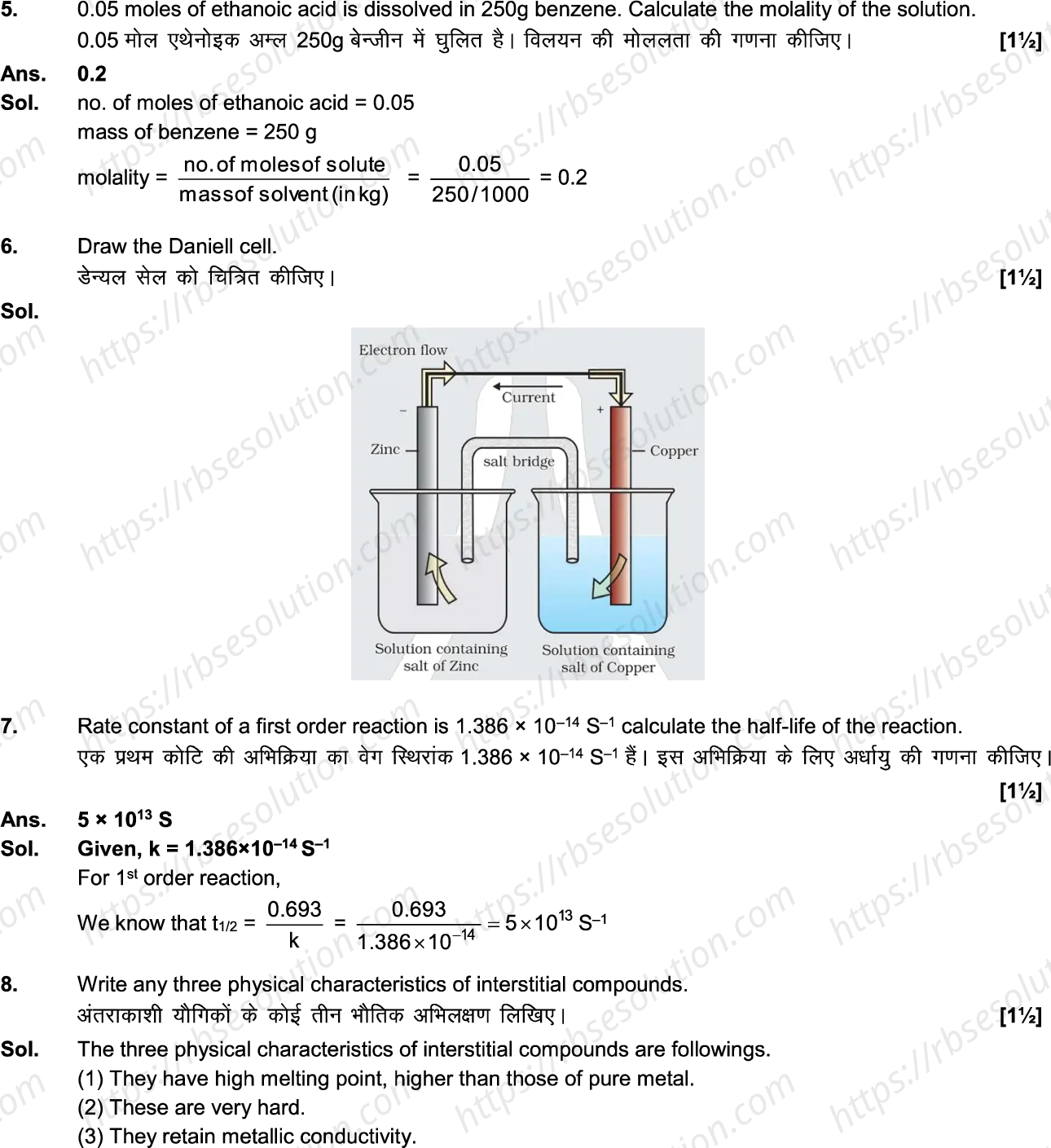
Draw the Daniell cell.
डेन्यल सेल को चित्रित कीजिए।
डेन्यल सेल का चित्र (Diagram of Daniell Cell):
        Electron flow (इलेक्ट्रॉन प्रवाह)
            ↑
            |
            |  Current (विद्युत धारा)
            |
    ┌───────┴───────┐
    │               │
    │   Zn          │      Cu
    │   (जिंक)      │      (कॉपर)
    │               │
    │   ┌─────┐     │      ┌─────┐
    │   │Salt │     │      │Salt │
    │   │Bridge│    │      │Bridge│
    │   │(लवण│     │      │(लवण│
    │   │ सेतु)│    │      │ सेतु)│
    │   └─────┘     │      └─────┘
    │               │
    │ Solution      │      Solution
    │ containing    │      containing
    │ salt of Zn    │      salt of Cu
    │ (जिंक लवण)   │      (कॉपर लवण)
    └───────────────┘
व्याख्या: डेन्यल सेल में जिंक एनोड और कॉपर कैथोड होता है। लवण सेतु (salt bridge) दोनों अर्ध-कोशिकाओं को जोड़ता है और विद्युत उदासीनता बनाए रखता है। इलेक्ट्रॉन जिंक से कॉपर की ओर प्रवाहित होते हैं।
प्रश्न 3
Rate constant of a first order reaction is 3.86 × 10⁻⁴ s⁻¹. Calculate the half-life of the reaction.
एक प्रथम कोटि की अभिक्रिया का वेग स्थिरांक 3.86 × 10⁻⁴ s⁻¹ है। इस अभिक्रिया के लिए अर्धायु की गणना कीजिए।
हल (Solution):
दिया गया है:
- वेग स्थिरांक (k) = 3.86 × 10⁻⁴ s⁻¹
- अभिक्रिया कोटि = प्रथम कोटि (First order)
प्रथम कोटि की अभिक्रिया के लिए अर्धायु (t₁/₂) का सूत्र:
t₁/₂ = 0.693 / k
अतः, t₁/₂ = 0.693 / (3.86 × 10⁻⁴)
t₁/₂ = 1795.34 सेकंड (लगभग)
या, t₁/₂ = 1795.34 / 60 = 29.92 मिनट (लगभग 30 मिनट)
प्रश्न 4
Write any three physical characteristics of interstitial compounds.
अंतराकाशी यौगिकों के कोई तीन भौतिक अभिलक्षण लिखिए।
उत्तर (Answer):
अंतराकाशी यौगिकों (Interstitial compounds) के तीन भौतिक अभिलक्षण निम्नलिखित हैं:
- उच्च गलनांक: इन यौगिकों का गलनांक शुद्ध धातु की तुलना में अधिक होता है।
- अत्यधिक कठोरता: ये यौगिक बहुत कठोर होते हैं।
- धात्विक चालकता: ये अपनी धात्विक चालकता (metallic conductivity) बनाए रखते हैं।
प्रश्न 4: संक्रमण धातुएँ उत्प्रेरकीय गुण क्यों प्रदर्शित करती हैं? समझाइए।
Why transition metals exhibit catalytic properties? Explain.
संक्रमण धातुओं और उनके यौगिकों की उत्प्रेरकीय गतिविधि निम्नलिखित कारणों से होती है:
- अपनी परिवर्तनशील ऑक्सीकरण अवस्थाओं की प्रवृत्ति के कारण, संक्रमण धातुएँ अस्थायी मध्यवर्ती यौगिक बनाती हैं और अभिक्रिया के लिए कम सक्रियण ऊर्जा वाला एक नया मार्ग प्रदान करती हैं।
- कुछ मामलों में, संक्रमण धातुएँ मुक्त संयोजकताओं के साथ एक उपयुक्त बड़ा सतह क्षेत्र प्रदान करती हैं, जिस पर अभिकारक अधिशोषित हो जाते हैं।
प्रश्न 5: इलेक्ट्रॉन अपनयक समूह होते हुए भी Cl-समूह इलेक्ट्रॉनरागी प्रतिस्थापन में ऑर्थो- और पैरा-निर्देशक क्यों है? कारण दीजिए।
Despite being an electron withdrawing group why Cl-group is ortho- and para-directing in electrophilic aromatic substitution? Give reason.
क्लोरीन प्रेरणिक प्रभाव (Inductive effect) के माध्यम से इलेक्ट्रॉनों को अपनी ओर खींचता है और अनुनाद (Resonance) के माध्यम से इलेक्ट्रॉनों का विस्थापन करता है।
- प्रेरणिक प्रभाव के माध्यम से, क्लोरीन इलेक्ट्रॉनरागी प्रतिस्थापन के दौरान बनने वाले मध्यवर्ती कार्बोकैटायन को अस्थिर करता है।
- अनुनाद के माध्यम से, हैलोजन कार्बोकैटायन को स्थिर करता है, और यह प्रभाव ऑर्थो- और पैरा- स्थितियों पर अधिक स्पष्ट होता है।
- प्रेरणिक प्रभाव अनुनाद से अधिक मजबूत होता है और शुद्ध इलेक्ट्रॉन अपनयन का कारण बनता है, जिससे शुद्ध निष्क्रियीकरण (deactivation) होता है।
- अनुनाद प्रभाव ऑर्थो- और पैरा- स्थितियों पर आक्रमण के लिए प्रेरणिक प्रभाव का विरोध करता है, जिससे ऑर्थो- और पैरा- आक्रमण के लिए निष्क्रियीकरण कम हो जाता है।
- इस प्रकार, अभिक्रियाशीलता मजबूत प्रेरणिक प्रभाव द्वारा नियंत्रित होती है, जबकि दिशा-निर्देशन अनुनाद प्रभाव द्वारा नियंत्रित होता है।
प्रश्न 6: उपरोक्त अभिक्रिया में [A] का IUPAC नाम तथा रासायनिक सूत्र लिखिए।
Write IUPAC name and chemical formula of [A] in the above reaction.
दी गई अभिक्रिया में, फिनोल (OH) का नाइट्रीकरण (HNO₃/H₂SO₄) करने पर 2,4,6-ट्राइनाइट्रोफिनॉल (पिक्रिक अम्ल) बनता है।
IUPAC नाम: 2,4,6-ट्राइनाइट्रोफिनॉल (2,4,6-Trinitrophenol)
रासायनिक सूत्र: C₆H₃N₃O₇
संरचना:
    OH
    |
O₂N — C — NO₂
    |
    C
   / \
  C   C
 /     \
H       H
(सरल रूप में: O₂N-C₆H₂(OH)(NO₂)₂)
प्रश्न 42
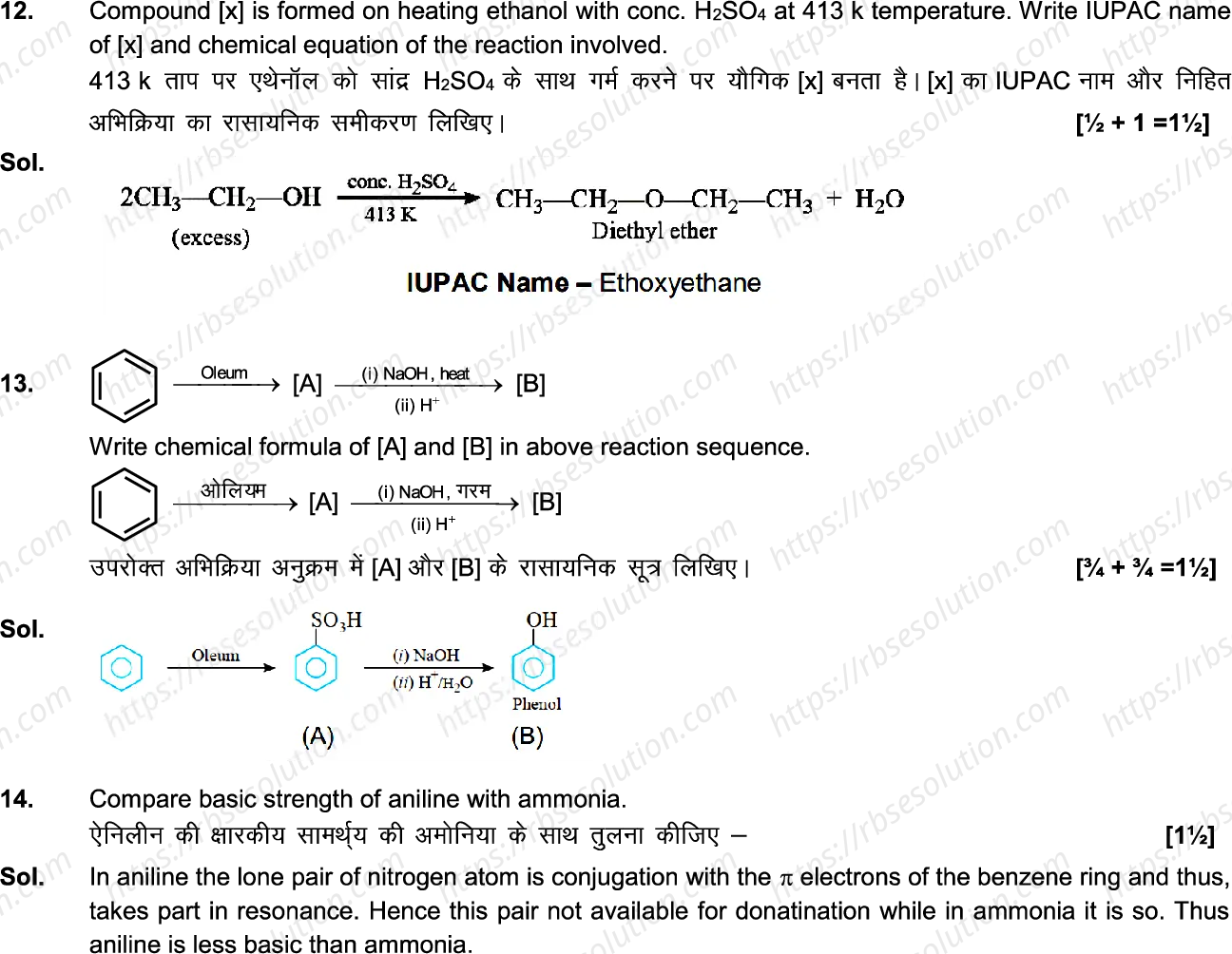
Compound [x] is formed on heating ethanol with conc. H₂SO₄ at 413 K temperature. Write IUPAC name of [x] and chemical equation of the reaction involved.
(413 K ताप पर एथेनॉल को सांद्र H₂SO₄ के साथ गर्म करने पर यौगिक [x] बनता है। [x] का IUPAC नाम और निहित अभिक्रिया का रासायनिक समीकरण लिखिए।)
Solution:
When ethanol is heated with excess concentrated sulphuric acid at 413 K, diethyl ether is formed.
Chemical Equation:
2CH₃—CH₂—OH → CH₃—CH₂—O—CH₂—CH₃ + H₂O
IUPAC Name: Ethoxyethane
प्रश्न 43
Write chemical formula of [A] and [B] in above reaction sequence.
उपरोक्त अभिक्रिया अनुक्रम में [A] और [B] के रासायनिक सूत्र लिखिए।
Solution:
The reaction sequence is:
Phenol → (Oleum) → [A] → (NaOH, heat) → [B]
[A] = C₆H₄(OH)(SO₃H) (o-hydroxybenzenesulphonic acid or p-hydroxybenzenesulphonic acid)
[B] = C₆H₄(OH)(OH) (Catechol or Resorcinol or Hydroquinone depending on position)
More precisely:
[A] = C₆H₄(OH)(SO₃H) (Phenol sulphonic acid)
[B] = C₆H₄(OH)₂ (Dihydroxybenzene)
प्रश्न 44
Compare basic strength of aniline with ammonia.
ऐनिलीन की क्षारकीय सामर्थ्य की अमोनिया के साथ तुलना कीजिए।
Solution:
In aniline, the lone pair of electrons on the nitrogen atom is in conjugation with the π-electrons of the benzene ring and participates in resonance. This delocalization makes the lone pair less available for donation to a proton. In ammonia, the lone pair is localized on nitrogen and is fully available for donation. Therefore, aniline is a weaker base than ammonia.
Conclusion: Aniline is less basic than ammonia.
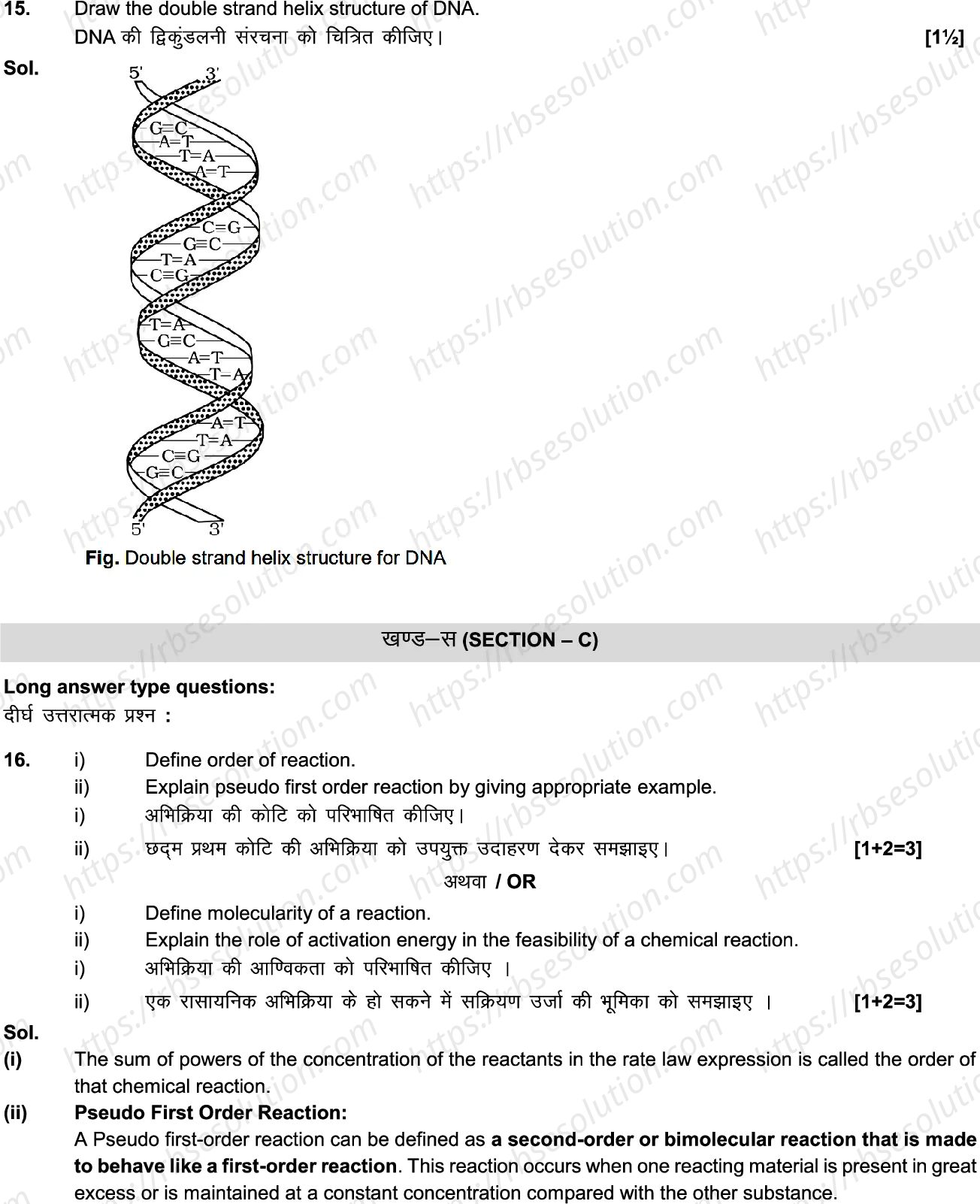
45. Draw the double strand helix structure of DNA. / DNA की द्विकुंडलनी संरचना को चित्रित कीजिए। [5]
Solution:
The double helix structure of DNA consists of two polynucleotide chains wound around each other in a right-handed spiral. The two strands are antiparallel, meaning they run in opposite directions (5' to 3' and 3' to 5'). The backbone is made of alternating sugar (deoxyribose) and phosphate groups, while the nitrogenous bases (adenine, thymine, guanine, cytosine) pair specifically: A with T (two hydrogen bonds) and G with C (three hydrogen bonds). The bases are stacked inside the helix, and the entire structure is stabilized by hydrogen bonds and hydrophobic interactions.
Fig. Double strand helix structure for DNA
खण्ड-स (SECTION — C)
Long answer type questions: / दीर्घ उत्तरात्मक प्रश्न:
46. (i) Define order of reaction. / अभिक्रिया की कोटि को परिभाषित कीजिए।
(ii) Explain pseudo first order reaction by giving appropriate example. / छद्म प्रथम कोटि की अभिक्रिया को उपयुक्त उदाहरण देकर समझाइए। [4+2=6]
Solution:
(i) Order of Reaction: The sum of the powers to which the concentration of the reactants are raised in the rate law expression is called the order of that chemical reaction. For example, for a reaction aA + bB → products, if the rate law is Rate = k[A]^m[B]^n, then the overall order of the reaction is m + n.
(ii) Pseudo First Order Reaction: A pseudo first-order reaction is a reaction that is actually of higher order (usually second order) but behaves like a first-order reaction because one of the reactants is present in large excess or its concentration remains constant throughout the reaction. This makes the rate depend only on the concentration of the other reactant.
Example: Hydrolysis of ethyl acetate (CH₃COOC₂H₅) in acidic medium:
CH₃COOC₂H₅ + H₂O → CH₃COOH + C₂H₅OH
Here, water is present in large excess, so its concentration remains practically constant. The rate law becomes: Rate = k[CH₃COOC₂H₅][H₂O] ≈ k'[CH₃COOC₂H₅], where k' = k[H₂O] (constant). Thus, the reaction follows first-order kinetics.
अथवा / OR
(i) Define molecularity of a reaction. / अभिक्रिया की आण्विकता को परिभाषित कीजिए।
(ii) Explain the role of activation energy in the feasibility of a chemical reaction. / एक रासायनिक अभिक्रिया के हो सकने में सक्रियण ऊर्जा की भूमिका को समझाइए। [4+2=6]
Solution:
(i) Molecularity of a Reaction: Molecularity of a reaction is defined as the number of molecules (atoms or ions) that collide simultaneously to bring about a chemical reaction in an elementary step. It is always a whole number (1, 2, 3, etc.) and cannot be zero or fractional. For example, a unimolecular reaction involves one molecule, a bimolecular reaction involves two molecules, and a termolecular reaction involves three molecules.
(ii) Role of Activation Energy in the Feasibility of a Chemical Reaction: Activation energy (Ea) is the minimum amount of energy that reacting molecules must possess for a successful collision leading to product formation. It acts as an energy barrier that must be overcome for a reaction to occur. A lower activation energy means more molecules have sufficient energy to react, making the reaction faster and more feasible. A higher activation energy means fewer molecules can overcome the barrier, making the reaction slower or even infeasible under normal conditions. Catalysts work by providing an alternative pathway with lower activation energy, thereby increasing the reaction rate without being consumed.
प्रश्न 7
For Example:
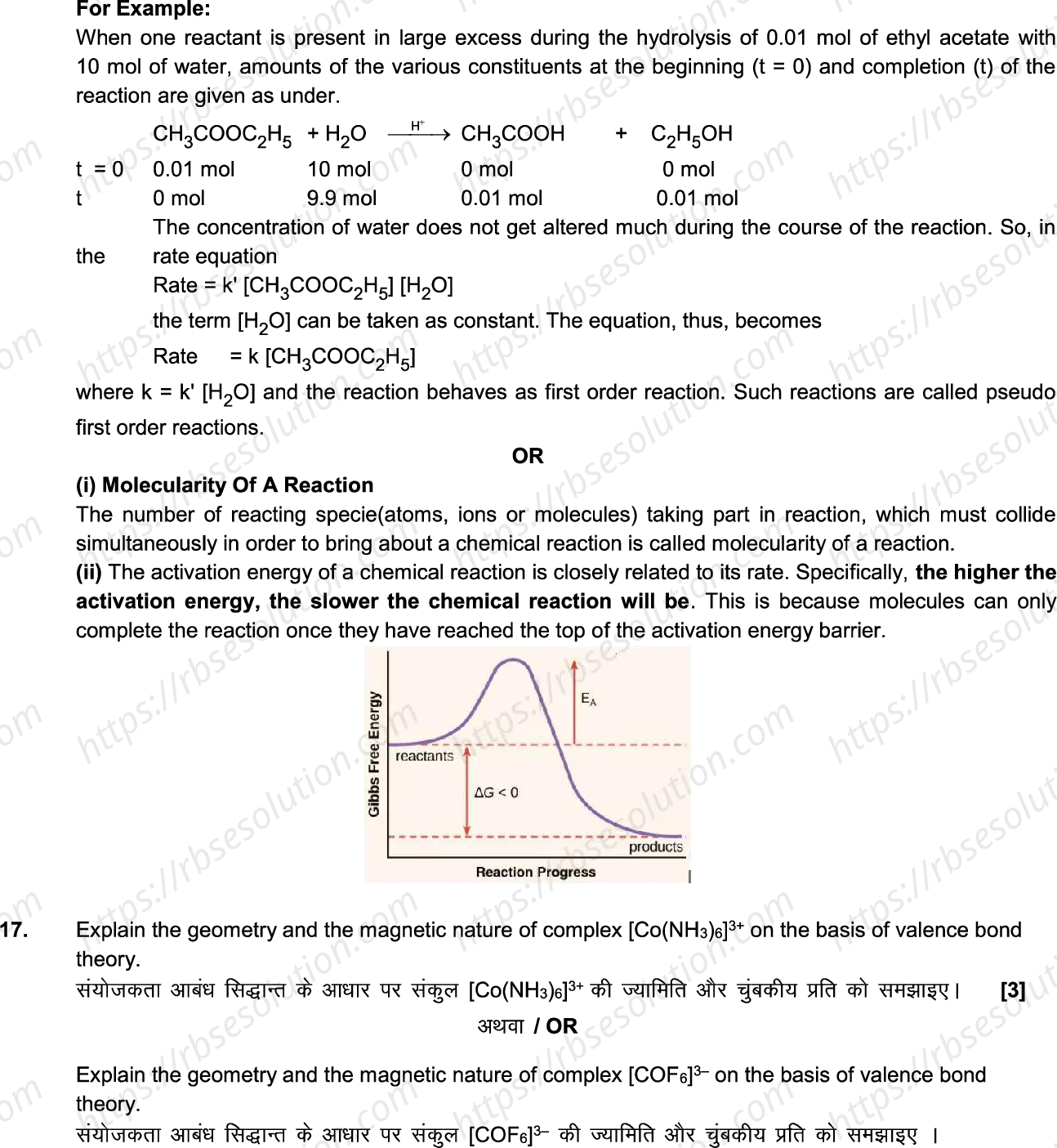
When one reactant is present in large excess during the hydrolysis of 0.01 mol of ethyl acetate with 10 mol of water, amounts of the various constituents at the beginning (t = 0) and completion (t) of the reaction are given as under.
CH₃COOC₂H₅ + H₂O → CH₃COOH + C₂H₅OH
0.01 mol 10 mol 0 mol 0 mol
0 mol 9.9 mol 0.01 mol 0.01 mol
The concentration of water does not get altered much during the course of the reaction. So, in the rate equation
Rate = k' [CH₃COOC₂H₅] [H₂O]
the term [H₂O] can be taken as constant. The equation, thus, becomes
Rate = k [CH₃COOC₂H₅]
where k = k' [H₂O] and the reaction behaves as first order reaction. Such reactions are called pseudo first order reactions.
OR
(i) Molecularity Of A Reaction
The number of reacting species (atoms, ions or molecules) taking part in reaction, which must collide simultaneously in order to bring about a chemical reaction is called molecularity of a reaction.
(ii) The activation energy of a chemical reaction is closely related to its rate. Specifically, the higher the activation energy, the slower the chemical reaction will be. This is because molecules can only complete the reaction once they have reached the top of the activation energy barrier.
Gibbs Free Energy
products
Reaction Progress →
Explain the geometry and the magnetic nature of complex [Co(NH₃)₆]³⁺ on the basis of valence bond theory.
संयोजकता आबंध सिद्धान्त के आधार पर संकुल [Co(NH₃)₆]³⁺ की ज्यामिति और चुंबकीय प्रकृति को समझाइए। — [3]
अथवा / OR
Explain the geometry and the magnetic nature of complex [CoF₆]³⁻ on the basis of valence bond theory.
संयोजकता आबंध सिद्धान्त के आधार पर संकुल [CoF₆]³⁻ की ज्यामिति और चुंबकीय प्रकृति को समझाइए।
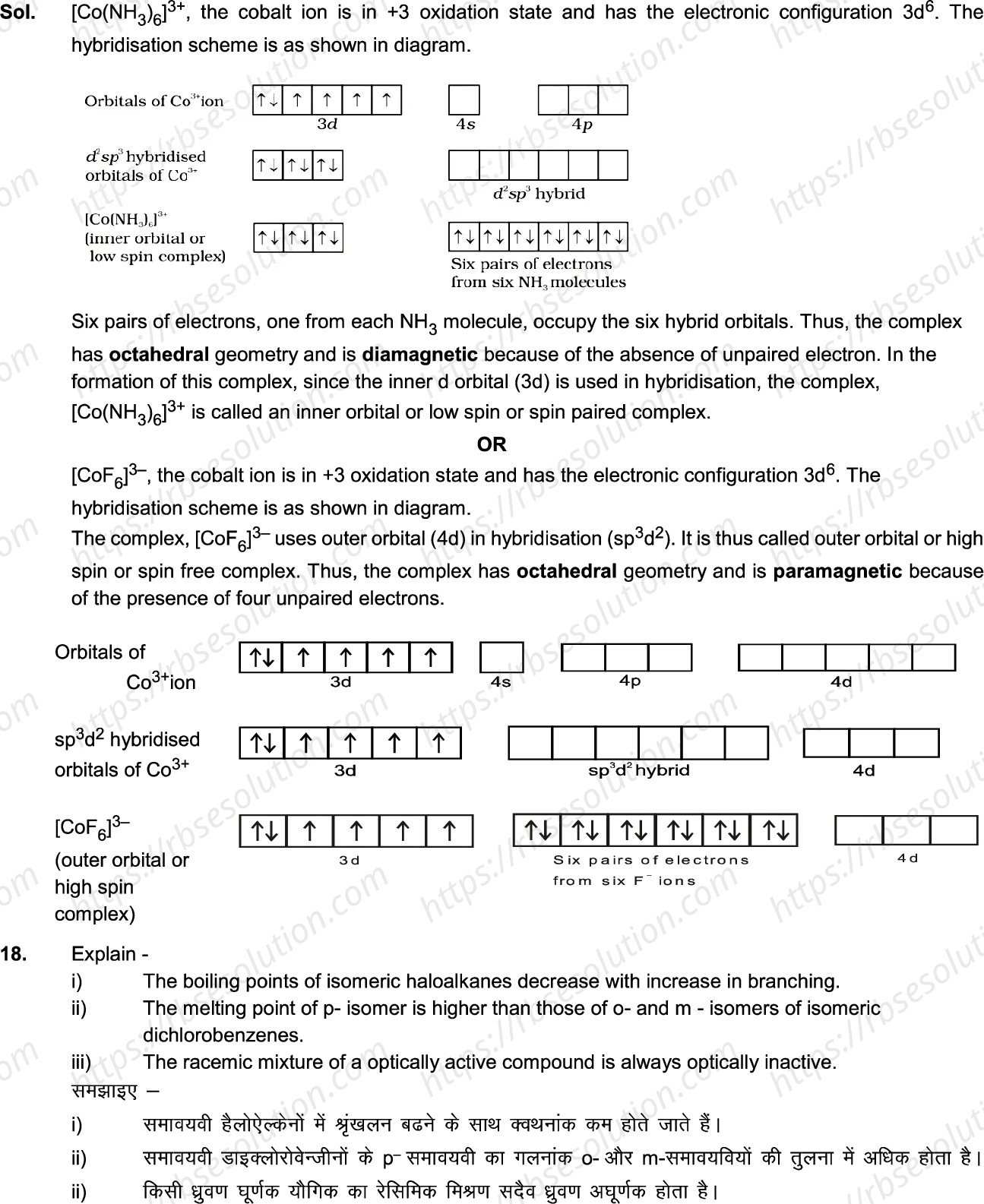
Solution for [Co(NH₃)₆]³⁺:
Step 1: Determine the oxidation state of cobalt.
Let oxidation state of Co be x. NH₃ is neutral, so x + 0 = +3 ⇒ x = +3. Thus, Co is in +3 oxidation state.
Step 2: Write the electronic configuration of Co³⁺.
Co (atomic number 27): [Ar] 3d⁷ 4s²
Co³⁺: [Ar] 3d⁶
Step 3: Hybridization and geometry.
NH₃ is a strong field ligand. It causes pairing of electrons in the 3d orbitals. The 3d orbitals are rearranged as: (t₂g)⁶ (e₉)⁰. Two 3d orbitals (one d₂² and one dₓ²₋ᵧ²) are empty. These empty d orbitals hybridize with one 4s and three 4p orbitals to form six d²sp³ hybrid orbitals. Each hybrid orbital accepts a lone pair from NH₃, forming an octahedral complex.
Step 4: Magnetic nature.
Since all six 3d electrons are paired (no unpaired electrons), the complex is diamagnetic.
Conclusion: Geometry = Octahedral; Magnetic nature = Diamagnetic.
Solution for [CoF₆]³⁻:
Step 1: Determine the oxidation state of cobalt.
Let oxidation state of Co be x. F⁻ has charge -1, so x + 6(-1) = -3 ⇒ x = +3. Thus, Co is in +3 oxidation state.
Step 2: Write the electronic configuration of Co³⁺.
Co³⁺: [Ar] 3d⁶
Step 3: Hybridization and geometry.
F⁻ is a weak field ligand. It does not cause pairing of electrons. The 3d orbitals contain 4 unpaired electrons (t₂g⁴ e₉²). The outer 4d orbitals are used for hybridization. One 4s, three 4p, and two 4d orbitals hybridize to form six sp³d² hybrid orbitals. Each hybrid orbital accepts a lone pair from F⁻, forming an octahedral complex.
Step 4: Magnetic nature.
Since there are 4 unpaired electrons, the complex is paramagnetic.
Conclusion: Geometry = Octahedral; Magnetic nature = Paramagnetic.
प्रश्न 8 (समझाइए)
Explain the following:
- The boiling points of isomeric haloalkanes decrease with increase in branching.
- The melting point of p- isomer is higher than those of o- and m- isomers of isomeric dichlorobenzenes.
- The racemic mixture of an optically active compound is always optically inactive.
समझाइए —
- समावयवी हैलोऐल्केनों में श्रृंखलन बढ़ने के साथ क्वथनांक कम होते जाते हैं।
- समावयवी डाइक्लोरोबेन्जीनों के p-समावयवी का गलनांक o- और m-समावयवियों की तुलना में अधिक होता है।
- किसी ध्रुवण घूर्णक यौगिक का रेसिमिक मिश्रण सदैव ध्रुवण अघूर्णक होता है।
उत्तर / Answer
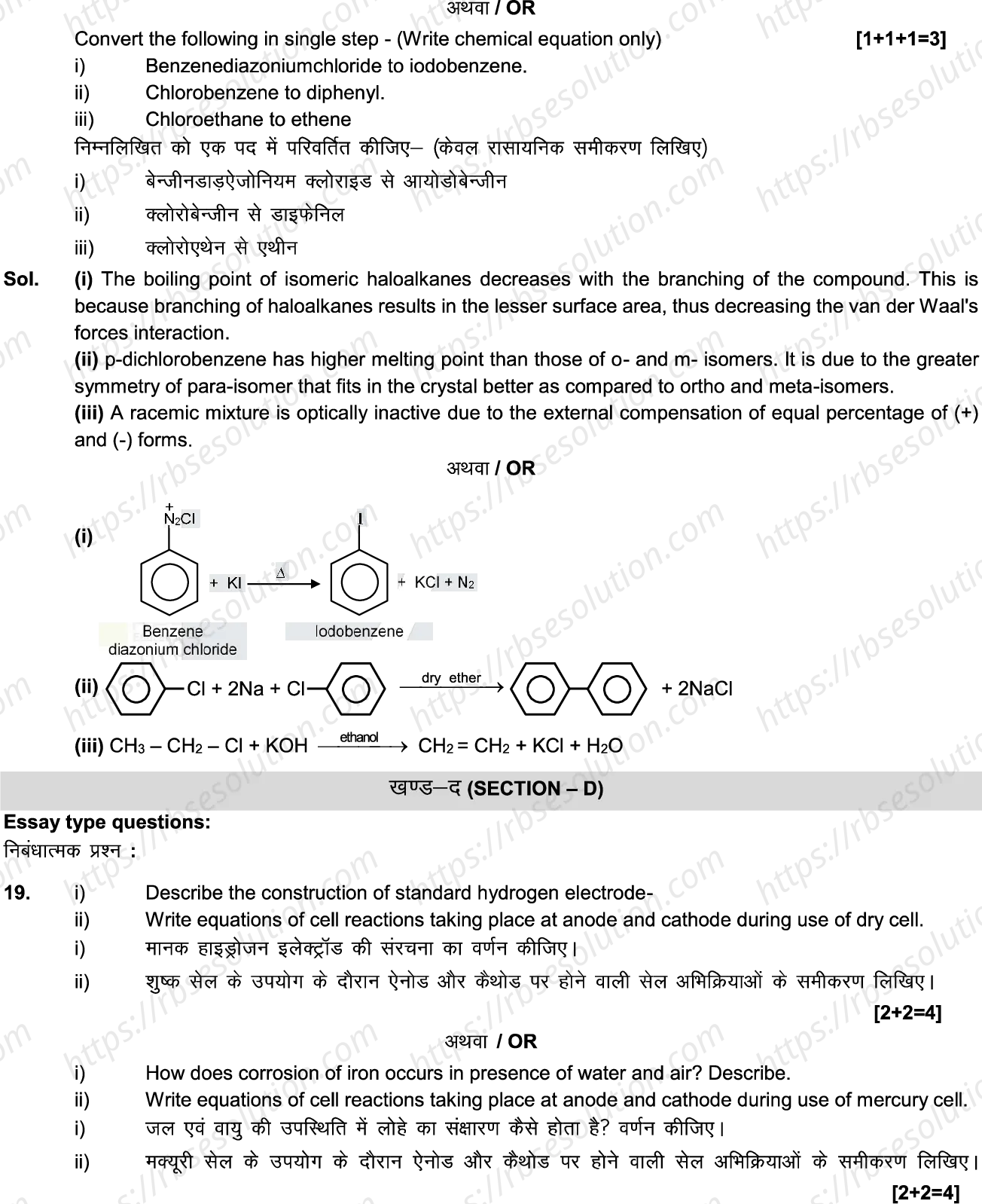
(i) The boiling points of isomeric haloalkanes decrease with increase in branching.
जैसे-जैसे हैलोऐल्केन में शाखाएँ (branching) बढ़ती हैं, अणु का आकार गोलाकार हो जाता है और अणुओं के बीच का पृष्ठीय क्षेत्रफल (surface area) कम हो जाता है। इससे अंतराअणुक बल (van der Waals forces) कमजोर हो जाते हैं, जिसके परिणामस्वरूप क्वथनांक (boiling point) घट जाता है। उदाहरण के लिए, n-पेंटेन का क्वथनांक 36.1°C है, जबकि नियोपेंटेन का क्वथनांक 9.5°C है।
(ii) The melting point of p- isomer is higher than those of o- and m- isomers of isomeric dichlorobenzenes.
p-डाइक्लोरोबेन्जीन में दो क्लोरीन परमाणु एक-दूसरे के विपरीत (para) स्थिति में होते हैं, जिससे अणु सममित (symmetrical) होता है। यह सममिति क्रिस्टल जालक (crystal lattice) में अणुओं को अधिक कसकर पैक होने में मदद करती है, जिससे अंतराअणुक बल मजबूत होते हैं और गलनांक (melting point) अधिक होता है। इसके विपरीत, o- और m-समावयवी कम सममित होते हैं, जिससे उनके क्रिस्टल जालक कमजोर होते हैं और गलनांक कम होता है।
(iii) The racemic mixture of an optically active compound is always optically inactive.
एक रेसिमिक मिश्रण (racemic mixture) में दो प्रकाशिक समावयवी (enantiomers) बराबर मात्रा में उपस्थित होते हैं: एक ध्रुवण घूर्णक (dextrorotatory, +) और दूसरा प्रतिध्रुवण घूर्णक (levorotatory, -)। ये दोनों समावयवी समतल-ध्रुवित प्रकाश (plane-polarized light) को विपरीत दिशाओं में समान मात्रा में घुमाते हैं, जिससे एक-दूसरे का प्रभाव निष्प्रभावी (cancel) हो जाता है। परिणामस्वरूप, मिश्रण कुल मिलाकर कोई शुद्ध घूर्णन (net rotation) नहीं दिखाता और प्रकाशिक रूप से निष्क्रिय (optically inactive) होता है।
प्रश्न 48 (भाग 1)
निम्नलिखित को एक पद में परिवर्तित कीजिए- (केवल रासायनिक समीकरण लिखिए)
-
बेन्जीनडाइऐजोनियम क्लोराइड से आयोडोबेन्जीन
C6H5N2Cl + KI → C6H5I + N2 + KCl
-
क्लोरोबेन्जीन से डाइफेनिल
2C6H5Cl + 2Na → (C6H5)2 + 2NaCl (शुष्क ईथर में)
-
क्लोरोएथेन से एथीन
CH3CH2Cl + KOH (अल्कोहलीय) → CH2=CH2 + KCl + H2O
प्रश्न 48 (भाग 2) - कारण सहित व्याख्या
-
समावयवी हैलोएल्केनों का क्वथनांक शाखाकरण के साथ घटता है।
शाखाकरण के कारण हैलोएल्केन का पृष्ठीय क्षेत्रफल कम हो जाता है, जिससे वान्डर वाल्स बल कमजोर हो जाते हैं और क्वथनांक घट जाता है।
-
p-डाइक्लोरोबेन्जीन का गलनांक o- और m- समावयवियों से अधिक होता है।
p-डाइक्लोरोबेन्जीन में अधिक सममिति होती है, जिसके कारण यह क्रिस्टल जालक में बेहतर ढंग से व्यवस्थित हो जाता है, जिससे गलनांक बढ़ जाता है।
-
रेसीमिक मिश्रण प्रकाशिक रूप से निष्क्रिय होता है।
रेसीमिक मिश्रण में (+) और (-) रूपों का समान प्रतिशत होता है, जो बाह्य क्षतिपूर्ति के कारण एक-दूसरे के प्रकाशिक घूर्णन को निरस्त कर देते हैं, जिससे मिश्रण प्रकाशिक रूप से निष्क्रिय हो जाता है।
खण्ड-द (SECTION - D)
प्रश्न 49
i) मानक हाइड्रोजन इलेक्ट्रॉड की संरचना का वर्णन कीजिए।
मानक हाइड्रोजन इलेक्ट्रॉड (SHE) एक प्लैटिनम इलेक्ट्रॉड होता है जो 1 M H+ आयन सांद्रता वाले अम्लीय विलयन में डुबोया जाता है। इसमें 1 atm दाब पर हाइड्रोजन गैस प्रवाहित की जाती है। प्लैटिनम फॉइल या जाली पर प्लैटिनम ब्लैक की परत चढ़ी होती है जो गैस अवशोषण में सहायक होती है। इसका विभव 25°C पर शून्य माना जाता है।
ii) शुष्क सेल के उपयोग के दौरान ऐनोड और कैथोड पर होने वाली सेल अभिक्रियाओं के समीकरण लिखिए।
ऐनोड अभिक्रिया: Zn → Zn2+ + 2e-
कैथोड अभिक्रिया: 2MnO2 + 2NH4+ + 2e- → Mn2O3 + 2NH3 + H2O
अथवा / OR
i) जल एवं वायु की उपस्थिति में लोहे का संक्षारण कैसे होता है? वर्णन कीजिए।
लोहे का संक्षारण (जंग लगना) एक विद्युत रासायनिक प्रक्रिया है। लोहे की सतह पर नमी और ऑक्सीजन की उपस्थिति में छोटी-छोटी गैल्वेनिक कोशिकाएँ बन जाती हैं। लोहे का कुछ भाग ऐनोड के रूप में कार्य करता है जहाँ Fe → Fe2+ + 2e- अभिक्रिया होती है। इलेक्ट्रॉन कैथोड भाग में जाते हैं जहाँ O2 + 2H2O + 4e- → 4OH- अभिक्रिया होती है। Fe2+ आयन OH- आयनों से अभिक्रिया कर Fe(OH)2 बनाते हैं जो आगे ऑक्सीकृत होकर Fe2O3.xH2O (जंग) बनाता है।
ii) मर्करी सेल के उपयोग के दौरान ऐनोड और कैथोड पर होने वाली सेल अभिक्रियाओं के समीकरण लिखिए।
ऐनोड अभिक्रिया: Zn (Hg) + 2OH- → ZnO + H2O + 2e-
कैथोड अभिक्रिया: HgO + H2O + 2e- → Hg + 2OH-
Solution
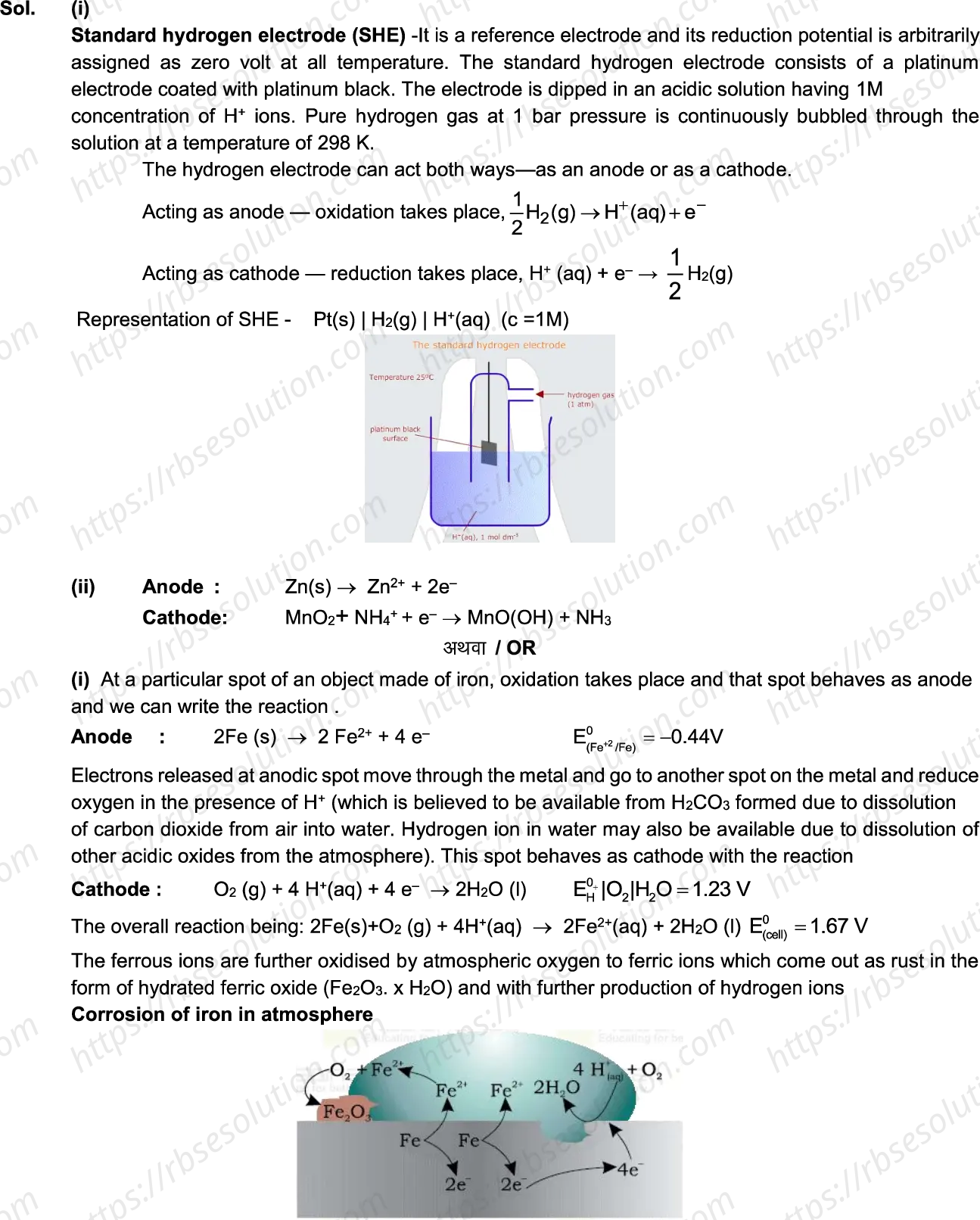
(i) Standard Hydrogen Electrode (SHE)
The Standard Hydrogen Electrode (SHE) is a reference electrode whose reduction potential is arbitrarily assigned as zero volt at all temperatures. It consists of a platinum electrode coated with platinum black, dipped in an acidic solution having 1 M concentration of H⁺ ions. Pure hydrogen gas at 1 bar pressure is continuously bubbled through the solution at a temperature of 298 K.
The hydrogen electrode can act both as an anode or as a cathode:
- Acting as anode (oxidation): ½ H₂(g) → H⁺(aq) + e⁻
- Acting as cathode (reduction): H⁺(aq) + e⁻ → ½ H₂(g)
Representation of SHE: Pt(s) | H₂(g) | H⁺(aq) (c = 1 M)
Key Points:
- Temperature: 25°C (298 K)
- Pressure of H₂ gas: 1 bar
- Concentration of H⁺: 1 M
- Platinum black provides large surface area for adsorption of H₂ gas
(ii) Electrochemical Cell Reactions
Anode: Zn(s) → Zn²⁺ + 2e⁻
Cathode: MnO₂ + NH₄⁺ + e⁻ → MnO(OH) + NH₃
अथवा / OR
(i) Corrosion of Iron (Rusting)
At a particular spot on an iron object, oxidation takes place and that spot behaves as the anode:
Anode reaction: 2Fe(s) → 2Fe²⁺ + 4e⁻ E°(Fe²⁺/Fe) = -0.44 V
Electrons released at the anodic spot move through the metal to another spot, where they reduce oxygen in the presence of H⁺ (available from H₂CO₃ formed by dissolution of CO₂ from air into water, or from other acidic oxides). This spot behaves as the cathode:
Cathode reaction: O₂(g) + 4H⁺(aq) + 4e⁻ → 2H₂O(l) E°(O₂|H₂O) = +1.23 V
Overall reaction: 2Fe(s) + O₂(g) + 4H⁺(aq) → 2Fe²⁺(aq) + 2H₂O(l) E°cell = +1.67 V
Explanation: The ferrous ions (Fe²⁺) formed are further oxidised by atmospheric oxygen to ferric ions (Fe³⁺), which come out as rust in the form of hydrated ferric oxide (Fe₂O₃·xH₂O), with further production of hydrogen ions. This process continues, leading to the gradual corrosion of iron in the atmosphere.
प्रश्न 20 (4 अंक)
भाग (i) से (iii) [2+2+4=4]
(i) लाल-चींटी के डंक में उपस्थित अम्ल का IUPAC नाम लिखिए।
(ii) कैनिजारो अभिक्रिया को उपयुक्त रासायनिक समीकरण देकर समझाइए।
(iii) CH₃COONa → [A] + Na₂CO₃ उपरोक्त अभिक्रिया में [A] का रासायनिक सूत्र लिखिए।
(i) Write IUPAC name of an acid present in red-ant sting.
(ii) Explain the Cannizzaro reaction by giving suitable chemical equation.
(iii) CH₃COONa → [A] + Na₂CO₃. Write chemical formula of [A] in above reaction.
हल / Solution
(i) लाल-चींटी के डंक में उपस्थित अम्ल का IUPAC नाम: मेथेनॉइक अम्ल (Methanoic acid) है। इसका रासायनिक सूत्र HCOOH है।
(ii) कैनिजारो अभिक्रिया (Cannizzaro reaction): वे ऐल्डिहाइड जिनमें α-हाइड्रोजन परमाणु नहीं होता, सांद्र क्षार के साथ अभिक्रिया करके स्व-ऑक्सीकरण और अपचयन (असमानुपातन) से गुजरते हैं।
2HCHO + Conc. KOH → HCOOK + CH₃OH
(फॉर्मेल्डिहाइड) → (पोटैशियम फॉर्मेट) + (मेथनॉल)
(iii) अभिक्रिया: CH₃COONa → [A] + Na₂CO₃
यह अभिक्रिया सोडियम एसीटेट के अपघटन को दर्शाती है। [A] का रासायनिक सूत्र: CH₄ (मीथेन) है।
CH₃COONa + NaOH → CH₄ + Na₂CO₃
अथवा / OR
(i) सिरके में उपस्थित अम्ल का IUPAC नाम लिखिए।
(ii) रोजेनमुंड अपचयन को उपयुक्त रासायनिक समीकरण देकर समझाइए।
(iii) CO + HCl → [Z] (निर्जल AlCl₃/CuCl) उपरोक्त अभिक्रिया में [Z] का रासायनिक सूत्र लिखिए।
(i) Write IUPAC name of an acid present in vinegar.
(ii) Explain the Rosenmund reduction by giving suitable chemical equation.
(iii) CO + HCl → [Z] (Anhyd. AlCl₃/CuCl). Write chemical formula of [Z] in above reaction.
हल / Solution
(i) सिरके में उपस्थित अम्ल का IUPAC नाम: एथेनॉइक अम्ल (Ethanoic acid) है। इसका रासायनिक सूत्र CH₃COOH है।
(ii) रोजेनमुंड अपचयन (Rosenmund reduction): इस अभिक्रिया में एसिड क्लोराइड को Pd/BaSO₄ उत्प्रेरक की उपस्थिति में H₂ गैस प्रवाहित करके ऐल्डिहाइड में अपचयित किया जाता है।
R-COCl + H₂ →Pd/BaSO₄ R-CHO + HCl
(एसिड क्लोराइड) → (ऐल्डिहाइड)
(iii) अभिक्रिया: CO + HCl → [Z] (निर्जल AlCl₃/CuCl)
यह गैटरमैन-कोच अभिक्रिया है। [Z] का रासायनिक सूत्र: H-COCl (फॉर्मिल क्लोराइड) है।
CO + HCl →AlCl₃/CuCl H-COCl
Chemistry (SS-41-2024) – Page 16
Question (i)
Ethanoic acid (CH₃COOH)
Question (ii)
Rosenmund Reduction: Hydrogenation in presence of H₂/Pd/BaSO₄ is called Rosenmund Reduction. It reduces alkyne to alkene and acid halide to aldehyde. It is a poisoned palladium catalyst, composed of powdered barium sulphate coated with palladium, poisoned with quinoline or sulphur.
Reaction:
R—COCl + H₂ →Pd/BaSO₄ (poisoned) R—CHO + HCl
Example: Benzoyl chloride (C₆H₅COCl) on Rosenmund reduction gives Benzaldehyde (C₆H₅CHO).
Question (iii)
Reaction:
Benzene + CO + HCl →Anhyd. AlCl₃ / CuCl Benzaldehyde (C₆H₅CHO)
Explanation: This is the Gattermann-Koch reaction. In this reaction, benzene is treated with carbon monoxide and hydrogen chloride in the presence of anhydrous aluminium chloride and cuprous chloride to form benzaldehyde.
Mechanism:
- CO + HCl + AlCl₃ → HCO⁺ + AlCl₄⁻
- Benzene attacks HCO⁺ to form a sigma complex.
- Loss of H⁺ gives benzaldehyde.
Overall reaction: C₆H₆ + CO + HCl →Anhyd. AlCl₃/CuCl C₆H₅CHO + HCl