
RBSE Class 12th 2026 ENGLISH-SS-02 Previous Year Papers
ENGLISH-SS-02 from the 2026 exam year is part of the Class 12th previous year papers archive on RBSE Solution. Many learners start here after finishing the textbook to see how questions were actually framed on the Rajasthan Board of Secondary Education (RBSE) paper.
Treat this question paper as a mock under gentle timing first, then as a marking exercise the second time. The introduction on this page is written only for this subject-and-year pair, not copied from other pages.
Bookmark the link if you coach juniors — the layout stays stable for search engines and classroom sharing.
Paper details
Quick reference for this previous year papers page — confirm board, class, and year & subject before you study.
| Board | RBSE |
|---|---|
| Class | Class 12th |
| Exam year | 2026 |
| Subject | ENGLISH-SS-02 |
| Resource type | Previous Year Papers |
| Category | RBSE Previous Year Question Papers |
| Website | RBSE Solution |
The table summarises this Previous Year Papers resource. Confirm RBSE, Class 12th, year 2026, and subject ENGLISH-SS-02 before studying.
RBSE Solution organises previous year papers so each URL carries chapter-specific guidance — better for students and for search engines than one generic paragraph for the whole class.
Turning 2026 papers into insight
One ENGLISH-SS-02 paper reveals style; several from the same year reveal pattern. After this page, open sibling subjects listed below to see whether marks cluster in certain units.
Keep rough work dated in your notebook. Examiners in Class 12th expect clear numbering even in practice sessions.
RBSE Class 12th 2026 ENGLISH-SS-02
Scroll through the Previous Year Papers pages for ENGLISH-SS-02 (2026).
Rajasthan Board Class 12th ENGLISH-SS-02 2026 solved Previous Year Question Papers
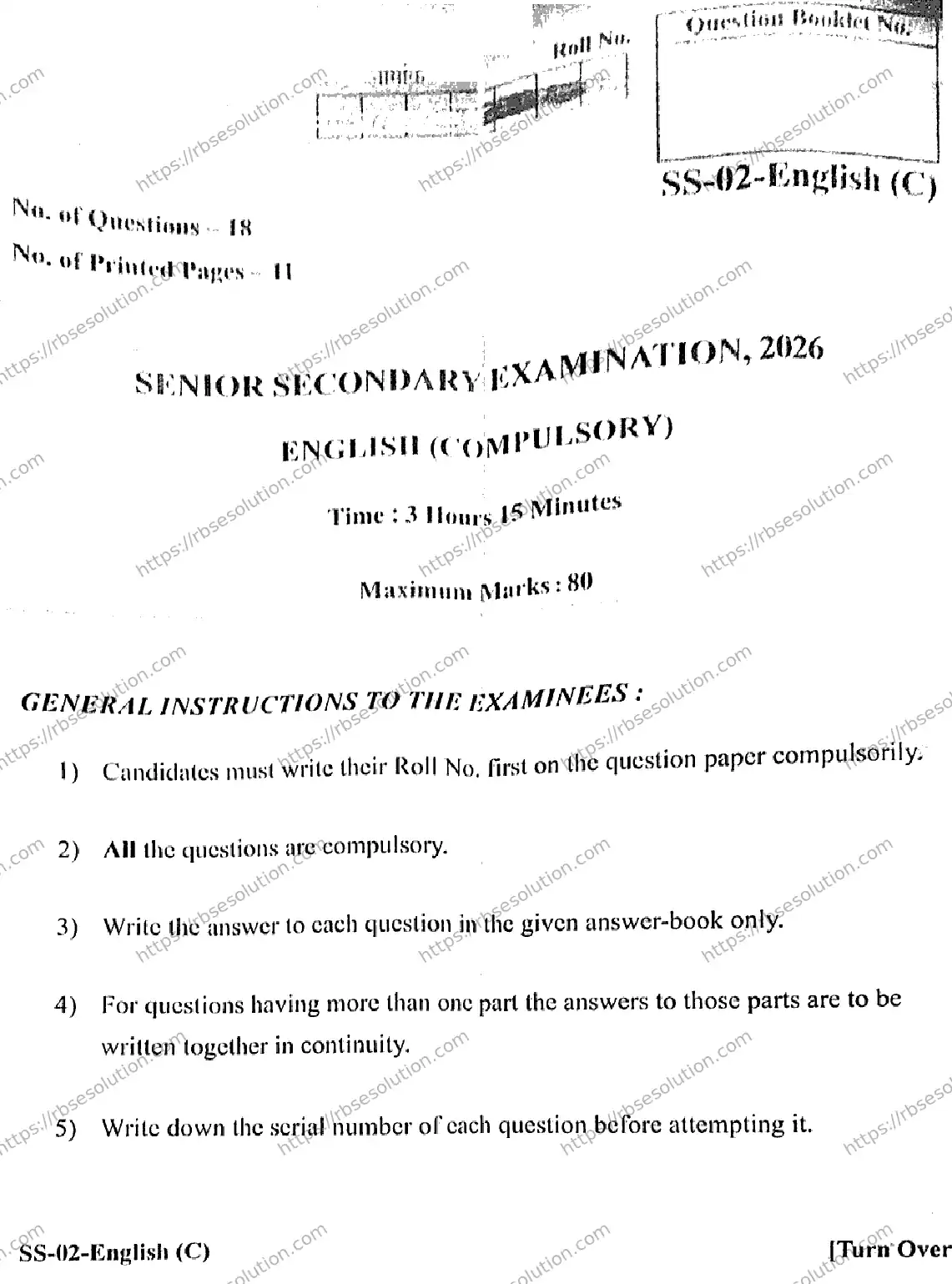
No. of Questions — 28
No. of Printed Pages — 11
RBSE EXAMINATION, 2026
SENIOR SECONDARY EXAMINATION
ENGLISH (COMPULSORY)
Time: 3 Hours 15 Minutes Maximum Marks: 80
GENERAL INSTRUCTIONS TO THE EXAMINEES:
- Candidates must write their Roll No. first on the question paper compulsorily.
- All the questions are compulsory.
- Write the answer to each question in the given answer-book only.
- For questions having more than one part, the answers to those parts are to be written together in continuity.
- Write down the serial number of each question before attempting it.
S-02-English (C) [Turn Over
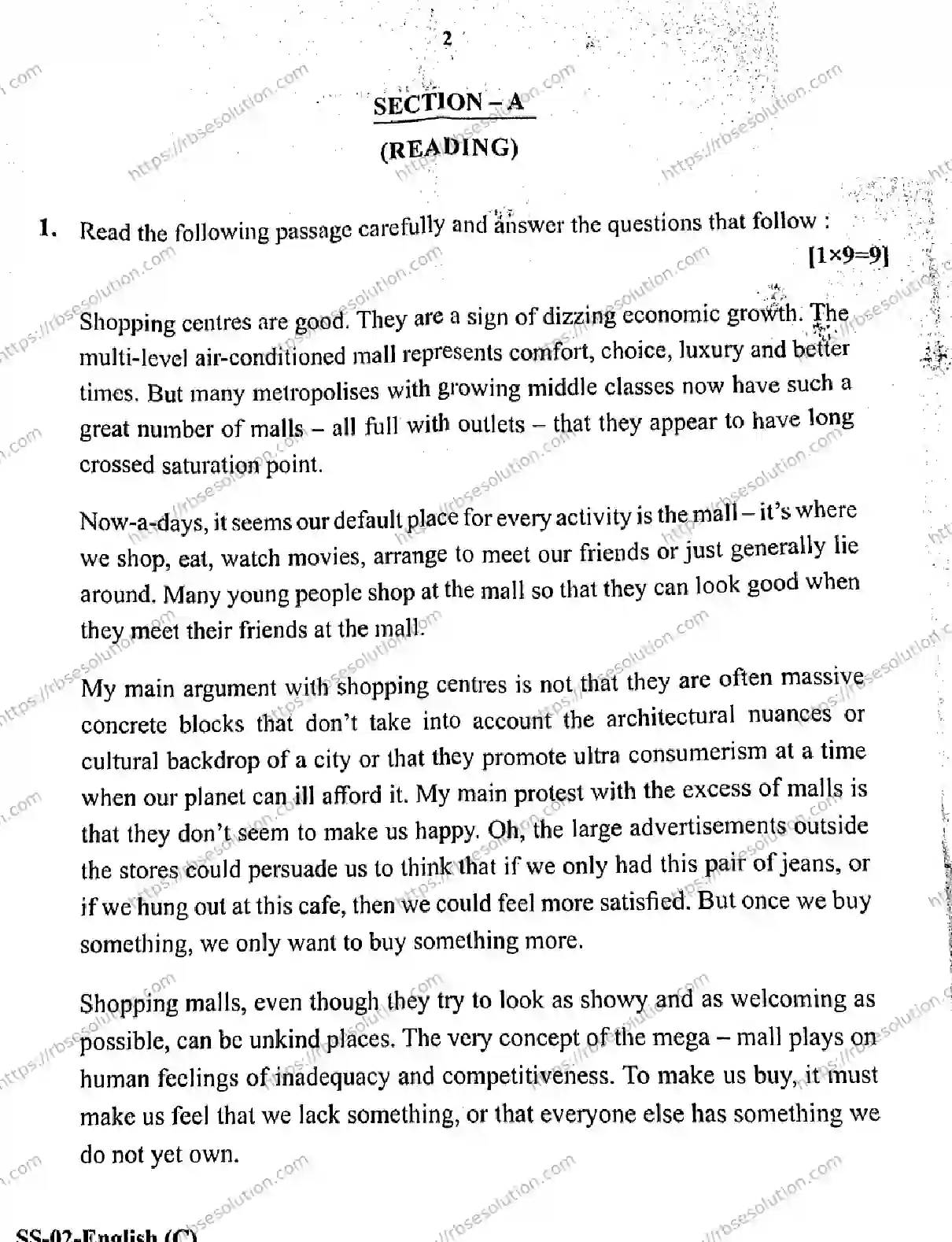
SECTION — A
(READING)
1. Read the following passage carefully and answer the questions that follow :
Shopping centres are good. They are a sign of dizzying economic growth. The multi-level air-conditioned mall represents comfort, choice, luxury and better times. But many metropolises with growing middle classes now have such a great number of malls — all full with outlets — that they appear to have long crossed saturation point.
Now-a-days, it seems our default place for every activity is the mall — it's where we shop, eat, watch movies, arrange to meet our friends or just generally lie around. Many young people shop at the mall so that they can look good when they meet their friends at the mall.
My main argument with shopping centres is not that they are often massive concrete blocks that don't take into account the architectural nuances or cultural backdrop of a city or that they promote ultra consumerism at a time when our planet can ill afford it. My main protest with the excess of malls is that they don't seem to make us happy. Oh, the large advertisements outside the stores could persuade us to think that if we only had this pair of jeans, or if we hung out at this cafe, then we could feel more satisfied. But once we buy something, we only want to buy something more.
Shopping malls, even though they try to look as showy and as welcoming as possible, can be unkind places. The very concept of the mega-mall plays on human feelings of inadequacy and competitiveness. To make us buy, it must make us feel that we lack something, or that everyone else has something we do not yet own.
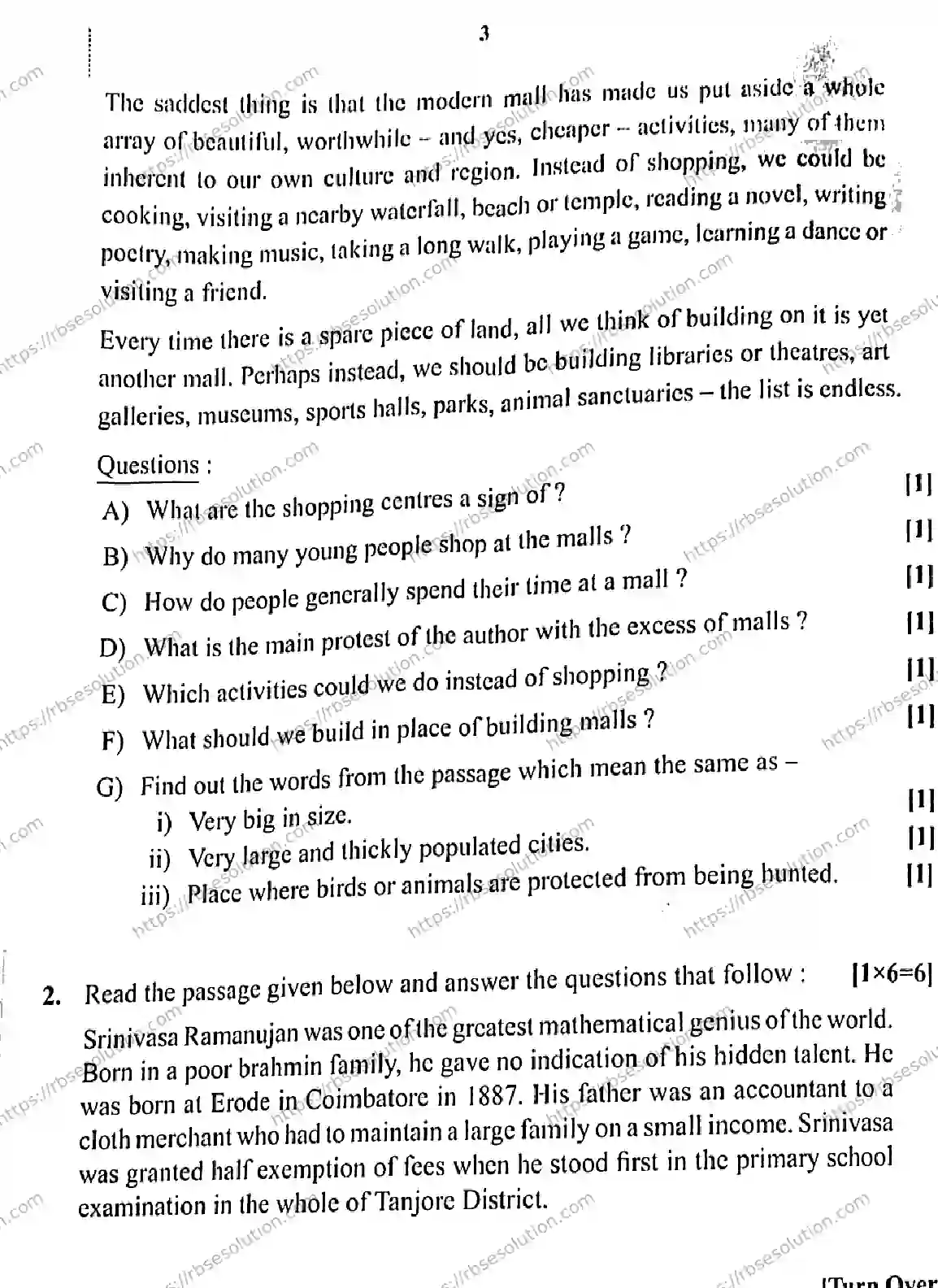
Questions:
-
What is the author's main argument against shopping malls?
The author's main argument is not about their architecture or consumerism, but that shopping malls do not make us truly happy. They create feelings of inadequacy and competitiveness, making us want to buy more even after a purchase.
-
Why do many young people shop at the mall according to the passage?
Many young people shop at the mall so that they can look good when they meet their friends at the mall.
-
What does the author mean by "the very concept of the mega-mall plays on human feelings of inadequacy and competitiveness"?
The author means that malls are designed to make shoppers feel that they lack something or that others have things they do not own. This feeling of inadequacy and the desire to compete with others drives people to buy more, even if they are not truly happy.
Questions:
-
A) What are the shopping centres a sign of? [1]
The shopping centres are a sign of modern materialism and consumerism, where people have put aside more meaningful activities.
-
B) Why do many young people shop at the malls? [1]
Many young people shop at malls because they find it a cheaper and convenient way to spend their time, engaging in activities like shopping.
-
C) How do people generally spend their time at a mall? [1]
People generally spend their time at a mall by shopping, eating, and engaging in various entertainment activities available there.
-
D) What is the main protest of the author with the excess of malls? [1]
The author protests that instead of building malls, we should build libraries, theatres, art galleries, museums, sports halls, parks, and animal sanctuaries, which are more worthwhile and beneficial for society.
-
E) Which activities could we do instead of shopping? [1]
Instead of shopping, we could read a novel, write poetry, make music, take a long walk, play a sport, visit a friend, cook, visit a waterfall or beach, learn a dance, or visit a temple.
-
F) What should we build in place of building malls? [1]
In place of building malls, we should build libraries, theatres, art galleries, museums, sports halls, parks, and animal sanctuaries.
-
G) Find out the words from the passage which mean the same as — [1]
-
Very big in size.
Answer: vast (or huge – from the context of "vast array")
-
Very large and thickly populated cities.
Answer: metropolis (or megacities – implied from the passage)
-
Place where birds or animals are protected from being hunted.
Answer: sanctuary (from "animal sanctuaries")
-
2. Read the passage given below and answer the questions that follow: [1×6=6]
Srinivasa Ramanujan was one of the greatest mathematical genius of the world. Born in a poor brahmin family, he gave no indication of his hidden talent. He was born at Erode in Coimbatore in 1887. His father was an accountant to a cloth merchant who had to maintain a large family on a small income. Srinivasa was granted half exemption of fees when he stood first in the primary school examination in the whole of Tanjore District.
Note: The questions for this passage are not provided in the given text. Please refer to the original question paper for the specific questions to be answered.
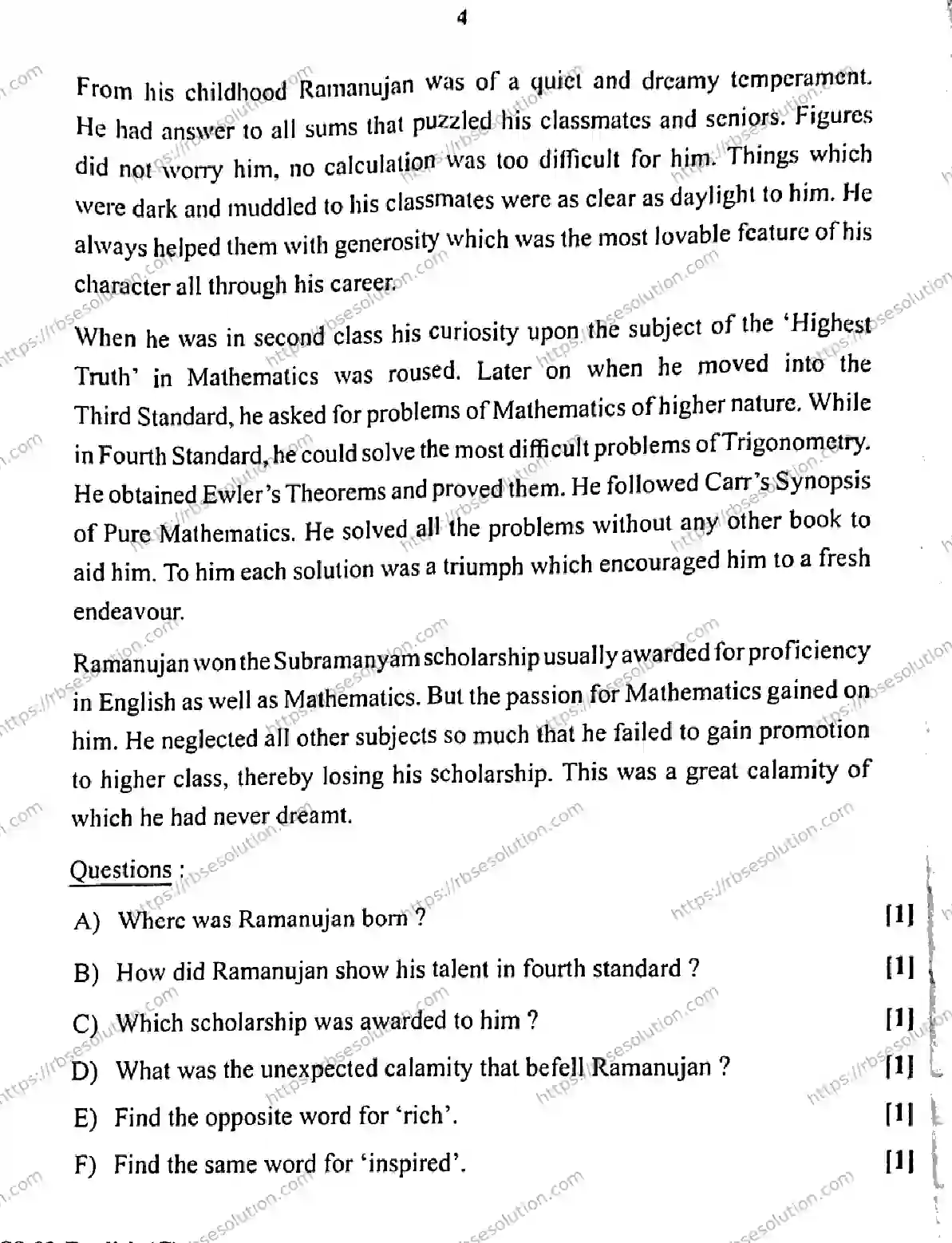
Questions
-
A) Where was Ramanujan born?
The passage does not mention Ramanujan's birthplace. It only describes his childhood and academic life.
-
B) How did Ramanujan show his talent in fourth standard?
While in the Fourth Standard, Ramanujan could solve the most difficult problems of Trigonometry. He obtained Euler's Theorems and proved them. He followed Carr's Synopsis of Pure Mathematics and solved all the problems without any other book to aid him.
-
C) Which scholarship was awarded to him?
Ramanujan won the Subramanyam scholarship, which was usually awarded for proficiency in English as well as Mathematics.
-
D) What was the unexpected calamity that befell Ramanujan?
The unexpected calamity was that Ramanujan neglected all other subjects due to his passion for Mathematics, so he failed to gain promotion to a higher class, thereby losing his scholarship.
-
E) Find the opposite word for 'rich'.
The opposite word for 'rich' is poor.
-
F) Find the same word for 'inspired'.
The same word for 'inspired' is encouraged (as used in the passage: "which encouraged him to a fresh endeavour").
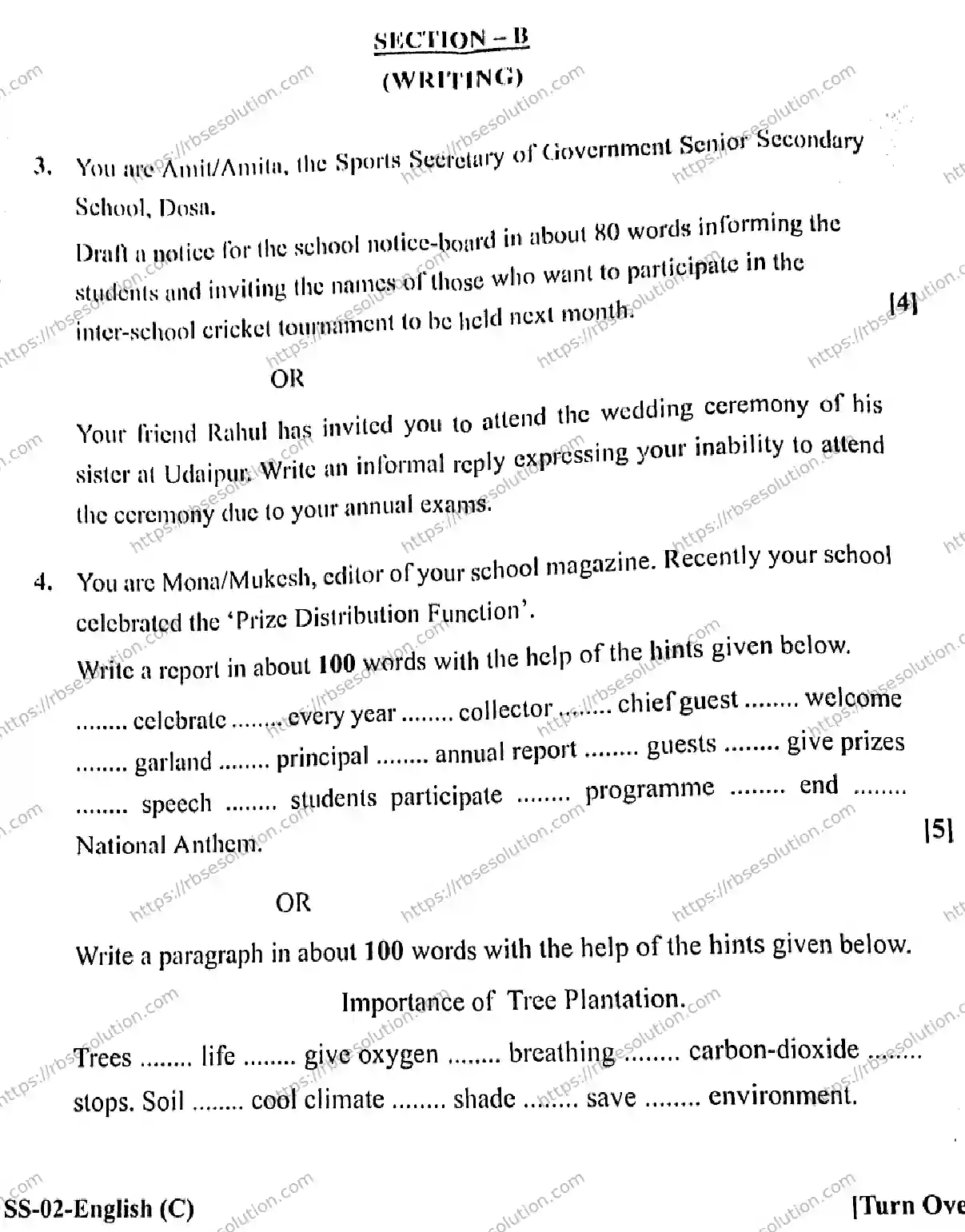
3.
You are Amit/Amita, the Sports Secretary of Government Senior Secondary School, Dosa. Draft a notice for the school notice-board in about 80 words informing the students and inviting the names of those who want to participate in the inter-school cricket tournament to be held next month.
NOTICE
Government Senior Secondary School, Dosa
Date: [Date]
Inter-School Cricket Tournament
This is to inform all students that our school is organizing an inter-school cricket tournament next month. Interested students are requested to submit their names to the undersigned by [last date]. Selection trials will be held on [date]. For further details, contact the Sports Secretary.
Amit/Amita
Sports Secretary
OR
Your friend Rahul has invited you to attend the wedding ceremony of his sister at Udaipur. Write an informal reply expressing your inability to attend the ceremony due to your annual exams.
[Address]
[Date]
Dear Rahul,
Thank you so much for your kind invitation to your sister's wedding ceremony at Udaipur. I am truly honored and would have loved to be a part of this joyous occasion. However, I regret to inform you that I will not be able to attend the ceremony as my annual exams are scheduled during that time. I am deeply sorry for this inconvenience. Please convey my heartfelt congratulations and best wishes to your sister and family. I will surely meet you all after my exams.
Yours lovingly,
[Your Name]
4.
You are Mona/Mukesh, editor of your school magazine. Recently your school celebrated the ‘Prize Distribution Function’. Write a report in about 100 words with the help of the hints given below.
Hints: school celebrates every year – conducted – chief guest – welcome – garland – principal – annual report – guests – give prizes – speech – students participate – programme – end – National Anthem.
Prize Distribution Function Celebrated
By Mona/Mukesh, Editor
Our school celebrated its annual Prize Distribution Function on [date] with great enthusiasm. The chief guest was [name], who was warmly welcomed with a garland. The principal presented the annual report highlighting the school's achievements. The chief guest then distributed prizes to students for their academic and co-curricular excellence. In his speech, he motivated students to work hard. Students presented a vibrant cultural programme. The function ended with the National Anthem.
OR
Write a paragraph in about 100 words with the help of the hints given below.
Hints: Importance of Tree Plantation – trees – life – give oxygen – breathing – carbon-dioxide – stops – soil – cool climate – shade – save – environment.
Importance of Tree Plantation
Trees are essential for life on Earth. They give us oxygen, which is vital for breathing, and absorb harmful carbon-dioxide. Tree plantation helps stop soil erosion and keeps the climate cool by providing shade. Trees also save the environment by reducing pollution and maintaining ecological balance. Therefore, planting more trees is crucial for our survival and for a healthier planet.
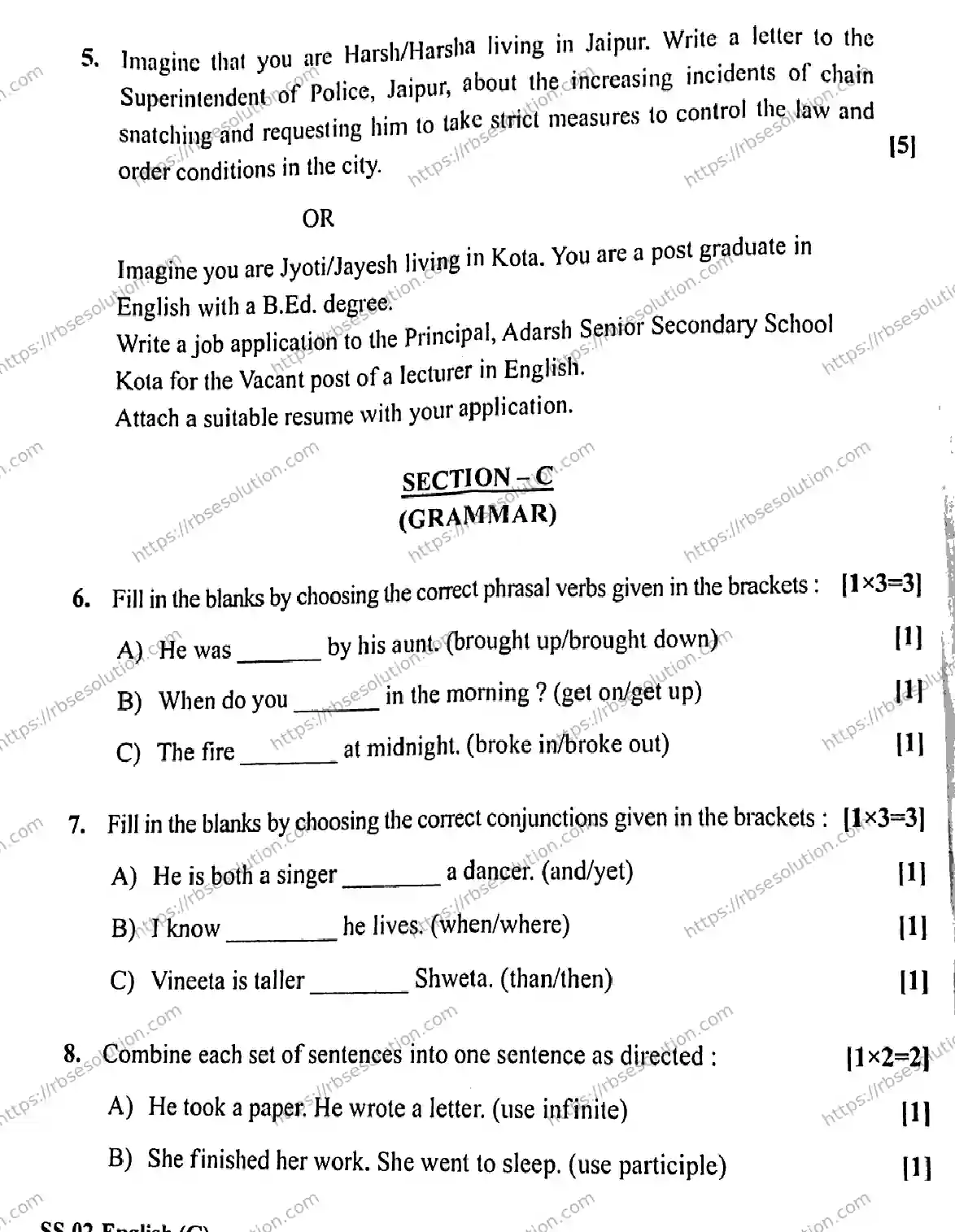
5. Imagine that you are Harsh/Harsha living in Jaipur. Write a letter to the Superintendent of Police, Jaipur, about the increasing incidents of chain snatching and requesting him to take strict measures to control the law and order conditions in the city.
OR
Imagine you are Jyoti/Jayesh living in Kota. You are a post graduate in English with a B.Ed. degree. Write a job application to the Principal, Adarsh Senior Secondary School, Kota for the vacant post of a lecturer in English. Attach a suitable resume with your application.
SECTION - C (GRAMMAR)
6. Fill in the blanks by choosing the correct phrasal verbs given in the brackets: [1×3=3]
- He was brought up by his aunt. (brought up/brought down)
- When do you get up in the morning? (get on/get up)
- The fire broke out at midnight. (broke in/broke out)
7. Fill in the blanks by choosing the correct conjunctions given in the brackets: [1×3=3]
- He is both a singer and a dancer. (and/yet)
- I know where he lives. (when/where)
- Vineeta is taller than Shweta. (than/then)
8. Rewrite each set of sentences into one sentence as directed: [1×2=2]
- He took a paper. He wrote a letter. (use infinitive)
Answer: He took a paper to write a letter. - She finished her work. She went to sleep. (use participle)
Answer: Having finished her work, she went to sleep.
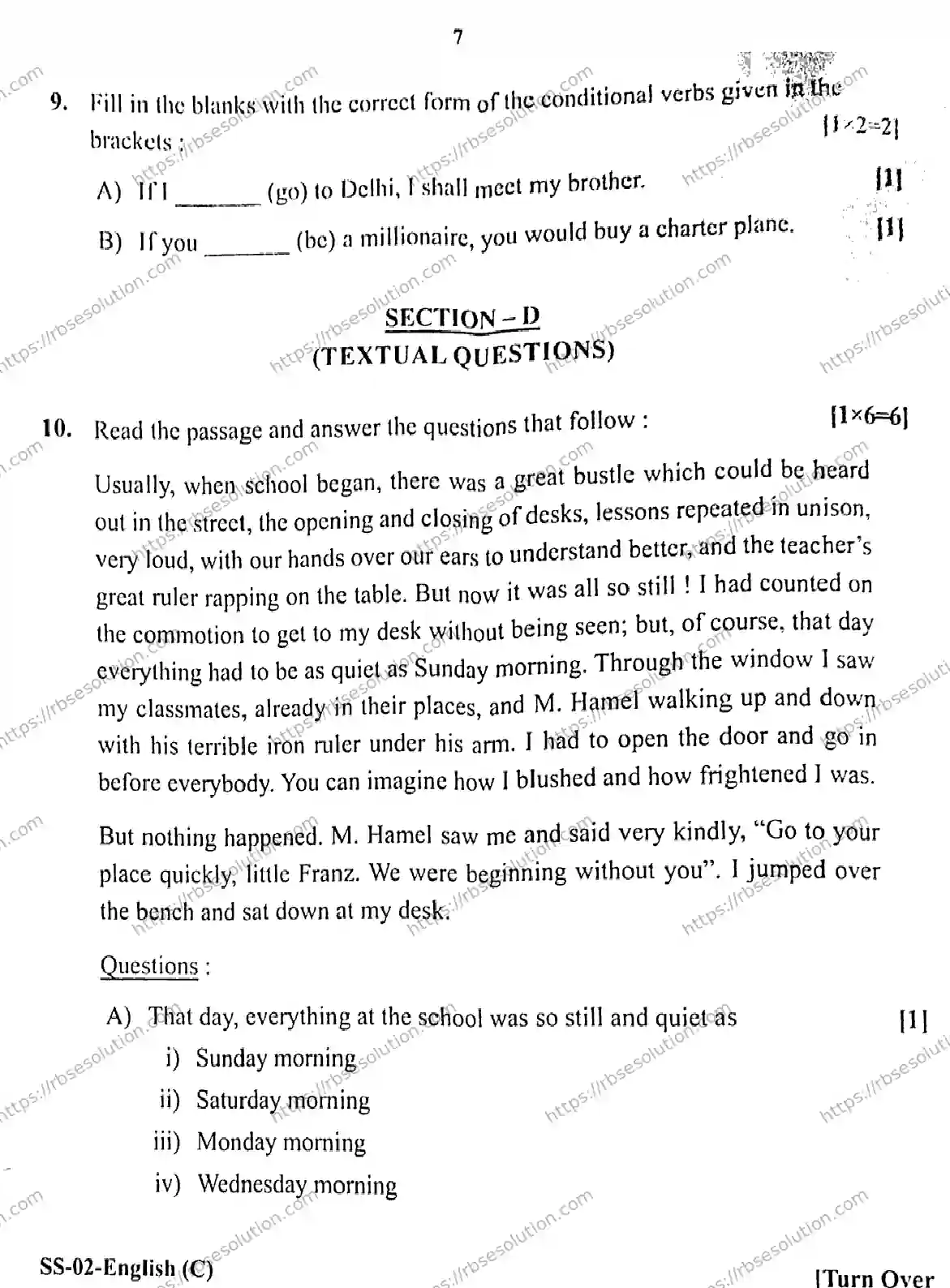
Fill in the blanks with the correct form of the conditional verbs given in brackets. [1×2=2]
-
If I go (go) to Delhi, I shall meet my brother.
-
If you were (be) a millionaire, you would buy a charter plane.
SECTION - B (TEXTUAL QUESTIONS)
0. Read the passage and answer the questions that follow: [1×6=6]
Usually, when school began, there was a great bustle which could be heard out in the street, the opening and closing of desks, lessons repeated in unison, very loud, with our hands over our ears to understand better; and the teacher’s great ruler rapping on the table. But now it was all so still! I had counted on the commotion to get to my desk without being seen; but, of course, that day everything had to be as quiet as Sunday morning. Through the window I saw my classmates, already in their places, and M. Hamel walking up and down with his terrible iron ruler under his arm. I had to open the door and go in before everybody. You can imagine how I blushed and how frightened I was.
But nothing happened. M. Hamel saw me and said very kindly, “Go to your place quickly, little Franz. We were beginning without you”. I jumped over the bench and sat down at my desk.
Questions:
-
A) That day, everything at the school was so still and quiet as ______.
- i) Sunday morning
- ii) Saturday morning
- iii) Monday morning
- iv) Wednesday morning
Explanation: The passage states, "that day everything had to be as quiet as Sunday morning." Hence, option (i) is correct.
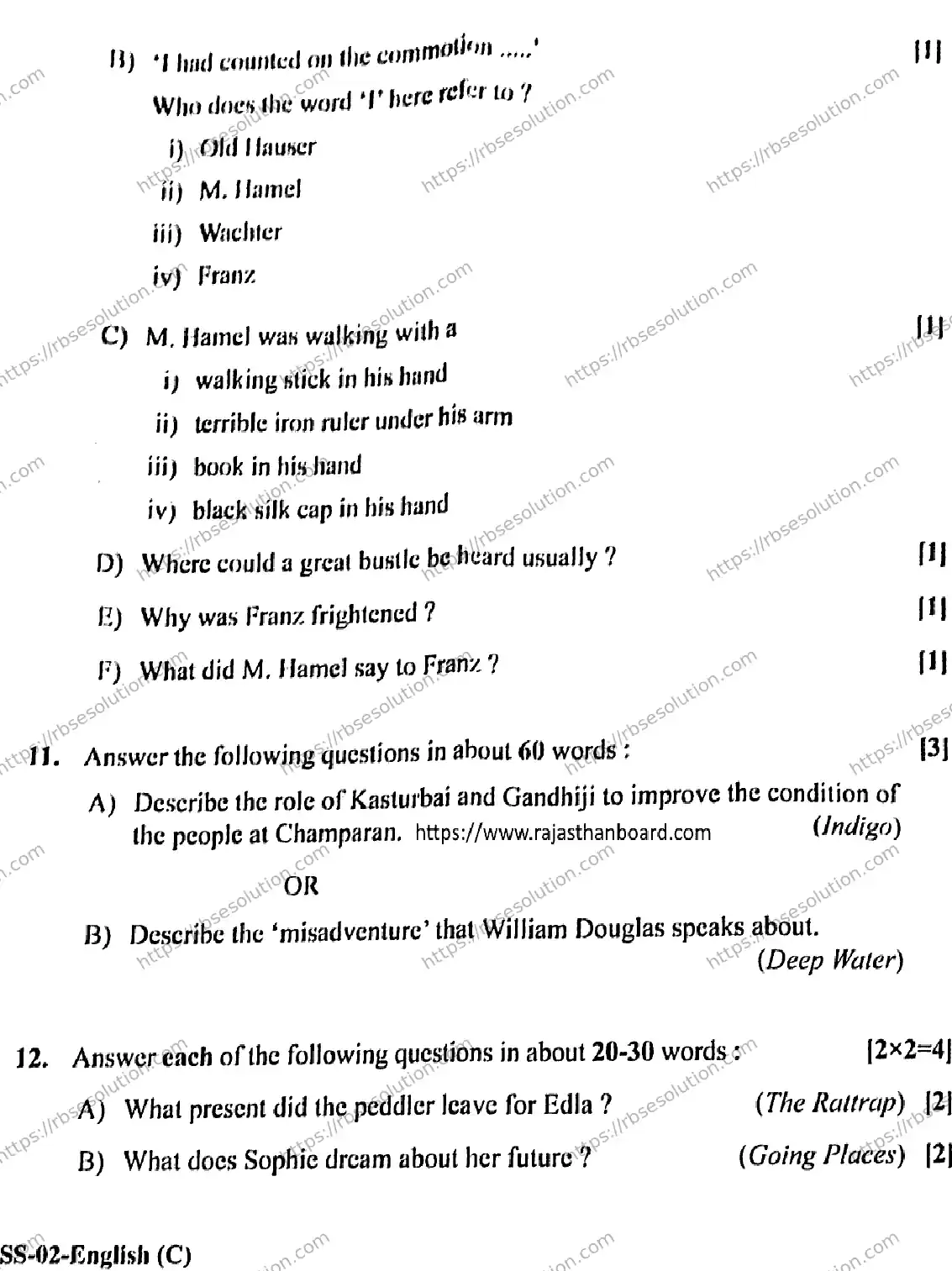
4) “I had counted on the comma!” Who does the word ‘I’ here refer to?
- i) Old Hauser
- ii) M. Hamel
- iii) Wachter
- iv) Franz
Explanation: In the lesson "The Last Lesson," Franz says this line when he realizes that the lesson on participles, which he had not prepared, was the subject of the question. The word 'I' refers to Franz, the narrator.
C) M. Hamel was walking with
- i) walking stick in his hand
- ii) terrible iron ruler under his arm
- iii) book in his hand
- iv) black silk cap in his hand
Explanation: In "The Last Lesson," M. Hamel is described as walking with a terrible iron ruler under his arm, which symbolizes his strictness and authority in the classroom.
9) Where could a great bustle be heard usually?
A great bustle could usually be heard from the street, near the town hall, where the bulletin board was located. It was the place where people gathered to read news and announcements.
2) Why was Franz frightened?
Franz was frightened because he was late for school and had not prepared his lesson on participles. He feared being scolded by M. Hamel, who was known for his strictness and use of the iron ruler.
F) What did M. Hamel say to Franz?
M. Hamel said to Franz, "I was about to begin the lesson without you. Go to your place quickly, little Franz. We were going to begin without you." He spoke gently, without anger, which surprised Franz.
I. Answer the following questions in about 60 words: (3)
A) Describe the role of Kasturbai and Gandhiji to improve the condition of the people at Champaran.
Gandhiji went to Champaran to investigate the plight of indigo farmers who were forced to grow indigo under oppressive contracts. Kasturbai accompanied him and helped by teaching hygiene, sanitation, and basic education to the women and children. Together, they organized the farmers, fought against the British landlords, and eventually secured justice for the peasants. Their efforts led to the abolition of the exploitative system and improved living conditions.
OR
B) Describe the ‘misadventure’ that William Douglas speaks about. (Deep Water)
William Douglas describes a terrifying misadventure when he was thrown into the deep end of a swimming pool by a bully. He sank to the bottom and struggled to reach the surface, nearly drowning. This experience left him with a deep fear of water that haunted him for years. He later overcame this fear through persistent practice and determination, learning to swim and conquering his phobia.
2. Answer each of the following questions in about 20-30 words [2×2=4]
A) What present did the peddler leave for Edla? (The Rattrap) [2]
The peddler left a small rattrap as a Christmas present for Edla, along with a note thanking her for her kindness and a letter explaining that the money he had taken was returned.
B) What does Sophie dream about her future? (Going Places) [2]
Sophie dreams of becoming a fashion designer and owning a boutique. She also fantasizes about meeting the footballer Danny Casey and having a romantic relationship with him, though these dreams are unrealistic.
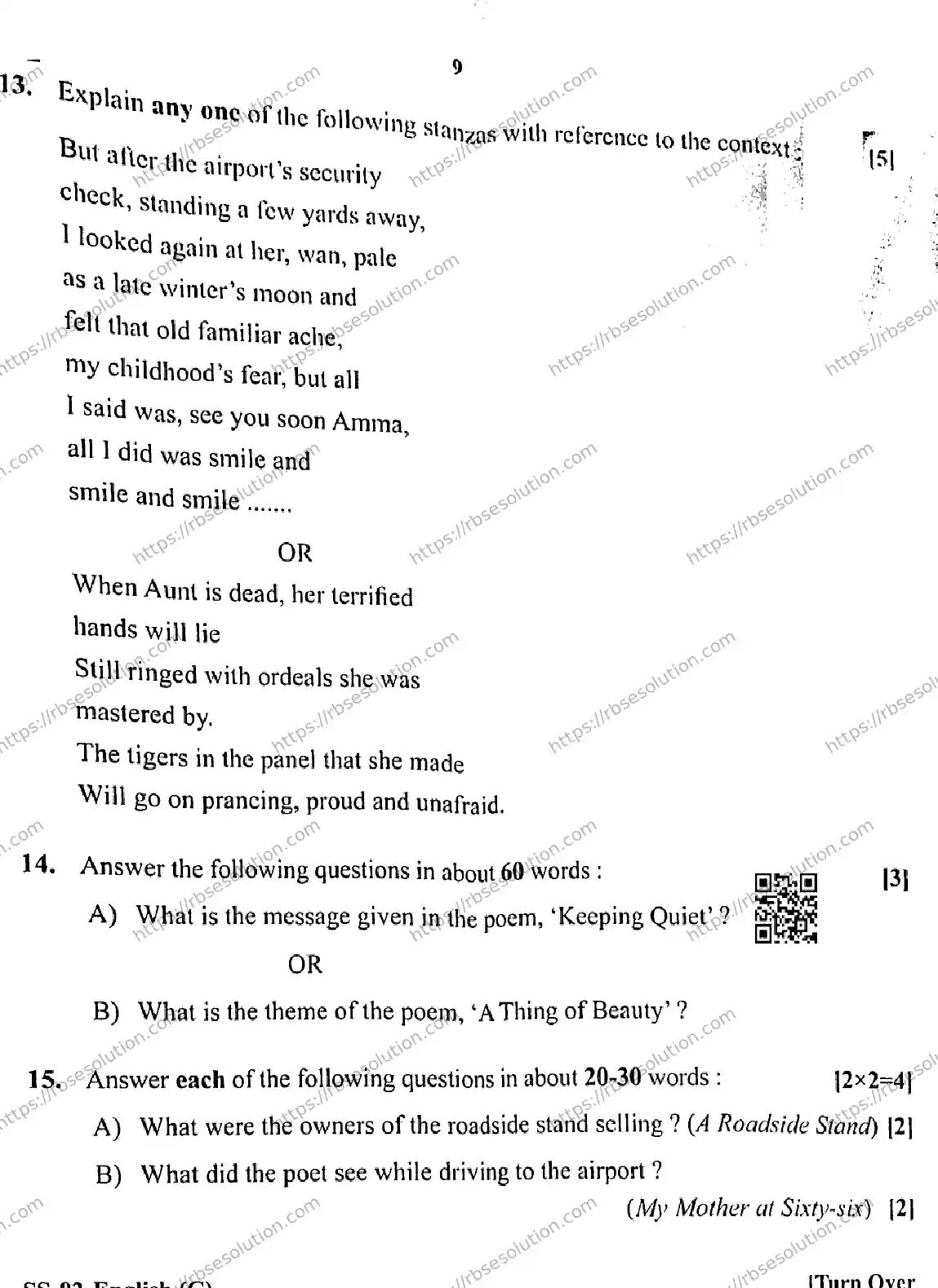
3. Explain ANY ONE of the following Stanzas with reference to the context:
Option 1:
But after the airport's security check, standing a few yards away,
I looked again at her, wan, pale
as a late winter's moon and
felt that old familiar ache:
My childhood's fear: but all
I said was, see you soon Amma,
all I did was smile and
smile and smile
Option 2:
When Aunt is dead, her terrified hands will lie
Still tinged with ordeals she was
Mastered by,
The tigers in the panel that she made
Will go on prancing, proud and unafraid.
Explanation (for Option 1): This stanza is from the poem "My Mother at Sixty-six" by Kamala Das. The poet describes the moment after the security check at the airport, when she looks back at her mother. The mother is compared to a "late winter's moon" – pale, weak, and fading. The poet feels the old familiar ache of childhood fear of losing her mother. However, to hide her emotions, she only smiles and says "see you soon, Amma," masking her pain with a cheerful farewell.
4. Answer the following questions in about 60 words:
A) What is the message given in the poem, ‘Keeping Quiet’?
The poem "Keeping Quiet" by Pablo Neruda conveys the message of introspection, peace, and unity. The poet urges everyone to pause all activities for a moment and observe silence. This quietness will help us understand ourselves and others better, reduce conflicts, and promote harmony. It emphasizes that stillness and reflection can heal the world from violence, greed, and haste, leading to a more thoughtful and compassionate life.
OR
B) What is the theme of the poem, ‘A Thing of Beauty’?
The theme of the poem "A Thing of Beauty" by John Keats is the enduring power of beauty. The poet asserts that a beautiful object provides eternal joy and never fades. It brings peace, comfort, and inspiration to the human soul, even in times of sorrow and despair. Beauty connects us to nature and the divine, making life meaningful and worth living. It is a source of endless happiness and spiritual nourishment.
5. Answer each of the following questions in about 20-30 words:
A) What were the owners of the roadside stand selling? (A Roadside Stand)
The owners of the roadside stand were selling farm produce such as berries, squash, and other fruits and vegetables grown by them. They hoped that passing city people would stop and buy their goods.
B) What did the poet see while driving to the airport? (My Mother at Sixty-six)
While driving to the airport, the poet saw her mother sitting beside her. She noticed that her mother looked pale, weak, and old, like a "late winter's moon." This sight filled the poet with sadness and fear of losing her.
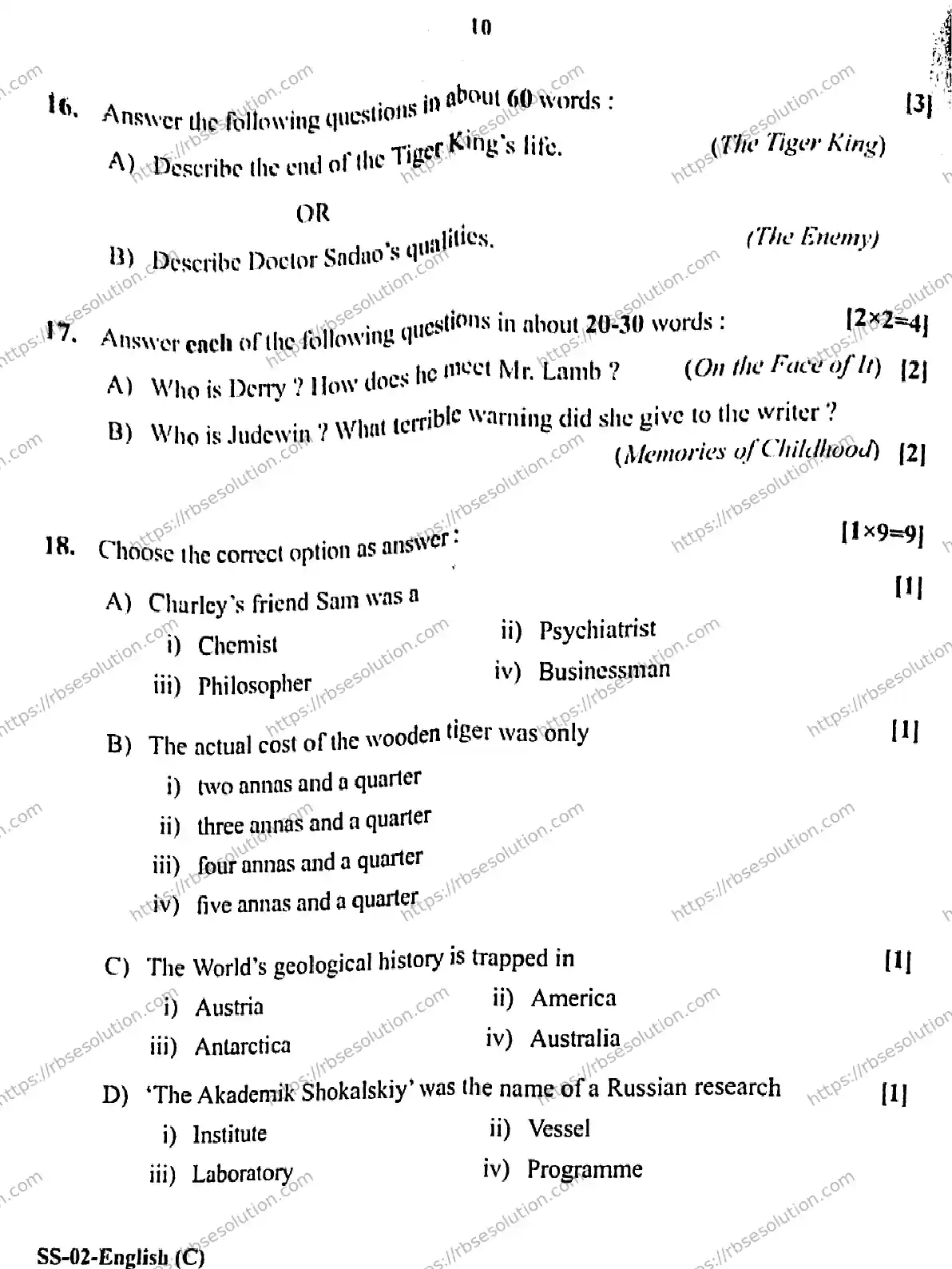
0. Answer the following questions in about 20-30 words : [3]
A) Describe the end of the Tiger King’s life. (The Tiger King)
The Tiger King died after being pricked by a sliver of wood from a toy tiger. The wooden tiger, which he had bought for his son, had a sharp edge that caused an infection, leading to his death.
B) Describe Doctor Sadao’s qualities. (The Enemy)
Doctor Sadao was a skilled surgeon, compassionate, and patriotic. He saved an American prisoner of war despite the risk, showing his humanity and dedication to his medical oath over national boundaries.
7. Answer each of the following questions in about 20-30 words : [2×2=4]
A) Who is Derry? How does he meet Mr. Lamb? (On the Face of It)
Derry is a young boy with a burnt face who feels self-conscious and isolated. He meets Mr. Lamb, an old man with a tin leg, in Mr. Lamb's garden, where they have a conversation that changes Derry's perspective.
B) Who is Judewin? What terrible warning did she give to the writer? (Memories of Childhood)
Judewin is a friend of the writer (Zitkala-Sa) at the boarding school. She warned the writer that the school authorities would cut their long hair, which was a terrible thing for them as it was against their Native American traditions.
8. Choose the correct option as answer : [1×9=9]
A) Charley's friend Sam was a
- Chemist
- Psychiatrist
- Philosopher
- Businessman
Sam was Charley's psychiatrist friend who claimed to have found a place called Galesburg.
B) The actual cost of the wooden tiger was only
- two annas and a quarter
- three annas and a quarter
- four annas and a quarter
- five annas and a quarter
The wooden tiger that caused the Tiger King's death cost only three annas and a quarter.
C) The World’s geological history is trapped in
- Austria
- America
- Antarctica
- Australia
Antarctica holds the world's geological history trapped in its ice sheets, as mentioned in the lesson "Journey to the End of the Earth".
D) ‘The Akademik Shokalskiy’ was the name of a Russian research
- Institute
- Vessel
- Laboratory
- Programme
The Akademik Shokalskiy was a Russian research vessel that got trapped in ice, as described in "Journey to the End of the Earth".
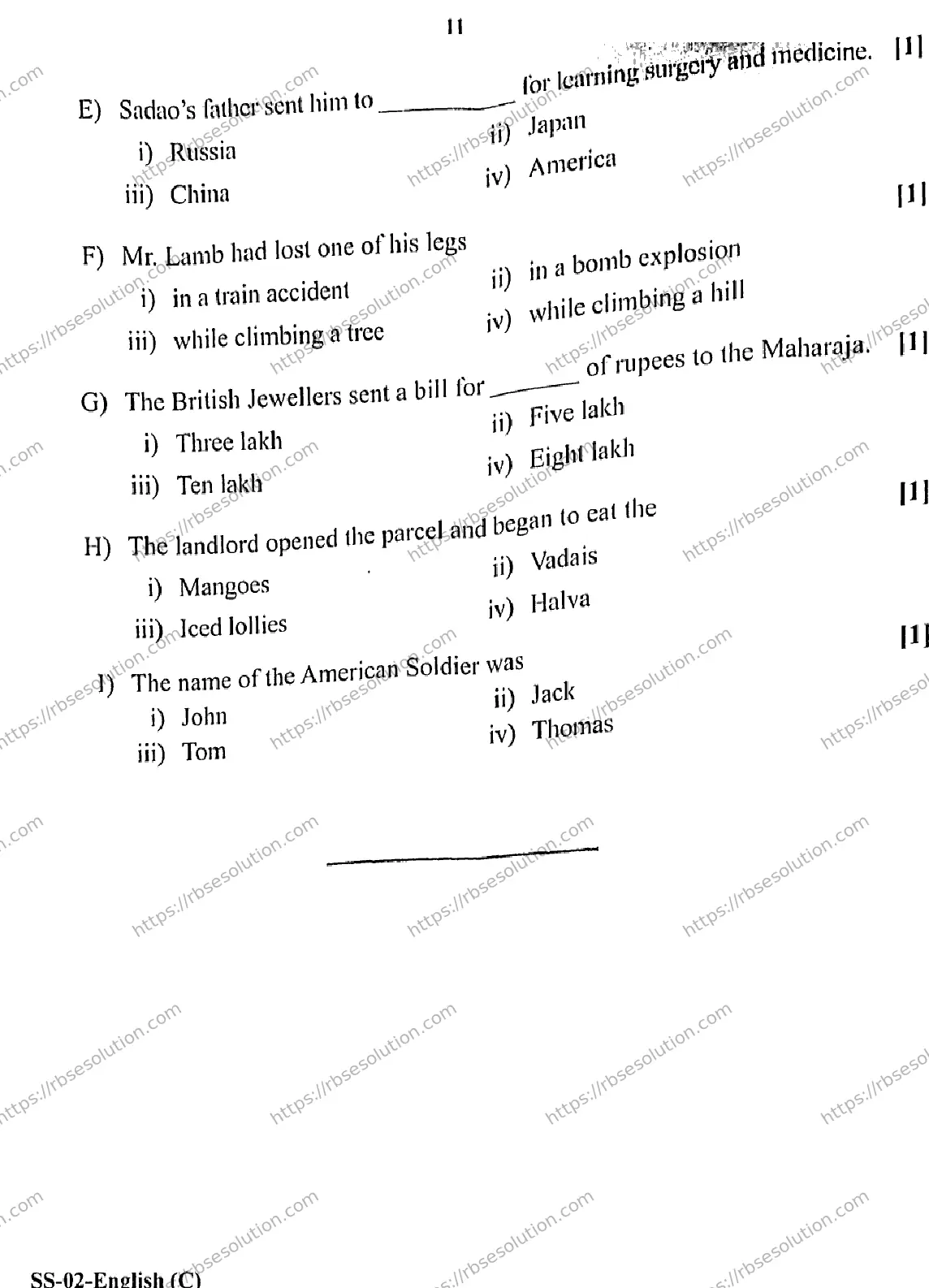
9) Sadao’s father sent him to __________ for learning surgery and medicine.
- i) Russia
- ii) Japan
- iii) China
- iv) America
Explanation: In the story "The Enemy," Sadao's father sent him to America to study surgery and medicine, as he believed in modern Western education.
F) Mr. Lamb had lost one of his legs __________
- i) in a train accident
- ii) in a war
- iii) while climbing tree
- iv) due to disease
Explanation: In the play "On the Face of It," Mr. Lamb lost one of his legs while climbing a tree, which is why he uses a tin leg.
G) The British Jewellers sent a bill for __________
- i) Three lakh
- ii) Five lakh
- iii) Ten lakh
- iv) Eight lakh
Explanation: In the story "The Rattrap," the British Jewellers sent a bill for ten lakh kronor to the ironmaster for the rattrap peddler's supposed purchase.
H) The landlord opened the parcel and began to eat __________
- i) Mangoes
- ii) Vadais
- iii) Iced lollies
- iv) Halva
Explanation: In the story "The Tiger King," the landlord opened the parcel containing vadais and began to eat them, which was part of the plot to kill the tiger.
I) The name of the American soldier was __________
- i) John
- ii) Jack
- iii) Tom
- iv) Thomas
Explanation: In the story "The Enemy," the American soldier who was wounded and helped by Dr. Sadao was named Tom.