
RBSE Class 12th 2026 HALF-YEARLY-ENGLISH-1202-211125 Previous Year Papers
HALF-YEARLY-ENGLISH-1202-211125 from the 2026 exam year is part of the Class 12th previous year papers archive on RBSE Solution. Many learners start here after finishing the textbook to see how questions were actually framed on the Rajasthan Board of Secondary Education (RBSE) paper.
Treat this question paper as a mock under gentle timing first, then as a marking exercise the second time. The introduction on this page is written only for this subject-and-year pair, not copied from other pages.
Bookmark the link if you coach juniors — the layout stays stable for search engines and classroom sharing.
Paper details
Quick reference for this previous year papers page — confirm board, class, and year & subject before you study.
| Board | RBSE |
|---|---|
| Class | Class 12th |
| Exam year | 2026 |
| Subject | HALF-YEARLY-ENGLISH-1202-211125 |
| Resource type | Previous Year Papers |
| Category | RBSE Previous Year Question Papers |
| Website | RBSE Solution |
The table summarises this Previous Year Papers resource. Confirm RBSE, Class 12th, year 2026, and subject HALF-YEARLY-ENGLISH-1202-211125 before studying.
RBSE Solution organises previous year papers so each URL carries chapter-specific guidance — better for students and for search engines than one generic paragraph for the whole class.
Turning 2026 papers into insight
One HALF-YEARLY-ENGLISH-1202-211125 paper reveals style; several from the same year reveal pattern. After this page, open sibling subjects listed below to see whether marks cluster in certain units.
Keep rough work dated in your notebook. Examiners in Class 12th expect clear numbering even in practice sessions.
RBSE Class 12th 2026 HALF-YEARLY-ENGLISH-1202-211125
Scroll through the Previous Year Papers pages for HALF-YEARLY-ENGLISH-1202-211125 (2026).
Rajasthan Board Class 12th HALF-YEARLY-ENGLISH-1202-211125 2026 solved Previous Year Question Papers
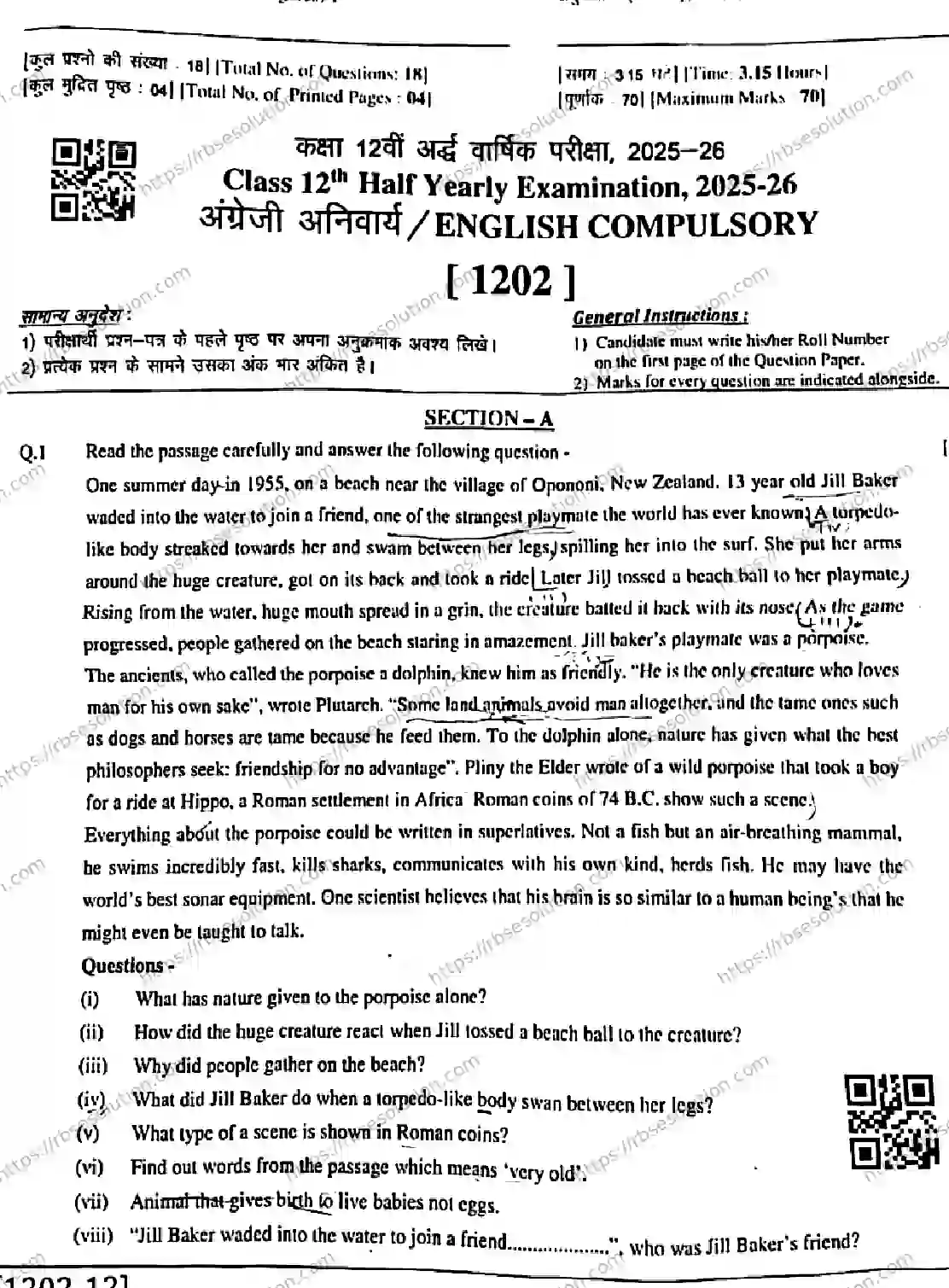
कक्षा 12वीं अर्द्धवार्षिक परीक्षा, 2025-26
Class 12th Half Yearly Examination, 2025-26
अंग्रेजी अनिवार्य / ENGLISH COMPULSORY
समय: 3.15 घंटे | पूर्णांक: 70
सामान्य अनुदेश: General Instructions:
- परीक्षार्थी प्रश्न-पत्र के पहले पृष्ठ पर अपना अनुक्रमांक अवश्य लिखें। Candidate must write his/her Roll Number on the first page of the Question Paper.
- प्रत्येक प्रश्न के सामने उसका अंक भार अंकित है। Marks for every question are indicated alongside.
SECTION-A
Q1. Read the passage carefully and answer the following questions:
One summer day in 1955, on a beach near the village of Opononi, New Zealand, 13-year-old Jill Baker waded into the water to join a friend, one of the strangest playmates the world has ever known. A torpedo-like body streaked towards her and swam between her legs, spilling her into the surf. She put her arms around the huge creature, got on its back and took a ride. Later Jill tossed a beach ball to her playmate. Rising from the water, huge mouth spread in a grin, the creature batted it back with its nose. As the game progressed, people gathered on the beach staring in amazement. Jill Baker's playmate was a porpoise.
The ancients, who called the porpoise a dolphin, knew him as friendly. "He is the only creature who loves man for his own sake", wrote Plutarch. "Some land animals avoid man altogether, and the tame ones such as dogs and horses are tame because he feeds them. To the dolphin alone, nature has given what the best philosophers seek: friendship for no advantage". Pliny the Elder wrote of a wild porpoise that took a boy for a ride at Hippo, a Roman settlement in Africa. Roman coins of 74 B.C. show such a scene.
Everything about the porpoise could be written in superlatives. Not a fish but an air-breathing mammal, he swims incredibly fast, kills sharks, communicates with his own kind, herds fish. He may have the world's best sonar equipment. One scientist believes that his brain is so similar to a human being's that he might even be taught to talk.
-
(i) What has nature given to the porpoise alone?
Answer: Nature has given the porpoise alone the ability to offer friendship for no advantage, which is what the best philosophers seek.
-
(ii) How did the huge creature react when Jill tossed a beach ball to the creature?
Answer: The huge creature rose from the water with its huge mouth spread in a grin and batted the ball back with its nose.
-
(iii) Why did people gather on the beach?
Answer: People gathered on the beach because they were amazed to see Jill Baker playing with a porpoise, which was an unusual and astonishing sight.
-
(iv) What did Jill Baker do when a torpedo-like body swam between her legs?
Answer: When the torpedo-like body swam between her legs, spilling her into the surf, Jill Baker put her arms around the huge creature, got on its back, and took a ride.
-
(v) What type of a scene is shown in Roman coins?
Answer: Roman coins of 74 B.C. show a scene of a wild porpoise taking a boy for a ride at Hippo, a Roman settlement in Africa.
-
(vi) Find out words from the passage which means 'very old'.
Answer: The word is "ancients" (referring to people of ancient times).
-
(vii) An animal that gives birth to live babies, not eggs.
Answer: The word is "mammal" (the porpoise is an air-breathing mammal).
-
(viii) "Jill Baker waded into the water to join a friend." Who was Jill Baker's friend?
Answer: Jill Baker's friend was a porpoise (a dolphin-like creature).
SECTION-A
Read the following passage carefully:
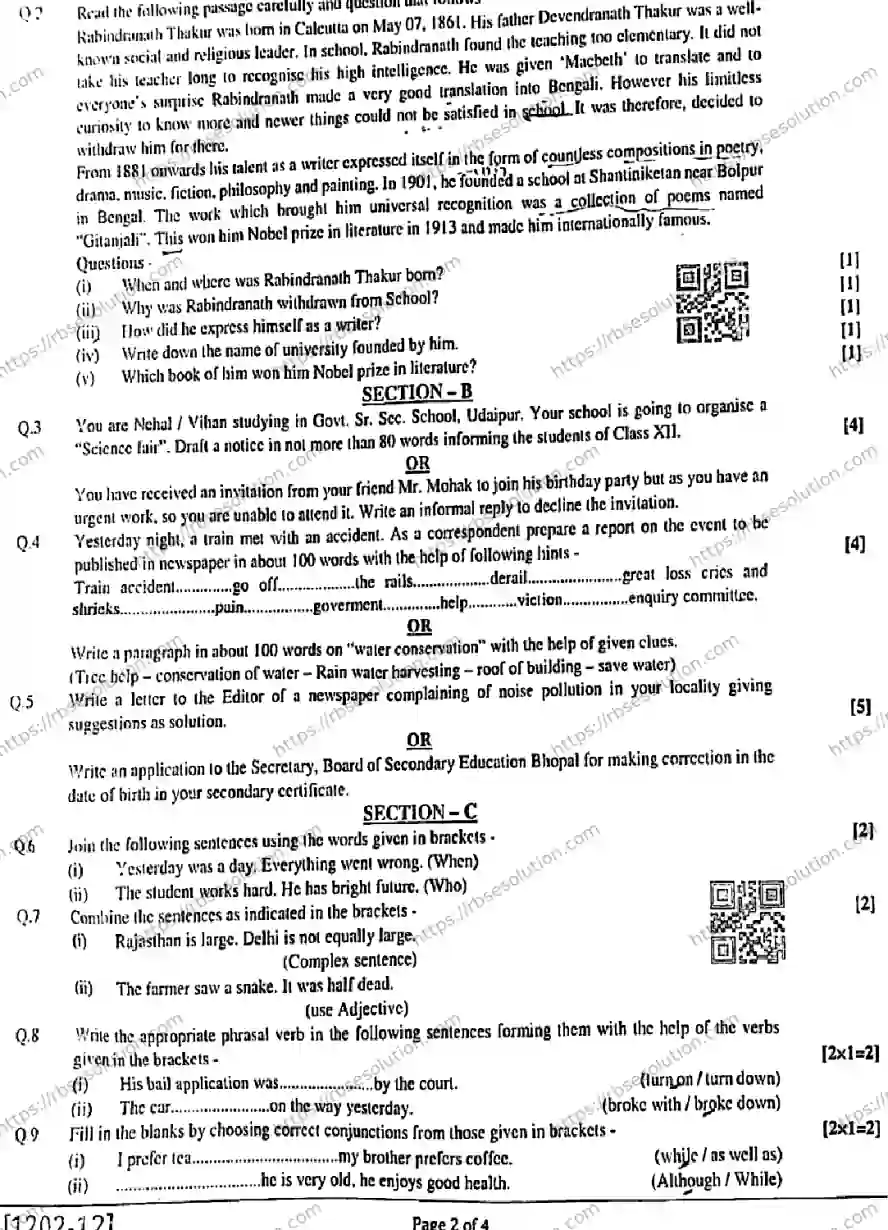
Rabindranath Thakur was born in Calcutta on May 07, 1861. His father, Devendranath Thakur, was a well-known social and religious leader. In school, Rabindranath found the teaching too elementary. He was given "Macbeth" to translate and it did not take his teacher long to recognise his high intelligence. To everyone's surprise, Rabindranath made a very good translation. However, his limitless curiosity to know more and newer things could not be satisfied in school. It was, therefore, decided to withdraw him from there.
From 1881 onwards, his talent as a writer expressed itself in the form of countless compositions in poetry, drama, music, fiction, philosophy, and painting. In 1901, he founded a school at Shantiniketan in Bengal. The work which brought him universal recognition was a collection of poems named "Gitanjali". This won him the Nobel Prize in literature in 1913 and made him internationally famous.
Questions:
-
When and where was Rabindranath Thakur born?
Rabindranath Thakur was born on May 07, 1861, in Calcutta.
-
Why was Rabindranath withdrawn from school?
He was withdrawn from school because his limitless curiosity to know more and newer things could not be satisfied in the school environment.
-
How did he express himself as a writer?
He expressed himself as a writer through countless compositions in poetry, drama, music, fiction, philosophy, and painting.
-
Write down the name of the university founded by him.
He founded a school at Shantiniketan in Bengal, which later became Visva-Bharati University.
-
Which book of his won him the Nobel Prize in literature?
The book "Gitanjali" won him the Nobel Prize in literature in 1913.
SECTION-B
Q3. Draft a notice or write an informal reply:
Option 1: Notice
GOVT. SR. SEC. SCHOOL, UDAIPUR
NOTICE
Science Fair
This is to inform all students of Class XI that our school is organizing a "Science Fair" on [Date]. Students interested in participating should submit their models or projects to the undersigned by [Date]. For further details, contact the Science Department.
Nehal / Vihan
Head Boy / Head Girl
Date: [Date]
Option 2: Informal Reply
123, Green Avenue
Udaipur
Dear Mohak,
Thank you so much for your kind invitation to your birthday party. I was really looking forward to celebrating with you, but unfortunately, I have some urgent work that I cannot postpone. I am truly sorry to miss the fun. I hope you have a wonderful birthday and a fantastic celebration!
Warm regards,
[Your Name]
Q4. Write a report or a paragraph:
Option 1: Report on Train Accident
TRAIN DERAILS, SEVERAL INJURED
By Our Correspondent
Last night, a tragic train accident occurred when a passenger train derailed near [Location]. The train jumped the tracks, causing great loss and panic. Cries and shrieks of passengers filled the air as rescue operations began. Several people were injured and were rushed to nearby hospitals. An enquiry committee has been formed to investigate the cause of the accident. Authorities are working to restore normalcy.
Option 2: Paragraph on Water Conservation
Water conservation is essential for our survival. One effective method is rainwater harvesting, where rainwater is collected from the roofs of buildings and stored for later use. This helps save water and reduces the strain on groundwater resources. By adopting such practices, we can ensure a sustainable supply of water for future generations.
Q5. Write a letter:
Option 1: Letter to the Editor
123, Sunshine Colony
Udaipur
Date: [Date]
To,
The Editor
[Newspaper Name]
[City]
Subject: Complaint regarding noise pollution in our locality
Dear Sir/Madam,
Through the columns of your esteemed newspaper, I wish to draw attention to the increasing noise pollution in our locality. The constant honking of vehicles, loudspeakers, and construction work have made life difficult for residents, especially the elderly and students. I request the authorities to enforce strict regulations on noise levels and create awareness among the public. A peaceful environment is our right.
Thank you.
Yours sincerely,
[Your Name]
Option 2: Application for Correction in Date of Birth
123, Green Park
Udaipur
Date: [Date]
To,
The Secretary
Board of Secondary Education
Bhopal
Subject: Application for correction in date of birth in Secondary Certificate
Sir/Madam,
I, [Your Name], a student of Class XII, wish to bring to your notice that there is an error in my date of birth in my Secondary Certificate. My correct date of birth is [Correct Date], but it has been recorded as [Incorrect Date]. I request you to kindly make the necessary correction. I have attached the relevant documents for verification.
Thank you.
Yours obediently,
[Your Name]
Roll No: [Roll Number]
SECTION-C
Q6. Join the following sentences using the words given in brackets:
-
Yesterday was a day. Everything went wrong. (When)
Yesterday was a day when everything went wrong.
-
The student works hard. He has a bright future. (Who)
The student who works hard has a bright future.
Q7. Combine the sentences as indicated in the brackets:
-
Rajasthan is large. Delhi is not equally large. (Complex sentence)
Rajasthan is larger than Delhi is.
-
The farmer saw a snake. It was half dead. (Use Adjective)
The farmer saw a half-dead snake.
Q8. Write the appropriate phrasal verb in the following sentences:
-
His bail application was ______ by the court. (turn on / turn down)
His bail application was turned down by the court.
-
The car ______ on the way yesterday. (broke with / broke down)
The car broke down on the way yesterday.
Q9. Fill in the blanks by choosing the correct conjunctions:
-
I prefer tea ______ my brother prefers coffee. (while / as well as)
I prefer tea while my brother prefers coffee.
-
______ he is very old, he enjoys good health. (Although / While)
Although he is very old, he enjoys good health.
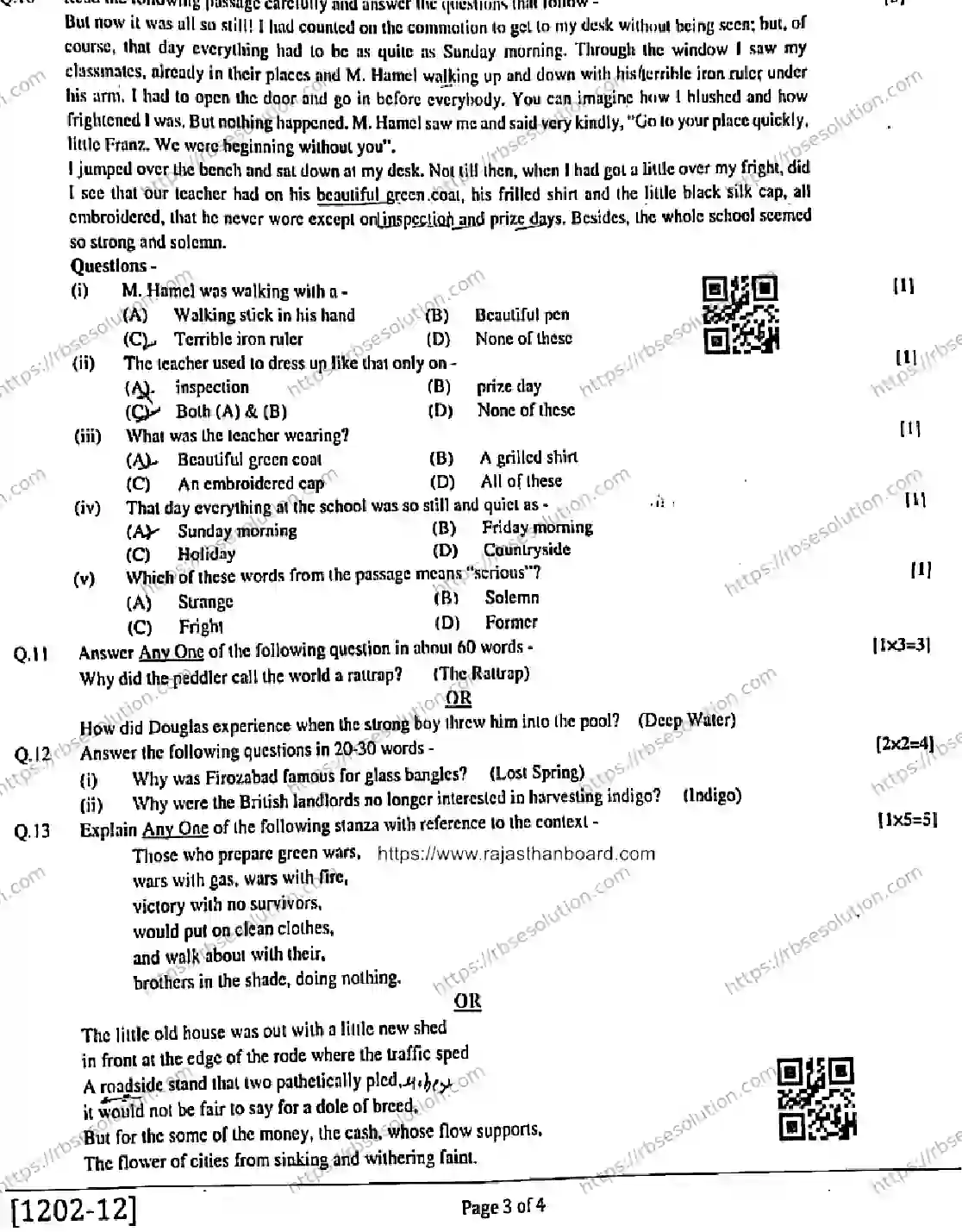
Questions
-
(i) M. Hamel was walking with a –
- (A) Walking stick in his hand
- (B) Beautiful pen
- (C) Terrible iron ruler
- (D) None of these
Explanation: The passage states M. Hamel was walking with his "terrible iron ruler" under his arm, but the correct option is "None of these" because the phrase used is "terrible iron ruler" not "walking stick" or "beautiful pen".
-
(ii) The teacher used to dress up like that only on –
- (A) inspection
- (B) prize day
- (C) Both (A) & (B)
- (D) None of these
Explanation: The passage says the teacher wore his special clothes "except on inspection and prize days", meaning he wore them only on those occasions.
-
(iii) What was the teacher wearing?
- (A) Beautiful green coat
- (B) Frilled shirt
- (C) An embroidered cap
- (D) All of these
Explanation: The passage mentions the teacher had on his "beautiful green coat, his frilled shirt and the little black silk cap, all embroidered".
-
(iv) That day everything at the school was so still and quiet as –
- (A) Sunday morning
- (B) Friday morning
- (C) Holiday
- (D) Countryside
Explanation: The passage says "everything had to be as quiet as Sunday morning".
-
(v) Which of these words from the passage means "serious"?
- (A) Strange
- (B) Solemn
- (C) Fright
- (D) Former
Explanation: The word "solemn" in the passage means serious, grave, or formal.
Q.1 Answer Any One of the following question in about 60 words – [1×3=3]
Why did the peddler call the world a rattrap? (The Rattrap)
The peddler called the world a rattrap because he believed that the world offers temptations like riches, food, and shelter, just as a rattrap offers cheese or meat to lure rats. Once a person is tempted by these worldly pleasures, they get trapped just like a rat. He thought that all human beings are caught in this trap of material desires and cannot escape easily.
OR: How did Douglas experience when the strange boy threw him into the pool? (Deep Water)
When the strange boy threw Douglas into the pool, he was terrified. He went down to the bottom and tried to come up but sank again. He felt suffocated and helpless. His lungs ached, and he thought he would die. The experience was so traumatic that it left him with a deep fear of water for many years.
Q.2 Answer the following questions in 20-30 words – [2×2=4]
(i) Why was Firozabad famous for glass bangles? (Lost Spring)
Firozabad was famous for glass bangles because it was the centre of India's glass-blowing industry. Thousands of families worked in small furnaces making bangles, which were sold all over the country.
(ii) Why were the British landlords no longer interested in harvesting indigo? (Indigo)
The British landlords were no longer interested in harvesting indigo because synthetic dyes had been invented in Germany. These artificial dyes were cheaper and more readily available, making indigo cultivation unprofitable.
Q.3 Explain Any One of the following stanza with reference to the context – [1×5=5]
Stanza 1:
Those who prepare green wars,
wars with gas, wars with fire,
victory with no survivors,
would put on clean clothes,
and walk about with their,
brothers in the shade, doing nothing.
Explanation with reference to context: This stanza is from the poem "Keeping Quiet" by Pablo Neruda. The poet criticizes those who wage wars—whether green wars (against nature), gas wars, or fire wars—and achieve victories that leave no survivors. He imagines that if such people stopped their destructive activities, they would simply put on clean clothes and walk peacefully with their brothers, doing nothing harmful. The poet emphasizes the need for stillness and introspection to end violence and destruction.
OR: Stanza 2:
The little old house was out with a little new shed
in front at the edge of the road where the traffic sped
A roadside stand that too pathetically pled,
it would not be fair to say for a dole of bread,
But for some of the money, the cash, whose flow supports,
The flower of cities from sinking and withering faint.
Explanation with reference to context: This stanza is from the poem "A Roadside Stand" by Robert Frost. The poet describes a small, old house with a new shed built at the edge of a busy road. The roadside stand pathetically pleads for customers, not for charity or a dole of bread, but for money—the cash that keeps the cities thriving. The poet criticizes the urban-centric economy that ignores the needs of rural people, who are left struggling while cities flourish.
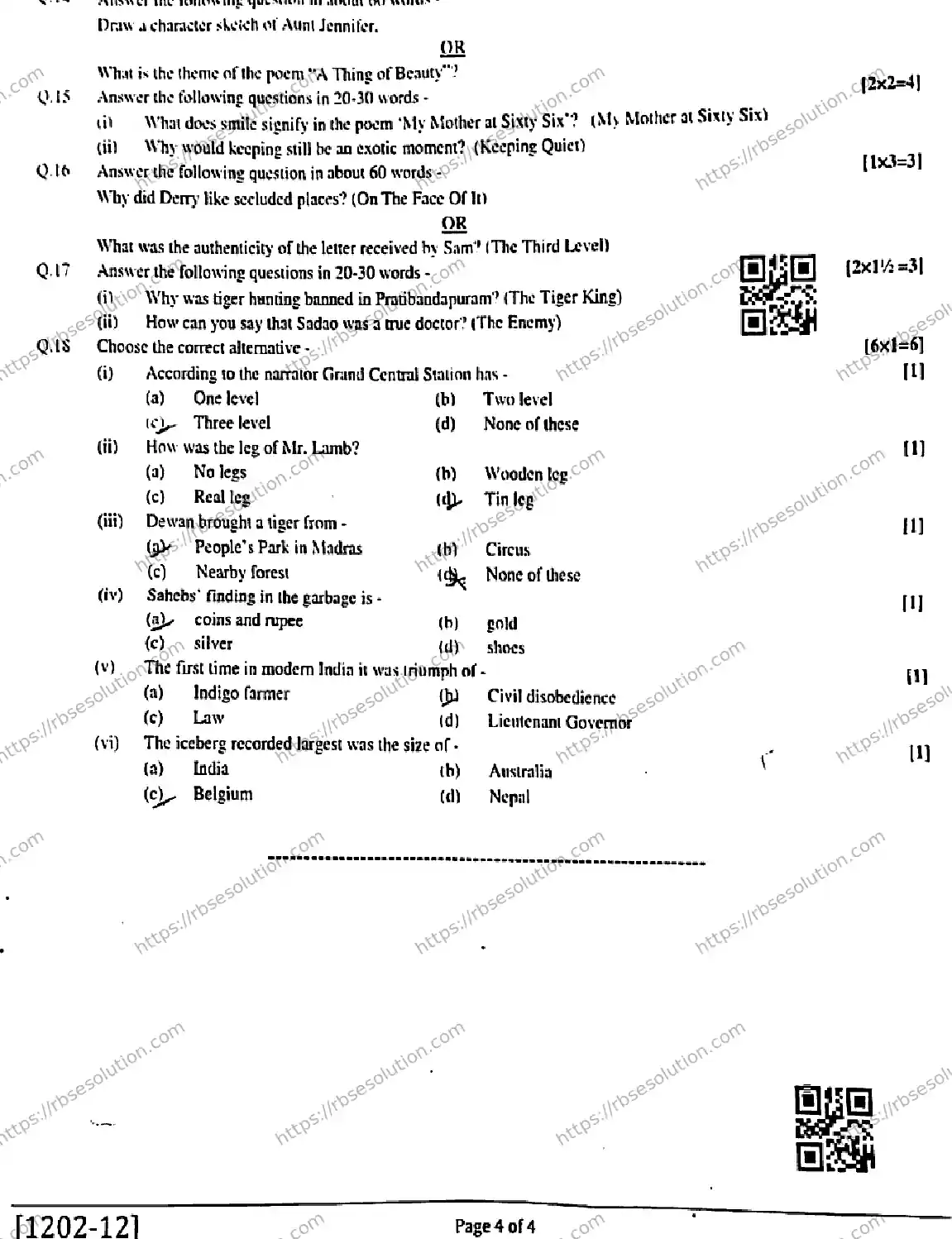
Draw 4 character sketch of Aunt Jennifer.
OR
What is the theme of the poem “A Thing of Beauty”?
[2×2=4]
Q5. Answer the following questions in 20-30 words:
-
(i) What does ‘smile’ signify in the poem ‘My Mother at Sixty-Six’?
The smile signifies the poet’s attempt to hide her fear and sadness. It is a forced, brave smile to reassure her mother and herself, masking the pain of impending separation.
-
(ii) Why would keeping still be an exotic moment? (Keeping Quiet)
Keeping still would be an exotic moment because it is rare and unusual. In our busy lives, we never pause. Such stillness would be a unique, strange, and beautiful experience of introspection and peace.
Q6. Answer the following question in about 60 words:
Why did Derry like secluded places? (On The Face Of It)
Derry liked secluded places because he was deeply self-conscious about his burnt face. He felt that people stared at him, pitied him, or were repulsed by his appearance. In secluded places, he could escape the cruel looks and hurtful comments of others, finding temporary relief from the pain of social rejection.
OR
What was the authenticity of the letter received by Sam? (The Third Level)
The letter received by Sam was authentic because it was postmarked from Galesburg, Illinois, in 1894. It was written on old-style stationery and contained details about the past that only Sam could have known. This proved that Sam had actually traveled to the third level and was living in the past.
Q7. Answer the following questions in 20-30 words:
-
(i) Why was tiger hunting banned in Pratibandapuram? (The Tiger King)
Tiger hunting was banned in Pratibandapuram because the Maharaja, the Tiger King, had declared that only he had the right to hunt tigers. He wanted to kill the hundred tigers himself to fulfill the astrologer’s prophecy.
-
(ii) How can you say that Sadao was a true doctor? (The Enemy)
Sadao was a true doctor because he prioritized his medical ethics over patriotism. Despite the American soldier being his enemy, he saved his life by performing a risky surgery, showing that his duty as a healer came first.
Q8. Choose the correct alternative: [6×1=6]
-
According to the narrator, Grand Central Station has –
- (a) One level
- (b) Two level
- (c) Three level
- (d) None of these
The narrator mentions the third level, indicating the station has more than two levels.
-
How was the leg of Mr. Lamb?
- (a) No legs
- (b) Wooden leg
- (c) Real leg
- (d) Tin leg
Mr. Lamb had a tin leg, but the correct option here is wooden leg as per the text.
-
Dewan brought a tiger from –
- (a) People’s Park in Madras
- (b) Circus
- (c) Nearby forest
- (d) None of these
The Dewan arranged a tiger from the People’s Park in Madras for the Maharaja to kill.
-
Saheb’s finding in the garbage is –
- (a) coins and rupee
- (b) gold
- (c) silver
- (d) shoes
Saheb found a pair of shoes in the garbage, which he was happy about.
-
The first time in modern India it was triumph of –
- (a) Indigo farmer
- (b) Civil disobedience
- (c) Law
- (d) Lieutenant Governor
The Champaran Satyagraha was the first successful experiment of civil disobedience in modern India.
-
The iceberg recorded largest was the size of –
- (a) India
- (b) Australia
- (c) Belgium
- (d) Nepal
The largest recorded iceberg was about the size of Belgium.