
RBSE Class 12th 2026 HALF-YEARLY-ENGLISH-LITERATURE-1214-041225 Previous Year Papers
HALF-YEARLY-ENGLISH-LITERATURE-1214-041225 from the 2026 exam year is part of the Class 12th previous year papers archive on RBSE Solution. Many learners start here after finishing the textbook to see how questions were actually framed on the Rajasthan Board of Secondary Education (RBSE) paper.
Treat this question paper as a mock under gentle timing first, then as a marking exercise the second time. The introduction on this page is written only for this subject-and-year pair, not copied from other pages.
Bookmark the link if you coach juniors — the layout stays stable for search engines and classroom sharing.
Paper details
Quick reference for this previous year papers page — confirm board, class, and year & subject before you study.
| Board | RBSE |
|---|---|
| Class | Class 12th |
| Exam year | 2026 |
| Subject | HALF-YEARLY-ENGLISH-LITERATURE-1214-041225 |
| Resource type | Previous Year Papers |
| Category | RBSE Previous Year Question Papers |
| Website | RBSE Solution |
The table summarises this Previous Year Papers resource. Confirm RBSE, Class 12th, year 2026, and subject HALF-YEARLY-ENGLISH-LITERATURE-1214-041225 before studying.
RBSE Solution organises previous year papers so each URL carries chapter-specific guidance — better for students and for search engines than one generic paragraph for the whole class.
Turning 2026 papers into insight
One HALF-YEARLY-ENGLISH-LITERATURE-1214-041225 paper reveals style; several from the same year reveal pattern. After this page, open sibling subjects listed below to see whether marks cluster in certain units.
Keep rough work dated in your notebook. Examiners in Class 12th expect clear numbering even in practice sessions.
RBSE Class 12th 2026 HALF-YEARLY-ENGLISH-LITERATURE-1214-041225
Scroll through the Previous Year Papers pages for HALF-YEARLY-ENGLISH-LITERATURE-1214-041225 (2026).
Rajasthan Board Class 12th HALF-YEARLY-ENGLISH-LITERATURE-1214-041225 2026 solved Previous Year Question Papers
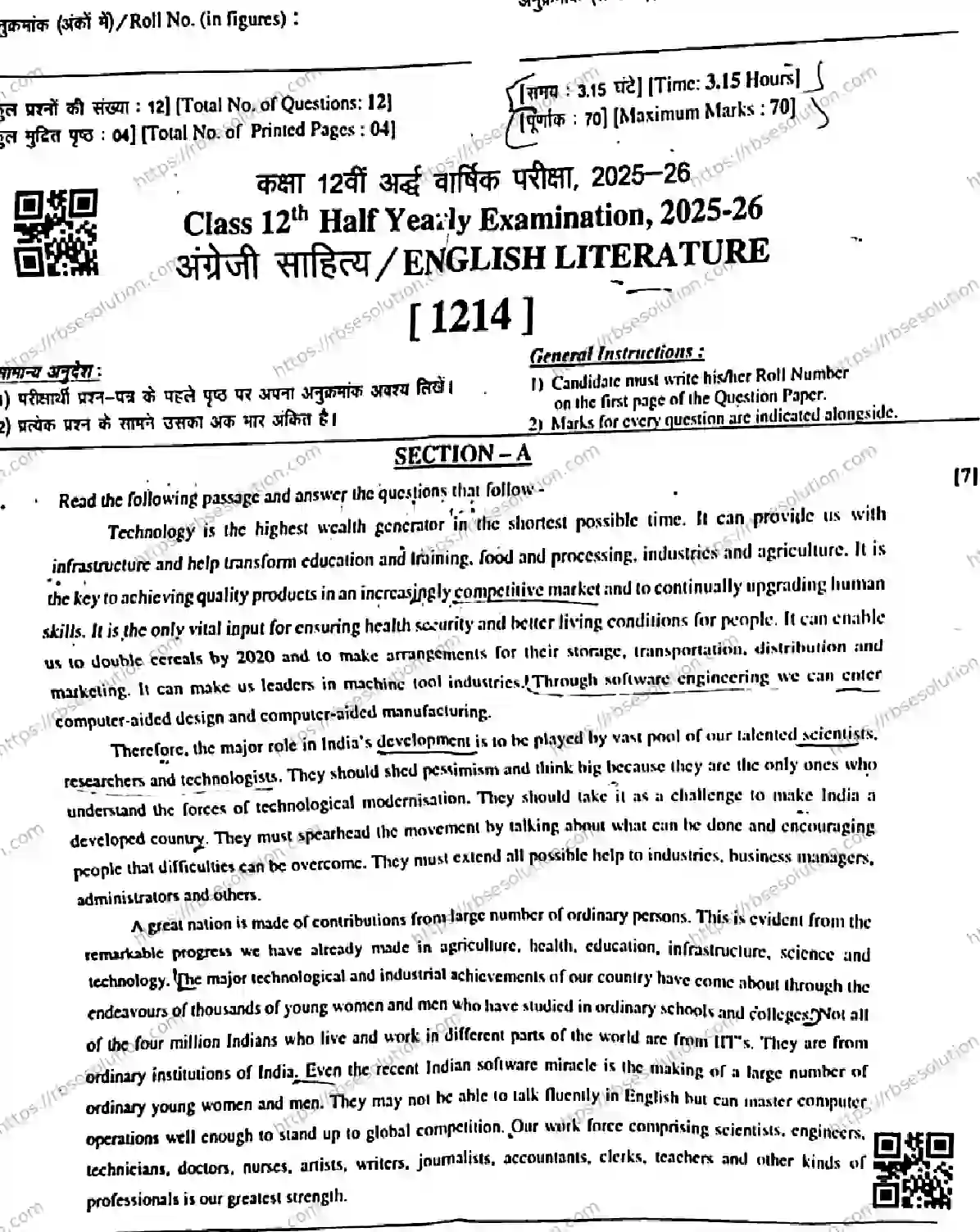
कक्षा 12वीं अर्द्ध वार्षिक परीक्षा, 2025-26
Class 12th Half Yearly Examination, 2025-26
अंग्रेजी साहित्य / ENGLISH LITERATURE
[1214]
सामान्य निर्देश / General Instructions:
- परीक्षार्थी प्रश्न-पत्र के पहले पृष्ठ पर अपना अनुक्रमांक अवश्य लिखें। / Candidate must write his/her Roll Number on the first page of the Question Paper.
- प्रत्येक प्रश्न के सामने उसका अंक भार अंकित है। / Marks for every question are indicated alongside.
SECTION-A
Read the following passage and answer the questions that follow:
Technology is the highest wealth generator in the shortest possible time. It can provide us with infrastructure and help transform education and training, food processing, industries and agriculture. It is the key to achieving quality products in an increasingly competitive market and to continually upgrading human skills. It is the only vital input for ensuring health security and better living conditions for people. It can enable us to double cereals by 2020 and to make arrangements for their storage, transportation, distribution and marketing. It can make us leaders in machine tool industries. Through software engineering we can computer-aided design and computer-aided manufacturing.
Therefore, the major role in India's development is to be played by the vast pool of our talented scientists, researchers and technologists. They should shed pessimism and think big because they are the only ones who understand the forces of technological modernization. They should take it as a challenge to make India a developed country. They must spearhead the movement by talking about what can be done and encouraging people that difficulties can be overcome. They must extend all possible help to industries, business managers, administrators and others.
A great nation is made of contributions from a large number of ordinary persons. This is evident from the remarkable progress we have already made in agriculture, health, education, science and technology. The major technological and industrial achievements of our country have come about through the endeavours of thousands of young women and men who have studied in ordinary schools and colleges. Not all of the four million Indians who live and work in different parts of the world are from IITs, IIMs, etc. They are from ordinary institutions of India. Even the recent Indian software miracle is the making of a large number of ordinary young women and men. They may not be able to talk fluently in English but can master computer operations well enough to stand up to global competition. Our work force comprising scientists, engineers, technicians, doctors, nurses, artists, writers, journalists, accountants, clerks, teachers and other kinds of professionals is our greatest strength.
Section A: Reading Comprehension
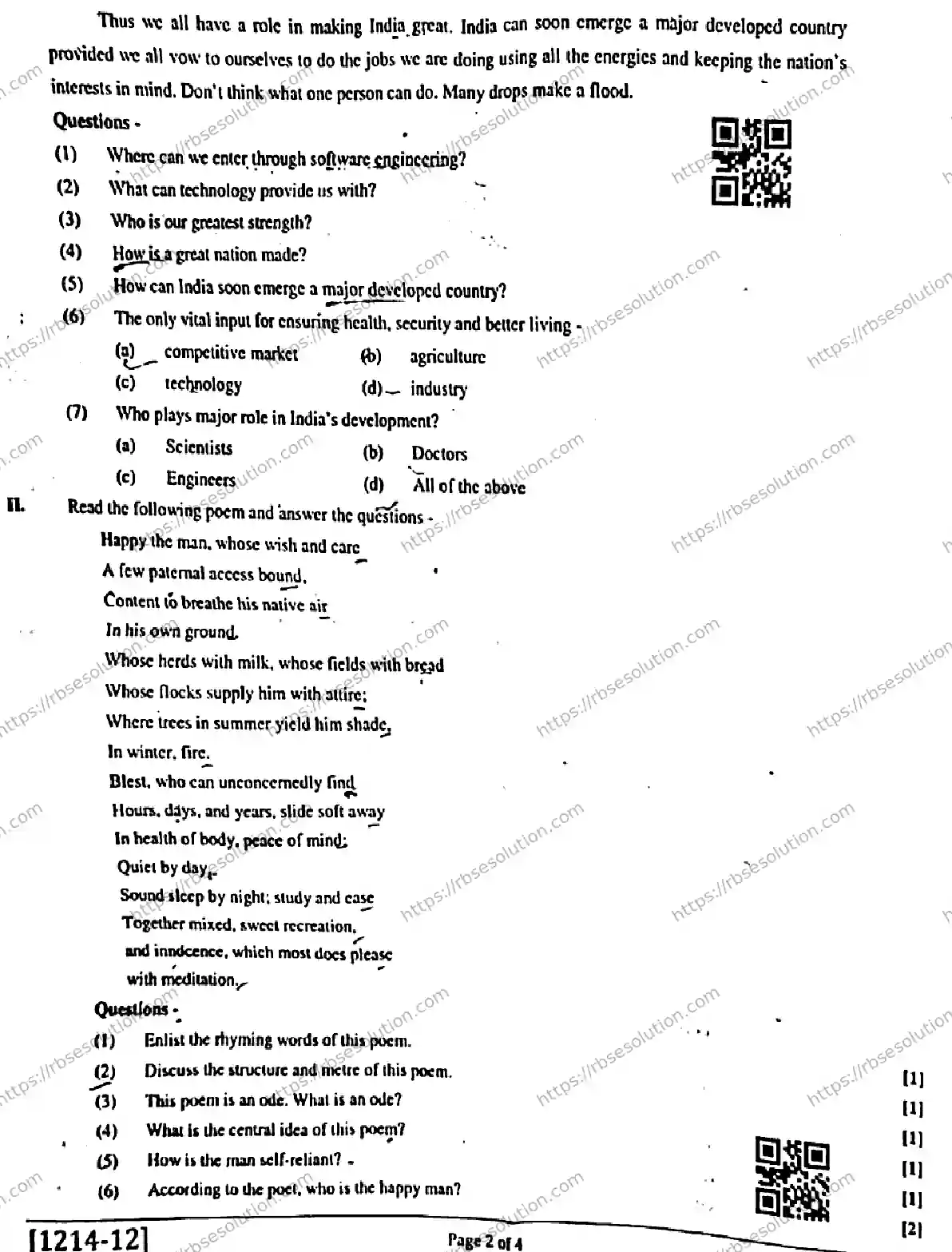
Thus we all have a role in making India great. India can soon emerge as a major developed country, provided we all vow to ourselves to do the jobs we are doing using all the energies and keeping the nation's interests in mind. Don't think, what one person can do. Many drops make a flood.
Questions
-
Where can we enter through software engineering?
Through software engineering, we can enter the global digital economy and contribute to India's technological growth.
-
What can technology provide us with?
Technology can provide us with tools for efficiency, innovation, and solutions to everyday problems, helping improve quality of life and national progress.
-
Who is our greatest strength?
Our greatest strength is our people—their skills, dedication, and collective effort.
-
How is a great nation made?
A great nation is made by the combined efforts of every citizen, each doing their job with full energy and keeping the nation's interests in mind.
-
How can India soon emerge as a major developed country?
India can soon emerge as a major developed country if every individual vows to perform their duties with full energy and always prioritizes the nation's interests.
-
The only vital input for ensuring health, security and better living is:
- competitive market
- agriculture
- technology
- industry
Technology is the vital input that drives health, security, and better living standards.
-
Who plays a major role in India's development?
- Scientists
- Doctors
- Engineers
- All of the above
Scientists, doctors, and engineers all contribute significantly to India's development.
Section B: Poetry
Read the following poem and answer the questions:
Happy the man, whose wish and care
A few paternal acres bound,
Content to breathe his native air
In his own ground.Whose herds with milk, whose fields with bread,
Whose flocks supply him with attire;
Whose trees in summer yield him shade,
In winter, fire.Blest, who can unconcernedly find
Hours, days, and years slide soft away
In health of body, peace of mind:
Quiet by day;Sound sleep by night; study and ease
Together mixed, sweet recreation,
And innocence, which most does please
With meditation.
Questions
-
Enlist the rhyming words of this poem.
The rhyming words are: care/air, bound/ground, bread/shade, attire/fire, find/mind, away/day, ease/please, recreation/meditation.
-
Discuss the structure and metre of this poem.
The poem consists of four stanzas, each with four lines (quatrains). The rhyme scheme is ABAB. The metre is iambic tetrameter, with alternating lines of eight and six syllables, giving a smooth, flowing rhythm suitable for reflective poetry.
-
This poem is an ode. What is an ode?
An ode is a formal, often ceremonious lyric poem that addresses and celebrates a person, place, thing, or idea. It typically has a serious tone and elaborate structure, expressing deep emotion or admiration.
-
What is the central idea of this poem?
The central idea is that true happiness lies in a simple, self-sufficient life close to nature, free from ambition and worry, enjoying health, peace of mind, and innocent pleasures.
-
How is the man self-reliant?
The man is self-reliant because his own land provides him with food (herds, fields), clothing (flocks), shelter (trees for shade and fire), and all necessities, so he depends on no one else.
-
According to the poet, who is the happy man?
According to the poet, the happy man is one who is content with his small piece of land, lives simply, enjoys health and peace of mind, and finds joy in nature and innocent activities.
SECTION – B
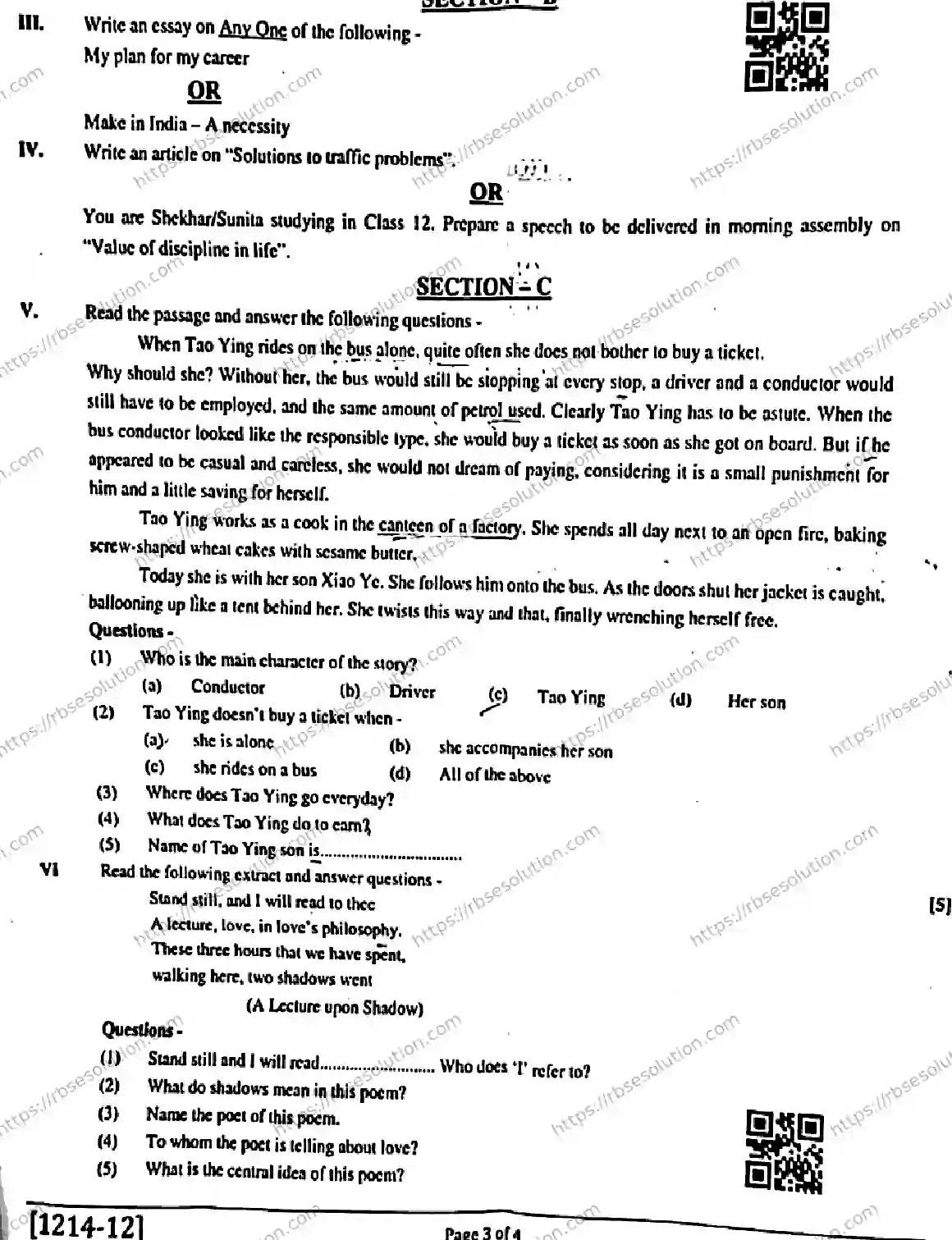
III. Write an essay on any one of the following (in about 150 words):
- My plan for my career
- Make in India – A necessity
IV. Write an article on “Solutions to traffic problems”.
OR
You are Shekhar/Sunita studying in Class 12. Prepare a speech to be delivered in morning assembly on “Value of discipline in life”.
SECTION – C
Read the passage and answer the following questions:
When Tao Ying rides on the bus alone, quite often she does not bother to buy a ticket. Why should she? Without her, the bus would still be stopping at every stop, a driver and a conductor would still have to be employed, and the same amount of petrol used. Clearly Tao Ying has to be astute. When the bus conductor looked like the responsible type, she would buy a ticket as soon as she got on board. But if he appeared to be casual and careless, she would not dream of paying, considering it is a small punishment for him and a little saving for herself.
Tao Ying works as a cook in the canteen of a factory. She spends all day next to an open fire, baking screw-shaped wheel cakes with sesame butter.
Today she is with her son Xiao Ye. She follows him onto the bus. As the doors shut her jacket is caught, ballooning up like a tent behind her. She twists this way and that, finally wrenching herself free.
-
Who is the main character of the story?
- Conductor
- Driver
- Tao Ying
- Her son
Explanation: The passage revolves around Tao Ying and her actions, making her the main character.
-
Tao Ying doesn’t buy a ticket when –
- she is alone
- she accompanies her son
- she rides on a bus
- All of the above
Explanation: The passage states she often doesn't buy a ticket when alone, and today she is with her son and still doesn't buy one, so all given situations apply.
-
Where does Tao Ying go every day?
Tao Ying goes to the canteen of a factory every day where she works as a cook.
-
What does Tao Ying do to earn a living?
Tao Ying works as a cook in the canteen of a factory, baking screw-shaped wheel cakes with sesame butter.
-
Name of Tao Ying's son.
Xiao Ye
Read the following extract and answer questions:
“Stand still, and I will read to thee
A lecture, love, in love's Philosophy.
These three hours that we have spent,
Walking here, two shadows went”
— (A Lecture upon Shadow)
-
Stand still and I will read –
The poet says, "Stand still, and I will read to thee a lecture, love, in love's Philosophy."
-
What do shadows mean in this poem?
In this poem, shadows symbolize the different phases of love and the passage of time, representing how love changes and matures.
-
Name the poet of this poem.
John Donne
-
To whom the poet is telling about love?
The poet is telling about love to his beloved (the woman he loves).
-
What is the central idea of this poem?
The central idea of the poem is that love is a philosophical journey that changes over time, just like shadows change with the position of the sun. The poet urges his beloved to understand the deeper meaning of love.
-
Who does ‘I’ refer to?
‘I’ refers to the poet, John Donne.
SECTION - D
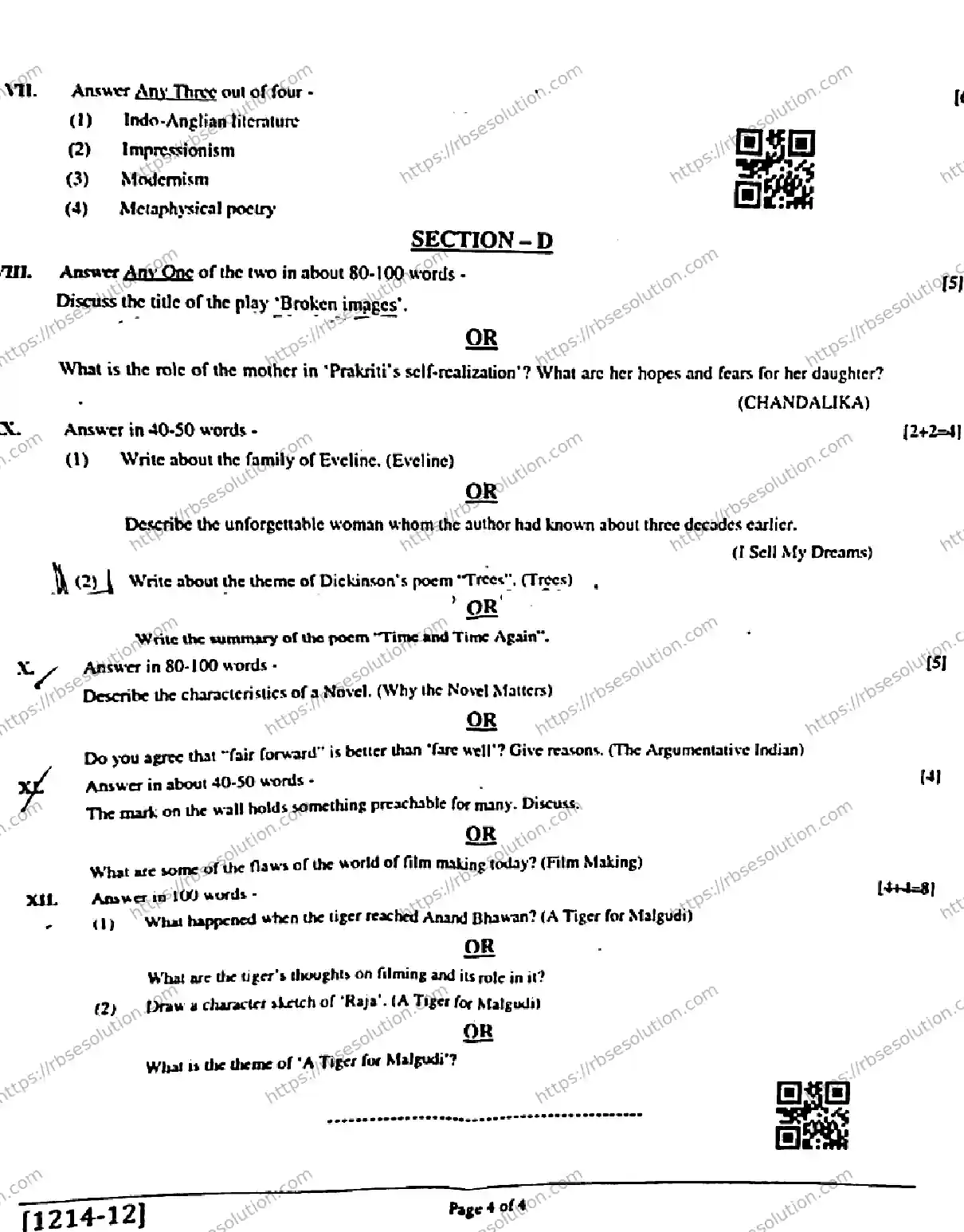
VII. Answer Any Three out of four:
- Indo-Anglian literature
- Impressionism
- Modernism
- Metaphysical poetry
Answer Any One of the two in about 80-100 words:
Discuss the title of the play “Broken Images”.
The title "Broken Images" is highly symbolic and central to the play's theme. It refers to the fragmented and distorted self-perception of the protagonist, Manjula Sharma, a successful writer. The "broken images" represent the shattered illusions of her identity, her past, and her relationships. As she interacts with her own reflection on a television screen, the images of her life—her success, her family, and her inner conflicts—are revealed as incomplete and fractured. The title thus captures the play's exploration of reality versus illusion, the duality of human nature, and the painful process of confronting one's true self, which is never whole but always in pieces.
OR
What is the role of the mother in “Prakriti's self-realization”? What are her hopes and fears for her daughter? (CHANDALIKA) [2+2=4]
In Tagore's "Chandalika", the mother plays a crucial role in Prakriti's journey of self-realization. She represents the voice of tradition, caste prejudice, and worldly wisdom. Her hopes for her daughter are rooted in a desire for social acceptance and a normal life, free from the stigma of being a "Chandal". She fears that Prakriti's attraction to the Buddhist monk Ananda will lead to heartbreak and further social ostracism. The mother's fears are practical—she knows the harsh realities of caste discrimination. However, her role is also that of a catalyst; her warnings and skepticism force Prakriti to confront her own desires and ultimately choose a path of spiritual awakening over societal norms.
X. Answer in 40-50 words:
(Q) Write about the family of Eveline. (Eveline)
Eveline's family is marked by hardship and duty. Her mother is deceased, and her father is a strict, often drunk man who controls the family finances. She has brothers and sisters, but the burden of caring for the household and her younger siblings falls on her. The family home is a place of both memory and oppression, tying her to a life of sacrifice.
OR
Describe the unforgettable woman whom the author had known about three decades earlier. (I Sell My Dreams)
The unforgettable woman is a mysterious figure who claims to sell her dreams. She is described as having a unique, almost magical quality. The author remembers her as someone who lived in a world of her own, selling dreams that were vivid and prophetic. She was a wanderer, and her ability to narrate her dreams with such clarity and conviction left a lasting impression on the author, making her unforgettable even after three decades.
(Q) Write about the theme of Dickinson's poem “Tree”. (Trees)
The theme of Emily Dickinson's poem "Tree" revolves around the idea of nature's quiet strength and resilience. The tree is portrayed as a silent observer, enduring the seasons and storms. It symbolizes steadfastness, growth, and the simple beauty of life. The poem reflects on the tree's connection to the earth and sky, highlighting themes of solitude, endurance, and the profound wisdom found in nature's stillness.
OR
Write the summary of the poem “Time and Time Again”. [5]
"Time and Time Again" is a reflective poem about the cyclical nature of life and time. The poet speaks of repeating patterns—seasons, memories, and emotions—that return again and again. It explores how the past echoes in the present, and how moments of joy and sorrow recur. The poem suggests that while time moves forward, certain experiences and feelings are eternal, returning to teach us lessons or to remind us of what we have lost or cherished.
XI. Answer in 80-100 words:
Describe the characteristics of a Novel. (Why the Novel Matters)
According to D.H. Lawrence in "Why the Novel Matters", the novel is the most vital and comprehensive form of art. Its key characteristics include its ability to present life in its entirety, capturing the complexity of human relationships and emotions. The novel is not bound by rigid rules; it flows like life itself. It deals with the whole man—mind, body, and spirit—and shows how characters change and grow. Lawrence argues that the novel is superior because it teaches us how to live, offering a pattern of life that is dynamic and alive, unlike abstract philosophies or doctrines.
OR
Do you agree that “fair forward” is better than “fare well”? Give reasons. (The Argumentative Indian) [4]
Yes, "fair forward" is better than "fare well" as argued by Amartya Sen in "The Argumentative Indian". "Fare well" implies a passive acceptance of fate or a simple goodbye, while "fair forward" suggests a proactive and just approach to progress. Sen advocates for a forward-looking perspective that emphasizes fairness, justice, and reasoned argument. "Fair forward" encourages continuous improvement and dialogue, whereas "fare well" can be static. In the context of Indian society, Sen believes that engaging in open debate and striving for a fairer future is more constructive than merely wishing well.
XII. Answer in about 40-50 words:
The mark on the wall holds something preachable for many. Discuss.
In Virginia Woolf's "The Mark on the Wall", the mark becomes a catalyst for a stream of consciousness. It is "preachable" because it triggers deep philosophical reflections on reality, perception, and the nature of knowledge. The narrator's attempt to identify the mark leads to a meditation on how we construct meaning. It teaches that even a trivial object can open doors to profound thought, challenging our assumptions about what is important.
OR
What are some of the flaws of the world of film making today? (Film Making)
Some flaws in modern filmmaking include an over-reliance on special effects at the expense of story and character development. There is also a tendency towards formulaic plots and sequels, driven by commercial interests rather than artistic vision. Additionally, the industry often lacks diversity in representation and struggles with the pressure of box office success, which can stifle creativity and lead to homogenized content.
XIII. Answer in 100 words:
(1) What happened when the tiger reached Anand Bhawan? (A Tiger for Malgudi)
When the tiger, Raja, reached Anand Bhawan, it caused chaos and panic. The tiger entered the house of the elderly couple, who were terrified. The tiger, however, was not aggressive but was confused and hungry. It roamed around the house, knocking over furniture and creating a mess. The couple hid in a room, and the tiger eventually settled in a corner. The incident drew a crowd outside, and the police were called. This event marked a turning point in the tiger's journey, leading to its capture and subsequent life in captivity.
OR
What are the tiger's thoughts on filming and its role in it?
The tiger, Raja, views filming as a confusing and unnatural experience. He is forced to perform for the camera, which he resents. He feels exploited and humiliated, as his wild nature is suppressed for human entertainment. The tiger thinks of the film crew as strange creatures who do not understand his true self. His role in the filming is that of a captive performer, and he longs for freedom. The experience deepens his sense of alienation and reinforces his desire to escape the artificial world of humans.
(2) Draw a character sketch of Raja. (A Tiger for Malgudi)
Raja is the majestic tiger who is the protagonist of the novel. He is proud, intelligent, and deeply sensitive. Initially a wild and powerful creature, he is captured and forced into a life of captivity. Raja is not merely a beast; he has a rich inner life, capable of reflection and emotion. He feels anger, fear, and a longing for freedom. His relationship with his master, the schoolmaster, shows his capacity for trust and affection. Raja's character symbolizes the conflict between nature and civilization, and his journey is one of suffering, adaptation, and ultimately, a search for dignity.
OR
What is the theme of 'A Tiger for Malgudi'?
The central theme of "A Tiger for Malgudi" is the conflict between freedom and captivity, both physical and spiritual. The novel explores the relationship between humans and animals, highlighting the cruelty and misunderstanding that often define it. It also delves into themes of identity, dignity, and the search for meaning. Through the tiger's perspective, R.K. Narayan critiques human society's arrogance and its tendency to dominate nature. The story is also about redemption and the possibility of a harmonious existence, as seen in the bond between the tiger and the schoolmaster.
— End of Page 4 —