
RBSE Class 12th 2026 HALF-YEARLY-MATHEMATICS-1204 Previous Year Papers
HALF-YEARLY-MATHEMATICS-1204 from the 2026 exam year is part of the Class 12th previous year papers archive on RBSE Solution. Many learners start here after finishing the textbook to see how questions were actually framed on the Rajasthan Board of Secondary Education (RBSE) paper.
Treat this question paper as a mock under gentle timing first, then as a marking exercise the second time. The introduction on this page is written only for this subject-and-year pair, not copied from other pages.
Bookmark the link if you coach juniors — the layout stays stable for search engines and classroom sharing.
Paper details
Quick reference for this previous year papers page — confirm board, class, and year & subject before you study.
| Board | RBSE |
|---|---|
| Class | Class 12th |
| Exam year | 2026 |
| Subject | HALF-YEARLY-MATHEMATICS-1204 |
| Resource type | Previous Year Papers |
| Category | RBSE Previous Year Question Papers |
| Website | RBSE Solution |
The table summarises this Previous Year Papers resource. Confirm RBSE, Class 12th, year 2026, and subject HALF-YEARLY-MATHEMATICS-1204 before studying.
RBSE Solution organises previous year papers so each URL carries chapter-specific guidance — better for students and for search engines than one generic paragraph for the whole class.
How to practise with this question paper
Stage one: read the HALF-YEARLY-MATHEMATICS-1204 question paper from 2026 without a timer and highlight command words — explain, prove, calculate, discuss. Stage two: attempt selected questions closed-book. Stage three: compare with solutions or teacher feedback.
Previous Year Papers work best when you log mistakes by topic, not only by question number. That log becomes your revision index before pre-boards.
RBSE Class 12th 2026 HALF-YEARLY-MATHEMATICS-1204
Scroll through the Previous Year Papers pages for HALF-YEARLY-MATHEMATICS-1204 (2026).
Rajasthan Board Class 12th HALF-YEARLY-MATHEMATICS-1204 2026 solved Previous Year Question Papers
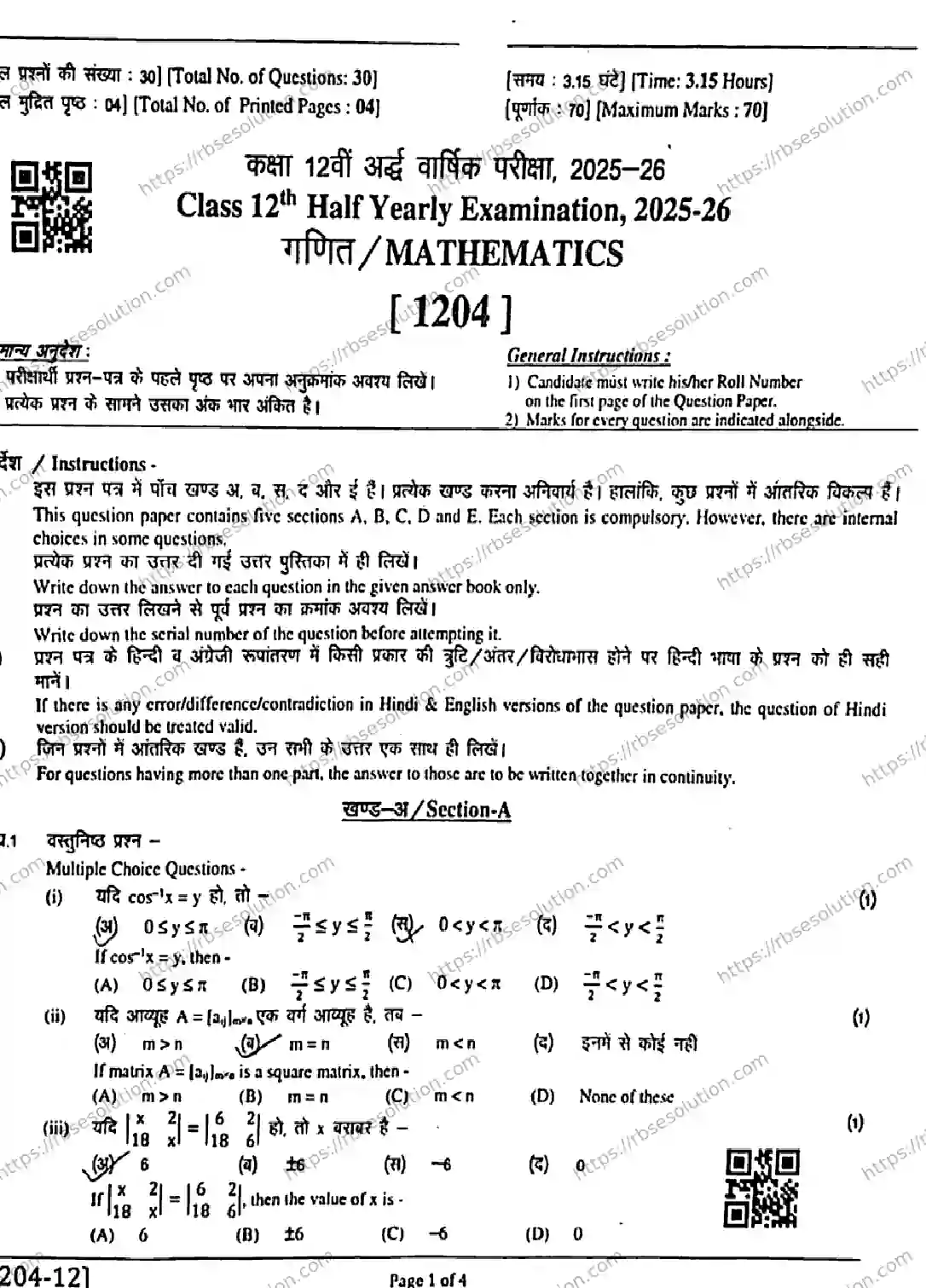
खण्ड-अ / Section-A
वस्तुनिष्ठ प्रश्न / Multiple Choice Questions
-
यदि cos⁻¹x = y हो, तो -
- (A) 0 ≤ y ≤ π
- (B) 0 ≤ y ≤ π
- (C) -π/2 ≤ y ≤ π/2
- (D) -π < y < π
सही उत्तर: (A) 0 ≤ y ≤ π
स्पष्टीकरण: cos⁻¹x का मुख्य मान शाखा [0, π] में होता है।
-
यदि आव्यूह A = [aᵢⱼ]ₘₓₙ एक वर्ग आव्यूह है, तब -
- (A) m > n
- (B) m = n
- (C) m < n
- (D) इनमें से कोई नहीं
सही उत्तर: (B) m = n
स्पष्टीकरण: वर्ग आव्यूह में पंक्तियों और स्तंभों की संख्या समान होती है, अतः m = n.
-
यदि
[x 2] = [7 -2]हो, तो x बराबर है -- (A) 6
- (B) -6
- (C) -8
- (D) 0
सही उत्तर: (A) 6
स्पष्टीकरण: आव्यूह समानता के अनुसार, संगत अवयव समान होते हैं। अतः x = 7 - 1 = 6.
खण्ड (ब) / Section (B)
-
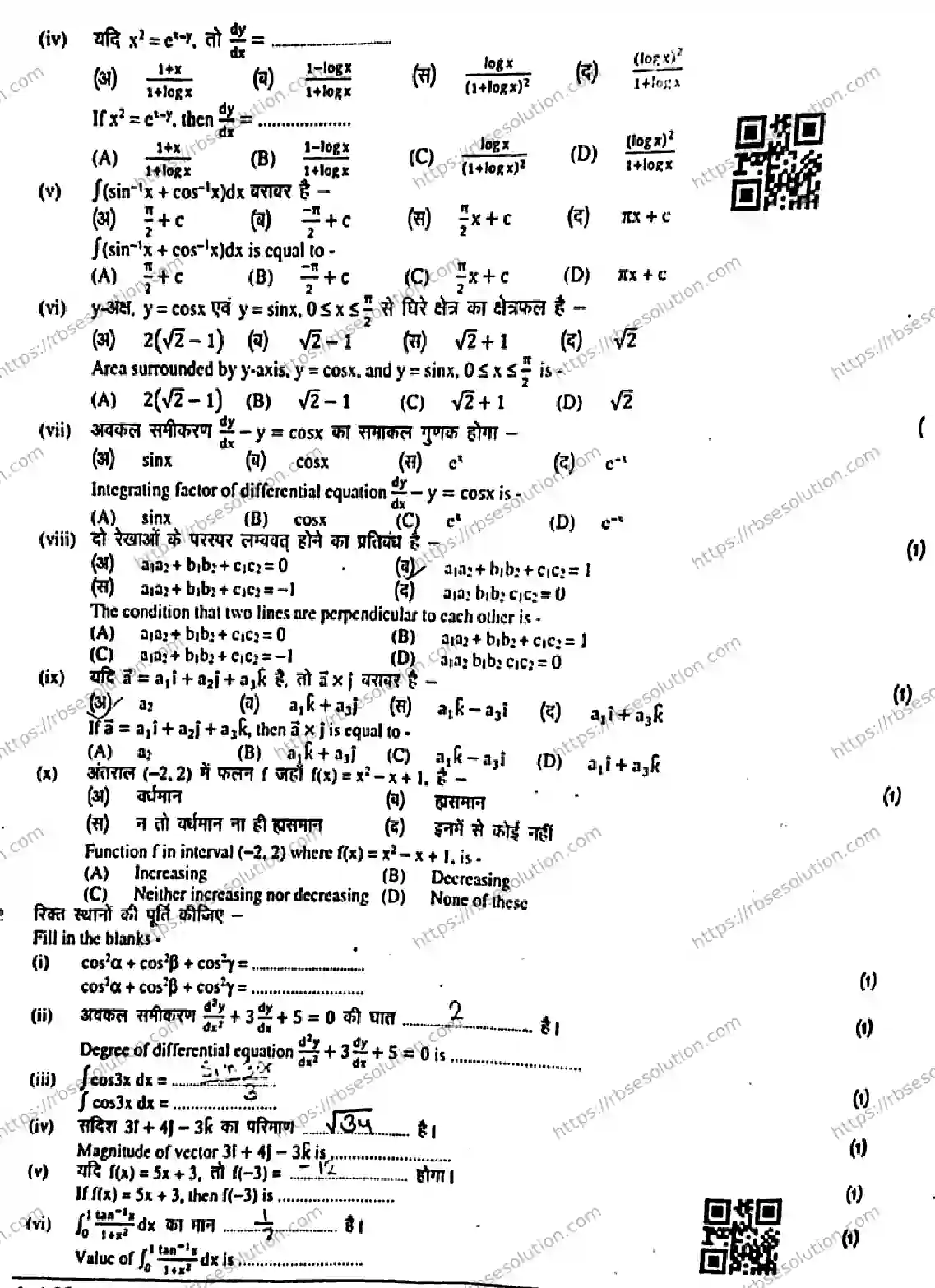
यदि \(x^y = e^{x-y}\), तो \(\frac{dy}{dx} =\)
- (A) \(\frac{\log x}{(1+\log x)^2}\)
- (B) \(\frac{1}{(1+\log x)^2}\)
- (C) \(\frac{\log x}{(1+\log x)^2}\)
- (D) \(\frac{1}{1+\log x}\)
Explanation: Taking log on both sides, \(y \log x = x - y\). Then \(y = \frac{x}{1+\log x}\). Differentiating gives \(\frac{dy}{dx} = \frac{\log x}{(1+\log x)^2}\).
-
\(\int (\sin^{-1}x + \cos^{-1}x) \, dx\) बराबर है —
- (A) \(\frac{\pi}{2}x + c\)
- (B) \(\frac{\pi}{2}x + c\)
- (C) \(\frac{\pi}{2}x + c\)
- (D) \(\frac{\pi}{2}x + c\)
Explanation: Since \(\sin^{-1}x + \cos^{-1}x = \frac{\pi}{2}\), the integral is \(\frac{\pi}{2}x + c\).
-
y-अक्ष, \(y = \cos x\) एवं \(y = \sin x\), \(0 \le x \le \frac{\pi}{2}\) से घिरे क्षेत्र का क्षेत्रफल है —
- (A) \(2(\sqrt{2} - 1)\)
- (B) \(\sqrt{2} - 1\)
- (C) \(\sqrt{2} + 1\)
- (D) \(\sqrt{2}\)
Explanation: Area = \(\int_0^{\pi/4} (\cos x - \sin x) \, dx = [\sin x + \cos x]_0^{\pi/4} = \sqrt{2} - 1\).
-
अवकल समीकरण \(\frac{dy}{dx} + y \tan x = \cos x\) का समाकल गुणक होगा —
- (A) \(\sin x\)
- (B) \(-\cos x\)
- (C) \(\sec x\)
- (D) \(e^x\)
Explanation: Integrating factor = \(e^{\int \tan x \, dx} = e^{\log \sec x} = \sec x\).
-
दो रेखाओं के परस्पर लम्बवत् होने का प्रतिबंध है —
- (A) \(a_1a_2 + b_1b_2 + c_1c_2 = 0\)
- (B) \(a_1a_2 + b_1b_2 + c_1c_2 = 1\)
- (C) \(a_1a_2 + b_1b_2 + c_1c_2 = -1\)
- (D) \(a_1a_2 + b_1b_2 + c_1c_2 = 0\)
Explanation: For perpendicular lines with direction ratios \((a_1,b_1,c_1)\) and \((a_2,b_2,c_2)\), the condition is \(a_1a_2 + b_1b_2 + c_1c_2 = 0\).
-
यदि \(\vec{a} = a_1\hat{i} + a_2\hat{j} + a_3\hat{k}\) है, तो \(\vec{a} \cdot \hat{j}\) बराबर है —
- (A) \(a_1\)
- (B) \(a_2\)
- (C) \(a_3 - a_1\)
- (D) \(a_1 + a_3\)
Explanation: \(\vec{a} \cdot \hat{j} = a_2\) because \(\hat{i}\cdot\hat{j}=0\), \(\hat{j}\cdot\hat{j}=1\), \(\hat{k}\cdot\hat{j}=0\).
-
अंतराल \((-2, 2)\) में फलन \(f(x) = x^2 - x + 1\) है —
- (A) वर्धमान (Increasing)
- (B) हासमान (Decreasing)
- (C) न तो वर्धमान न ही हासमान (Neither increasing nor decreasing)
- (D) इनमें से कोई नहीं (None of these)
Explanation: \(f'(x) = 2x - 1\). In \((-2,2)\), \(f'(x) > 0\) for \(x > 0.5\) and \(f'(x) < 0\) for \(x < 0.5\), so it is neither purely increasing nor decreasing.
रिक्त स्थानों की पूर्ति कीजिए / Fill in the blanks
-
\(\cos^2\alpha + \cos^2\beta + \cos^2\gamma =\) 1
Solution: For direction cosines, \(\cos^2\alpha + \cos^2\beta + \cos^2\gamma = 1\). -
अवकल समीकरण \(\frac{d^2y}{dx^2} + 3\frac{dy}{dx} + 5 = 0\) की घात 1 है।
Solution: The highest order derivative is \(\frac{d^2y}{dx^2}\) with power 1, so degree is 1. -
\(\int \cos 3x \, dx =\) \(\frac{1}{3}\sin 3x + c\)
Solution: \(\int \cos 3x \, dx = \frac{1}{3}\sin 3x + c\). -
सदिश \(3\hat{i} + 4\hat{j} - 3\hat{k}\) का परिमाण \(\sqrt{34}\) है।
Solution: Magnitude = \(\sqrt{3^2 + 4^2 + (-3)^2} = \sqrt{9+16+9} = \sqrt{34}\). -
यदि \(f(x) = 5x + 3\), तो \(f(-3) =\) -12
Solution: \(f(-3) = 5(-3) + 3 = -15 + 3 = -12\). -
\(\frac{d}{dx} \tan^{-1} \left(\frac{y}{x}\right)\) का मान \(\frac{x\frac{dy}{dx} - y}{x^2 + y^2}\) होगा।
Solution: \(\frac{d}{dx} \tan^{-1}\left(\frac{y}{x}\right) = \frac{1}{1+(y/x)^2} \cdot \frac{x\frac{dy}{dx} - y}{x^2} = \frac{x\frac{dy}{dx} - y}{x^2 + y^2}\).
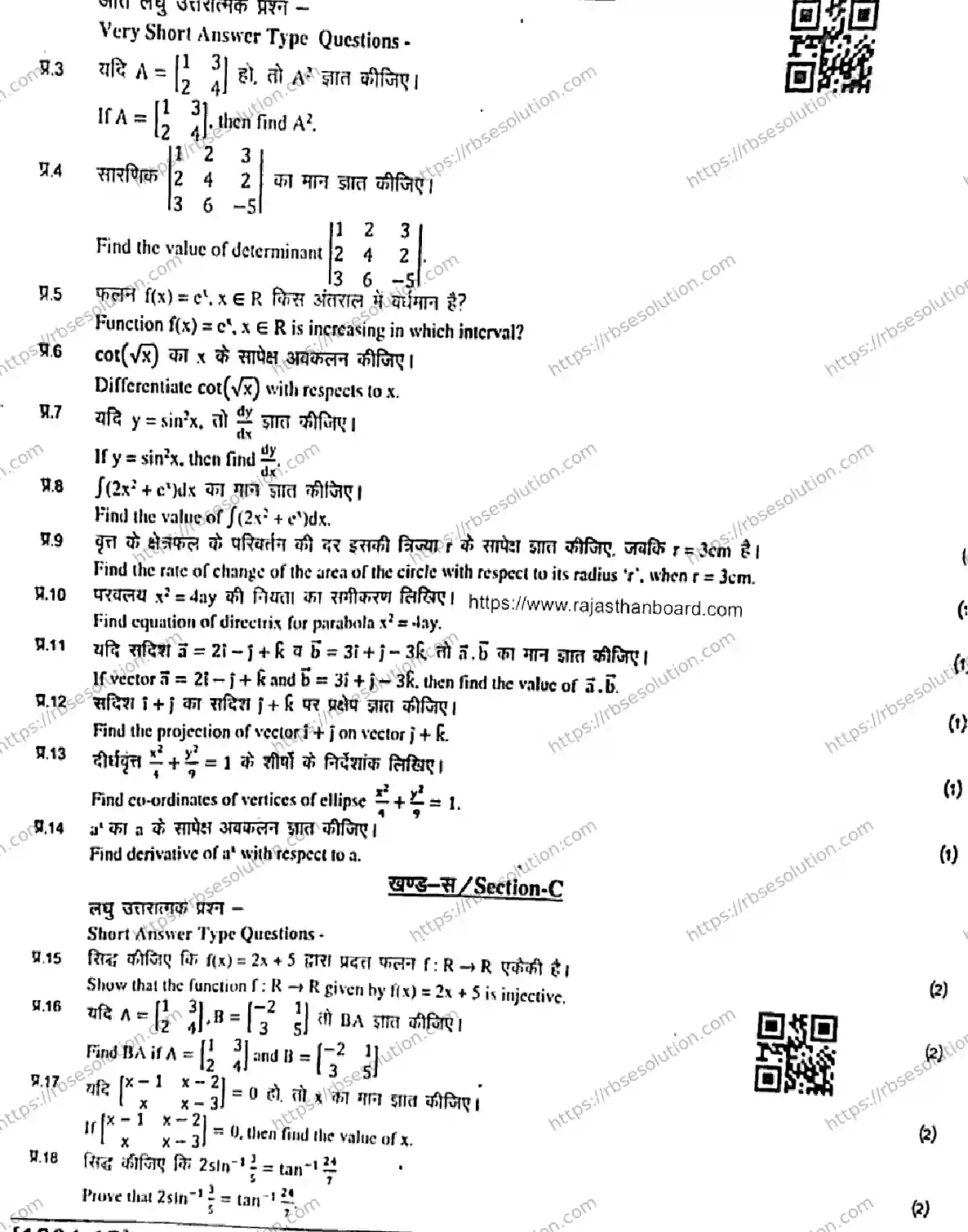
Very Short Answer Type Questions
-
यदि A = [3 5; 2 1] हो, तो A⁻¹ ज्ञात कीजिए।
If A = [3 5; 2 1], then find A⁻¹.दिया है: A = [3 5; 2 1]
|A| = (3×1) - (5×2) = 3 - 10 = -7
adj A = [1 -5; -2 3]
A⁻¹ = adj A / |A| = [1 -5; -2 3] / (-7) = [-1/7 5/7; 2/7 -3/7]
-
सारणिक |2 3; 2 4; 3 6 -5| का मान ज्ञात कीजिए।
Find the value of determinant |2 3; 2 4; 3 6 -5|.सारणिक = 2(4×(-5) - 2×6) - 3(2×(-5) - 2×3) + 0(2×6 - 4×3)
= 2(-20 - 12) - 3(-10 - 6) + 0
= 2(-32) - 3(-16)
= -64 + 48 = -16
-
फलन f(x) = cos x, x ∈ R किस अंतराल में वर्धमान है?
Function f(x) = cos x, x ∈ R is increasing in which interval?f'(x) = -sin x
f(x) वर्धमान होगा जब f'(x) > 0, अर्थात -sin x > 0 या sin x < 0
sin x < 0 अंतराल (π, 2π) में होता है।
अतः f(x) = cos x अंतराल (π, 2π) में वर्धमान है।
-
cos(√x) का x के सापेक्ष अवकलन कीजिए।
Differentiate cos(√x) with respect to x.माना y = cos(√x)
dy/dx = -sin(√x) × d(√x)/dx
= -sin(√x) × (1/(2√x))
= -sin(√x) / (2√x)
-
यदि y = sin²x, तो dy/dx ज्ञात कीजिए।
If y = sin²x, then find dy/dx.y = sin²x
dy/dx = 2 sin x × cos x
= sin 2x
-
∫(2x² + eˣ) dx का मान ज्ञात कीजिए।
Find the value of ∫(2x² + eˣ) dx.∫(2x² + eˣ) dx = 2∫x² dx + ∫eˣ dx
= 2(x³/3) + eˣ + C
= (2x³/3) + eˣ + C
-
वृत्त के क्षेत्रफल के परिवर्तन की दर इसकी त्रिज्या के सापेक्ष ज्ञात कीजिए, जबकि r = 3 cm है।
Find the rate of change of the area of the circle with respect to its radius r, when r = 3 cm.वृत्त का क्षेत्रफल A = πr²
dA/dr = 2πr
जब r = 3 cm, dA/dr = 2π(3) = 6π cm²/cm
-
परवलय x² = 4ay की नियता का समीकरण लिखिए।
Find equation of directrix for parabola x² = 4ay.परवलय x² = 4ay के लिए, नियता का समीकरण y = -a है।
-
यदि सदिश a = 2i - j + k और b = 3i + j - 3k, तो a·b का मान ज्ञात कीजिए।
If vector a = 2i - j + k and b = 3i + j - 3k, then find the value of a·b.a·b = (2)(3) + (-1)(1) + (1)(-3)
= 6 - 1 - 3 = 2
-
सदिश i + j का सदिश i + k पर प्रक्षेप ज्ञात कीजिए।
Find the projection of vector i + j on vector i + k.प्रक्षेप = |(i+j)·(i+k)| / |i+k|
= |1(1) + 1(0) + 0(1)| / √(1²+0²+1²)
= 1 / √2
-
दीर्घवृत्त x²/16 + y²/9 = 1 के शीर्षों के निर्देशांक लिखिए।
Find co-ordinates of vertices of ellipse x²/16 + y²/9 = 1.दीर्घवृत्त x²/16 + y²/9 = 1 में, a² = 16, b² = 9
a = 4, b = 3
शीर्षों के निर्देशांक: (±4, 0) = (4, 0) और (-4, 0)
-
aˣ का x के सापेक्ष अवकलन ज्ञात कीजिए।
Find derivative of aˣ with respect to x.d(aˣ)/dx = aˣ ln a
Section-C / खण्ड-सी
लघु उत्तरीय प्रश्न - Short Answer Type Questions
-
सिद्ध कीजिए कि f(x) = 2x + 5 द्वारा प्रदत्त फलन f : R → R एकैकी है।
Show that the function f : R → R given by f(x) = 2x + 5 is injective.माना f(x₁) = f(x₂)
⇒ 2x₁ + 5 = 2x₂ + 5
⇒ 2x₁ = 2x₂
⇒ x₁ = x₂
अतः f एकैकी (injective) फलन है।
-
यदि A = [3 1; 5 7] और B = [1 3; 2 4], तो BA ज्ञात कीजिए।
Find BA if A = [3 1; 5 7] and B = [1 3; 2 4].BA = [1 3; 2 4] × [3 1; 5 7]
= [(1×3+3×5) (1×1+3×7); (2×3+4×5) (2×1+4×7)]
= [(3+15) (1+21); (6+20) (2+28)]
= [18 22; 26 30]
-
यदि [x 2; 3 x] - [x 4; 0 x-2] = [4 2; 3 3], तो x का मान ज्ञात कीजिए।
If [x 2; 3 x] - [x 4; 0 x-2] = [4 2; 3 3], then find the value of x.[x 2; 3 x] - [x 4; 0 x-2] = [x-x 2-4; 3-0 x-(x-2)]
= [0 -2; 3 2]
दिया है: [0 -2; 3 2] = [4 2; 3 3]
यह संभव नहीं है क्योंकि संगत अवयव समान नहीं हैं।
प्रश्न में त्रुटि प्रतीत होती है।
-
सिद्ध कीजिए कि 2 sin⁻¹(3/5) = tan⁻¹(24/7)
Prove that 2 sin⁻¹(3/5) = tan⁻¹(24/7)माना sin⁻¹(3/5) = θ, तो sin θ = 3/5
cos θ = √(1 - 9/25) = √(16/25) = 4/5
tan θ = sin θ/cos θ = (3/5)/(4/5) = 3/4
अब, 2 sin⁻¹(3/5) = 2θ
tan 2θ = 2 tan θ / (1 - tan²θ)
= 2(3/4) / (1 - 9/16)
= (3/2) / (7/16)
= (3/2) × (16/7) = 24/7
अतः 2θ = tan⁻¹(24/7)
⇒ 2 sin⁻¹(3/5) = tan⁻¹(24/7)
खण्ड-सी / Section-C
प्र.22
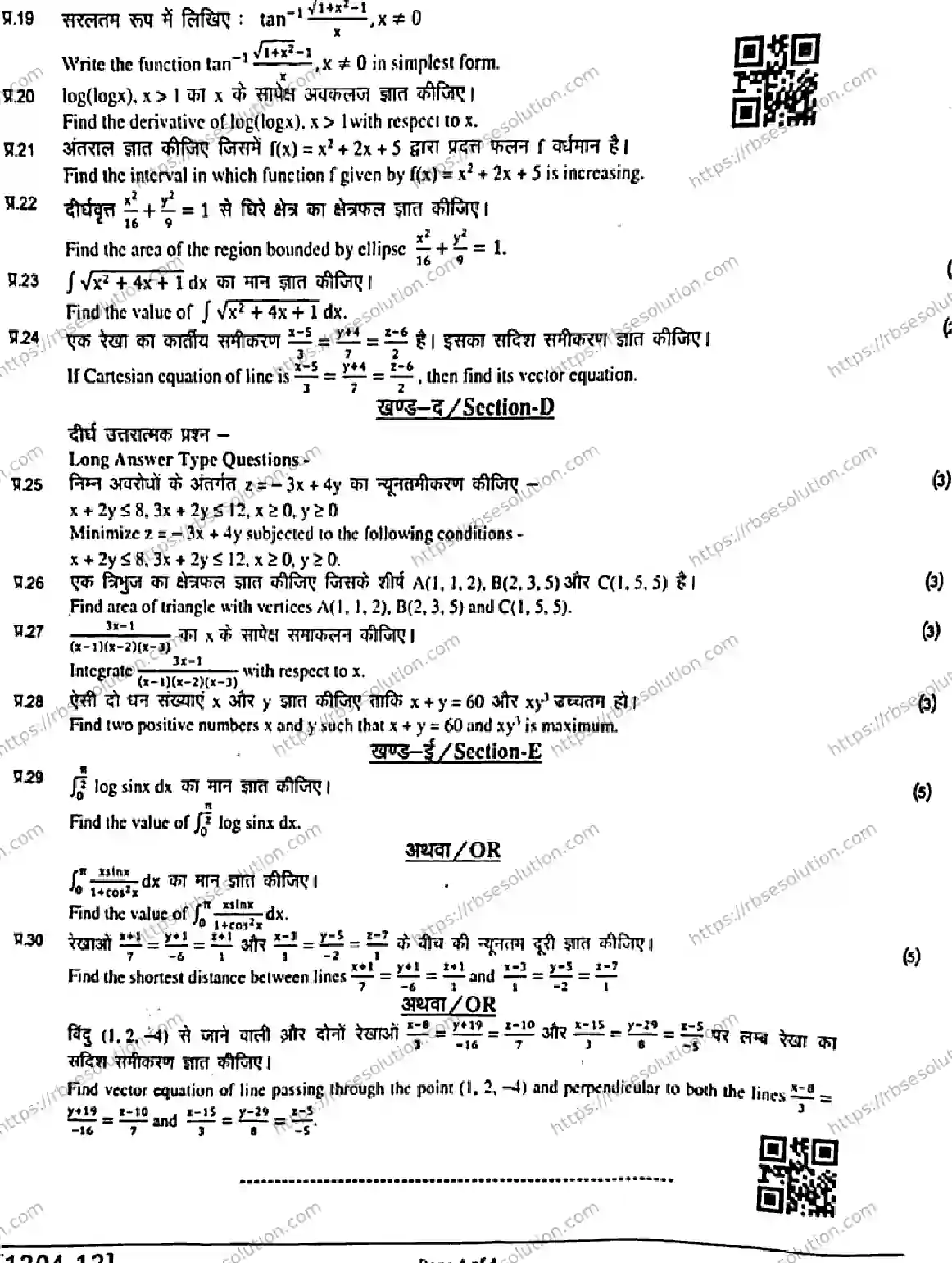
सरलतम रूप में लिखिए: tan⁻¹(√(1+x²) - 1)/x, x ≠ 0
Write the function tan⁻¹(√(1+x²) - 1)/x, x ≠ 0 in simplest form.
हल / Solution:
माना x = tan θ, तब θ = tan⁻¹ x
tan⁻¹(√(1+tan²θ) - 1)/tan θ = tan⁻¹(sec θ - 1)/tan θ
= tan⁻¹((1/cos θ - 1) / (sin θ/cos θ)) = tan⁻¹((1 - cos θ)/sin θ)
= tan⁻¹(2 sin²(θ/2) / (2 sin(θ/2) cos(θ/2))) = tan⁻¹(tan(θ/2))
= θ/2 = (1/2) tan⁻¹ x
अतः सरलतम रूप: (1/2) tan⁻¹ x
प्र.23
log(log x), x > 1 का x के सापेक्ष अवकलज ज्ञात कीजिए।
Find the derivative of log(log x), x > 1 with respect to x.
हल / Solution:
माना y = log(log x)
dy/dx = (1/log x) × (1/x) = 1/(x log x)
अतः अवकलज = 1/(x log x)
प्र.24
अंतराल ज्ञात कीजिए जिसमें f(x) = x² + 2x + 5 द्वारा प्रदत्त फलन f वर्धमान है।
Find the interval in which function f given by f(x) = x² + 2x + 5 is increasing.
हल / Solution:
f'(x) = 2x + 2 = 2(x + 1)
f वर्धमान होगा यदि f'(x) ≥ 0
⇒ 2(x + 1) ≥ 0 ⇒ x + 1 ≥ 0 ⇒ x ≥ -1
अतः फलन अंतराल [-1, ∞) में वर्धमान है।
प्र.25
दीर्घवृत्त x²/a² + y²/b² = 1 से घिरे क्षेत्र का क्षेत्रफल ज्ञात कीजिए।
Find the area of the region bounded by ellipse x²/a² + y²/b² = 1.
हल / Solution:
दीर्घवृत्त का क्षेत्रफल = πab वर्ग इकाई
क्योंकि दीर्घवृत्त x-अक्ष और y-अक्ष के सममित है, अतः कुल क्षेत्रफल = 4 × प्रथम चतुर्थांश का क्षेत्रफल
अतः अभीष्ट क्षेत्रफल = πab वर्ग इकाई
प्र.26
∫₀^π/2 sin x dx का मान ज्ञात कीजिए।
Find the value of ∫₀^π/2 sin x dx.
हल / Solution:
∫₀^π/2 sin x dx = [-cos x]₀^π/2
= -cos(π/2) - (-cos 0) = -0 + 1 = 1
अतः मान = 1
प्र.27
एक रेखा का कार्तीय समीकरण (x-5)/3 = (y+4)/7 = (z-6)/2 है। इसका सदिश समीकरण ज्ञात कीजिए।
If Cartesian equation of line is (x-5)/3 = (y+4)/7 = (z-6)/2, find its vector equation.
हल / Solution:
रेखा बिंदु (5, -4, 6) से होकर जाती है और दिक्-अनुपात 3, 7, 2 हैं।
सदिश समीकरण: r = (5i - 4j + 6k) + λ(3i + 7j + 2k)
खण्ड-डी / Section-D
दीर्घ उत्तरात्मक प्रश्न - Long Answer Type Questions
प्र.28
निम्न अवरोधों के अंतर्गत z = 3x + 4y का न्यूनतमीकरण कीजिए —
x + 2y ≤ 8, 3x + 2y ≤ 12, x ≥ 0, y ≥ 0
Minimize z = 3x + 4y subjected to the following conditions —
x + 2y ≤ 8, 3x + 2y ≤ 12, x ≥ 0, y ≥ 0.
हल / Solution:
चरण 1: अवरोधों को समीकरणों में बदलें:
x + 2y = 8 ⇒ y = (8-x)/2
3x + 2y = 12 ⇒ y = (12-3x)/2
चरण 2: सुसंगत क्षेत्र के कोणीय बिंदु ज्ञात करें:
प्रतिच्छेदन बिंदु: x + 2y = 8 और 3x + 2y = 12 को हल करने पर:
घटाने पर: 2x = 4 ⇒ x = 2, तब y = 3
कोणीय बिंदु: O(0,0), A(4,0), B(2,3), C(0,4)
चरण 3: प्रत्येक कोणीय बिंदु पर z का मान:
O(0,0): z = 0
A(4,0): z = 12
B(2,3): z = 6 + 12 = 18
C(0,4): z = 16
चरण 4: न्यूनतम मान = 0, बिंदु (0,0) पर
अतः z का न्यूनतम मान 0 है।
प्र.29
एक त्रिभुज का क्षेत्रफल ज्ञात कीजिए जिसके शीर्ष A(1, 2, 2), B(2, 3, 5) और C(1, 5, 5) हैं।
Find area of triangle with vertices A(1, 2, 2), B(2, 3, 5) and C(1, 5, 5).
हल / Solution:
AB = (2-1)i + (3-2)j + (5-2)k = i + j + 3k
AC = (1-1)i + (5-2)j + (5-2)k = 0i + 3j + 3k
AB × AC = |i j k|
|1 1 3|
|0 3 3|
= i(3-9) - j(3-0) + k(3-0)
= -6i - 3j + 3k
|AB × AC| = √(36 + 9 + 9) = √54 = 3√6
त्रिभुज का क्षेत्रफल = (1/2)|AB × AC| = (1/2) × 3√6 = (3√6)/2 वर्ग इकाई
अतः क्षेत्रफल = (3√6)/2 वर्ग इकाई
प्र.30
∫ dx/(x² - 1) का x के सापेक्ष समाकलन कीजिए।
Integrate ∫ dx/(x² - 1) with respect to x.
हल / Solution:
∫ dx/(x² - 1) = ∫ dx/[(x-1)(x+1)]
आंशिक भिन्नों में: 1/[(x-1)(x+1)] = (1/2)[1/(x-1) - 1/(x+1)]
∫ dx/(x² - 1) = (1/2)[∫ dx/(x-1) - ∫ dx/(x+1)]
= (1/2)[log|x-1| - log|x+1|] + C
= (1/2) log|(x-1)/(x+1)| + C
अतः समाकलन = (1/2) log|(x-1)/(x+1)| + C
प्र.31
ऐसी दो धन संख्याएं x और y ज्ञात कीजिए ताकि x + y = 60 और xy³ उच्चतम हो।
Find two positive numbers x and y such that x + y = 60 and xy³ is maximum.
हल / Solution:
माना P = xy³, जहाँ y = 60 - x
P = x(60-x)³
dP/dx = (60-x)³ + x·3(60-x)²(-1) = (60-x)²[(60-x) - 3x]
= (60-x)²(60 - 4x)
उच्चतम के लिए dP/dx = 0 ⇒ (60-x)²(60-4x) = 0
⇒ x = 60 या x = 15
x = 60 पर y = 0 (धन नहीं), अतः x = 15
d²P/dx² = -4(60-x)² - 2(60-x)(60-4x)
x = 15 पर d²P/dx² = -4(45)² - 0 < 0, अतः उच्चतम
अतः x = 15, y = 45
खण्ड-ई / Section-E
प्र.32
∫₀^π/2 log sin x dx का मान ज्ञात कीजिए।
Find the value of ∫₀^π/2 log sin x dx.
हल / Solution:
माना I = ∫₀^π/2 log sin x dx ...(1)
गुणधर्म से: ∫₀^a f(x)dx = ∫₀^a f(a-x)dx
I = ∫₀^π/2 log sin(π/2 - x) dx = ∫₀^π/2 log cos x dx ...(2)
(1) और (2) को जोड़ने पर:
2I = ∫₀^π/2 (log sin x + log cos x) dx = ∫₀^π/2 log(sin x cos x) dx
= ∫₀^π/2 log(sin 2x / 2) dx = ∫₀^π/2 log sin 2x dx - ∫₀^π/2 log 2 dx
माना 2x = t, तब dx = dt/2, सीमाएँ: x=0 ⇒ t=0, x=π/2 ⇒ t=π
∫₀^π/2 log sin 2x dx = (1/2)∫₀^π log sin t dt = (1/2)×2∫₀^π/2 log sin t dt = I
अतः 2I = I - (π/2)log 2
⇒ I = -(π/2)log 2
अतः ∫₀^π/2 log sin x dx = -(π/2) log 2
अथवा / OR
प्र.32
∫₀^π/2 √(sin x) / (√(sin x) + √(cos x)) dx का मान ज्ञात कीजिए।
Find the value of ∫₀^π/2 √(sin x) / (√(sin x) + √(cos x)) dx.
हल / Solution:
माना I = ∫₀^π/2 √(sin x) / (√(sin x) + √(cos x)) dx ...(1)
गुणधर्म से: I = ∫₀^π/2 √(sin(π/2-x)) / (√(sin(π/2-x)) + √(cos(π/2-x))) dx
= ∫₀^π/2 √(cos x) / (√(cos x) + √(sin x)) dx ...(2)
(1) और (2) को जोड़ने पर:
2I = ∫₀^π/2 [√(sin x) + √(cos x)] / [√(sin x) + √(cos x)] dx = ∫₀^π/2 1 dx = π/2
⇒ I = π/4
अतः मान = π/4
प्र.33
रेखाओं (x-1)/2 = (y-2)/3 = (z-3)/4