
RBSE Class 6th 2026 ENGLISH-170326 Previous Year Papers
ENGLISH-170326 from the 2026 exam year is part of the Class 6th previous year papers archive on RBSE Solution. Many learners start here after finishing the textbook to see how questions were actually framed on the Rajasthan Board of Secondary Education (RBSE) paper.
Treat this question paper as a mock under gentle timing first, then as a marking exercise the second time. The introduction on this page is written only for this subject-and-year pair, not copied from other pages.
Bookmark the link if you coach juniors — the layout stays stable for search engines and classroom sharing.
Paper details
Quick reference for this previous year papers page — confirm board, class, and year & subject before you study.
| Board | RBSE |
|---|---|
| Class | Class 6th |
| Exam year | 2026 |
| Subject | ENGLISH-170326 |
| Resource type | Previous Year Papers |
| Category | RBSE Previous Year Question Papers |
| Website | RBSE Solution |
The table summarises this Previous Year Papers resource. Confirm RBSE, Class 6th, year 2026, and subject ENGLISH-170326 before studying.
RBSE Solution organises previous year papers so each URL carries chapter-specific guidance — better for students and for search engines than one generic paragraph for the whole class.
Turning 2026 papers into insight
One ENGLISH-170326 paper reveals style; several from the same year reveal pattern. After this page, open sibling subjects listed below to see whether marks cluster in certain units.
Keep rough work dated in your notebook. Examiners in Class 6th expect clear numbering even in practice sessions.
RBSE Class 6th 2026 ENGLISH-170326
Scroll through the Previous Year Papers pages for ENGLISH-170326 (2026).
Rajasthan Board Class 6th ENGLISH-170326 2026 solved Previous Year Question Papers
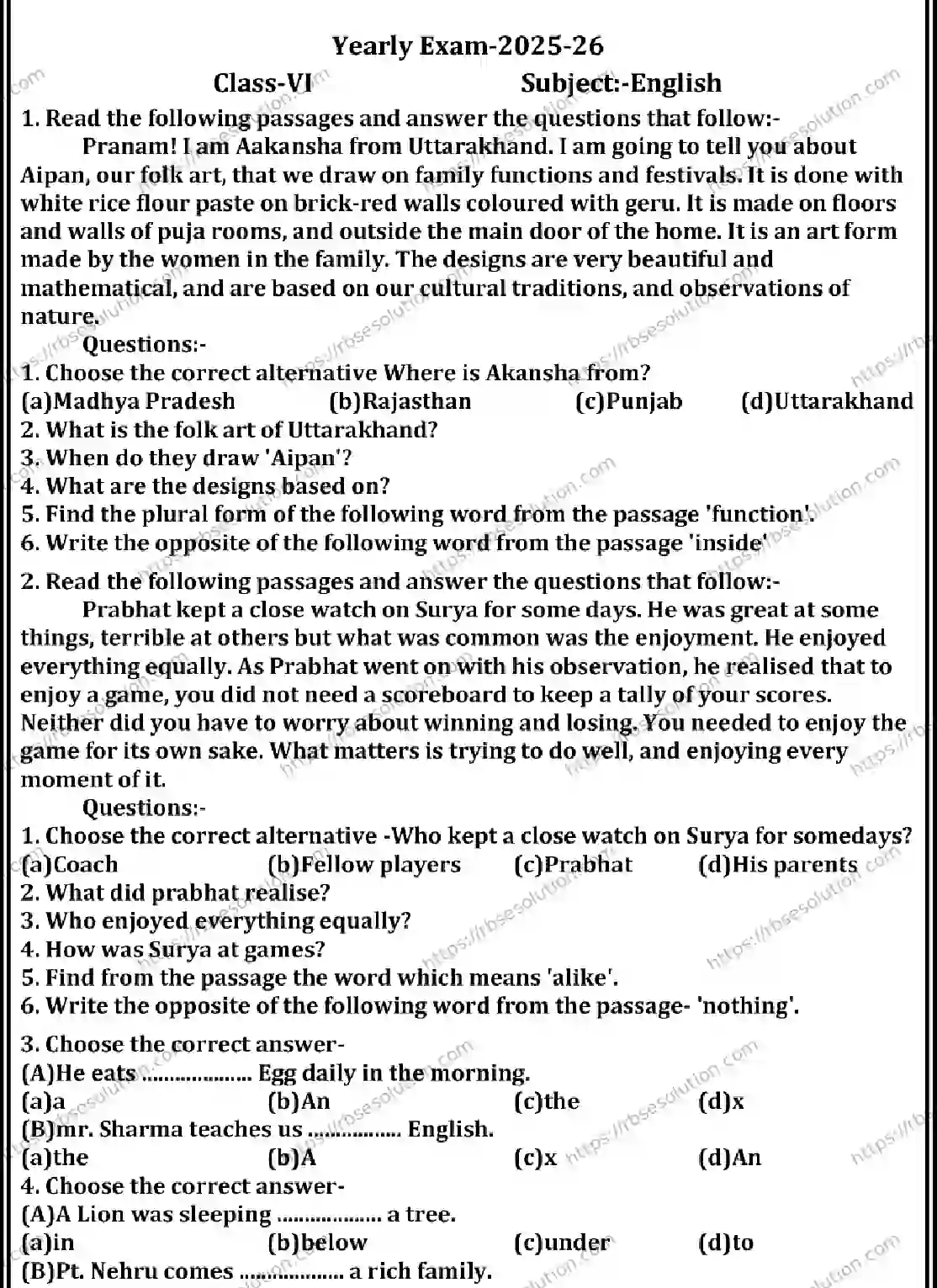
Yearly Exam-2025-26
Class-VI Subject:-English
1. Read the following passages and answer the questions that follow:-
Pranam! I am Aakansha from Uttarakhand. I am going to tell you about Aipan, our folk art, that we draw on family functions and festivals. It is done with white rice flour paste on brick-red walls coloured with geru. It is made on floors and walls of puja rooms, and outside the main door of the home. It is an art form made by the women in the family. The designs are very beautiful and mathematical, and are based on our cultural traditions, and observations of nature.
Questions:-
-
Choose the correct alternative: Where is Aakansha from?
- (a) Madhya Pradesh
- (b) Rajasthan
- (c) Punjab
- (d) Uttarakhand
Explanation: The passage clearly states, "I am Aakansha from Uttarakhand."
-
What is the folk art of Uttarakhand?
The folk art of Uttarakhand is Aipan.
-
When do they draw 'Aipan'?
They draw Aipan on family functions and festivals.
-
What are the designs based on?
The designs are based on cultural traditions and observations of nature.
-
Find the plural form of the following word from the passage: 'function'.
The plural form is functions.
-
Write the opposite of the following word from the passage: 'inside'.
The opposite of 'inside' is outside.
2. Read the following passages and answer the questions that follow:-
Prabhat kept a close watch on Surya for some days. He was great at some things, terrible at others but what was common was the enjoyment. He enjoyed everything equally. As Prabhat went on with his observation, he realised that to enjoy a game, you did not need a scoreboard to keep a tally of your scores. Neither did you have to worry about winning and losing. You needed to enjoy the game for its own sake. What matters is trying to do well, and enjoying every moment of it.
Questions:-
-
Choose the correct alternative: Who kept a close watch on Surya for some days?
- (a) Coach
- (b) Fellow players
- (c) Prabhat
- (d) His parents
Explanation: The passage begins with "Prabhat kept a close watch on Surya for some days."
-
What did Prabhat realise?
Prabhat realised that to enjoy a game, you do not need a scoreboard or worry about winning and losing. You need to enjoy the game for its own sake, try to do well, and enjoy every moment.
-
Who enjoyed everything equally?
Surya enjoyed everything equally.
-
How was Surya at games?
Surya was great at some things and terrible at others, but he enjoyed everything equally.
-
Find from the passage the word which means 'alike'.
The word is equally.
-
Write the opposite of the following word from the passage: 'nothing'.
The opposite of 'nothing' is everything.
3. Choose the correct answer:-
-
He eats ......... egg daily in the morning.
- (a) a
- (b) An
- (c) the
- (d) x
Explanation: 'Egg' begins with a vowel sound, so we use 'an'.
-
Mr. Sharma teaches us ......... English.
- (a) the
- (b) A
- (c) x
- (d) An
Explanation: Names of languages (like English) do not take an article before them.
4. Choose the correct answer:-
-
A lion was sleeping ......... a tree.
- (a) in
- (b) below
- (c) under
- (d) to
Explanation: 'Under a tree' is the correct preposition to show the lion was beneath the tree.
-
Pt. Nehru comes ......... a rich family.
- (a) from
- (b) in
- (c) of
- (d) to
Explanation: 'Comes from' is the correct phrase to indicate origin or family background.
Previous Year Question Paper – ENGLISH (170326)
Section A: Objective Questions
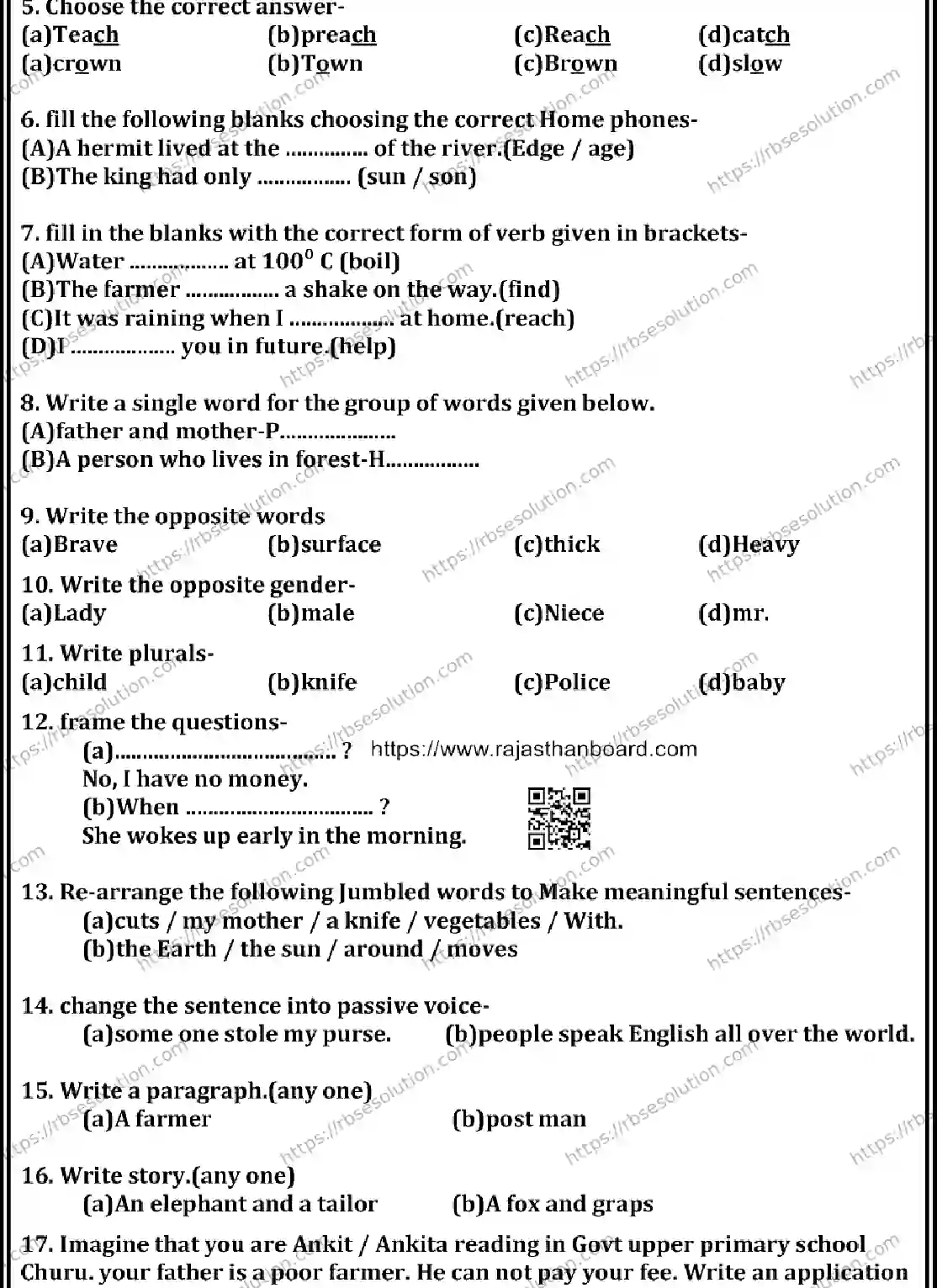
9. Choose the correct answer:
-
Which word is correctly spelled?
- (a) Teach
- (b) preach
- (c) Reach
- (d) catch
Explanation: All four words are correctly spelled. The question likely asks for the correct spelling among given options; all are correct.
-
Which word rhymes with 'crown'?
- (a) crown
- (b) Town
- (c) Brown
- (d) slow
Explanation: 'Town' and 'Brown' rhyme with 'crown'. Option (d) 'slow' does not rhyme.
6. Fill in the blanks choosing the correct homophones:
- A hermit lived at the edge of the river. (Edge / age)
- The king had only one son. (sun / son)
7. Fill in the blanks with the correct form of verb given in brackets:
- Water boils at 100° C. (boil)
- The farmer found a snake on the way. (find)
- It was raining when I reached home. (reach)
- I will help you in future. (help)
8. Write a single word for the group of words given below:
- Father and mother – Parents
- A person who lives in forest – Hermit / Forester
9. Write the opposite words:
- Brave – Coward
- Surface – Depth / Interior
- Thick – Thin
- Heavy – Light
10. Write the opposite gender:
- Lady – Gentleman
- Male – Female
- Niece – Nephew
- Mr. – Mrs.
11. Write plurals:
- Child – Children
- Knife – Knives
- Police – Police (plural form same)
- Baby – Babies
Section B: Grammar & Writing
12. Frame the questions:
-
Question: Do you have any money?
Answer: No, I have no money.
-
Question: When does she wake up?
Answer: She wakes up early in the morning.
13. Re-arrange the following jumbled words to make meaningful sentences:
- My mother cuts vegetables with a knife.
- The Earth moves around the sun.
14. Change the sentence into passive voice:
- Someone stole my purse. → My purse was stolen.
- People speak English all over the world. → English is spoken all over the world.
Section C: Composition
15. Write a paragraph (any one):
Paragraph: A Farmer
A farmer is a hardworking person who works in the fields. He wakes up early in the morning and goes to his farm. He ploughs the land, sows seeds, and waters the crops. He works very hard to grow food for us. Farmers are very important because they provide us with grains, vegetables, and fruits. We should respect farmers and their hard work.
16. Write a story (any one):
Story: The Fox and the Grapes
One day, a hungry fox was walking through a forest. He saw a bunch of ripe grapes hanging from a high vine. The fox wanted to eat them. He jumped up but could not reach the grapes. He tried again and again but failed. Finally, he gave up and said, "Those grapes are sour anyway." So, the fox walked away. The story teaches us that we often pretend to dislike what we cannot have.
17. Imagine that you are Ankit / Ankita reading in Govt Upper Primary School, Churu. Your father is a poor farmer. He cannot pay your fee. Write an application:
Application for Fee Concession
To,
The Headmaster,
Govt Upper Primary School,
Churu.
Subject: Application for fee concession
Respected Sir/Madam,
I am Ankit/Ankita, a student of class 6 in your school. My father is a poor farmer. He works very hard but earns very little. He is unable to pay my school fees due to financial problems. I am a hardworking student and want to continue my studies. I request you to kindly grant me fee concession so that I can complete my education.
Thanking you.
Yours obediently,
Ankit/Ankita
Class 6
Date: ________