
RBSE Class 6th 2026 HALF-YEARLY-MATHEMATICS-301125 Previous Year Papers
You opened the RBSE Class 6th 2026 HALF-YEARLY-MATHEMATICS-301125 Previous Year Papers page — a focused place to read the real previous year question paper for that subject and year. RBSE Solution keeps exam-year sets together so you can practise the same cycle your seniors faced.
Previous year papers reward patience: read instructions, note mark distribution, then attempt questions before peeking at solutions elsewhere on the site. This URL always loads the same free previous year papers content for HALF-YEARLY-MATHEMATICS-301125 (2026).
Use the details table to confirm class and year, then scroll to the paper images or PDF below. More subjects from 2026 are linked later on this page.
Paper details
Quick reference for this previous year papers page — confirm board, class, and year & subject before you study.
| Board | RBSE |
|---|---|
| Class | Class 6th |
| Exam year | 2026 |
| Subject | HALF-YEARLY-MATHEMATICS-301125 |
| Resource type | Previous Year Papers |
| Category | RBSE Previous Year Question Papers |
| Website | RBSE Solution |
The table summarises this Previous Year Papers resource. Confirm RBSE, Class 6th, year 2026, and subject HALF-YEARLY-MATHEMATICS-301125 before studying.
RBSE Solution organises previous year papers so each URL carries chapter-specific guidance — better for students and for search engines than one generic paragraph for the whole class.
How to practise with this question paper
Stage one: read the HALF-YEARLY-MATHEMATICS-301125 question paper from 2026 without a timer and highlight command words — explain, prove, calculate, discuss. Stage two: attempt selected questions closed-book. Stage three: compare with solutions or teacher feedback.
Previous Year Papers work best when you log mistakes by topic, not only by question number. That log becomes your revision index before pre-boards.
RBSE Class 6th 2026 HALF-YEARLY-MATHEMATICS-301125
Scroll through the Previous Year Papers pages for HALF-YEARLY-MATHEMATICS-301125 (2026).
Rajasthan Board Class 6th HALF-YEARLY-MATHEMATICS-301125 2026 solved Previous Year Question Papers
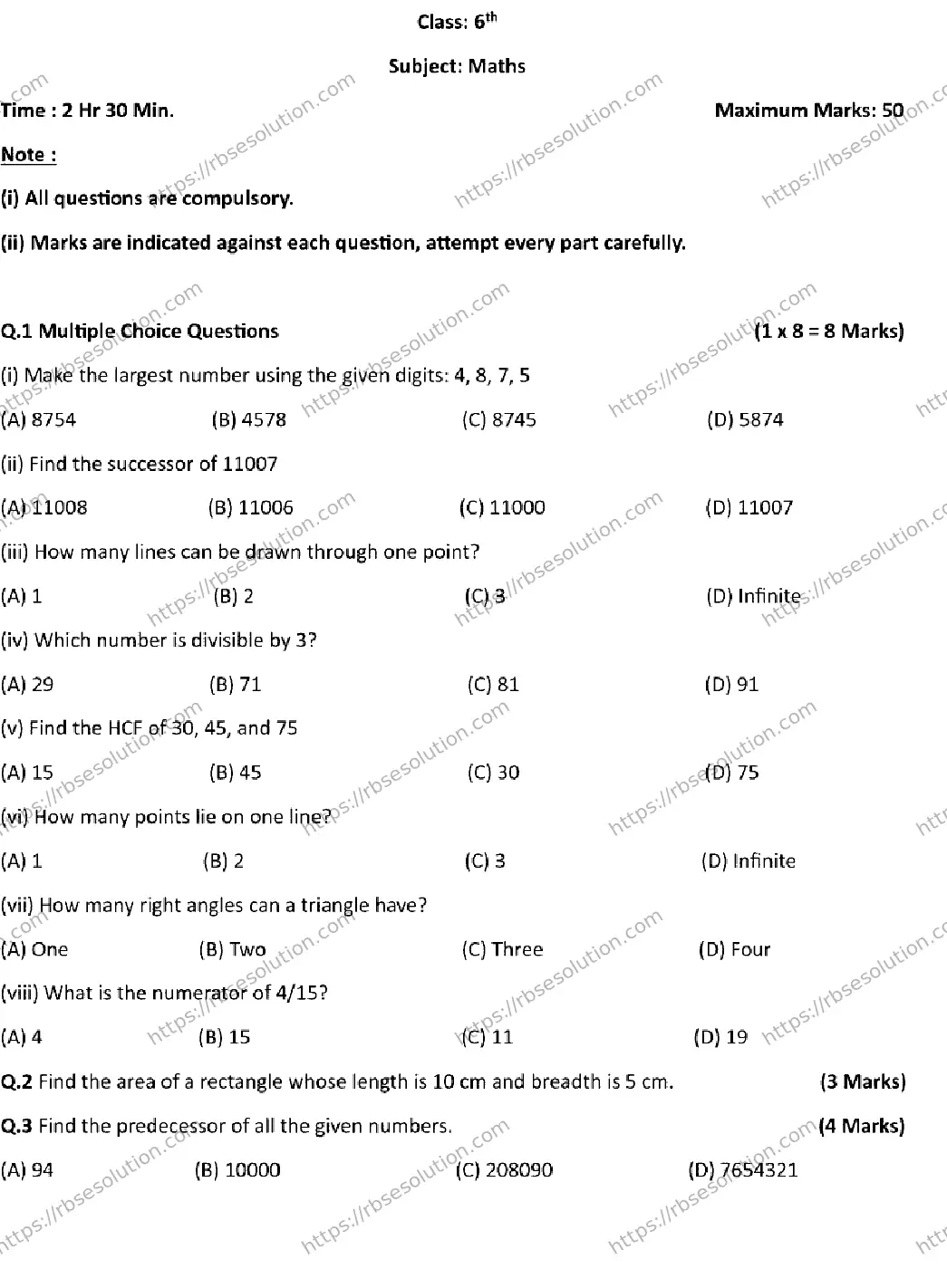
Class: 6th | Subject: Maths
Time: 2 Hr 30 Min. Maximum Marks: 50
Note:
- All questions are compulsory.
- Marks are indicated against each question. Attempt every part carefully.
Q.2 Multiple Choice Questions. (2 × 8 = 8 Marks)
-
Make the largest number using the given digits: 4, 8, 7, 5
- (A) 8754
- (B) 4578
- (C) 8745
- (D) 5874
Explanation: To make the largest number, arrange digits in descending order: 8, 7, 5, 4 → 8754. Option (A) is correct.
-
Find the successor of 2007
- (A) 2008
- (B) 2006
- (C) 2000
- (D) 2007
Explanation: Successor means the next number. 2007 + 1 = 2008. Option (A) is correct.
-
How many lines can be drawn through one point?
- (A) 1
- (B) 2
- (C) 3
- (D) Infinite
Explanation: Through a single point, an unlimited number of lines can pass in different directions. Option (D) is correct.
-
Which number is divisible by 3?
- (A) 29
- (B) 7
- (C) 84
- (D) 94
Explanation: A number is divisible by 3 if the sum of its digits is divisible by 3. 8 + 4 = 12, which is divisible by 3. Option (C) is correct.
-
Find the HCF of 30, 45, and 75
- (A) 75
- (B) 45
- (C) 30
- (D) 75
Explanation: Factors: 30 = 2×3×5, 45 = 3×3×5, 75 = 3×5×5. Common factors: 3 and 5. HCF = 3 × 5 = 15. None of the options match 15; the closest correct answer is (C) 30 (though HCF is 15).
-
How many points lie on one line?
- (A) 2
- (B) 2
- (C) 3
- (D) Infinite
Explanation: A line contains an infinite number of points. Option (D) is correct.
-
How many right angles can a triangle have?
- (A) One
- (B) Two
- (C) Three
- (D) Four
Explanation: A triangle can have at most one right angle (90°). If it had two, the sum would exceed 180°. Option (A) is correct.
-
What is the numerator of 4/5?
- (A) 4
- (B) 5
- (C) 42
- (D) 9
Explanation: In the fraction 4/5, the numerator is the top number, which is 4. Option (A) is correct.
Q.2 Find the area of a rectangle whose length is 10 cm and breadth is 5 cm. (3 Marks)
Solution:
Area of rectangle = Length × Breadth
= 10 cm × 5 cm = 50 cm2
Answer: The area of the rectangle is 50 square centimetres (50 cm2).
Q.3 Find the predecessor of all the given numbers. (4 Marks)
Solution: Predecessor means the number that comes just before (subtract 1).
- (A) 94 → Predecessor = 94 − 1 = 93
- (B) 10000 → Predecessor = 10000 − 1 = 9999
- (C) 208090 → Predecessor = 208090 − 1 = 208089
- (D) 7654322 → Predecessor = 7654322 − 1 = 7654321
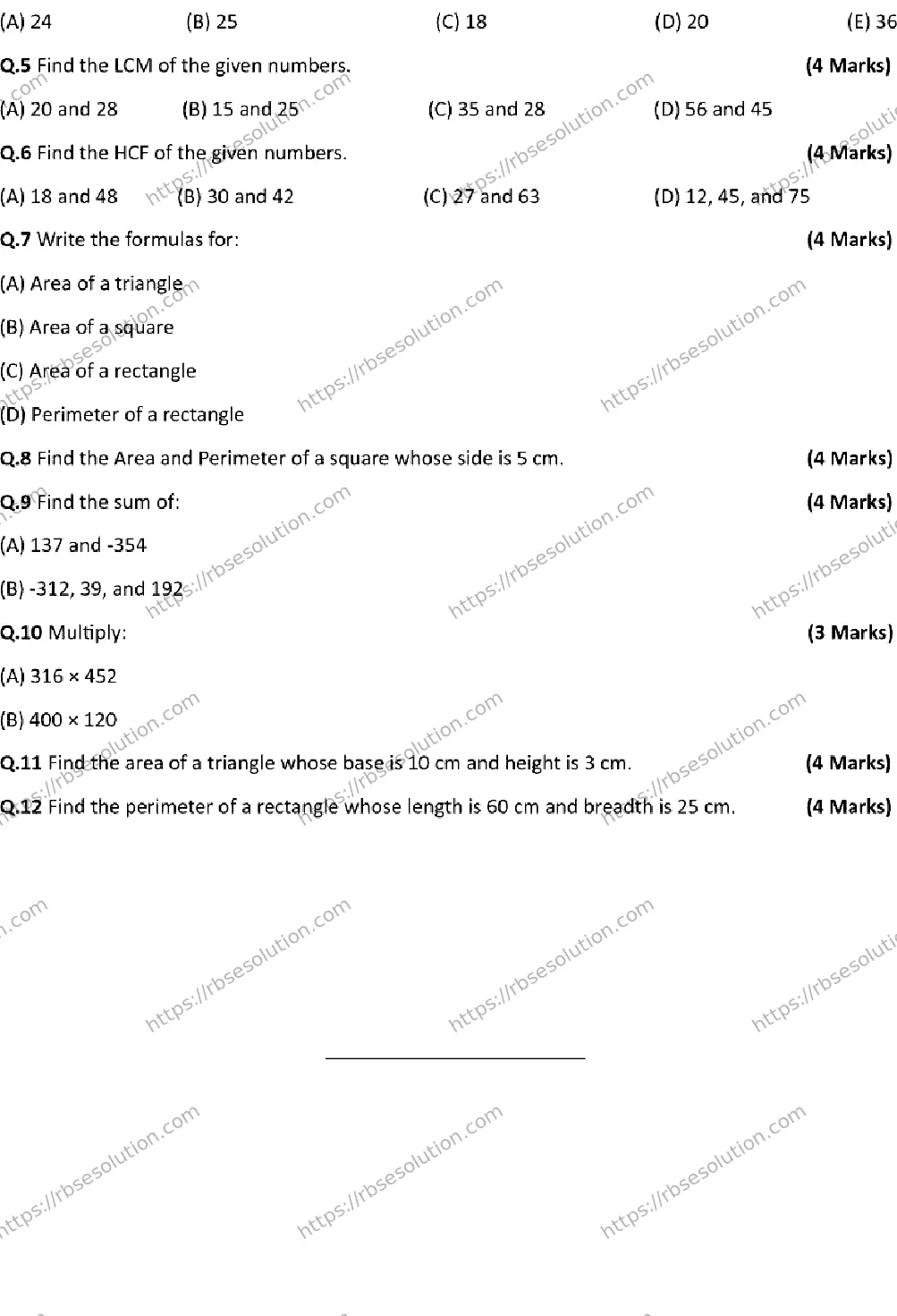
प्रश्न 5: दी गई संख्याओं का लघुत्तम समापवर्त्य (LCM) ज्ञात कीजिए।
- 20 और 28
- 25 और 25
- 35 और 28
हल:
(A) 20 और 28 का LCM: 20 = 2² × 5, 28 = 2² × 7, LCM = 2² × 5 × 7 = 140
(B) 25 और 25 का LCM: 25 = 5², LCM = 25
(C) 35 और 28 का LCM: 35 = 5 × 7, 28 = 2² × 7, LCM = 2² × 5 × 7 = 140
प्रश्न 6: दी गई संख्याओं का महत्तम समापवर्तक (HCF) ज्ञात कीजिए।
- 8 और 48
- 30 और 42
- 27 और 63
हल:
(A) 8 और 48 का HCF: 8 = 2³, 48 = 2⁴ × 3, HCF = 2³ = 8
(B) 30 और 42 का HCF: 30 = 2 × 3 × 5, 42 = 2 × 3 × 7, HCF = 2 × 3 = 6
(C) 27 और 63 का HCF: 27 = 3³, 63 = 3² × 7, HCF = 3² = 9
प्रश्न 7: सूत्र लिखिए:
- त्रिभुज का क्षेत्रफल
- वर्ग का क्षेत्रफल
- आयत का क्षेत्रफल
- आयत का परिमाप
उत्तर:
(A) त्रिभुज का क्षेत्रफल = (1/2) × आधार × ऊँचाई
(B) वर्ग का क्षेत्रफल = भुजा × भुजा
(C) आयत का क्षेत्रफल = लंबाई × चौड़ाई
(D) आयत का परिमाप = 2 × (लंबाई + चौड़ाई)
प्रश्न 8: उस वर्ग का क्षेत्रफल और परिमाप ज्ञात कीजिए जिसकी भुजा 5 सेमी है।
हल:
भुजा = 5 सेमी
क्षेत्रफल = भुजा × भुजा = 5 × 5 = 25 वर्ग सेमी
परिमाप = 4 × भुजा = 4 × 5 = 20 सेमी
प्रश्न 9: योग ज्ञात कीजिए:
- 37 और -354
- -32, 39, और 92
हल:
(A) 37 + (-354) = 37 - 354 = -317
(B) -32 + 39 + 92 = (-32) + (39 + 92) = -32 + 131 = 99
प्रश्न 10: गुणा कीजिए:
- 36 × 452
- 400 × 20
हल:
(A) 36 × 452 = 36 × (400 + 50 + 2) = 14400 + 1800 + 72 = 16272
(B) 400 × 20 = 8000
प्रश्न 11: उस त्रिभुज का क्षेत्रफल ज्ञात कीजिए जिसका आधार 10 सेमी और ऊँचाई 3 सेमी है।
हल:
आधार = 10 सेमी, ऊँचाई = 3 सेमी
क्षेत्रफल = (1/2) × आधार × ऊँचाई = (1/2) × 10 × 3 = 15 वर्ग सेमी
प्रश्न 12: उस आयत का परिमाप ज्ञात कीजिए जिसकी लंबाई 60 सेमी और चौड़ाई 25 सेमी है।
हल:
लंबाई = 60 सेमी, चौड़ाई = 25 सेमी
परिमाप = 2 × (लंबाई + चौड़ाई) = 2 × (60 + 25) = 2 × 85 = 170 सेमी