
RBSE Class 8th 2019 English-UP-02-2019 Previous Year Papers
English-UP-02-2019 from the 2019 exam year is part of the Class 8th previous year papers archive on RBSE Solution. Many learners start here after finishing the textbook to see how questions were actually framed on the Rajasthan Board of Secondary Education (RBSE) paper.
Treat this question paper as a mock under gentle timing first, then as a marking exercise the second time. The introduction on this page is written only for this subject-and-year pair, not copied from other pages.
Bookmark the link if you coach juniors — the layout stays stable for search engines and classroom sharing.
Paper details
Quick reference for this previous year papers page — confirm board, class, and year & subject before you study.
| Board | RBSE |
|---|---|
| Class | Class 8th |
| Exam year | 2019 |
| Subject | English-UP-02-2019 |
| Resource type | Previous Year Papers |
| Category | RBSE Previous Year Question Papers |
| Website | RBSE Solution |
The table summarises this Previous Year Papers resource. Confirm RBSE, Class 8th, year 2019, and subject English-UP-02-2019 before studying.
RBSE Solution organises previous year papers so each URL carries chapter-specific guidance — better for students and for search engines than one generic paragraph for the whole class.
Turning 2019 papers into insight
One English-UP-02-2019 paper reveals style; several from the same year reveal pattern. After this page, open sibling subjects listed below to see whether marks cluster in certain units.
Keep rough work dated in your notebook. Examiners in Class 8th expect clear numbering even in practice sessions.
RBSE Class 8th 2019 English-UP-02-2019
Scroll through the Previous Year Papers pages for English-UP-02-2019 (2019).


Rajasthan Board Class 8th English-UP-02-2019 2019 solved Previous Year Question Papers
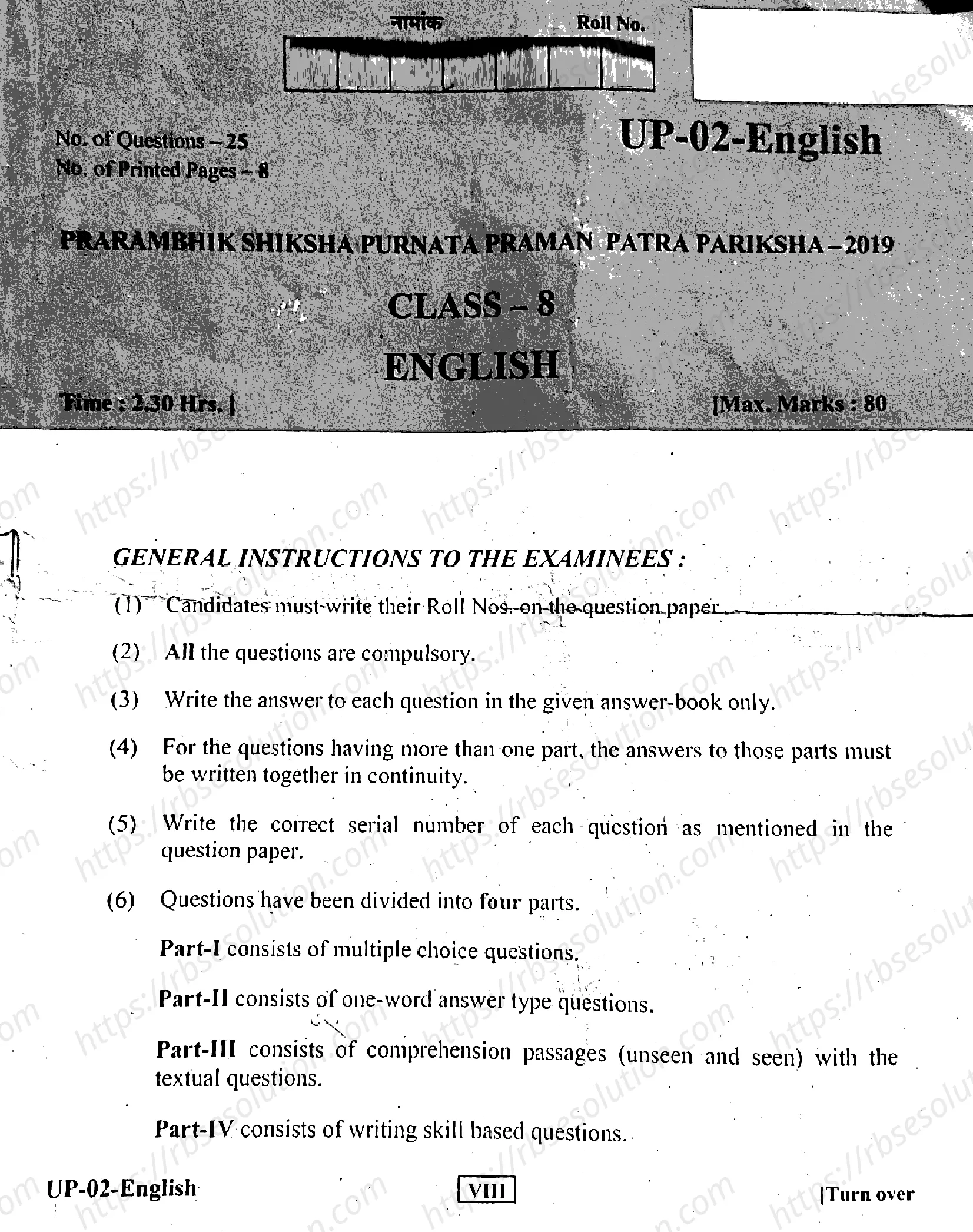
GENERAL INSTRUCTIONS TO THE EXAMINEES
- Candidates must write their Roll Nos. on the question paper.
- All the questions are compulsory.
- Write the answer to each question in the given answer-book only.
- For the questions having more than one part, the answers to those parts must be written together in continuity.
- Write the correct serial number of each question as mentioned in the question paper.
- Questions have been divided into four parts.
Part-I consists of multiple choice questions.
Part-II consists of one-word answer type questions.
Part-III consists of comprehension passages (unseen and seen) with the textual questions.
Part-IV consists of writing skill based questions.
UP-02-English
PART - I
Choose the correct answers:
-
Is this the feast for a Prime Minister? Here “feast” means -
- (a) meal
- (b) sleep
- (c) kingdom
- (d) thing
Correct Answer: (a) meal
Explanation: In the context, "feast" refers to a large meal, so option (a) is correct.
-
Less than 3% of all the water on earth is fresh water, most of __ lies frozen in Antarctica and Greenland.
- (a) what
- (b) who
- (c) which
- (d) whose
Correct Answer: (c) which
Explanation: "Which" is used to refer to a thing (water) previously mentioned.
-
Which of the following is not related to a hospital?
- (a) Doctor
- (b) Nurse
- (c) Patient
- (d) Shopkeeper
Correct Answer: (d) Shopkeeper
Explanation: Doctor, nurse, and patient are directly associated with a hospital, while a shopkeeper is not.
-
Wastage water should be avoided as far as possible.
- (a) on
- (b) of
- (c) to
- (d) in
Correct Answer: (b) of
Explanation: The correct phrase is "wastage of water" meaning water that is wasted.
-
Which of the underlined letter have a different sound?
- (a) blood
- (b) fool
- (c) pool
- (d) tooth
Correct Answer: (a) blood
Explanation: The 'oo' in "blood" is pronounced as /ʌ/ (short u sound), while in fool, pool, and tooth it is pronounced as /uː/ (long u sound).
-
As you are new in the school, you ____ well with your seniors and roommates.
- (a) was behaving
- (b) is behaving
- (c) should behave
- (d) behaved
Correct Answer: (c) should behave
Explanation: "Should" is used to give advice or suggestion, which fits the context.
-
At this moment, sudden shouts of joy ____.
- (a) hear
- (b) heard
- (c) was heard
- (d) were heard
Correct Answer: (d) were heard
Explanation: "Shouts" is plural, so the plural past passive "were heard" is correct.
PART — II
-
Make new words by adding "d" or "ed" to the following words:
- ask + ed = asked
- care + d = cared
-
Write plurals of the following words:
- tooth → teeth
- man → men
-
Write the missing letters in the following words:
- L_v_ly → Lovely
- b_f_re → before
-
Identify the words with incorrect spelling and re-write after correcting them:
Incorrect: He gave me tow hundrad rup.
Correct: He gave me two hundred rupees.
-
Drive attentively so that you can reach home safe.
(Choose: and / but / so that)
-
Use punctuation marks such as inverted comma (“ ”), comma (,), question mark (?), full stop (.) and capital letters in the following sentences wherever required:
- Corrected: “Are you not going to deposit any more?” asked the clerk.
- Corrected: “Since then I bank no more.”
-
Arrange the words in proper order to make meaningful sentences:
- Kailash lives in the village Gadota.
- Bajrang has kicked the ball.
-
Join the following sentences using "so .... that":
Original: It rained heavily. All the rivers and brooks were in flood.
Joined: It rained so heavily that all the rivers and brooks were in flood.
-
Fill in the blanks with the help of the words given in bracket: (right, middle, close, left)
- Keep left on the road while walking.
- We should overtake other vehicles to the right side.
PART - III
(A) Read the passage carefully and answer the questions given below:
To have access to safe water and to avoid water crisis in the near future it is necessary that correct policies and schemes are made. Water conservation and its proper management can also be considered as one of the effective steps to avoid crisis. India has a long tradition of water harvesting. Harvesting rainwater is one of the most effective ways to tackle the water crisis. The basic principle is, to collect the rain water where it falls, use it and let it seep into the ground. In this Rashtrapati Bhawan is leading the way. It is one of the few buildings in Delhi that conserves rain water. Aizawl in Mizoram meets most of its water needs through roof top harvesting. In 1994, a law was made for the citizens of Chennai making it compulsory for new buildings to harvest rain water if they wanted municipal water connections.
17. (a) What does India have?
Answer: India has a long tradition of water harvesting.
(b) Which is the building in Delhi that conserves rain water?
Answer: Rashtrapati Bhawan is the building in Delhi that conserves rain water.
18. (a) What is the basic principle?
Answer: The basic principle is to collect the rain water where it falls, use it and let it seep into the ground.
(b) How does Aizawl meet its water needs?
Answer: Aizawl meets most of its water needs through roof top harvesting.
(c) Write one word from the passage of the following:
(i) short
Answer: near
(ii) optional
Answer: compulsory
(B) Read the following passage carefully and answer the questions given below
Dr. Ashutosh: The first computer was made by Herman Hollerith in 1946. His machine was called the ‘Electric Tabulating System’.
Naveen: Dr., will you please tell us about the different types of computers?
Dr. Ashutosh: Certainly. The main types of computers are the digital and the analog.
-
(a) Who invented the first computer?
Answer: Herman Hollerith invented the first computer.(b) What name was given to the first computer?
Answer: The first computer was called the ‘Electric Tabulating System’. -
(a) When was the first computer invented?
Answer: The first computer was invented in 1946.(b) What are the main types of computers?
Answer: The main types of computers are digital and analog.(c) Find out the word from the passage which means: “kinds”.
Answer: The word is “types”.
(C) Read the following passage carefully and answer the questions given below
One of the earliest scientists was Sushruta. He repaired a nose some 26 centuries ago and was the first plastic surgeon. He was an expert in removing urinary stones, treating fractures and eye operations. He even advised his pupils to use dead bodies for practice before surgery. He is known as the father of anesthesia also. Charak was the first physician who suggested that there were 360 bones in a human body.
-
(a) Who was the first plastic surgeon?
Answer: Sushruta was the first plastic surgeon.(b) What did Sushruta advise his pupils?
Answer: Sushruta advised his pupils to use dead bodies for practice before surgery. -
(a) What did Charak suggest?
Answer: Charak suggested that there were 360 bones in a human body.(b) Write one word for the following sentence: The persons who study science.
Answer: Scientists.(c) Find out the word which means: “students”.
Answer: The word is “pupils”.
PART-III
23. Re-arrange the following sentences according to the time of events:
- The lion became angry.
- It was sleeping under a tree.
- Once upon a time, there was a lion.
- The mouse began to jump on its body.
- A mouse came there.
Correct Order:
- Once upon a time, there was a lion.
- It was sleeping under a tree.
- A mouse came there.
- The mouse began to jump on its body.
- The lion became angry.
PART-IV
24. Imagine that you are Abdul Haneef from Mahalan. Write a letter to your friend inviting him to attend your birthday party.
You may use the following points:
- Whom did you invite?
- How did you celebrate?
- What gifts did you receive?
- How did you feel?
Sample Letter:
Mahalan
[Date]
Dear [Friend's Name],
I hope this letter finds you in good health. I am writing to invite you to my birthday party which I am celebrating on [Date] at my home in Mahalan.
I have invited all my close friends and family members. We will have a small celebration with cake, snacks, and games. I will be very happy if you can join us and make the day special.
I received many lovely gifts last year, including books, a watch, and a new school bag. This year, I am looking forward to spending time with my friends more than anything else.
I feel very excited and happy about my birthday. Your presence will make it even more memorable. Please come and join the fun.
Your loving friend,
Abdul Haneef
Question 7
You are Rajendra, reading in Govt. Upper Primary School, Nashoda. Your grandmother is very old and today she is alone at home. There is nobody to look after her. Write an application to your headmaster requesting him to grant you one day’s leave.
You may use the following clues: (grandmother is very old, family members went to another village, alone and cannot care herself, you have to look after her, grant leave).
Answer
To,
The Headmaster,
Govt. Upper Primary School,
Nashoda.
Subject: Application for one day’s leave
Respected Sir,
I am Rajendra, a student of class 8th in your school. I humbly request you to grant me one day’s leave today. My grandmother is very old and all other family members have gone to another village. She is alone at home and cannot take care of herself. There is nobody to look after her. Therefore, I have to stay at home to take care of her.
I shall be grateful if you kindly grant me leave for one day.
Thanking you,
Yours obediently,
Rajendra
Class 8th
Date: ________
Section: Writing
Question 235
Write a short paragraph in about 70 words on: "My Village".
You may use the following words:
(name of village, people of different professions, schools, hospital, bank, post office, shops, facilities)
Solution (Paragraph):
My village is named Rampur. It is a small but beautiful village. People of different professions live here, such as farmers, teachers, and shopkeepers. We have a primary school, a small hospital, a bank, and a post office. There are many shops where we buy daily needs. The village has good facilities like electricity and clean water. I love my village because it is peaceful and green.
OR
Write a story in about 76–80 words with the help of the given outline:
Once an elephant — goes to a pond — a tailor's — used to give breads — elephant and tailor becomes — friendship — tailor's son — pricks a needle — goes to pond — fills mud in its trunk — spreads — all clothes spoils — Tit.
Solution (Story):
Once an elephant used to go to a pond every day. On the way, it passed by a tailor's shop. The tailor used to give breads to the elephant. Soon, they became good friends. One day, the tailor's son pricked the elephant's trunk with a needle. The elephant felt hurt. It went to the pond, filled its trunk with mud, and came back. It spread the mud all over the tailor's clothes. All the clothes were spoilt. The tailor learned a lesson.