
RBSE Class 9th 2017 English-APS-905-2017 Previous Year Papers
Class 9th students hunting authentic previous year papers for English-APS-905-2017 (2017) land here for a reason: the paper below matches how RBSE assessments are remembered from that year. RBSE Solution does not mix years on one page; each combination gets its own notes.
Skim the overview sections, then work through the scanned pages. Pair this practice with RBSE books and solutions when you need to relearn a concept a question exposed.
Paper details
Quick reference for this previous year papers page — confirm board, class, and year & subject before you study.
| Board | RBSE |
|---|---|
| Class | Class 9th |
| Exam year | 2017 |
| Subject | English-APS-905-2017 |
| Resource type | Previous Year Papers |
| Category | RBSE Previous Year Question Papers |
| Website | RBSE Solution |
The table summarises this Previous Year Papers resource. Confirm RBSE, Class 9th, year 2017, and subject English-APS-905-2017 before studying.
RBSE Solution organises previous year papers so each URL carries chapter-specific guidance — better for students and for search engines than one generic paragraph for the whole class.
Turning 2017 papers into insight
One English-APS-905-2017 paper reveals style; several from the same year reveal pattern. After this page, open sibling subjects listed below to see whether marks cluster in certain units.
Keep rough work dated in your notebook. Examiners in Class 9th expect clear numbering even in practice sessions.
RBSE Class 9th 2017 English-APS-905-2017
Scroll through the Previous Year Papers pages for English-APS-905-2017 (2017).
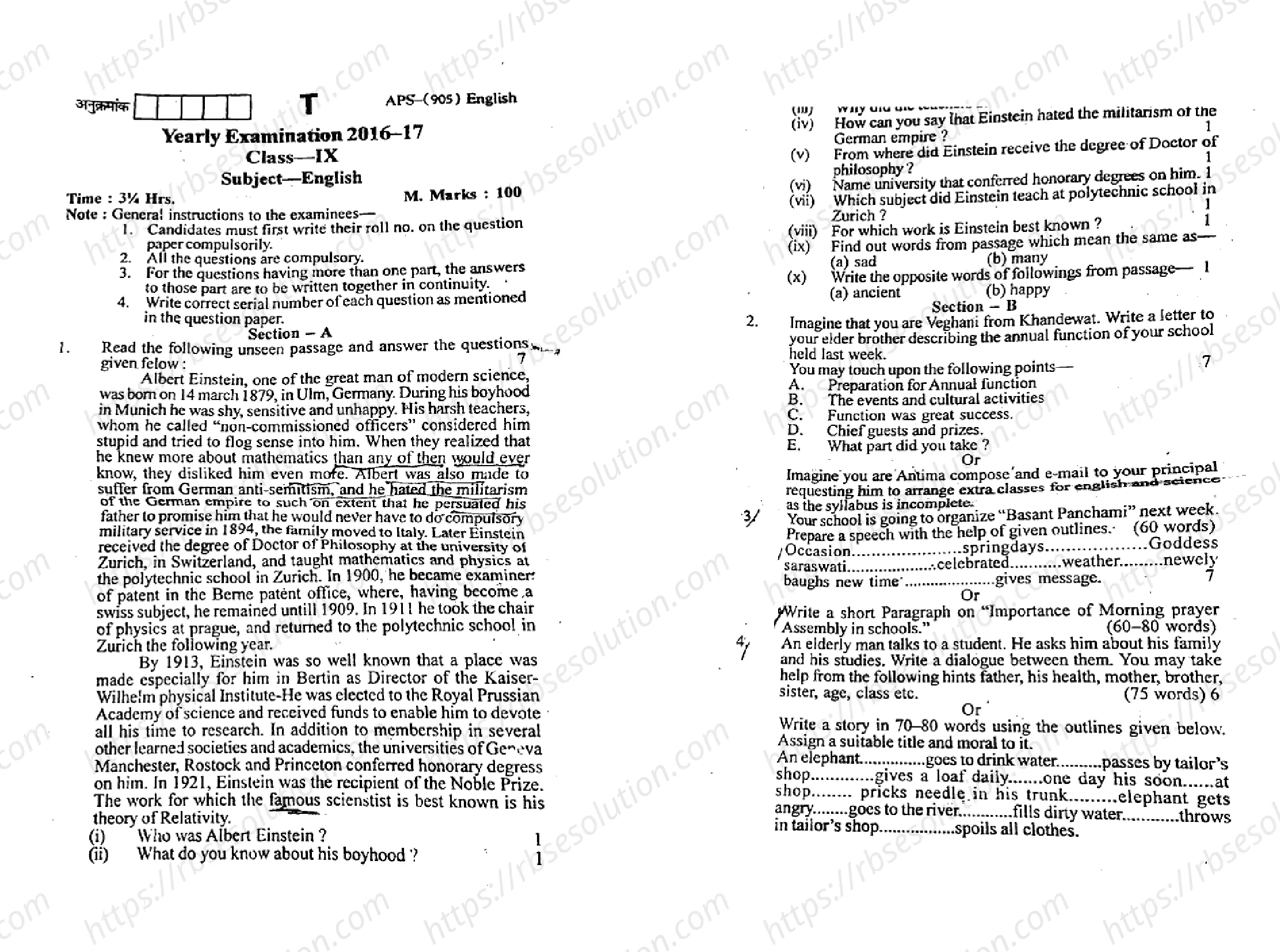


Rajasthan Board Class 9th English-APS-905-2017 2017 solved Previous Year Question Papers
Time: 3¼ Hours
Note: General instructions to the examinees—
- Candidates must first write their roll no. on the question paper compulsorily.
- All the questions are compulsory.
- For the questions having more than one part, the answers to those parts are to be written together in continuity.
- Write correct serial number of each question as mentioned in the question paper.
Section — A
Read the following unseen passage and answer the questions given below:
Albert Einstein, one of the great men of modern science, was born on 4 March 1879, in Ulm, Germany. During his boyhood in Munich he was shy, sensitive and unhappy. His harsh teachers, whom he called "non-commissioned officers" considered him stupid and tried to flog sense into him. When they realized that he knew more about mathematics than any of them would ever know, they disliked him even more. He was also made to suffer from German anti-Semitism, and he hated the militarism of the German empire to such an extent that he persuaded his father to promise him that he would never have to do compulsory military service. In 1894, the family moved to Italy. Later Einstein received the degree of Doctor of Philosophy at the University of Zurich, in Switzerland, and taught mathematics and physics at the polytechnic school in Zurich. In 1900, he became examiner of patents in the Berne patent office, where, having become a Swiss subject, he remained until 1909. In 1914 he took the chair of physics at Prague, and returned to the polytechnic school in Zurich the following year.
By 1913, Einstein was so well known that a place was made especially for him in Berlin as Director of the Kaiser-Wilhelm Physical Institute. He was elected to the Royal Prussian Academy of Science and received funds to enable him to devote all his time to research. In addition to membership in several other learned societies and academies, the universities of Geneva, Manchester, Rostock and Princeton conferred honorary degrees on him. In 1921, Einstein was the recipient of the Nobel Prize. The work for which the famous scientist is best known is his theory of Relativity.
-
(i) Who was Albert Einstein?
Albert Einstein was one of the great men of modern science, born on 4 March 1879 in Ulm, Germany. He is best known for his theory of Relativity.
-
(ii) What do you know about his boyhood?
During his boyhood in Munich, Einstein was shy, sensitive and unhappy. His teachers considered him stupid and tried to punish him. He knew more mathematics than his teachers, which made them dislike him even more. He also suffered from German anti-Semitism.
-
(iii) How can you say that Einstein hated the militarism of the German empire?
Einstein hated the militarism of the German empire so much that he persuaded his father to promise him that he would never have to do compulsory military service.
-
(iv) From where did Einstein receive the degree of Doctor of Philosophy?
Einstein received the degree of Doctor of Philosophy at the University of Zurich, in Switzerland.
-
(v) Name the universities that conferred honorary degrees on him.
The universities of Geneva, Manchester, Rostock and Princeton conferred honorary degrees on Einstein.
-
(vi) Which subject did Einstein teach at polytechnic school?
Einstein taught mathematics and physics at the polytechnic school in Zurich.
-
(vii) For which work is Einstein best known?
Einstein is best known for his theory of Relativity.
-
(viii) Find out words from the passage which mean the same as:
a) sad
unhappy
b) many
several
-
(ix) Write the opposite words of the following from the passage:
a) ancient
modern
b) happy
unhappy
Section — B
Imagine that you are Veghani from Khandewat. Write a letter to your elder brother describing the annual function of your school held last week.
You may touch upon the following points—
- A. Preparation for Annual function
- B. The events and cultural activities
- C. Function was a great success.
- D. Chief guests and prizes.
- E. What part did you take?
Sample Answer:
Khandewat
Date: 15 March 2017
Dear Elder Brother,
I hope you are doing well. I am writing to tell you about our school's annual function held last week. The preparations began a month in advance with students practicing dances, songs, and plays. The event started with a welcome song and a speech by the principal. The chief guest, the District Education Officer, gave away prizes to meritorious students. I participated in a group dance and a skit. The cultural activities included a fashion show, a quiz, and a drama. The function was a great success and everyone enjoyed it. I felt very proud to be part of it.
Your loving brother,
Veghani
Imagine you are Antima. Compose an e-mail to your principal requesting him to arrange extra classes for English.
Sample Answer:
To: principal@school.edu
Subject: Request for Extra English Classes
Respected Principal,
I am Antima, a student of Class IX. I humbly request you to arrange extra classes for English. Many students are facing difficulty in grammar and writing skills. Extra classes will help us improve our performance in the upcoming exams. Kindly consider our request.
Thanking you,
Yours obediently,
Antima
Class IX
Your school is going to organize "Basant Panchami" next week. Prepare a speech with the help of given outlines: (60 words)
Occasion... Spring days... Goddess Saraswati... celebrated... weather... new leaves... new time... gives message.
Sample Speech:
Good morning everyone. Today we celebrate Basant Panchami, the festival of spring. It marks the arrival of spring days when the weather becomes pleasant and new leaves appear on trees. We worship Goddess Saraswati, the goddess of knowledge and wisdom. This festival gives us a message of new beginnings and learning. Let us all embrace this new time with joy and dedication. Thank you.
Write a short paragraph on "Importance of Morning Prayer Assembly in schools." (60-80 words)
Sample Paragraph:
The morning prayer assembly is an important part of school life. It brings all students and teachers together to start the day with prayer and discipline. It helps in developing a sense of unity, punctuality, and respect for values. The assembly also includes news reading, thought of the day, and national anthem, which enhance knowledge and patriotism. It sets a positive tone for the day and helps students focus on their studies. Thus, the morning assembly is essential for holistic development.
An elderly man talks to a student. He asks him about his family and his studies. Write a dialogue between them. You may take help from the following hints: father, his health, mother, brother, sister, age, class etc. (75 words)
Sample Dialogue:
Elderly Man: Good morning, young man. How are you?
Student: Good morning, sir. I am fine.
Elderly Man: What is your name and how old are you?
Student: My name is Ravi. I am 14 years old and study in Class IX.
Elderly Man: How is your family? How is your father's health?
Student: My father is a teacher and his health is good. My mother is a homemaker. I have a younger brother and an elder sister. They all are well.
Elderly Man: That's good. Keep studying hard.
Student: Thank you, sir.
Or
Write a story in 70-80 words using the outlines given below. Assign a suitable title and moral to it.
An elephant... goes to drink water... passes by tailor's shop... gives a loaf daily... one day his son... at shop... pricks needle in his trunk... elephant gets angry... goes to the river... fills dirty water... throws in tailor's shop... spoils all clothes.
Title: The Revenge of the Elephant
Story: An elephant used to go to the river to drink water. Every day, it passed by a tailor's shop. The tailor gave it a loaf of bread daily. One day, the tailor's son was at the shop. He pricked a needle into the elephant's trunk. The elephant got angry. It went to the river, filled its trunk with dirty water, and threw it all over the tailor's shop, spoiling all the clothes.
Moral: Do not harm those who are kind to you.
Section – C
5. Fill in the blanks with the correct form of the verbs given in the brackets:
- Father is ......... (make) tea.
Answer: making - He has not ......... (complete) his homework so far.
Answer: completed - When I entered the room he ......... (watch) TV.
Answer: was watching - My brother ......... (be) an engineer.
Answer: is
6. Fill in the blanks choosing suitable modals from brackets (Might, Must, Should, Can, Could):
- We ......... follow the traffic rules.
Answer: must - He ......... jump 6 feet in his childhood.
Answer: could - The sky is clear, it ......... rain today.
Answer: might - Fire ......... dangerous.
Answer: can
7. Fill in the blanks with a verb in agreement with its subject:
- Mathematics ......... a difficult subject. (is/are)
Answer: is - The Indians ......... laborious. (is/are)
Answer: are - The teacher and ......... coming. (are/is)
Answer: is - Either he or I ......... mistaken. (is/am)
Answer: am
8. Change the following sentences into indirect speech:
- The old man said to me, "Please take a glass of water."
Answer: The old man requested me to take a glass of water. - The teacher said to the student, "Are you going to buy a pen for your sister?"
Answer: The teacher asked the student if he was going to buy a pen for his sister.
9. Select the word that is opposite in meaning to the word given in bold letter. Write A, B, C or D of correct answer in brackets:
- Beautiful – (a) ugly (b) lovely (c) handsome (d) attractive
Answer: (a) ugly - Allow – (a) permit (b) accept (c) command (d) deny
Answer: (d) deny - Atrocity – (a) cruelty (b) barbarous (c) kindness (d) brutality
Answer: (c) kindness - Appear – (a) emerge (b) visible (c) watch (d) disappear
Answer: (d) disappear
10. Pick out right word from the brackets and fill in the blanks:
- Shakila gave ......... a bicycle. (she/her/his)
Answer: her - Anil met ......... at the station. (i, me, my)
Answer: me - Prachi invited ......... to her party. (they/them/their)
Answer: them - The farmer took ......... to his field. (they/their/them)
Answer: them
11. Fill in the blanks with appropriate preposition given in brackets:
- She made a request ......... her teacher. (on/for/to)
Answer: to - Rekha is ......... Ram and Shyam. (between/among)
Answer: between - He jumped ......... a pond. (in/into)
Answer: into - He gets ......... early in the morning. (up/to/of)
Answer: up
12. Write one word for the following group of words:
- A place of worship for Hindus –
Answer: Temple
Section – D
13. Read the following passage carefully and answer the questions below it:
The subject assigned to me is, "what are the prospects of democracy in India?" Most Indians speak with great pride as though their country was already a democracy. The foreigners also, when they sit at a dinner table to do diplomatic honour to India, speak of the Great Indian Prime Minister and the Great Indian Democracy.
From this, it is held without waiting to argue that where there is a Republic there must be democracy. It is also supposed that here there is parliament which is elected by the people on the basis of adult suffrage and the laws are made by the people's representatives in parliament elected after few years, there is democracy. In other words, democracy is understood to be a political instrument and where this political instrument exists, there is democracy.
Democracy is quite different from Republic as also from Parliamentary government. The roots of democracy lie not in the form of Government, Parliamentary or otherwise. Democracy is more than a form of Government. It is primarily a mode of associated living—the roots of that associated life are searched in the social relationships in the community between the people who live together.
- What subject was assigned to the speaker?
Answer: The subject assigned was "what are the prospects of democracy in India?" - How do most Indians speak about democracy in India?
Answer: Most Indians speak with great pride as though their country was already a democracy. - How do foreigners do diplomatic honour to India?
Answer: Foreigners speak of the Great Indian Prime Minister and the Great Indian Democracy. - Where is democracy generally considered to exist?
Answer: Democracy is generally considered to exist where there is a political instrument of parliamentary government. - What is there where there is Parliament?
Answer: Where there is Parliament, there is democracy (as per the common understanding). - What is meant by adult suffrage?
Answer: Adult suffrage means the right to vote given to all adult citizens. - Who makes laws in Parliament?
Answer: The people's representatives in Parliament make laws. - What is democracy different from?
Answer: Democracy is different from Republic and Parliamentary government. - Make plural forms of given words:
(a) country – countries
(b) instrument – instruments - Find from the passage the words which mean:
(a) Possibilities, chances of being successful – prospects
(b) Given – assigned
14. Answer any three of the following questions in 20-30 words:
- What did Kalam's meal in childhood normally consist of?
Answer: Kalam's meal in childhood normally consisted of simple, traditional South Indian food like rice, sambar, and vegetables. - What is the power of prayer?
Answer: The power of prayer lies in its ability to give strength, peace, and a sense of connection with the divine. - Why are food habits important? (from "Food Manners")
Answer: Food habits are important because they reflect culture, discipline, and good manners, and they affect health and social relationships. - How did Gandhi look at the theme of social service?
Answer: Gandhi viewed social service as a duty and a way to serve the nation, especially through helping the poor and the needy. - How did the tiger treat the goat? (from "The Tiger and the Goat")
Answer: The tiger treated the goat with kindness and friendship, contrary to its natural instinct.
English (APS-905-2017) – Page 3
Question 5 (v)
Where did the women participants perform great deeds? (Women’s Role in National Movement)
Answer: Women participants performed great deeds in various fields of the national movement, including protests, marches, boycotts, and even in the battlefield, showing immense courage and sacrifice for India's freedom.
Question 15 – Answer any three of the following in 20-30 words (2+2+2=6)
-
(i) What, according to Tagore, are some of the qualities that the land of freedom should have? (The Heaven of Freedom)
Answer: According to Tagore, the land of freedom should have a mind without fear, a head held high, knowledge free, and a world not broken by narrow domestic walls.
-
(ii) What, according to the mother, is the story of one of the champak trees? (Ecology)
Answer: The mother tells the story of a champak tree that was cut down, and how its absence affected the environment and the speaker's emotions.
-
(iii) What makes the speaker in the poem angry the day after the first rain year after year? (Ecology)
Answer: The speaker is angry because every year after the first rain, he sees the red champak trees blooming, reminding him of their destruction and loss.
-
(iv) Who is the speaker? What does the poem reveal about the speaker's character? (Ecology)
Answer: The speaker is a person deeply connected to nature. The poem reveals that the speaker is sensitive, emotional, and angry about environmental destruction.
Question 16 – Answer any three of the following in 20-30 words (2+2+2=6)
-
(i) Was the King satisfied with answers of the various learned men? If not, why? (Three Questions)
Answer: No, the King was not satisfied because the learned men gave different and conflicting answers, and none of them could provide a complete and correct solution to his three questions.
-
(ii) What did the girl say about Mussoorie? (The Eyes Are Not Here)
Answer: The girl said that Mussoorie is a beautiful hill station, and she was going there to enjoy the scenery and the cool weather.
-
(iii) What did the king do to remove the horns from his head? (The King and the Drum)
Answer: The king tried various methods like cutting, filing, and covering the horns, but nothing worked. Finally, he accepted them and wore a crown to hide them.
-
(iv) Comment on Sir Mohan Lal's manner of speech. (Karma)
Answer: Sir Mohan Lal spoke in a very polished, Anglicized manner, using perfect English and showing off his Western education, which reflected his snobbish and pretentious nature.
Question 17 – Explain the lines with context and reference (4 marks)
Option 1: "Where the mind is without fear and the head is held high; Where knowledge is free; Where the world has not been broken into fragments by narrow domestic walls; Where words come out from the depth of truth; Where tireless striving stretches its arms towards perfection."
Context: These lines are from Rabindranath Tagore's poem "Where the Mind is Without Fear" (from Gitanjali). The poet prays for a free and enlightened India.
Explanation: Tagore envisions a land of freedom where people are fearless, knowledgeable, and united. He criticizes narrow divisions (like caste, religion) and emphasizes truth, hard work, and the pursuit of perfection. The lines reflect his dream of a progressive and harmonious society.
Option 2: "The day after the first rain; for years I would come home in a rage; for I could see, from a mile away; out there Red champak trees; had done it again."
Context: These lines are from the poem "Ecology" by A.K. Ramanujan. The speaker recalls his childhood anger after the first rain each year.
Explanation: The speaker is angry because the red champak trees bloom after the first rain, reminding him of their beauty and also of their destruction (as they were cut down). The repetition "year after year" shows his lasting frustration and helplessness about environmental loss.
Question 18 – Answer any one of the following in 60-80 words (4 marks)
-
(i) What do you know about Kalam's family? Explain. (Power of Prayer)
Answer: Dr. A.P.J. Abdul Kalam was born into a humble Tamil Muslim family in Rameswaram. His father, Jainulabdeen, was a boat owner and imam of a local mosque, known for his wisdom and simplicity. His mother, Ashiamma, was a kind and generous homemaker. Kalam grew up in a joint family with many relatives, and his parents taught him values of honesty, hard work, and faith. Despite limited means, they supported his education, which shaped his character and future as a scientist and President of India.
-
(ii) According to Bose, women can serve in freedom struggle in various capacities. How? (Women's Role in the National Movement)
Answer: According to Subhas Chandra Bose, women could serve the freedom struggle in many ways: as nurses caring for wounded soldiers, as spies gathering intelligence, as organizers of protests and boycotts, and even as fighters in the Indian National Army (INA). He believed women had equal courage and could inspire the nation. They could also spread nationalist ideas through education and writing. Bose emphasized that women's participation was essential for a complete and successful revolution against British rule.
Question 19 – Answer any one of the following in 60-80 words (4 marks)
-
(i) Why did the king run out of the fort? (The King and the Drum)
Answer: The king ran out of the fort because he was desperate to find a way to remove the horns that had grown on his head. He felt ashamed and wanted to hide them. He went to various people—barbers, doctors, and wise men—seeking a cure. His running out showed his anxiety and foolishness. Eventually, he realized that the horns were a part of him, and he accepted them by wearing a crown, learning that some things cannot be changed and must be embraced.
-
(ii) What did the postmaster do in such moments? Did the postmaster miss his family? (The Postmaster)
Answer: In moments of loneliness, the postmaster would sit on the veranda of his small post office, looking at the stars and thinking about his family in Calcutta. He missed his mother, sisters, and the busy city life. He felt isolated in the village of Ulapur. To cope, he would write letters to his family and sometimes talk to Ratan, the orphan girl who helped him. However, his longing for his family was so strong that he eventually decided to leave the village, showing his deep attachment to his urban roots.