
RBSE Class 9th 2017 Maths-A-3-35-2017 Previous Year Papers
Class 9th students hunting authentic previous year papers for Maths-A-3-35-2017 (2017) land here for a reason: the paper below matches how RBSE assessments are remembered from that year. RBSE Solution does not mix years on one page; each combination gets its own notes.
Skim the overview sections, then work through the scanned pages. Pair this practice with RBSE books and solutions when you need to relearn a concept a question exposed.
Paper details
Quick reference for this previous year papers page — confirm board, class, and year & subject before you study.
| Board | RBSE |
|---|---|
| Class | Class 9th |
| Exam year | 2017 |
| Subject | Maths-A-3-35-2017 |
| Resource type | Previous Year Papers |
| Category | RBSE Previous Year Question Papers |
| Website | RBSE Solution |
The table summarises this Previous Year Papers resource. Confirm RBSE, Class 9th, year 2017, and subject Maths-A-3-35-2017 before studying.
RBSE Solution organises previous year papers so each URL carries chapter-specific guidance — better for students and for search engines than one generic paragraph for the whole class.
How to practise with this question paper
Stage one: read the Maths-A-3-35-2017 question paper from 2017 without a timer and highlight command words — explain, prove, calculate, discuss. Stage two: attempt selected questions closed-book. Stage three: compare with solutions or teacher feedback.
Previous Year Papers work best when you log mistakes by topic, not only by question number. That log becomes your revision index before pre-boards.
RBSE Class 9th 2017 Maths-A-3-35-2017
Scroll through the Previous Year Papers pages for Maths-A-3-35-2017 (2017).
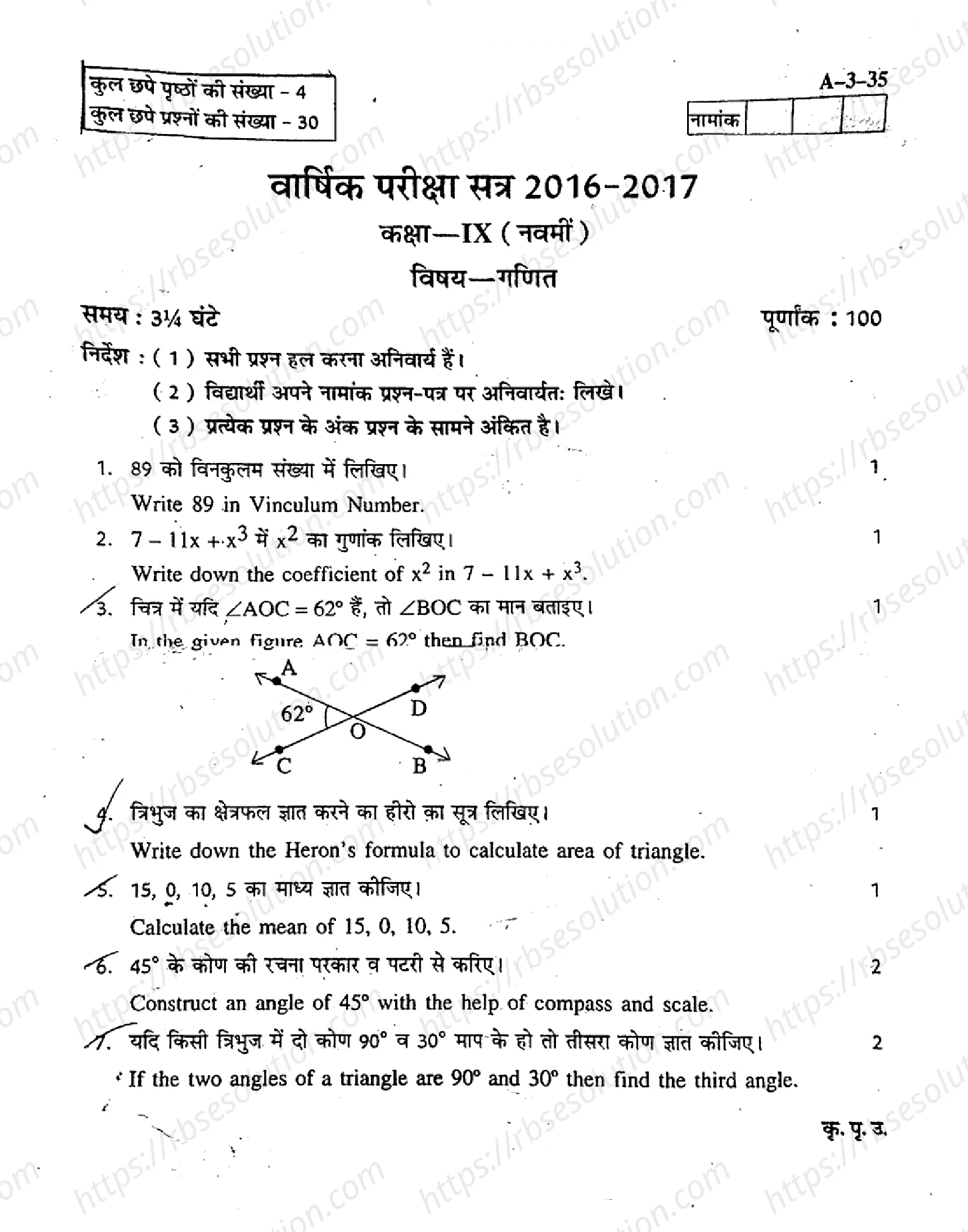


Rajasthan Board Class 9th Maths-A-3-35-2017 2017 solved Previous Year Question Papers
वार्षिक परीक्षा 2076-207
गणित (नवमी)
समय: 3¼ घंटे पूर्णांक: 70
निर्देश:
- सभी प्रश्न हल करना अनिवार्य हैं।
- विद्यार्थी अपने नामांक प्रश्न-पत्र पर अनिवार्यतः लिखें।
- प्रत्येक प्रश्न के अंक प्रश्न के सामने अंकित हैं।
1. 89 को विनकुलम संख्या में लिखिए।
Write 89 in Vinculum Number. (1 अंक)
हल: विनकुलम संख्या में, 89 को 1̅1̅1̅ (अर्थात 111 के ऊपर बार) के रूप में लिखा जाता है।
2. 7 - 11x + x³ में x² का गुणांक लिखिए।
Write down the coefficient of x² in 7 - 11x + x³. (1 अंक)
हल: दिए गए बहुपद 7 - 11x + x³ में x² का कोई पद नहीं है, अतः x² का गुणांक 0 है।
3. चित्र में यदि ∠AOC = 62° हैं, तो ∠BOC का मान बताइए।
In the given figure ∠AOC = 62° then find ∠BOC. (1 अंक)
A — O — B (सरल रेखा)
हल: AOB एक सरल रेखा है, अतः ∠AOC + ∠BOC = 180° (रैखिक युग्म)।
∠BOC = 180° - 62° = 118°.
4. त्रिभुज का क्षेत्रफल ज्ञात करने का हीरो का सूत्र लिखिए।
Write down the Heron’s formula to calculate area of triangle. (1 अंक)
हल: यदि त्रिभुज की भुजाएँ a, b, c हैं और अर्धपरिमाप s = (a+b+c)/2 है, तो हीरो का सूत्र:
क्षेत्रफल = √[s(s-a)(s-b)(s-c)]
5. 5, 0, 10, 5 का माध्य ज्ञात कीजिए।
Calculate the mean of 5, 0, 10, 5. (1 अंक)
हल: माध्य = (5 + 0 + 10 + 5) / 4 = 20 / 4 = 5.
6. 45° के कोण की रचना परकार व पटरी से करिए।
Construct an angle of 45° with the help of compass and scale. (2 अंक)
हल: रचना के चरण:
- एक रेखा AB खींचिए।
- बिंदु A पर 90° का कोण बनाइए (लंब खींचकर)।
- 90° के कोण के अंतः भाग में एक चाप लगाइए जो दोनों भुजाओं को काटे।
- उस चाप के दोनों प्रतिच्छेद बिंदुओं से समान त्रिज्या के चाप लगाइए जो एक-दूसरे को काटें।
- काटने वाले बिंदु को A से मिलाइए। यह 45° का कोण बनाता है।
7. यदि किसी त्रिभुज में दो कोण 90° व 30° माप के हो तो तीसरा कोण ज्ञात कीजिए।
If the two angles of a triangle are 90° and 30° then find the third angle. (2 अंक)
हल: त्रिभुज के तीनों कोणों का योग 180° होता है।
तीसरा कोण = 180° - (90° + 30°) = 180° - 120° = 60°.
प्रश्न 8
एक घन की भुजा 2 सेमी है तो घन का सम्पूर्ण पृष्ठीय क्षेत्रफल ज्ञात कीजिए।
Side of cube is 2 cm then find the surface area of the cube.
हल: घन का सम्पूर्ण पृष्ठीय क्षेत्रफल = 6 × (भुजा)² = 6 × (2)² = 6 × 4 = 24 वर्ग सेमी।
प्रश्न 9
60° को रेडियन में परिवर्तित कीजिए।
Convert 60° in Radians.
हल: 180° = π रेडियन, अतः 60° = (60/180) × π = π/3 रेडियन।
प्रश्न 10
यदि sin θ = 3/5 है तो tan θ का मान ज्ञात कीजिए।
If sin θ = 3/5 then find the value of tan θ.
हल: sin θ = लंब/कर्ण = 3/5, अतः लंब = 3, कर्ण = 5। पाइथागोरस प्रमेय से आधार = √(5² - 3²) = √(25 - 9) = √16 = 4। इसलिए tan θ = लंब/आधार = 3/4।
प्रश्न 11
निखिलम आधार विधि से 103 × 105 × 106 का गुणा कीजिए।
With the help of Nikhilam Base method multiply 103 × 105 × 106.
हल: आधार = 100 लेने पर, विचलन: 103 = +3, 105 = +5, 106 = +6।
तीनों का योग = 3 + 5 + 6 = 14।
तीनों का गुणनफल = 3 × 5 × 6 = 90।
पहला भाग = आधार + योग = 100 + 14 = 114।
दूसरा भाग = 90 (तीन अंकों में, क्योंकि आधार 100 है, अतः 090)।
अतः गुणनफल = 114 × 100 + 90 = 11400 + 90 = 11490।
इस प्रकार 103 × 105 × 106 = 11490।
प्रश्न 12
1/(2√3) का परिमेयकरण कीजिए।
Rationalize the given value 1/(2√3).
हल: 1/(2√3) = (1 × √3)/(2√3 × √3) = √3/(2 × 3) = √3/6।
प्रश्न 13
बहुपद p(x) = 3x + 2 का शून्यक ज्ञात कीजिए।
Find the zero(s) of given polynomial p(x) = 3x + 2.
हल: शून्यक के लिए p(x) = 0, अतः 3x + 2 = 0 ⇒ 3x = -2 ⇒ x = -2/3।
प्रश्न 14
सिद्ध कीजिए यदि किसी त्रिभुज की दो भुजाएँ बराबर हों, तो उनके सम्मुख कोण भी बराबर होते हैं।
Prove that if in a triangle two sides are equal then the value of their corresponding angles are also equal.
हल: माना त्रिभुज ABC में AB = AC है। सिद्ध करना है कि ∠B = ∠C।
रचना: A से BC पर लंब AD डालें।
अब त्रिभुज ABD और त्रिभुज ACD में:
AB = AC (दिया है)
AD = AD (उभयनिष्ठ)
∠ADB = ∠ADC = 90° (रचना से)
अतः RHS सर्वांगसमता से, ΔABD ≅ ΔACD।
इसलिए ∠B = ∠C (सर्वांगसम त्रिभुजों के संगत कोण)।
प्रश्न 15
एक बक्से की लम्बाई 30 सेमी, चौड़ाई 20 सेमी एवं ऊँचाई 6 सेमी है। इसमें 10 सेमी × 5 सेमी × 2 सेमी माप की कितनी कैसेट रखी जा सकती है?
If the length of box is 30 cm, breadth 20 cm and height 6 cm respectively then how many cassettes can be fit in it which have dimensions 10 cm × 5 cm × 2 cm?
हल: बक्से का आयतन = 30 × 20 × 6 = 3600 घन सेमी।
एक कैसेट का आयतन = 10 × 5 × 2 = 100 घन सेमी।
कैसेटों की संख्या = बक्से का आयतन / एक कैसेट का आयतन = 3600 / 100 = 36।
अतः 36 कैसेट रखी जा सकती हैं।
प्रश्न 16
त्रिभुज की रचना कीजिए, जबकि AB + BC + CA = 10 सेमी, ∠B = 60° एवं ∠C = 80°।
Construct a triangle which have AB + BC + CA = 10 cm, ∠B = 60° and ∠C = 80°.
हल: रचना के चरण:
1. एक रेखा PQ = 10 सेमी (AB + BC + CA) खींचें।
2. P पर ∠BPQ = 60° बनाएं और Q पर ∠CQP = 80° बनाएं।
3. इन कोणों के समद्विभाजक खींचें जो एक बिंदु A पर मिलते हैं।
4. A से PQ पर लंब समद्विभाजक खींचें जो PQ को B और C पर काटते हैं।
5. AB और AC को मिलाएं।
इस प्रकार अभीष्ट त्रिभुज ABC प्राप्त होता है।
प्रश्न 17
समलम्ब चतुर्भुज ABCD की रचना कीजिए जिसमें AB || CD, AB = 8 सेमी, BC = 6 सेमी, CD = 4 सेमी और ∠B = 75°।
Construct a trapezium ABCD whose AB || CD, AB = 8 cm, BC = 6 cm, CD = 4 cm and ∠B = 75°.
हल: रचना के चरण:
1. AB = 8 सेमी खींचें।
2. B पर 75° का कोण बनाएं और BC = 6 सेमी काटें।
3. C से AB के समांतर रेखा खींचें और CD = 4 सेमी काटें।
4. D को A से मिलाएं।
इस प्रकार अभीष्ट समलम्ब चतुर्भुज ABCD प्राप्त होता है।
प्रश्न 18
एक समकोण त्रिभुज ABC में AD भुजा BC पर लम्बवत् है। सिद्ध कीजिए कि AB² = AC² + BD² - 2BD × DC।
हल: माना त्रिभुज ABC में ∠A = 90° और AD ⊥ BC है।
पाइथागोरस प्रमेय से, AB² = AD² + BD² ...(1)
तथा AC² = AD² + DC² ...(2)
समीकरण (1) में से (2) घटाने पर:
AB² - AC² = BD² - DC²
⇒ AB² = AC² + BD² - DC²
चूँकि BD² - DC² = (BD - DC)(BD + DC) = (BD - DC) × BC, लेकिन यहाँ BC = BD + DC, अतः
AB² = AC² + (BD - DC)(BD + DC) = AC² + BD² - DC²
इसे पुनः लिखने पर: AB² = AC² + BD² - 2BD × DC + (BD² - 2BD·DC + DC²) नहीं, बल्कि सीधे:
AB² = AC² + (BD - DC)² = AC² + BD² + DC² - 2BD·DC
लेकिन AC² = AD² + DC², तो AB² = AD² + DC² + BD² - 2BD·DC = AD² + BD² + DC² - 2BD·DC
चूँकि AD² + BD² = AB², अतः यह सर्वसमिका सिद्ध होती है।
सरल रूप में: AB² = AC² + BD² - 2BD·DC।
79.
In an acute angle ΔABC, AD is a perpendicular on side BC. Then prove that
AC² = AB² + BC² – 2BC × DC
Solution:
In right-angled ΔADC, by Pythagoras theorem:
AC² = AD² + DC² …(i)
In right-angled ΔADB, by Pythagoras theorem:
AB² = AD² + BD²
⇒ AD² = AB² – BD² …(ii)
From (i) and (ii):
AC² = AB² – BD² + DC²
AC² = AB² – (BC – DC)² + DC²
AC² = AB² – (BC² – 2BC·DC + DC²) + DC²
AC² = AB² – BC² + 2BC·DC – DC² + DC²
AC² = AB² + BC² – 2BC·DC
Hence proved.
20.
एक वर्गाकार मैदान का क्षेत्रफल 2025 वर्ग मीटर है। इसके चारों ओर 3.5 मीटर चौड़ा मार्ग है, तो मार्ग का क्षेत्रफल ज्ञात कीजिए।
If a square field has an area of 2025 m² and a 3.5 m wide path around it, then find the area of the path.
Solution:
Area of square field = 2025 m²
Side of square field = √2025 = 45 m
Width of path = 3.5 m
Side of outer square (including path) = 45 + 2 × 3.5 = 45 + 7 = 52 m
Area of outer square = 52 × 52 = 2704 m²
Area of path = Area of outer square – Area of field
= 2704 – 2025 = 679 m²
Thus, the area of the path is 679 m².
27.
एक दीवार की लम्बाई 8 मीटर तथा ऊँचाई 4 मीटर है। दीवार 35 सेमी मोटी है। इसमें एक दरवाजा 2 मीटर × 1 मीटर का और दो खिड़कियाँ 1.2 मीटर × 1 मीटर की हैं। दीवार बनाने का खर्च 7500 रुपये प्रति घन मीटर की दर से ज्ञात कीजिए।
If a wall is 8 m long and 4 m high and 35 cm thick, in which there is a door of 2 m × 1 m and two windows of 1.2 m × 1 m each, then find the cost of construction of the wall at the rate of ₹7500 per cubic metre.
Solution:
Length of wall = 8 m, Height = 4 m, Thickness = 35 cm = 0.35 m
Volume of wall (without openings) = 8 × 4 × 0.35 = 11.2 m³
Volume of door = 2 × 1 × 0.35 = 0.7 m³
Volume of one window = 1.2 × 1 × 0.35 = 0.42 m³
Volume of two windows = 2 × 0.42 = 0.84 m³
Total volume of openings = 0.7 + 0.84 = 1.54 m³
Volume of wall to be constructed = 11.2 – 1.54 = 9.66 m³
Cost = 9.66 × 7500 = ₹72,450
Thus, the cost of construction is ₹72,450.
22.
यदि sin θ = 4/5 हो, तो (4 tan θ – 5 cos θ) / (sec θ + 4 cot θ) का मान ज्ञात कीजिए।
If sin θ = 4/5, then find the value of (4 tan θ – 5 cos θ) / (sec θ + 4 cot θ).
Solution:
Given sin θ = 4/5
In a right triangle, opposite side = 4, hypotenuse = 5
Adjacent side = √(5² – 4²) = √(25 – 16) = √9 = 3
Thus:
cos θ = 3/5, tan θ = 4/3, sec θ = 5/3, cot θ = 3/4
Now, (4 tan θ – 5 cos θ) / (sec θ + 4 cot θ)
= (4 × 4/3 – 5 × 3/5) / (5/3 + 4 × 3/4)
= (16/3 – 3) / (5/3 + 3)
= (16/3 – 9/3) / (5/3 + 9/3)
= (7/3) / (14/3)
= 7/14 = 1/2
Thus, the value is 1/2.
[3] A-3-35
सिद्ध करो कि √[(sec θ + 1)/(sec θ – 1)] = cot θ + cosec θ
Prove that √[(sec θ + 1)/(sec θ – 1)] = cot θ + cosec θ
Solution:
LHS = √[(sec θ + 1)/(sec θ – 1)]
Multiply numerator and denominator by (sec θ + 1):
= √[(sec θ + 1)² / (sec² θ – 1)]
= √[(sec θ + 1)² / tan² θ]
= (sec θ + 1) / tan θ
= sec θ/tan θ + 1/tan θ
= (1/cos θ) / (sin θ/cos θ) + cot θ
= 1/sin θ + cot θ
= cosec θ + cot θ
= RHS
Hence proved.
CL:
निम्नलिखित बारम्बारता बंटन के लिए आयत चित्र की सहायता से बारम्बारता बहुभुज का निर्माण कीजिए।
Draw a frequency polygon with the help of a histogram for the following frequency distribution:
| प्राप्तांक (Marks) | 2-4 | 4-6 | 6-8 | 8-20 | 10-12 |
|---|---|---|---|---|---|
| विद्यार्थियों की संख्या (Number of Students) | 3 | 4 | 6 | 7 | 2 |
Solution:
To draw a frequency polygon using a histogram:
- Draw a histogram with class intervals on x-axis and frequencies on y-axis.
- Find the midpoints of each class interval: (2+4)/2=3, (4+6)/2=5, (6+8)/2=7, (8+10)/2=9, (10+12)/2=11
- Plot points at these midpoints with corresponding frequencies: (3,3), (5,4), (7,6), (9,7), (11,2)
- Join these points with straight lines to form the frequency polygon.
- To close the polygon, add two imaginary classes at the beginning and end with zero frequency (e.g., 0-2 and 12-14 with midpoints 1 and 13, frequency 0).
The frequency polygon is thus obtained by joining the midpoints of the tops of the histogram bars.
24.
एक नीले रंग के आयताकार संकेतांक 30" × 25" का है, इसके मध्य में सफेद वर्ग 20" × 20" का है जिसमें रेड-क्रास का चिह्न अंकित है। नीले क्षेत्र का क्षेत्रफल ज्ञात कीजिए। इस संकेतांक का अर्थ क्या है?
A rectangular blue coloured signboard has sides 30" × 25" and in its centre there is a white square of side 20" × 20" which contains a red cross in it then find the area of the blue region. Also describe what does the signboard indicates.
हल:
आयताकार संकेतांक का क्षेत्रफल = 30" × 25" = 750 वर्ग इंच
सफेद वर्ग का क्षेत्रफल = 20" × 20" = 400 वर्ग इंच
नीले क्षेत्र का क्षेत्रफल = आयताकार संकेतांक का क्षेत्रफल - सफेद वर्ग का क्षेत्रफल = 750 - 400 = 350 वर्ग इंच
इस संकेतांक का अर्थ है कि यह एक चिकित्सा सहायता या प्राथमिक चिकित्सा केंद्र को दर्शाता है (रेड-क्रास चिह्न के कारण)।
25.
27x³ + y³ + z³ - 9xyz का गुणनखण्ड कीजिए।
Factorize of 27x³ + y³ + z³ - 9xyz.
अथवा
25x³ - 8y³ का गुणनखण्ड कीजिए।
Factorize of 25x³ - 8y³.
हल (पहला विकल्प):
27x³ + y³ + z³ - 9xyz = (3x)³ + y³ + z³ - 3(3x)(y)(z)
सूत्र a³ + b³ + c³ - 3abc = (a + b + c)(a² + b² + c² - ab - bc - ca) का उपयोग करने पर:
= (3x + y + z)[(3x)² + y² + z² - (3x)(y) - (y)(z) - (z)(3x)]
= (3x + y + z)(9x² + y² + z² - 3xy - yz - 3zx)
हल (दूसरा विकल्प):
25x³ - 8y³ = (5x)³ - (2y)³
सूत्र a³ - b³ = (a - b)(a² + ab + b²) का उपयोग करने पर:
= (5x - 2y)[(5x)² + (5x)(2y) + (2y)²]
= (5x - 2y)(25x² + 10xy + 4y²)
26.
निम्न समीकरण का आलेखीय विधि से हल ज्ञात कीजिए।
Find the solution of following equation from graphically method
x + y = 3; 3x + 2y = 7
हल:
समीकरण x + y = 3 के लिए बिंदु:
यदि x = 0, तो y = 3; यदि x = 1, तो y = 2; यदि x = 3, तो y = 0
समीकरण 3x + 2y = 7 के लिए बिंदु:
यदि x = 0, तो 2y = 7 ⇒ y = 3.5; यदि x = 1, तो 3 + 2y = 7 ⇒ 2y = 4 ⇒ y = 2; यदि x = 2, तो 6 + 2y = 7 ⇒ 2y = 1 ⇒ y = 0.5
दोनों रेखाओं का आलेख खींचने पर, वे बिंदु (1, 2) पर प्रतिच्छेद करती हैं।
अतः हल है: x = 1, y = 2
27.
एक टीम ने फुटबाल के 10 मैचों में निम्नलिखित गोल किए: 2, 3, 4, 5, 0, 1, 3, 3, 4, 3। इन गोलों का माध्य, माध्यक और बहुलक ज्ञात कीजिए।
If the goals scored by a football team in the 10 football matches are 2, 3, 4, 5, 0, 1, 3, 3, 4, 3 then, find the mean, median and mode of goals scored.
हल:
गोलों का योग = 2 + 3 + 4 + 5 + 0 + 1 + 3 + 3 + 4 + 3 = 28
माध्य = योग / कुल मैच = 28 / 10 = 2.8
आरोही क्रम में गोल: 0, 1, 2, 3, 3, 3, 3, 4, 4, 5
माध्यक = (5वाँ पद + 6वाँ पद) / 2 = (3 + 3) / 2 = 3
बहुलक = सबसे अधिक बार आने वाला मान = 3 (4 बार आया है)
28.
सिद्ध करो कि त्रिभुज की दो भुजाओं के मध्य बिंदुओं को मिलाने वाला रेखाखण्ड तीसरी भुजा के समान्तर एवं उसका आधा होता है।
Prove that in a triangle the line segment which connects the mid point of two sides is parallel and half of the third side.
हल:
माना त्रिभुज ABC में, D और E क्रमशः भुजाओं AB और AC के मध्य बिंदु हैं।
रचना: DE को मिलाएँ और इसे F तक इस प्रकार बढ़ाएँ कि DE = EF हो। CF को मिलाएँ।
उपपत्ति:
त्रिभुज ADE और त्रिभुज CFE में:
AE = EC (E, AC का मध्य बिंदु है)
DE = EF (रचना से)
∠AED = ∠CEF (शीर्षाभिमुख कोण)
अतः, △ADE ≅ △CFE (SAS सर्वांगसमता से)
इसलिए, AD = CF और ∠ADE = ∠CFE
चूँकि AD = DB (D, AB का मध्य बिंदु है), इसलिए DB = CF
∠ADE = ∠CFE, ये एकांतर कोण हैं, इसलिए AD ∥ CF, अर्थात DB ∥ CF
अब, चतुर्भुज DBCF में, DB ∥ CF और DB = CF, अतः DBCF एक समांतर चतुर्भुज है।
इसलिए, DF ∥ BC और DF = BC
चूँकि DE = EF, इसलिए DE = DF/2 = BC/2
अतः, DE ∥ BC और DE = ½ BC
29.
एक आयताकार कक्ष 7 मीटर लम्बा, 6 मीटर चौड़ा एवं 3.5 मीटर ऊँचाई का है। यदि इसमें 3 दरवाजे 2 मी × 1.5 मी के तथा 4 खिड़कियाँ 1.25 मी × 1 मी की हो, तो ₹ 4.50 पैसे प्रति वर्ग मीटर की दर से दीवारों पर रंग कराने का व्यय ज्ञात करो।
If a room is in the cuboidical shape which has length 7m breadth 6m and height 3.5m and it has 3 doors of 2m × 1.5m sides and 4 windows of 1.25m × 1m sides then find the cost of painting the walls if the rate of painting is Rs 4.50 per sq.m.
हल:
कक्ष की चारों दीवारों का क्षेत्रफल = 2 × (लम्बाई + चौड़ाई) × ऊँचाई = 2 × (7 + 6) × 3.5 = 2 × 13 × 3.5 = 91 वर्ग मीटर
दरवाजों का कुल क्षेत्रफल = 3 × (2 × 1.5) = 3 × 3 = 9 वर्ग मीटर
खिड़कियों का कुल क्षेत्रफल = 4 × (1.25 × 1) = 4 × 1.25 = 5 वर्ग मीटर
रंग करने योग्य क्षेत्रफल = दीवारों का क्षेत्रफल - (दरवाजों का क्षेत्रफल + खिड़कियों का क्षेत्रफल) = 91 - (9 + 5) = 91 - 14 = 77 वर्ग मीटर
रंग कराने का व्यय = 77 × 4.50 = ₹ 346.50
30.
गुणनखण्ड कीजिए (कोई से दो):
Factorised following (Any two):
- 4x² - x - 3
- 2x² - 7x + 3
- x⁸ - 256
हल:
(i) 4x² - x - 3
4x² - x - 3 = 4x² - 4x + 3x - 3 = 4x(x - 1) + 3(x - 1) = (x - 1)(4x + 3)
(ii) 2x² - 7x + 3
2x² - 7x + 3 = 2x² - 6x - x + 3 = 2x(x - 3) - 1(x - 3) = (x - 3)(2x - 1)
(iii) x⁸ - 256
x⁸ - 256 = (x⁴)² - (16)² = (x⁴ - 16)(x⁴ + 16) = [(x²)² - (4)²](x⁴ + 16) = (x² - 4)(x² + 4)(x⁴ + 16) = (x - 2)(x + 2)(x² + 4)(x⁴ + 16)