
RBSE Class 9th 2017 Social Utility Planning-APS-915-E-2017 Previous Year Papers
You opened the RBSE Class 9th 2017 Social Utility Planning-APS-915-E-2017 Previous Year Papers page — a focused place to read the real previous year question paper for that subject and year. RBSE Solution keeps exam-year sets together so you can practise the same cycle your seniors faced.
Previous year papers reward patience: read instructions, note mark distribution, then attempt questions before peeking at solutions elsewhere on the site. This URL always loads the same free previous year papers content for Social Utility Planning-APS-915-E-2017 (2017).
Use the details table to confirm class and year, then scroll to the paper images or PDF below. More subjects from 2017 are linked later on this page.
Paper details
Quick reference for this previous year papers page — confirm board, class, and year & subject before you study.
| Board | RBSE |
|---|---|
| Class | Class 9th |
| Exam year | 2017 |
| Subject | Social Utility Planning-APS-915-E-2017 |
| Resource type | Previous Year Papers |
| Category | RBSE Previous Year Question Papers |
| Website | RBSE Solution |
The table summarises this Previous Year Papers resource. Confirm RBSE, Class 9th, year 2017, and subject Social Utility Planning-APS-915-E-2017 before studying.
RBSE Solution organises previous year papers so each URL carries chapter-specific guidance — better for students and for search engines than one generic paragraph for the whole class.
Turning 2017 papers into insight
One Social Utility Planning-APS-915-E-2017 paper reveals style; several from the same year reveal pattern. After this page, open sibling subjects listed below to see whether marks cluster in certain units.
Keep rough work dated in your notebook. Examiners in Class 9th expect clear numbering even in practice sessions.
RBSE Class 9th 2017 Social Utility Planning-APS-915-E-2017
Scroll through the Previous Year Papers pages for Social Utility Planning-APS-915-E-2017 (2017).
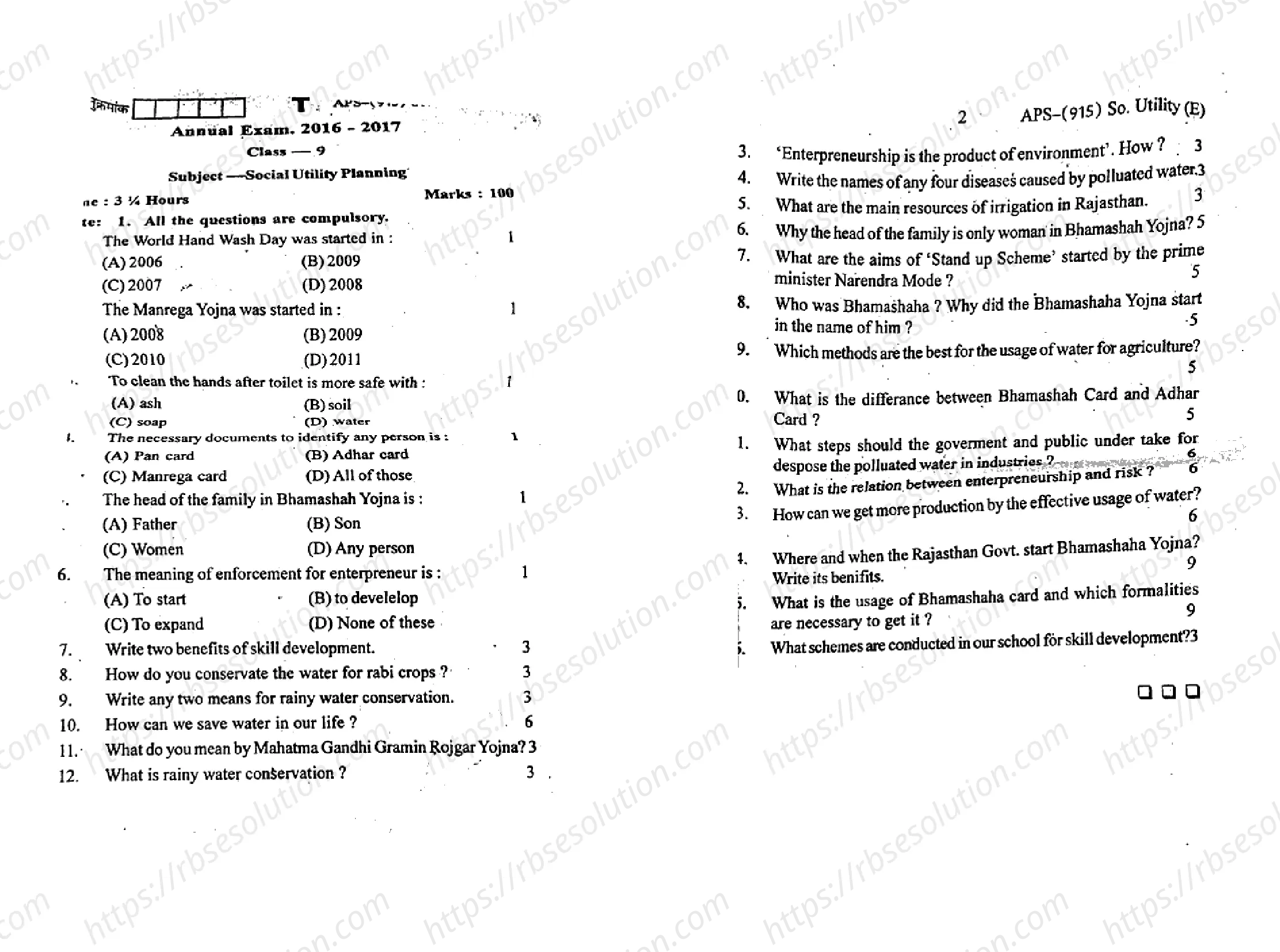
Rajasthan Board Class 9th Social Utility Planning-APS-915-E-2017 2017 solved Previous Year Question Papers
Annual Exam, 2016-2017
Class – 9
Subject – Social Utility Planning
Time: 3 Hours Marks: 90
Note: All the questions are compulsory.
-
The World Hand Wash Day was started in:
- (A) 2006
- (B) 2009
- (C) 2007
- (D) 2008
Explanation: Global Handwashing Day was first observed in 2008 to promote hand washing with soap as a key health measure.
-
The Manrega Yojna was started in:
- (A) 2008
- (B) 2009
- (C) 2007
- (D) 2011
Explanation: MGNREGA (Mahatma Gandhi National Rural Employment Guarantee Act) was launched in 2009, though the Act was passed in 2005.
-
To clean the hands after toilet is more safe with:
- (A) ash
- (B) soil
- (C) soap
- (D) water
Explanation: Soap is most effective in removing germs and dirt, making it safer than ash, soil, or water alone.
-
The necessary documents to identify any person is:
- (A) Pan card
- (B) Adhar card
- (C) Manrega card
- (D) All of these
Explanation: All three cards (Pan, Aadhaar, and MGNREGA) serve as identification documents, though Aadhaar is most commonly used.
-
The head of the family in Bhamashah Yojna is:
- (A) Father
- (B) Son
- (C) Women
- (D) Any person
Explanation: In Bhamashah Yojana, the head of the family is designated as a woman to empower women and ensure direct benefit transfer to her account.
-
The meaning of enforcement for entrepreneur is:
- (A) To start
- (B) To develop
- (C) To expand
- (D) None of these
Explanation: "Enforcement" in entrepreneurship context refers to implementing or executing plans, not specifically starting, developing, or expanding.
-
Write two benefits of skill development. (3 marks)
Answer: Two benefits of skill development are:
- It increases employability and job opportunities for individuals.
- It enhances productivity and income, leading to economic growth.
-
How do you conserve water for rabi crops? (3 marks)
Answer: Water for rabi crops can be conserved by:
- Using drip irrigation or sprinkler systems to reduce water wastage.
- Mulching the soil to retain moisture and reduce evaporation.
- Adopting crop rotation and selecting drought-resistant varieties.
-
Write any two means for rainy water conservation. (3 marks)
Answer: Two means for rainy water conservation are:
- Rainwater harvesting through rooftop collection and storage in tanks.
- Building check dams or ponds to capture runoff and recharge groundwater.
-
How can we save water in our life? (6 marks)
Answer: We can save water in daily life by:
- Turning off taps while brushing teeth or shaving.
- Fixing leaks in pipes and faucets promptly.
- Using a bucket instead of a hose for washing cars or floors.
- Collecting rainwater for gardening and cleaning.
- Using water-efficient appliances like low-flow showerheads.
- Reusing wastewater from washing vegetables for plants.
-
What do you mean by Mahatma Gandhi Gramin Rojgar Yojna? (3 marks)
Answer: Mahatma Gandhi Gramin Rojgar Yojna (MGNREGA) is a government scheme that guarantees 100 days of wage employment per year to rural households whose adult members volunteer for unskilled manual work. It aims to enhance livelihood security and create durable assets in rural areas.
-
What is rainy water conservation? (3 marks)
Answer: Rainy water conservation refers to the collection and storage of rainwater from surfaces like rooftops, roads, or open grounds for later use. It helps recharge groundwater, reduce water scarcity, and manage stormwater runoff.
-
"Entrepreneurship is the product of environment." How? (3 marks)
Answer: Entrepreneurship is influenced by the environment because factors like economic conditions, government policies, social norms, and access to resources shape opportunities and risks. A supportive environment with education, infrastructure, and funding encourages entrepreneurial activities, while a restrictive environment may hinder them.
-
Write the names of any four diseases caused by polluted water. (3 marks)
Answer: Four diseases caused by polluted water are:
- Cholera
- Typhoid
- Dysentery
- Hepatitis A
-
What are the main resources of irrigation in Rajasthan? (3 marks)
Answer: The main resources of irrigation in Rajasthan are:
- Canals (e.g., Indira Gandhi Canal)
- Wells and tube wells
- Ponds and tanks
- Rainwater harvesting structures
-
Why is the head of the family only woman in Bhamashah Yojna? (5 marks)
Answer: In Bhamashah Yojana, the head of the family is designated as a woman to empower women financially and socially. This ensures that government benefits are directly transferred to women, promoting their decision-making power, financial independence, and overall family welfare. It also aims to reduce gender inequality and improve the status of women in society.
-
What are the aims of 'Stand up Scheme' started by Prime Minister Narendra Modi? (3 marks)
Answer: The aims of the 'Stand up Scheme' are:
- To promote entrepreneurship among women and Scheduled Castes/Scheduled Tribes.
- To provide bank loans (between ₹10 lakh and ₹1 crore) for setting up greenfield enterprises.
- To create employment opportunities and foster economic inclusion.
-
Who was Bhamashaha? Why did the Bhamashaha Yojna name in the name of him? (5 marks)
Answer: Bhamashaha was a 17th-century financier and philanthropist from Rajasthan who served as a treasurer for Maharana Pratap. He was known for his generosity and support during times of crisis. The Bhamashah Yojana is named after him to honor his legacy of financial support and community welfare, reflecting the scheme's aim to provide financial assistance and empowerment to families.
-
Which methods are the best for the usage of water for agriculture? (5 marks)
Answer: The best methods for water usage in agriculture include:
- Drip irrigation: delivers water directly to plant roots, reducing wastage.
- Sprinkler irrigation: mimics rainfall and covers large areas efficiently.
- Mulching: reduces evaporation and retains soil moisture.
- Rainwater harvesting: captures rainwater for irrigation.
- Use of drought-resistant crops and proper scheduling of irrigation.
-
What is the difference between Bhamashah Card and Adhar Card? (5 marks)
Answer: The differences are:
- Bhamashah Card: A family-based identification card issued by Rajasthan government for availing state welfare schemes and direct benefit transfers. It includes family details and is linked to a bank account.
- Aadhaar Card: A unique 12-digit identification number issued by the central government (UIDAI) to individuals based on biometric data. It is used for identity verification across various services.
- Bhamashah Card is state-specific and family-oriented, while Aadhaar is national and individual-specific.
-
What steps should the government and public undertake for disposal of polluted water in industries? (5 marks)
Answer: Steps for disposal of polluted water from industries:
- Government: Enforce strict pollution control laws, set up effluent treatment plants (ETPs), monitor industrial discharge, and provide subsidies for green technologies.
- Public: Report illegal dumping, participate in awareness campaigns, support recycling initiatives, and use water responsibly to reduce industrial demand.
- Both should collaborate to promote zero-liquid discharge systems and treat wastewater before release.
-
What is the relation between entrepreneurship and risk? (3 marks)
Answer: Entrepreneurship and risk are closely related because entrepreneurs take calculated risks to start and grow businesses. Risk involves uncertainty about profits, market demand, or competition. Successful entrepreneurs manage risks through planning, innovation, and adaptability, turning potential losses into opportunities.
-
How can we get more production by the effective usage of water? (5 marks)
Answer: More production through effective water usage can be achieved by:
- Using precision irrigation techniques like drip or sprinkler systems.
- Adopting water-efficient crops and crop rotation.
- Implementing soil moisture monitoring and scheduling irrigation.
- Recycling and reusing wastewater for agriculture.
- Rainwater harvesting to supplement water supply.
-
Where and when did the Rajasthan Government start Bhamashaha Yojna? Write its benefits. (5 marks)
Answer: The B