
RBSE Class 9th 2024 English-APS (902)-2024 Previous Year Papers
English-APS (902)-2024 from the 2024 exam year is part of the Class 9th previous year papers archive on RBSE Solution. Many learners start here after finishing the textbook to see how questions were actually framed on the Rajasthan Board of Secondary Education (RBSE) paper.
Treat this question paper as a mock under gentle timing first, then as a marking exercise the second time. The introduction on this page is written only for this subject-and-year pair, not copied from other pages.
Bookmark the link if you coach juniors — the layout stays stable for search engines and classroom sharing.
Paper details
Quick reference for this previous year papers page — confirm board, class, and year & subject before you study.
| Board | RBSE |
|---|---|
| Class | Class 9th |
| Exam year | 2024 |
| Subject | English-APS (902)-2024 |
| Resource type | Previous Year Papers |
| Category | RBSE Previous Year Question Papers |
| Website | RBSE Solution |
The table summarises this Previous Year Papers resource. Confirm RBSE, Class 9th, year 2024, and subject English-APS (902)-2024 before studying.
RBSE Solution organises previous year papers so each URL carries chapter-specific guidance — better for students and for search engines than one generic paragraph for the whole class.
How to practise with this question paper
Stage one: read the English-APS (902)-2024 question paper from 2024 without a timer and highlight command words — explain, prove, calculate, discuss. Stage two: attempt selected questions closed-book. Stage three: compare with solutions or teacher feedback.
Previous Year Papers work best when you log mistakes by topic, not only by question number. That log becomes your revision index before pre-boards.
RBSE Class 9th 2024 English-APS (902)-2024
Scroll through the Previous Year Papers pages for English-APS (902)-2024 (2024).
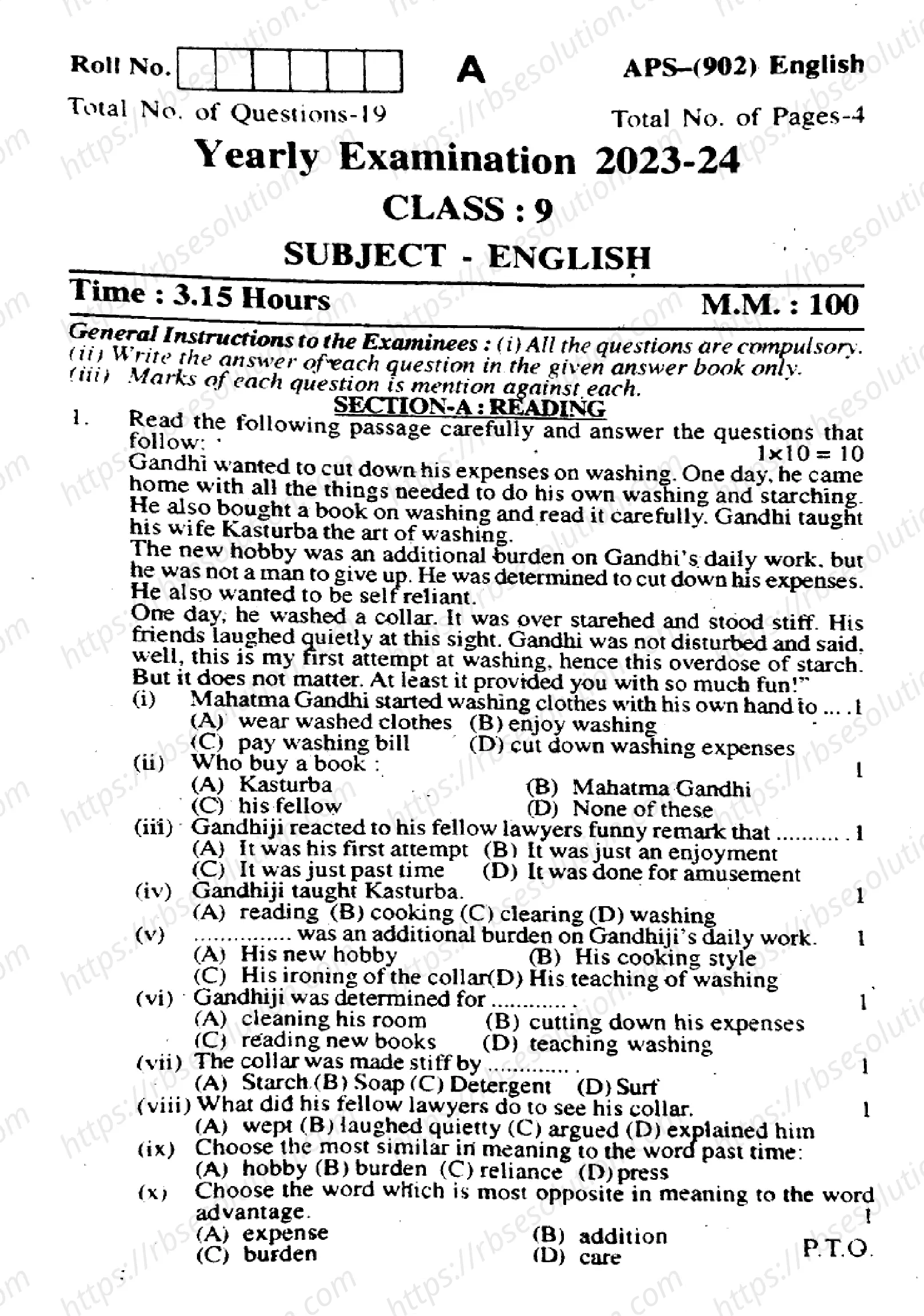


Rajasthan Board Class 9th English-APS (902)-2024 2024 solved Previous Year Question Papers
Yearly Examination 2023-24
Class: 9 | Subject: English | Time: 3.15 Hours | M.M.: 80
General Instructions to the Examinees:
- All the questions are compulsory.
- Write the answer of each question in the given answer book only.
- Marks of each question are mentioned against each.
SECTION-A: READING
1. Read the following passage carefully and answer the questions that follow:
Gandhi wanted to cut down his expenses on washing. One day, he came home with all the things needed to do his own washing and starching. He also bought a book on washing and read it carefully. Gandhi taught his wife Kasturba the art of washing.
The new hobby was an additional burden on Gandhi's daily work, but he was not a man to give up. He was determined to cut down his expenses. He also wanted to be self-reliant.
One day, he washed a collar. It was overstarched and stood stiff. His friends laughed quietly at this sight. Gandhi was not disturbed and said, "Well, this is my first attempt at washing, hence this overdose of starch. But it does not matter. At least it provided you with so much fun."
-
(i) Mahatma Gandhi started washing clothes with his own hands to ______.
- wear washed clothes
- enjoy washing
- pay washing charges
- cut down washing expenses
Explanation: The passage clearly states, "Gandhi wanted to cut down his expenses on washing."
-
(ii) Who bought a book?
- Kasturba
- Mahatma Gandhi
- his fellow
- None of these
Explanation: The passage says, "He also bought a book on washing and read it carefully."
-
(iii) Gandhiji reacted to his fellow lawyers' funny remark that ______.
- it was his first attempt
- It was just an enjoyment
- It was just past time
- It was done for amusement
Explanation: Gandhi said, "this is my first attempt at washing, hence this overdose of starch."
-
(iv) Gandhiji taught Kasturba ______.
- reading
- cooking
- clearing
- washing
Explanation: The passage mentions, "Gandhi taught his wife Kasturba the art of washing."
-
(v) ______ was an additional burden on Gandhiji's daily work.
- His new hobby
- His cooking style
- His ironing of the collar
- His teaching of washing
Explanation: The passage states, "The new hobby was an additional burden on Gandhi's daily work."
-
(vi) Gandhiji was determined for ______.
- cleaning his room
- cutting down his expenses
- reading new books
- teaching washing
Explanation: The passage says, "He was determined to cut down his expenses."
-
(vii) The collar was made stiff by ______.
- Starch
- Soap
- Detergent
- Surf
Explanation: The passage mentions "overstarched" and "overdose of starch."
-
(viii) What did his fellow lawyers do to see his collar?
- wept
- laughed quietly
- argued
- explained him
Explanation: The passage says, "His friends laughed quietly at this sight."
-
(ix) Choose the most similar in meaning to the word past time:
- hobby
- burden
- reliance
- press
Explanation: 'Past time' refers to an activity done for enjoyment, which is a hobby.
-
(x) Choose the word which is most opposite in meaning to the word advantage.
- expense
- addition
- burden
- care
Explanation: 'Advantage' means benefit, while 'burden' means a heavy load or disadvantage, making it the opposite.
Section A: Reading
Read the following passage carefully and answer the questions given below.
Albert Einstein, one of the great men of modern science, was born on 4 March 1879 in Ulm, Germany. During his boyhood in Munich he was shy, sensitive and unhappy. His harsh teachers, whom he called "non-commissioned officers", considered him dull. They disliked him because he asked difficult questions which they could not answer. He was also made to suffer from German anti-semitism and he hated the militarism of the German empire to such an extent that he persuaded his father to promise him that he would never have to do compulsory military service. The famous scientist is best known for his—Theory of Relativity.
-
Who was Albert Einstein?
Albert Einstein was one of the great men of modern science. -
How was Einstein during his boyhood?
During his boyhood, Einstein was shy, sensitive and unhappy. -
Why did the teachers at Munich school dislike him?
The teachers disliked him because he asked difficult questions which they could not answer. -
How can you say that Einstein hated the militarism of the German empire?
Einstein hated the militarism of the German empire so much that he persuaded his father to promise him that he would never have to do compulsory military service. -
From where did Einstein receive the degree of Doctor of Philosophy?
The passage does not mention where Einstein received his Doctor of Philosophy degree. -
What did Einstein call his teachers?
Einstein called his harsh teachers "non-commissioned officers". -
Which subjects did Einstein teach at polytechnic school in Zurich?
The passage does not mention which subjects Einstein taught at the polytechnic school in Zurich. -
For which work is Einstein best known?
Einstein is best known for his Theory of Relativity. -
Find out the words from the passage which mean the same as:
- (a) sad – unhappy
- (b) made agree – persuaded
-
Find out the Opposite of the following words from the passage:
- like – dislike
- happy – unhappy
Section B: Writing
1. Email to Principal
You are Netal, a student of class IX. Compose an email to be sent to your principal stating the need for a bicycle stand in the school campus.
To: principal@school.edu
Subject: Request for a Bicycle Stand in the School Campus
Respected Principal,
I am Netal, a student of class IX. I am writing to bring to your kind attention the urgent need for a bicycle stand in our school campus. Many students, including myself, come to school by bicycle. However, there is no proper place to park them safely. Bicycles are often left in the open, exposed to sun and rain, and sometimes get damaged or misplaced. A covered bicycle stand would protect our bicycles and keep the campus organized. I request you to kindly consider installing a bicycle stand at the earliest.
Thanking you,
Yours obediently,
Netal
Class IX
2. Speech on "Knowledge is Power"
You are Rohan. Tomorrow a speech competition is going to be held in your school. Prepare a speech with the help of the given outline on the topic: "Knowledge is Power" in about 80-100 words.
Outline: Knowledge is power – school – powerhouses – used to think might is right – have made progress – knowledge.
Good morning, respected teachers and dear friends. Today, I am going to speak on the topic "Knowledge is Power". In ancient times, people used to think that might is right. But with the growth of knowledge, we have made great progress. Schools are the powerhouses of knowledge where we learn and grow. Knowledge gives us the ability to think, understand, and solve problems. It empowers us to make better decisions and improve our lives. Without knowledge, we are like a ship without a rudder. So, let us all strive to gain knowledge and use it for the betterment of ourselves and society. Thank you.
3. Debate on "Urban Life versus Rural Life"
There is a debate competition on "Urban life versus Rural life". Write a debate in about 80-100 words in favour of the motion. You may take help from the given outline.
Outline: Support city life.
Good morning, everyone. I am here to speak in favour of the motion that "Urban life is better than rural life". City life offers many advantages. There are better educational institutions, hospitals, and job opportunities. People have access to modern amenities like electricity, internet, and transportation. Cities are hubs of culture, entertainment, and innovation. In contrast, rural areas often lack basic facilities and opportunities. Urban life provides a faster pace of life and more chances for personal and professional growth. Therefore, I strongly believe that urban life is superior to rural life. Thank you.
4. Dialogue between Patient and Doctor
Apateathe has been unwell for some time. He goes to a doctor's clinic. Write an imaginary dialogue in 80 to 100 words which may take place between the patient and the doctor. You may take help from the following: Your ailment, a high fever, a sore throat, shivering, blood report, malaria, injection, medicine.
Patient: Good morning, doctor. I have been feeling very unwell for the past few days.
Doctor: Good morning. What seems to be the problem?
Patient: I have a high fever, a sore throat, and I am shivering a lot.
Doctor: I see. Let me check your temperature. It is quite high. Have you had a blood test done?
Patient: Yes, doctor. Here is my blood report.
Doctor: (Looking at the report) The report shows you have malaria. You will need an injection and some medicine. Take the medicine regularly and rest for a few days. You will be fine soon.
Patient: Thank you, doctor. I will follow your advice.
5. Story Writing
Write a story in 80-100 words using the outline given below. Assign a suitable title and moral to it.
Outline: A fox – hungry – searches food – sees a vine of grapes – sad bunches of ripe grapes – goes there – hanging high – jumps again and again – not reaches the grapes – all in vain – tired – runs away – the grapes are sour.
Title: The Fox and the Sour Grapes
One day, a hungry fox was searching for food. He wandered here and there but found nothing to eat. At last, he saw a vine full of ripe, juicy grapes hanging high above. His mouth watered. He jumped again and again to reach the grapes, but they were too high. After many attempts, he was tired and could not get them. Finally, he gave up and walked away, saying, "The grapes are sour anyway."
Moral: It is easy to despise what you cannot have.
SECTION-C : GRAMMAR
6. Fill in the blanks with the correct form of the verb given in the brackets:
(1×4=4)
- Some of my friends visited the Hawa Mahal last week.
- The sun rises in the east.
- He will go to Jaipur tomorrow.
- I wrote a letter to my friend just now.
7. Fill in the blanks with relative pronouns given in the brackets:
(1×2=2)
- This is the machine which costs ten thousand rupees.
- We visited the school where my father taught.
8. Choose the correct option:
(1×3=3)
- He escaped from the jail last night.
- (A) of
- (B) from
- (C) in
- (D) to
- She saw someone drowning in the river.
- (A) on
- (B) at
- (C) by
- (D) in
- My father is an M.L.A.
- (A) a
- (B) an
- (C) the
- (D) x
9. Fill in the blanks with appropriate prepositions given in the brackets:
(1×3=3)
- He is fond of sweets.
- There is a bridge across the river.
- He is not afraid of the dog.
SECTION-D : TEXT BOOKS
10. Read the passage carefully and answer the questions:
At the Bauddhnath stupa. The Bauddhnath shrine of Kathmandu, there is in contrast a sense of stillness. Its immense white dome is ringed by a road. Small shops stand on its outer edge: many of these are owned by Tibetan emigrants. Felt bags, Tibetan prints and silver jewellery can be bought here. There are no crowds: this is a haven of quietness in the busy streets around.
Kathmandu is vivid, mercenary, religious with small shrines to flower-adorned deities along the narrowest and busiest street: with fruit sellers, flute sellers, hawkers of postcards, shops selling western cosmetics, film rolls and chocolates or copper utensils and Nepalese antiques. Film songs blare out from the radios, car horns sound, bicycle bells ring, stray cows low questioningly at motorcycles, vendors shout out their wares.
I indulge myself mindlessly: buy a bar of marzipan, a corn-on-the-cob roasted in a charcoal brazier on the pavement (rubbed with salt, chilli powder and lemon), a couple of love story comics and even a Reader's Digest. All this I wash down with Coca-Cola and a nauseating orange drink and feel much the better for it.
- Which place is a haven of quietness?
The Bauddhnath stupa (shrine) in Kathmandu is a haven of quietness.
- How does Kathmandu seem to the author?
Kathmandu seems vivid, mercenary, and religious to the author.
- What types of streets are there at Kathmandu?
The streets in Kathmandu are narrow and busy.
- What types of noises does the author hear in Kathmandu?
The author hears film songs blaring from radios, car horns, bicycle bells, stray cows lowing, and vendors shouting.
- Which books did the author buy from the market?
The author bought a couple of love story comics and a Reader's Digest.
- What things are sold near the shrines?
Near the shrines, felt bags, Tibetan prints, silver jewellery, fruit, flutes, postcards, western cosmetics, film rolls, chocolates, copper utensils, and Nepalese antiques are sold.
- Find the word from the passage which means 'different' (opposite of 'same').
The word is "contrast".
- Find the word from the passage which means 'a person who sells goods in the street'.
The word is "vendor".
11. Answer the following questions in about 30-40 words each (Three short answer type questions):
(3×3=9)
- What is a belief at Pashupatinath (Kathmandu) about the end of Kaliyug?
At the Pashupatinath temple in Kathmandu, there is a belief that when the goddess inside the temple will emerge, the age of Kaliyug will end. This is a popular religious belief among the devotees.
- What is Gerrard's profession? Quote the parts of the play that support your answer.
Gerrard is a playwright. In the play "If I Were You," he says, "I am a dramatist" and mentions that he writes plays. He also talks about his telephone and his work, which shows he is a writer of plays.
- Who invited Santosh to scale Mt. Everest a second time? What was her achievement? (Reach for the Top)
Santosh Yadav was invited by the Indo-Nepalese Women's Expedition to scale Mt. Everest a second time. Her achievement was that she became the first woman in the world to climb Mount Everest twice, and she also successfully collected and brought down 500 kg of garbage from the mountain.
English-APS (902)-2024
Section: Long Answer Questions (around 80 words each)
3. Who was Luskofb? How was he transformed totally?
Luskofb was a poor, homeless beggar who was addicted to alcohol. He was transformed totally by the kindness and compassion of a woman named Olga. She gave him work, food, and shelter, and treated him with respect. Over time, Luskofb gave up drinking, started working regularly, and became a responsible and self-respecting person. Her constant care and belief in him changed his life completely.
4. (iv) What did Karia's father do before going to work? (The Little Girl)
Before going to work, Karia's father would go to her room, wake her up with a kiss, and then leave for his office. He was a busy man but always made time to show affection to his daughter in the morning.
Answer the following questions (around 80 words) (One long answer out of two)
5. Why was Gerrard packing a bag at the beginning of the play? How did it help him to outwit and trap an intruder? (If I were you)
Gerrard was packing a bag because he was planning to go on a short trip. When an intruder entered his home with a gun, Gerrard cleverly used the bag to trick him. He pretended that he was a criminal like the intruder and that the police were after him. He said he had to leave quickly. This made the intruder lower his guard. Gerrard then pushed the intruder into a cupboard and locked him, thus outwitting and trapping him using his intelligence.
6. How does the author describe the Flute seller? What does he see in the Flute Music?
The author describes the flute seller as a man who sits on the pavement with flutes spread around him. He plays the flute with great concentration and joy. The author sees in the flute music a sense of peace, beauty, and harmony. The music seems to rise above the noise and chaos of the city, creating a moment of calm and spiritual connection. It represents the pure and simple joy of art.
Answer the following question about 40 words (one out of two questions)
7. How does the play prove that wit (intelligence) always has an upper hand?
The play "If I Were You" proves that wit always has an upper hand because Gerrard, using his quick thinking and clever words, outsmarts the dangerous intruder. He traps him without any violence, showing that intelligence is more powerful than brute force.
OR
Write a brief character sketch of Santosh Yadav.
Santosh Yadav is a determined and courageous mountaineer. She was the first woman in the world to climb Mount Everest twice. She is hardworking, fearless, and passionate about her goals. She broke traditional norms and proved that women can achieve great heights with dedication and willpower.
Read the passage given below and answer the questions
8. "A Slumber did my spirit seal. I had no human fears. She seemed a thing that could not feel. The touch of earthly years."
(i) What does a slumber mean here?
Here, 'slumber' means a deep sleep or a state of unawareness. The poet was in a dreamlike state where he did not realize the reality of life and death.
(ii) What was it that sealed the poet's spirits?
The poet's spirit was sealed by the deep sleep or slumber of ignorance. He was so lost in his love and happiness that he did not fear losing his beloved. This false sense of security sealed his spirit.
9. "So she made a very little cake. But as it baking lay. She looked at it, and thought it seemed. Too large to give away."
(i) Who made a very little cake?
The old woman (the saint's wife) made a very little cake.
(ii) Why did she make a very little cake?
She made a very little cake because she was greedy and did not want to give away a large cake to the saint. She thought even the small cake was too big to give away.
Answer any two of the following questions about 20-30 words (2x2=4)
(i) What did the woman do on being asked to give away a cake?
On being asked to give away a cake, the woman made a very small cake. But when it was baked, she thought even that was too large to give away.
(ii) What does the poet like to do when it rains?
The poet likes to lie in his bed and listen to the sound of rain falling on the roof. He enjoys the peaceful and soothing feeling it brings.
(iii) What is the central idea of the poem "No Men Are Foreign"?
The central idea is that all human beings are the same. We all share the same earth, breathe the same air, and have similar feelings. There should be no hatred or war based on nationality.
Answer any one of the following questions about 80 words (1x5=5)
10. What is the poet's reaction to the death of his beloved? (A Slumber did my spirit seal)
The poet is shocked and saddened by the death of his beloved. He realizes that he was living in a false dream (slumber) where he thought she would never die. Now, she is motionless and cannot feel anything. She has become part of the earth, rolling with rocks and stones. The poet feels a deep sense of loss and understands the harsh reality of life and death. His initial ignorance is replaced by painful awareness.
OR
Why does the poet want to go to Innisfree? Will he get there what he desires? Give your views on it. (The Lake Isle of Innisfree)
The poet wants to go to Innisfree to escape the noise and busy life of the city. He desires peace, quiet, and a simple life close to nature. He wants to hear the bee's hum, the cricket's song, and the lake water lapping. In my view, he will get what he desires if he actually goes there. Innisfree represents a place of inner peace and harmony with nature. However, the peace he seeks is also a state of mind, so he must find it within himself too.
Answer any one of the following questions in about 80 words (1x5=5)
11. Describe the fire tragedy that struck Zaan's house. (The Beggar)
The fire tragedy struck Zaan's house suddenly. A fire broke out in the house, causing great panic and destruction. The family lost many of their belongings. The fire spread quickly, and they had to rush out to save their lives. It was a terrible event that left them homeless and in distress. This tragedy changed their lives and made them realize the value of kindness and help from others.
OR
Describe the fire tragedy that struck Zaan's house? (The Beggar)
The fire tragedy struck Zaan's house suddenly. A fire broke out in the house, causing great panic and destruction. The family lost many of their belongings. The fire spread quickly, and they had to rush out to save their lives. It was a terrible event that left them homeless and in distress. This tragedy changed their lives and made them realize the value of kindness and help from others.
Answer any two of the following questions in about 60 words (2x3=6)
(i) Behrman has a dream. What is it? Does it come true? (Last Leaf)
Behrman's dream was to paint a masterpiece, a great work of art that would be remembered. Yes, his dream came true, but in a tragic way. He painted a leaf on the wall during a stormy night to save Johnsy's life. That leaf was his masterpiece. It was so realistic that it gave Johnsy hope to live. Behrman died of pneumonia after painting it, but his painting became his greatest work.
(ii) What did Prashant see on reaching his village? (Kathmandu)
On reaching his village, Prashant saw a scene of complete devastation. The super cyclone had destroyed everything. Houses were flattened, trees were uprooted, and there were dead bodies of humans and animals everywhere. People were homeless, hungry, and in deep shock. It was a heartbreaking sight of destruction and suffering.
(iii) Why does the disciple decide to stay in the Kingdom of Fools?
The disciple decides to stay in the Kingdom of Fools because everything there was very cheap. He could buy a large amount of food for just one rupee. He thought it was a wonderful place to live cheaply and comfortably. He did not realize the dangers of living in a kingdom ruled by foolish people.
(iv) How does Toto come to grandfather's private zoo?
Toto came to grandfather's private zoo when grandfather bought him from a tonga driver for five rupees. The tonga driver was keeping Toto, a little monkey, and grandfather felt sorry for him. He brought Toto home and added him to his collection of animals.
Choose the correct answer (1x4=4)
-
What do yellow woods represent?
- (A) People
- (B) Older people
- (C) Poets
- (D) Choice
Explanation: In the poem "The Road Not Taken," the yellow woods symbolize a fork in the road, representing a choice in life.
-
Who is the author of the lesson "The Beggar"?
- (A) Bill Bryson
- (B) Anton Chekhov
- (C) Zen Gaudiose
- (D) O. Henry
Explanation: "The Beggar" is a short story written by the famous Russian writer Anton Chekhov.
-
Who does the wind make fun of?
- (A) The rich
- (B) The strong
- (C) The weak
- (D) None of these
Explanation: In the poem "Wind," the wind makes fun of the weak because they cannot withstand its force. It destroys the weak but respects the strong.
-
What was the trouble to the playwright?
- (A) He was sick
- (B) He was cold and hungry
- (C) He was dull and boring
- (D) He had no work to do
Explanation: In the play "If I Were You," the playwright Gerrard's trouble was that he had no work to do at that moment, which is why he was packing a bag for a trip.